
Columbia University Libraries Digital Collections: The Real Estate Record
Use your browser's Print function to print these pages.
Real estate record and builders' guide: v. 7, no. 167: May 27, 1871
Text version:
Please note: this text may be incomplete. For more information about this OCR, view About OCR text.
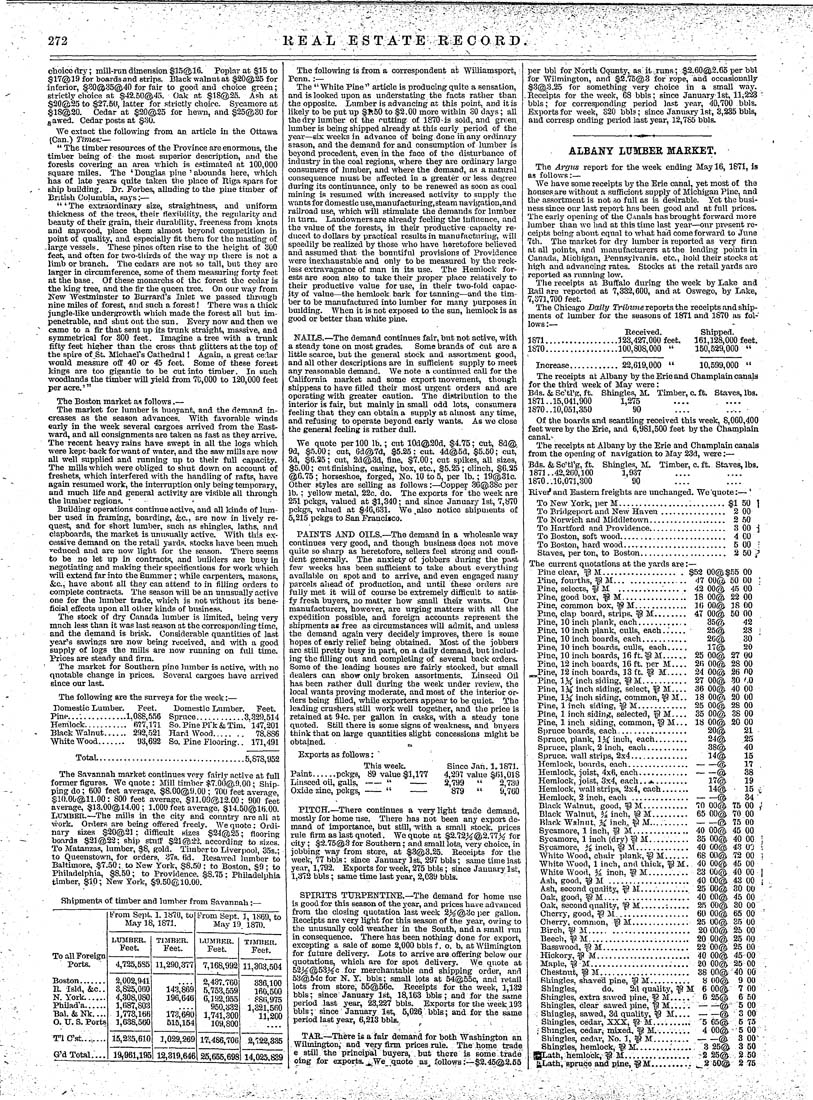
272 REAL ESTATE RECORD. choice dry; miU-nm dimension §15®16. Poplar at §15 to §17® 19 for boards and strips. Black walnut at §20@25 for inferior, §30®35@40 for fair to good and choice green; strictly choice at §42.50@45, 0.ak at §18@,25. Ash at §20®*25 to §27,60, latter for .strictly choice. Svcamore at §18®20. Cedar at §20®25 for hewn, and §25@30 for gawed. Cedar posts at §30. We extact the foUowhig from an article iu the Ottawa (Can.) Times:— " The timber resources of the Province are enormous, the timber being of the most superior description, and the forests coveiing au area which is estimated at 100,000 square mUes. The 'Douglas pine 'abounda here, which has of late years quite taken the place of Riga -spara for ship building. Dr. Forbes, aUuding to the pine timber of British Columbia, says:— "'The extraordinary size, straightness, and uniform tliickness of the trees, their flexibility, the regularity and beauty of their grain, their durability, freeness from knots arid aapwood, place them almost beyond competition in point of quaUty, and eapeciaUj' fit them for the masting of -large vessels. These pines often rise to the height of 300 feefc, and often for two-thirds of the way np there is not a limb or branch. Tlie cedars are not so tall, but they are larger in circumference, some of them meaaurin.g forty feet atthebaae. Of these monarchs of the forest the cedar is the kin.g tree, and the fir the queen tree. On our way from New "Westminster to Burrard's Inlefc we passed through nine mUes of forest, and such a forest! There was a thick jungle-Uke undergrowth which made the forest all but im¬ penetrable, and shut oufc the sun. Every now and then we came to a fir that sent up its trunk straight, massive, and symmetrical for SOO feet. Imagine a tree wifch a trunk fifty feet higher than the cross that glitters at the top of the spire of St. Michael's Cathedral! Again, a great celar would measure off 40 or 45 feet. Some of these forest kings are too gi.gantic to be cut into timber. In such woodlands the timber wiU yield from 70,000 to 120,000 feefc per acre.'" The Bosfcon markefc as follows.— The markefc for lumber is buoyanfc, and fche demand in¬ creases as the season advances, "With favorable -winds early in the week several cargoes arrived from the Easi> ward, and aU consignments are taken as fast as they arrive. The recent hea-vy rains have swept in aU the logs which were kept-back for want of water, and the sawmiUsare now all well supplied and running up to their fuU capacity. The miUs which were obliged to shut down on account of freshets, which interfered -with fche handling of raffcs, have again resumed work, fche uiteiTuption only being temporarj', and much Ufe and general activity are visible all through the lumber region.s. • - BuUding operations continue active, aud all kinds of lum¬ ber used in framing, boarding, fcc. are now in lively re¬ quesfc, and for short lumber, sucli .as shingles, laths, and clapboards, the market is unusually active. With this ex¬ cessive demand on the retaU yards, stocks have been much -reduced and are now lighfc for the season. There seems to be no lefc up in contracts, and buUders are busy in negotiating and making their specifications for work -which %viU extend far into the Summer; while carpenters, masons, &c., have aboufc all thej"- can attend to in fiUing orders to complete contracts. The season wiU be an unusually active one for the lumber ti-ade, which is not without its bene¬ ficial effects upon all other kinds of busineas. The stock of dry Canada lumber is limited, being very much le.ss than it was last season afc fche corresponding time, and the demand is brisk. Considerable quantities of last ye.ar's sawings are now being received, and with a good supply of logs the mills are now ruuning on fuU time. Prices are steady and firm. The market for Southern pine lumber is acfcive, witli no quotable change in prices. Several cargoes have arrived since our last. The foUo-wing are the surveys for the week:— Domestic Lumber. Feet. Domestic Lumber. Feet. Pine...-,...........1.088,-5.56 Spruce............3.-329.514 Hemlock........... 677.171 So. Piue Pl'k & Tim. 147,201 Black AValnut...... 292,-521 Hard Wood....... 78,886 White Wood....... 93,692 So, Pine Flooring.. 171,491 TotaL....................................5,878,952 The Savannah market continues very fairly active at fuU former figures. We quote : Mill fcimber ^7.00@9.00; Ship¬ ping do; 600 feet avera.ge, §8.00@9.00 ; 700 feet average §1().00@11.00: 800 feet average, $11,00@12.00; 900 feet average, §1-3.00@,14.00 ; 1.000 feefc average, §14.50@.16.00. Lumber.—The mills in the city and conntrj' are all at work. Orders are being oft'ered freely. We quote: Ordi¬ nary sizes §20®21: difficult sizes §24@25; flooring bo.ard3 §21@22; ship stuff §21@22, according to sizes. To Matanzas, lumber, §8, gold. Timber to Liveriiool, 35s.: to Queenstown, for orders, :378. 6d, Resawed lumber to Baltimore, §7.50;. to Now 'i'ork, §8.50 : to Boston, $9; to Philadelphia, §8,50; to Providence. §8.75: PhUadelphia tunber, §10; New Tork, §9,50®10.00.' Shipments of timber and lumber from Savannah:__ b'rom Sejifc. 1.1«70, to May 18, 1871. From Sept. 1, 1869, to May 19. 1870. To all Foreign Ports. LITMBER. Feefc. TIJIBKR. Feet. LUJIRER. Feefc. TIJIBER. Feet. 4,725,585 11,290,-377 7,168,992 11,303,504 Boston....... R, Isld, &c,. N.York...... Bal.&Nk.... O. XJ. S. Ports 2,002,941 3,825,000 4,-308,080 l,(i87,803 1,773,166 1,6.38,560 143-869 196,646 173,'606 515,154 2,4-37.760 5,753,559 6,192,955 950,332 1,741,-300 109,800 336,100 160,500 886.975 l,32i;560 11,200 T'lCst....... 15,2«,610 19^961,195 1,029,269 17.486,706 2,722,3;« G'd Total.... 12,319,6461 26,655,698 14,025,839 The following is from a correspondent at WiUiamsport, Penn.:— The " White Pine " article is producing quite a sensation, and is looked upon as understatmg the facts rather than the opposite. Lumber is advancing at this point, and it is likely to be put up §ft50 to §2.00 more witliin 30 days; aU the dry lumber of the cutting of 1870-is sold,.and gnieii lumber is being shipped already afc this early period of the year—six weeks in advance of being done in any ordinary season, and the demand for and consumption of limiber is beyond precedent, even in the face of the disturbance of industrj'^ in the coal regions, where they are ordmary large consumers of lumber, and where the demand, as a natur.al consequence must be affected iu a greater or less degree during its continuance, only to be renewed aa soon as coal mining is resumed -with increased acti-vity to snpply the wants for domestic use, manufacturing, ateam navigation, and railroad use, which will stimulate the demands for lumber in turn. Landowners are already feeling the Influence, and the value of the forests, in their productive capacity re¬ duced to doUars by practical results iu manufacturing, will speedily be realized by- those wiio have heretofore believed and assumed that the bountiful provisions of Providence were inexhaustable and only to be measured by the reck¬ less extravagance of man in its use. The Hemlock for¬ ests are soon also to take their jproper place relatively to their productive value for use, in their two-fold capac¬ ity of value—the hemlock bark for tanning—and the tim¬ ber to be manufactured into lumber for many purposes iu building. When it is nofc exposed to the sun, hemlock is as good or befcfcer than white pine. NAILS.—The demand continues fair, but not active, with a steady tone on most grades. Some brands of cut are a Uttle scarce, but the general stock and assortment good, and all other descriptions are in sufficient supply to meet any reasonable demand. We note a continued caU for the California markefc and some export movement, though shippeas to have filied their most urgent orders and are operating -with greater caution. The distribution to the interior is fair, but mainly in smaU odd lots, consumers feeUng that they can obtain a supply ot almost any time, and refusing to operate beyond early wants. As we close the general feeUng is rather dull. We quote per 100 lb.; cut 10d@20d. §4.75; cut, 8d@, 9d, §.'>.00; cut, 6d@7d, §5.25: cufc. 4d@5d, §5.50; cut,' 3d, §6.35; cut, 2d@3d, fine, §7',00; cufc spikes, aU sizes, §5.00; cutfinishing, casing, box, etc., §5.25; clinch, §6.25 @0.75; horseshoe, forged. No. 10 to 5, per lb.; 19@31c. Other styles are seUing as follows:—Copper -36@,38c per lb. ; yellow metal, 22c, do. The exports for ^ the week are 2.51 pckgs, valued at §1,340; and since January 1st, 7,870 pckg.s, valued at §46,631. We ,also notice shipments of 6,215 pckgs to San Francisco. PAINTS AND OILS.—The demand in a wholesale way continues very good, and though busuiess does not move quite so sharp as heretofore, sellers feel strong and coufi- denfc generally. The anxiety of jobbers during the past few weeks has been sufficient to take about everything available on spot and to arrive, and even engaged many parcels ahead of production, and untU these orders are fully met it wiU of course be extremely difficult to satis¬ fy freah buyera, no matter how smaU their wants. Our manufacturers, however, are urging mafctera with all the expedition possible, and foreign accounts represent the shipments as free as circumstances wiU admit, and unle.ss the demand again very decidely improves, there is some hopes of early relief being obtained. Most of the jobbers arc stUl pretty busy in part, on a daily demand, but includ¬ ing fche fiUing out and completing of several back orders. Some of the leading houses are fairly stocked, but small dealers can show only broken asaortments. Linseed OU has been rather duU during the week under review, the local wants proving moderate, and most of the interior or¬ ders beuig fiUed, whUe exporters appejir to be quiet. Tho leading crushers sfcUl work -weU fcogether, and the price is retained afc 94c. per gallon in casks, \vifch a steady tone quoted. StiU there is some signs of weakness, and buyers think that on large quantities sUghfc concessions might be obtained. ^ E.^ports as foUows: This week. Paint......pckgs, 89 value §1,177 Linseed oU, galls,-----" ----- Oxide zinc, pckgs, —— " ----- Since Jan. 1.1871. 4,297 value §61,018 2,799 " 2,730 879 " 9,760 per bbl for North County, as it runs; §2.60®2.65 per bbl for Wilmington, and §2.75@3 for rope, and occasionally §3@3,25 for something very choice in a smaU way. Receipts for the week, 68 bbls; since January 1st, 11,223 bbls; for correspondin.g period ]o.st year, 40,700 bbls. Exporfcs for week, 320 bbls; since January 1st, 3,235 bbls, and corresp ending period lasfc year, 12,786 bbls. PITCH.—^There continues a very lighfc trade demand, mostly for home use. There has not been any export de¬ mand of importance, but stiU,-with a sm.all stock, prices rule firm as last quoted. We quote at §2.72%@2.77>< for city; §2.75@3 for Southern; and small lots, very choice, in jobbing way from store, at §3®3.25. Receipts for the week, 77 bbls: .since January 1st, 297 bbls; same time last year, 1,792, Exports for week, 275 bbls; since January 1st, 1,372 bbls; same time last year, 2,039 bbls. SPIRITS T"nRPENTINE.—The demand for home use is good for this season of the year, and prices have advanced from the closing quotation last weclc 2>tj@3c per gaUon. Receipts are very light for this season of the year, owing to the unusuaUy cold weather in the South, and a small rnn in consequence. There has been nothing done for export, excepting a sale of some 2,000 bbls f, o. b. at WUmington for future deUvery. Lots to arrive are offering below our quotations, which are for spot deUvery. We quote at 52;^(gj,53>