
Columbia University Libraries Digital Collections: The Real Estate Record
Use your browser's Print function to print these pages.
Real estate record and builders' guide: v. 17, no. 421: April 8, 1876
Text version:
Please note: this text may be incomplete. For more information about this OCR, view About OCR text.
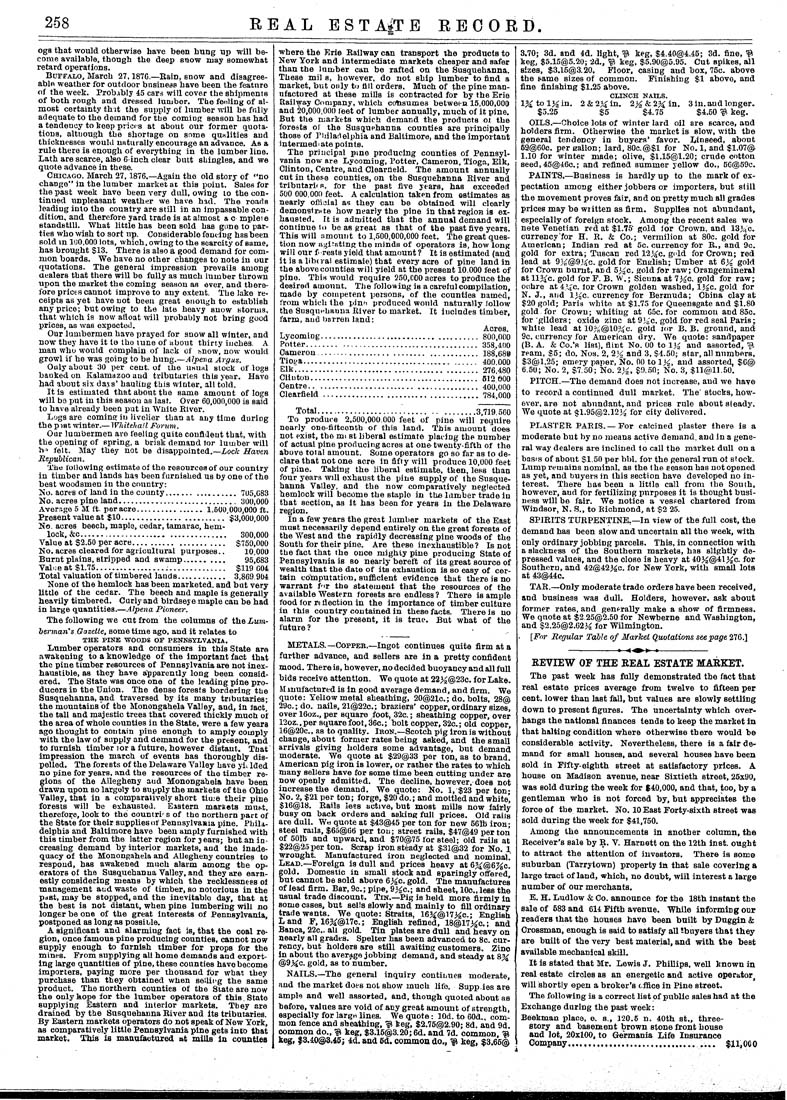
258 REAL ESTAiTE RECORD. ogs that would otherwise have been hung up will be¬ come available, though the deep snow may somewhat retard operations. Buffalo, March 27,1870.-Rain, snow and disagree¬ able weather for outdoor business have been the feature of the week. Probably 45 cars will cover the shipments of both rough and dressed lumber. The feeling of al¬ most certainty thit the supply of lumber will be fcUly adequate to the demand for ttie coming season has had a tendency to keep prices at about our former quota¬ tions, altnough the shortage on some qualities aud thicknesses would naturally encourage an advance. As a rule there is enough of everything in the lumber line. Lath are scarce, also Cinch clear butt shingles, and we quote advance in these. Chic-^^go, March 27,1876.-Again tho old story of "no change" in the lumber market at this point. Sales for the past week have been very dull, owing to the con¬ tinued unpleasant weather we have had. The roads leading into the country are still in an impassable con¬ dition, and therefore yard trade is at almost a c mpleie standstill. What little has been sold has gone to par¬ ties who wish to sort up. Considerable fencing has been sold m 100,009 lots, which, owing to the scarcity of same, has brought $13. There is also a good demand for com¬ mon boards. We have no other changes to note in our quotations. The general imijression prevails among aealers that there will be fully as much lumber thrown upon the market the coming season as ever, and there¬ fore prices cannot improve to any extent. The lake re¬ ceipts as yet have not been great enough to establish any price; but owing to the late heavy snow storms, that which is now afloat will probably not bring good prices, as was expected. Our lumbermen have prayed for snow all winter, and now they have it to tho tune of about thirty inches. A man who would complain of lack of t>now, now would growl if he was going to be hnjig.—Alpena Argus. Ouly about 30 per cent, of the UHUal stock of logs banked on Kalamazoo and tributaries this year. Have had about six da.vs' hauling ttiis winter, all told. It is estimated that about the same amount of logs will be put iu this season as last. Over 60,000,000 is said to have already been put in White River. Logs are coming iu livelier than at anytime during the pist winter.— Whitehall Forum. Oar lumbermen are feeling quite confldeut that, with the opening of spring, a brisk demand tor lumber will b^ felt. May they not be disappointed.—iocfc Haven Republican. The following estimate of the resources of our country in timber and lands has been furnished us by one of the best woodsmen iu the country: No. acres of land in the county................. 705.C83 No. acres pine land............................. 300,000 Aver.^.ge 5 M ft. per acre................ 1,500,000,000 ft. Present value at $10......................... $3,000,000 No. acres beech, maple, cedar, tamarac, hem¬ lock, &c................................... 300,000 Value at $2.50 per acre..................... $750,000 No. acres cleared for agricultural purposes.. 10,000 Burnt plains, stripped and swamp.......... 95,683 Value at $1.75................................ $119 604 Total valuation of timbered lands............ 3,869 904 None of the hemlock has been marketed, and but very little of the cedar. The beech and maple is generahy heavily timbered. Curlyand birdseye maple can be had in large quantities.—Alpena Pioneer. The following we cut from the columns of the Lum¬ berman's Gazelle, some time ago, and it relates to THE PINE WOODS OF PENNSYLVANIA. Lumber operators and consurders in this State are awakening to a knowledge of the important fact that the pine timber resources of Pennsylvania are not inex¬ haustible, as they have apparently long been consid¬ ered. The State was once one of the leading pine pro¬ ducers in the Union. The dense forests bordering the Susquehanna, and traversed by its many tributaries; the mountains of the Monongahela Valley, and, in lact, the tall and majestic trees that covered thickly much of the area of whole counties in the State, were a few years ago thought to contain piue enough to amply comply with the law of supply and demand for the present, and to furnish timber ior a future, however distant. That impression the march of events has thoroughly dis¬ pelled. The forests of the Delaware Valley have yii Ided no pine for years, and the resources of the timber re¬ gions of the Allegheny and Monongahela have been drawn upon so largely to supply the markets of the Ohio Valley, that in a comparatively short tiu;e their piue forests will be exhausted. Eistern marnets must, therefore, look to the countri' s of the northern part of the State for their supplies of Pennsylvania pine. Phila¬ delphia and Baltimore have been amply furnished with this timber from the latter region for jears; but.an in¬ creasing demand by interior markets, and the inade¬ quacy of the Monongahela and Allegheny countries to respoud, has awakened much alarm among the op¬ erators of the Susquehanna Valley, and they are earn¬ estly considering means by which the recklessness ol management and waste of timber, so notorious in the past, may be stopped, and the inevitable day, that at the best is not distant, when pine lumbering will no longer be one of the great Interests of Pennsylvania, postponed as long as possll>le. A significant and alarming fact is, that the coal re¬ gion, once famous pine producing counties, cannot now supply enough to furnish timber for props for the mines. From supplying all home demands aud export¬ ing large quantities of pine, these counties have become importers, paying more per thousand toi what they purchase than they obtained when selling the same product. The northern counties of the State are now the only hope for the lumber operators of this State supplying Eastern and interior markets. Tbey are drained by the Susquehanna River and its tributaries. By Eastern markets operators do not speak of New York, as comparatively little Pennsylvania pine gets info that market. Tliis is manafavtored at mllla la cotrntles where the Erie Railway can transport the products to New York and intermediate markets cheaper and safer than the lumber can be rafted on the Susquehanna. These mil s, however, do not ship lumber to find a market, but only to fill orders. Much of the pine man¬ ufactured at these mills is contracted for by the Erie Railway Company, which consumes between 15,000,000 and 20,000,000 leet of lumber annually, much of it pine. But the markets which demand the products ol the forests ol the Susquehanna counties are principally those of Philarielphia and Baltimore, and the important intermediate points. The principal pine producing counties of Pennsyl¬ vania now are Lycoming, Potter, Cameron, Tioga, Elk, Clinton, Centre, and Clearfield. The amount annually cut in these counties, on the Susquehanna River and trlbutarl'p. for the past five years, has exceeded 500 000,000 feet. A calculation taken from estimates as nearly offialal as they can be obtained will clearly demonstrate how nearly the pine in that regioa is ex¬ hausted. It is admitted that the annual demand will continue to be as great aa that of the past five years. This will amount to 1,500,000,000 feet. The great ques¬ tion now a-^lJatlng the minds of operators is, how long will our {• rests yield that amount ? It is estimated (and It is a liberal estimale) that every acre of pine land in the above counties will yield at the present 10.000 feet of plno. This would require 250,000 acres to produce the desired amount. The following is a carelulcompilation, made by competent persons, of the counties named, from which the pinn produced would naturally follow the Susquehauna River to market. It includes timber, farm, aud barren land: Acres. Lycoming...................................... 800,000 Potter......................................... 358,41)0 Cameron...................................... 188,689 Tioya.......................................... 400.000 Elk............................................ 276,480 CUnton......................................... 612 600 Centre........................................ 400.000 Clearfield ..................................... 784,000 Total.....................................3,719.560 To produce 2.500,000,000 feet of pine will require nearly one-fiiteenth of this land. This amount does not exist, the mi st liberal estimate placing the number of actual pine producing acres at one twenty-fifth of the above total amount. Some operators go so far as fo de¬ clare that not one acre in fifty will produce 10,000 feet of pine. Taking the liberal estimate, then, less than four years will exhaust the pine supply of the Susque¬ hanna Valley, and the now comparatively neglected hemlock will become the staple in the lumber trade In that section, as It has been for years in the Delaware region. In a few years the great lumber markets of the East must necessarily depend entirely on the great forests of the West and the rapidly decreasing pine woods of the South for their pine. Are these inexhaustible ? Is not the fact that the once mighty piue producing State of Pennsylvania is so nearly bereft of its great source of wealth that the date of its exhaustion Is so easy of cer¬ tain computation, sufflcient evidence that there is no warrant f-ir the statement that the resources of the available Western forests are endless ? There is ample food for rt flection in the importance of timber culture in this country contained in these facts. There Is no alarm for the present, it is true. But what of the future ? METALS.—CopPEB.—Ingot continues quite firm at a farther advance, and sellers are in a pretty confident mood. There is, however, no decided buoyancy and all full bids receive attention. We quote at 22>^@23c. for Lake. Mmufactured is in good average demand, and firm. We quote: Yellow metal sheathing, 20@21c.; do. bolts, 28@ 29c.; do. nails, 21@22c.; braziers' copper, ordinary sizes, over 16oz., per square foot, 32c.; sheathing copper, over 12oz., per square foot, 36c.; bolt copper, 32c.; old copper, 16(s>20c., as to quality. Ikon.—Scotch pig Iron is without change, about former rates being asked, and the small arrivals giving holders some advantage, but demand moderate. We quote at $29@33 por ton, as to brand. American pig iron is lower, or rather the rates to which many sellers have for some time been cutting under are now openly admitted. The decline, however, does not increase the demand. We quote: No. 1, $23 per ton- No. 2, $21 per ton; forge, $20 do.; and mottled and white', $16@18. Rails lees active, but most mills now lairly busy on back orders and asking full prices. Old rails are dull. W« quote at $43@45 per ton for new 561b iroa- steel rails, $63@66 per ton; street rails, $47@49 per ton of 50ib and upward, and $70@75 for steel; old rails at $22@25 per ton. Scrap iron steady at $31@32 for No. 1 wrought. Manufactured iron neglected and nominal. Lead.—Foreign ia dull and prices heavy at 6X@0%o. gold. Domestic in small stock and sparingly offered, but cannot be sold above OXo. gold. The manufactures of lead firm. Bar, 9c.; pipe, 9Xc.; and sheet, lOcless the usual trade discount. Tin.—Pig is held more firmly in some cases, but sells slowly and mainly to fill ordinary trade wants. We quote: Straita, 16X@^1Xo.; English Land F, 16?.^@17c.; English reflned, 18@17i^o.; and Banca, 22c.. all gold. Tin plates are dull and heavy on nearly all grades. Spelter has been advanced to 8o. cur¬ rency, but holders are still awaiting customers. Zino In about tho average jobbing demand, and steady at 8X @9>^c. gold, as to number. NAILS.—The general inquiry continues moderate, and the market does not show much life. Sapp.ies are ample and well assorted, and, though quoted about aa before, values are void of any great amount of strength, espeoially for large lines. Wequote: lOd. to 60d. com¬ mon fence and sheathing, ^ keg, $2.75®2.90; 8d. and 9d. common do., ^ keg, $3.15@3.20; 6d. and 7d. common, ^ keg, |3.40@3.45; 4d. and 6d. common do., ^ keg, $3.65@ 3.70; 3d. and 4d. light, "^ keg, $4.40@4.45; 3d. fine, '^ keg, $5.15@5.20; 2d., ^ keg, $5.90@5.95. Cut spikes, all sizea, $3.15@3.20. Floor, casing aud box, 75c. above the same sizes of common. Finishing $1 above, and fine finishing $1.25 above. clinch nails. 1% to IXin. 2&2J;iin. 2>^ & 2% in. 3 in.aud longer. $5.25 $5 $4.75 $4.50 ^ keg. OILS.—Choice lots of winter lard oil are scarce, and hodders firm. Otherwise the market is slow, with the general tendency in buyers' favor. Linseed, about 59@60o. per gallon; lard, 80c.@$l for No. 1, and $1.07@ 1.10 for winter made; olive, $1.15@1.20; crude cotton seed, 45@46c.; and refined summer yellow do., 50@59c. PAINTS.—Business is hardly up to the mark of ex¬ pectation among either jobbers or importers, but still the movement proves fair, and on pretty much all grades prices may be wiitten as firm. Suppiiea not abundant, especially of foreign stock. Among the recent sales we nete Venetian red at $1.75" gold lor Crown, and IZy^^o. currency for H. R. & Co.; vermilion at 80c. gold for American; Indian red at 5c. currency for R., and 9c. gold for extra; Tuscan red 12;^c. gold for Crown; red lead at 9%@.9>^Cc. gold for English; Umber at 6X gold for Crown burnt, and 5>^c. gold for raw; Orangemineral at ll^.ic. gold for F. B. W.; Sienna at 7>^, aud assorted, $C@ 6.50; No. 2, $7.50; No. 2X, $9.50; No. 3, $1]@11.50. PITCH.—The demand does not increase, aud we have to record a continued dull market. The' stocks, how¬ ever, are not abundant, and pricea rule about steady. We quote at $1.95@2.12)^ for city delivered. PLASTER PARIS.—For calcined plaster there is a moderate but hy no means active demand, and In a gene¬ ral way dealers are inclined to call the inarket dull ou a basis of about $1.50 per bbl. for the general run ot stock. Lump remains nominal, as the the season has not opened as yet, and buyers in this section have developed no in¬ terest. There haa been a little call from the South, however, aud for fertilizing purposes it is thought busi¬ ness will be fair. We notice a vessel chartered from Windsor, N. S., to Bichmond, at $2 25. SPIRITS TURPENTINE,—In view of the full cost, the demand has been alow and uncertain all the week, with only ordinary jobbing parcels. This, in connection with a slackness of the Southern markets, has alightly de¬ pressed values, and the close is heavy at 403^@41>^c. for Southern, and 42@42>^c. for New York, with small lots at 43@44e. TAR.—Only moderate trade orders have been received, and business was dull. Holders, however, ask about former rates, and generally make a show of firmness. We quote at $2.25@2.50 for Newberne and Washington, and $2.25@2.623.^ for Wilmington. . [For Regular Table of Market Quotations seepage 276.] < 4^¥ » EEVIEW OF THE REAL ESTATE MARKET. The past week has fully demonstrated the fact that real estate prices average from twelve to fifteen per cent, lower than laat fall, but values are slowly settling down to present figures. The uncertainty which over¬ hangs the national finances tends to keep the market in that halting condition where otherwise there would be considerable activity. Nevertheless, there is a fair de¬ mand for small houses, and several houaea have been aold in Fifty-eighth street at satisfactory prices. A house on Madison avenue, near Sixtieth street, 25x90, was sold during the week for $40,000, and that, too, by a gentleman who is not forced by, but appreciates the force of the market. No. 10 East Forty-sixth street waa sold during the week for $41,750. Among the announcements in another column, the Receiver's aale by B. V. Harnett on the 12th inst. ought to attract the attention of iuveatora. There ia some suburban (Tarrytown) property in that sale covering a large tract of land, which, no doubt, will interest a large number of our merchants. E. H. Ludlow & Co. announce for the 18th instant the sale of 583 and 614 Fifth avenue. While informing onr readers that the houses have been built by Duggin & Croaaman, enough is said to satisfy all Sbuyers that they are built of the very best material, and with the best available mechanical skill. It ia atated that Mr. Lewis J. Phillips, weU known in real estate circles as an energetic and active operator will shortly open a broker's cfflce in Pine atreet. The following is a correct list of public sales had at the Exchange during the past week: Beekman place, e. s., 120.5 n. 40th St., three- Story and basement brown stone front house and lot, 20x100, to Germania Life Insurance Company............................... .... $11,000