
Columbia University Libraries Digital Collections: The Real Estate Record
Use your browser's Print function to print these pages.
Real estate record and builders' guide: v. 17, no. 432: June 24, 1876
Text version:
Please note: this text may be incomplete. For more information about this OCR, view About OCR text.
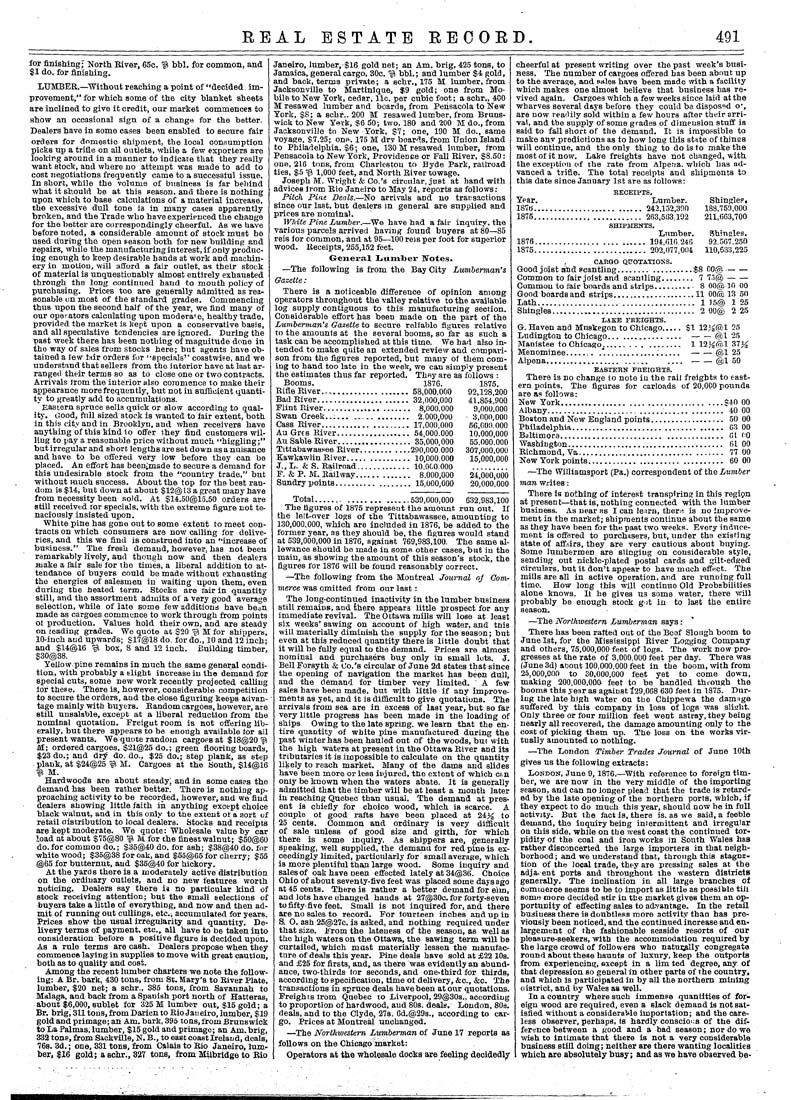
REAL ESTATE RECORD. 491 for finishingT North River, 65c. ^ bbl. for common, and $1 do, for flnishing. LUMBEE.—^Without reaching a point of "decided im¬ provement," for which some of the city blanket sheets are inclined to give it credit, our market commences to show an occasional sign of a change for the better. Dealers have in some cases been enabled to secure fair orders for domestic shipment, the local con.sumptlon picks up a trifle on all outlets, while a few exportera are looking around in a manner to indicate that they really want stock, and where no attempt was made to add to cost negotiations frequently came to a succesatul issue. In short, while the volume of business is far behind what it should be at this season, and there is nothing upon which to base calculations of a material increase, the excessive dull tone is in many cases apparently broken, and the Trade who have experienced the change for the better are correspondingly cheerful. As we have before noted, a considerable amount of stock must be used during the opeu season both for new building and repairs, while the manufacturinginterest.if only produc¬ ing enough to keep desirable hands at work and machin¬ ery in motion, will afford a fair outlet, as their stock of material is unquestionably almost entirely exhausted through the long continued hand to mouth policy of purchasing. Prices too are generally admitted as rea¬ sonable on most of the standard grades. Commencing thus upon the second ha)f of the year, we find many of our operators calculating upon moderate, healthy trade, provided the marKet is kept upon a conservative basis, and all speculative tondencies are ignored. During the past week there has been nothing of maguitude done in the way of sales from stocks here; but agents have ob¬ tained a lew titir orders for '•specials'' coastwise, and we understand that sellers from the interior have at last ar¬ ranged their terms so as to close one or two contracts. Arrivals trom the interior also commence to make their ajipearance more frequently, but not in sufficient quanti¬ ty to greatly add to accumulations. Eastern spruce sells quick or slow according to qual¬ ity. Good, ftiU sized stock is wanted to lair extent, both in this cit.v and in Brookl.yn, and when receivers have anything of this kind to offer they find customers wil¬ ling to pay a reasonable price without much "higgling;" but irregular and sh ort lengths are set down as a nuisance and have to be offered very low before they can be placed. An effort has been^made to secure a demand for this undesirable stock from the "country trade," but without much success. About the top for the best ran¬ dom is $14, but down at about $12(^13 a great many have from necessity been sold. At $14.50@15.50 orders are still received for specials, with the extreme figure not te¬ naciously insisted upon. White pine has gone out to some extent to meet con¬ tracts on which consumers are now calling for delive¬ ries, and this we find is construed into an "increase of business." The fresh demand, however, has not been remarkably lively, and though now and then dealers make a fair sale for tho times, a liberal addition to at¬ tendance of buyers could be made without exhausting the energies of salesmen in waiting upon them, even during the heated term. Stocks are lair in quantity still, and the assortment admits of a very good average selection, while of late some few additiouts have be^n made as cargoes commence to work through from points ot production. Values hold their own, and are steady on leading grades. We quote at $20 ^ M for shippers, 10-iuch aud upwards; S17@18 do. for do., 10 and 12 inch; and $U@16 ^ box, 8 and 12 inch. Building timber. yellowpine remains in much the same general condi¬ tion, with probably a slight increase in the demand for special cuts, some new work recently projected calUng tor these. There is, however, considerable competition to secure the orders, aud the close figuring keeps advan¬ tage mainly witb buyers. Random cargoes, however, are still unsalable, except at a liberal reduction from the nominal quotation. Freigut room is not offering lib¬ erally, but there appears to be enough available tor all present wants. We quote random cargoes at $18(^20 ^p M.; ordered cargoes, $21(^25 do.; green flooring boards, $23 do.; and d^ do. do., $25 do.; step plank, as step plank, at $24@25 ^ M. Cargoes at the aouth, Sli@l6 •^ M. Hardwoods are about steady; and in some cases the demand has been rather better. There is nothing ap¬ proaching activity to be recorded, however, and we fiud dealers showing Httle faith in anything except choice black walnut, and in this only to the extent ot a sort of retail aistribution to local dealers. Stocks and receipts are kept moderate. We qnote: Wholesale value by car load at about $75@80 ^ M for the flnestwalnut; $50@60 do.for common do.; S3o@40 do. for ash; $38@40 do. for whitewood; $35(g38 for oak, and $53(^65 for cherry; $55 @65 for butternut, and $35<®40 for hickory. At the yards there is a moderately active distribution on the ordinary outlets, and no new features worth noticing. Dealers say there i« no particular kind of stock receiving attention; but the small selections of buyers take a little of everything, and now and then ad¬ mit of running out cullings, etc.; accumulated for years. Prices show the usual irregularity and quantity. De¬ livery terms of payment, etc., all have to be taken into consideration before a positive figure is decided uiDon. As a rule terms are cash. Dealers propose when they commence laying in supplies to move with great caution, both as to quality and cost. Among the recent lumber charters we note the follow¬ ing: A Br. bark, 430 tons, from St. Mary's to Biver Plate, lumber, $20 net; a schr., 385 tons, from Savannah to Malaga, and back from a Spanish port north of Hatteras, about $6,000, sublet for 325 M lumber out, $15 gold; a Br. brig, 311 tons, from Darien to Kio Jan eiro, lumber, $19 gold and primage; an Am. bark, 395 tons, from Brunswick to La Palmas, lumber, $15 gold and primage; an Am. brig, 332 tons,from SackvUle, N.B., to eastcoastIreland, deals, 76s. 3d.; one, 331 tons, from Calais to Rio Janeiro, lum¬ ber, $16 gold; a schr., 327 tons, from Milbrldge to Rio Janeiro, lumber,$l6 gold net; an Am. brig, 425 tons, to Jamaica, general cargo, 30c. "'^ bbl.; and lumber $4 gold, and baek, terms private; a schr., 175 M lumber, from Jacksonville to Martinique, $9 gold; one from Mo¬ bile to New York, cedar, lie. per cubic foot; a schr., 400 M resawed lumber and boards, from Pensacola to New York, $8; a schr.. 200 M resawed lumber, from Bruns¬ wick to New Yerk, $6 60; two. 180 and 200 M do., from Jacksonville to New York, $1; one, 190 M do., same voyage, $7.25; one, 175 M dry boar-^.s, from Union Island to Phiiadelphia, S6; one, 130 M resawed lumber, from Pensacola to New York, Providence or Fall River, $8.50: one, 216 tons, from Charleston to Hyde Park, railroad ties, $5 "^ 1,000 feet, and North River towage. Joseph M. Wright & Co.'s circular, just at hand with advices from Rio Janeiro to May 24, reports as follows: Pitch Pine Deals.—No arrivals and no traRsactions since our last, but dealers in general are supplied and prices are nominal. White Pine Lumber.—^We have had a fair inquiry, the various parcels arrived having found buyers at 80—85 reis for common, and at 95—100 reis per foot for superior wood. Receipts, 255,152 feet. General Iiiimlhei' Notes. —The following is from the Bay City Lumberman's Gazette : There is a noticeable difference of opinion among operators throughout the valley relative to the available log supply contiguous to this manufacturing section. Considerable effort has been made on the part of the Lumberman's Gazette to secure reliable figures relative to the amounts at the several booms, so far as such a task can be accomplished at this time. We had also in¬ tended to make quite an extended review and cnmpari- son from the figures reported, but many of them com¬ ing to hand too late in the week, we can simply present the estimates thus far reported. They are as follows : Booms. 1876. 1875. Rifle River..................... 58,000,000 92,128,200 BadEiver...................... 32,000,000 41,854.900 FlintKiver..................... 8,000,000 9,000.000 Swan Creek..;................ 2.000,000 3,000,000 Cass River..................... 17,000,000 56,000.000 Au Gres River.................. 54,000.000 10,000,000 AuSableRiver.................. 35,000,000 55.000.000 Tittabawassee Eiver........... .290,000.000 307,000,000 Kawkawlin River...............10,000.000 15,000,000 J.,L. & S. Railroad............. lO.OCO.OOO ......... P. & P. M. Railway............. 8.000,000 24,000,000 Stmdry points.................. 15.000,000 20.000,000 Total.....................539,000,000 632,983,100 The figures of 1875 represent the amount run out. If the lett-over loga of the Tittabawassee, amounting to 130,000,000, which are included in 1876, be added to the former year, as they should he, the figures would stand at 539,000,000 in 1876, against 769,983,100. Tho same al¬ lowance should be made in some other cases, but iu the main, as showing the amount of this season's stock, the flgures for 1876 will be found reasonably correct. —The following from the Montreal Journal of Com¬ merce was omitted from our last: The long-continued Inactivity in the lumber business still remains, aud there appears little prospect for any immediate revival. The Ottawa mills will lose at least six weeks' sawing on account of high water, and tnis will materially diminish the supply for the season; but even at this reduced quantity there is little doubt that it will be fully equal to the demand. Prices are almost nominal and purchasers buy only in small lots. J. Bell Forsyth & Co.'s circular of June 2d states that since the opening of navigation the market has been dull, and the demand for timber very limited. ' A few sales have beeu made, bnt with little if any improve¬ ments as yet, and it is difficult to give quotations. The arrivals from sea are in excess of last year, but so far very little progress has been made in the loading of ships Owing to the late spring, we learn that the en¬ tire quantity of white pine manufactured during the past winter has been hauled out of tbe woods, but with the high waters at present in the Ottawa Biver and its tributaries it is impossible to calculate on the quantity likely to reach market. Many of the dams and slides have been more or less injured, the extent of which ctn only be known when the waters abate. It is generally admitted that the timber will be at least a month later iu reaching Quebec than usual. The demand at pres¬ ent is chiefly for choice wood, which is scarce. A couple ot good rafts have been placed at 243^ to 25 cents. Common and ordinary is very difficult of sale unless of good size and girth, for which there is some inquiry. As shippers are, generahy speaking, well supplied, the demand for red pine is ex¬ ceedingly limited, particularly for small average, which is more plentiful than large wood. Some inquiry and sales of oak have oeen effected lately at 34@36. Choice Ohio of about seventy-five feet was placed some days ago at 45 centa. There is rather a better demand for eim, and lots have changed hands at 27@30c. for forty-seven to fifty-five feet. Small is not inquired for, and there are no sales to record. Por lourteen inches and up in S. O. ash 25@27c. is asked, and nothing required under that size, irom the lateness of the season, as well as the high waters on the Ottawa, the sawing term will be curtailed, which mast materially lessen the manufac¬ ture of deals this year. Pine deals have sold at £22 10s. and £25 for firsts, and, as there was evidently an abund¬ ance, two-thirds for seconds, and one-third for thirds, according to specification, time ot delivery, &c., &c. The transactions in spruce deals have been at our quotations. Freights Irom Quebec to Liverpool, 29@30s., according to proportion of hardwood, and 80s. deals. Loudon, 80a. deals, and to the Clyde, 27s. 6d.@29a., according to car¬ go. Prices at Montreal unchanged. —The NortJiwestem Lumberman ot June 17 reports as follows on the Chicago market: Operators at the wholesale docks are feeling decidedly cheerful at present writing over the past week's busi¬ ness. The number of cargoes offered has been about up to the average, and sales have been made with a facility which makes one almost believe that business has re¬ vived again. Cargoes which a few weeks since laid at the wharves several days before they could bs disposed o', are now reaOily sold within a few hours after their arri¬ val, and tbe supply of some grades of dimension stuff is said to fall short of the demand. It is impo.ssible to make any predictions as to how long this state of thinss will continue, and the only thing to do is to make the most of it now. Lake freights have not changed, with the exception of the rate from Alpena, wbich has ad¬ vanced a trifle. The total receipts and shipments to this date since January 1st are as lollows: KECEIPTS, Year. Lumber. Shingle?, 187ti..........................242,152,3n0 188,750,000 1875.......................... 268,563,102 211,663,700 SHIPMENTS. Lumber. Shiusles. 1876..........................194,61(;.'246 92,507,2.50 1875........................... 202,077,004 110,533,225 CAE.GO QTJOTATIOSS. Good joist and scantling..................$8 00(g)-------- Common to fair joist and scantling........ 7 ir^®-------- Commou to fair boards an d strips......... 8 00(a 10 00 Good boards and strips....................11 OOOi 13 50 Lath...................................... 115® 125 Shingles................................... 2 00(2} 2 25 LAKE FEEIGHTS. G. Haven and Mnskegon to Chicago..... $1 12J^(a)l 25 Ludington to Chicago.................-------®l 25 Manistee to Chicago.................. 1 12}i®l SIX Menominee........*...................--------@1 25 Alijena........................ ___--------(ail 50 EASTERN FUEIGHTS. There is no change to note iu the rail freights to east¬ ern points. The flgures for carloads of 20,000 pounds are aa follows: New York......................................$40 00 Albany.......................................... 40 00 Boston and New England points.................. 50 00 Philadelphia.................................... 03 00 Baltimore....................................... 61 (^0 Washington...................................... 61 00 Richmond.Va................................... 77 00 New York points................................ 60 00 —The Williamsport (Pa.) correspondent of the Lumber man writes: There is nothing of interest transpiring in this regipn at present—that is, nothing connected with the lumber business. As near as I can le.irn, tbem is no Improve¬ ment ia the market; shipments continue about the same as they have been for the past two weeks. Every induce¬ ment ia offered to purchasers, but, under the existing state of aff.iirs, they are very cautious about buying. Some lumbermen are slinging on considerable style, sending out nickle-plated postal cards and gilt-edged circulars, but it don't appear to have much effect. The mills are all in active operation, and are running full timo. How long this will continue Old Probabilities alone knows. It he gives us some water, there will probably be enough stock g)t iu to last the entire season. —^The Northivestern Lumberman says: There has been rafted out of the Beef Slongh boom to June 1st, for the Mississippi River Logging Company and others, 75,000,000 feet of logs. The work now pro¬ gresses at the rate of 3,000,000 feet per day. There waa (June 3d) about 100.000.000 feet in the boom, vfith from 25,000,000 to 30,000,000 feet yet to come down, making 200.000,000 feet to be handled thiough the booms this year as against l29,0G8 630 feet in 1875. Dur¬ ing the late high water ou tiJe Cbippewa the damage suffered by this company in loss of logs was slisiht. Only three or four million feet went astray, they being nearly all recovered, the damage amounting only to the cost of picking them up. The loss on the works vir¬ tually amounted to nothing. —The London Timber Trades Journal of June 10th gives us the foUowing extracts: London, June 9,1876.—With reference to foreign tim¬ ber, we are now in the very middle of the importing season, and can no longer plead that the trade is retard¬ ed by the late opening of the northern ports, which, if they expect to do much this year, should now he in full activity. Bnt the fact is, there is. as we said, a feeble demand, the Inquiry being intermittent and irregular on this side, while on the west coast the continued tor¬ pidity of the coal and iron works in South Wales has rather disconcerted the large importers in that neigh¬ borhood; and we understand that, through this stagna¬ tion of the local trade, they are pressing sales at the adjacent ports and throughout the western districts generally. The inclination in all large branches of cummeroe seems to be to import as little as possible till some more decided stir in the market gives them an op¬ portunity of effecting sales to advantage. In the retail busiuess there is doubtless more activlt.v than has pre¬ viously been noticed, and the continued increase and en¬ largement of the fashionable seaside resorts of our ploasure-seekers, with the accommodation required by the large crowd of followers who natni;^lly congregate round about these haunts of luxury, keep the outports from experiencing, except in a lim ted degree, any of that depression so general in other parts of the country, and which is participated iu by all the northern mining oistrict, and by Wales aa well. In a country where such immense quantities of for¬ eign wood are required, even a slack demand is not sat¬ isfied without a consideraWe importation; and the care¬ less observer, perhaps, is hardly conscious of the dif¬ ference between a good and a bad season; nor do we wish to intimate that there is not a very considerable business still doing; neither are there wanting localities Which are absolutely busy; and as we have observed be-