
Columbia University Libraries Digital Collections: The Real Estate Record
Use your browser's Print function to print these pages.
Real estate record and builders' guide: v. 21, no. 516: February 2, 1878
Text version:
Please note: this text may be incomplete. For more information about this OCR, view About OCR text.
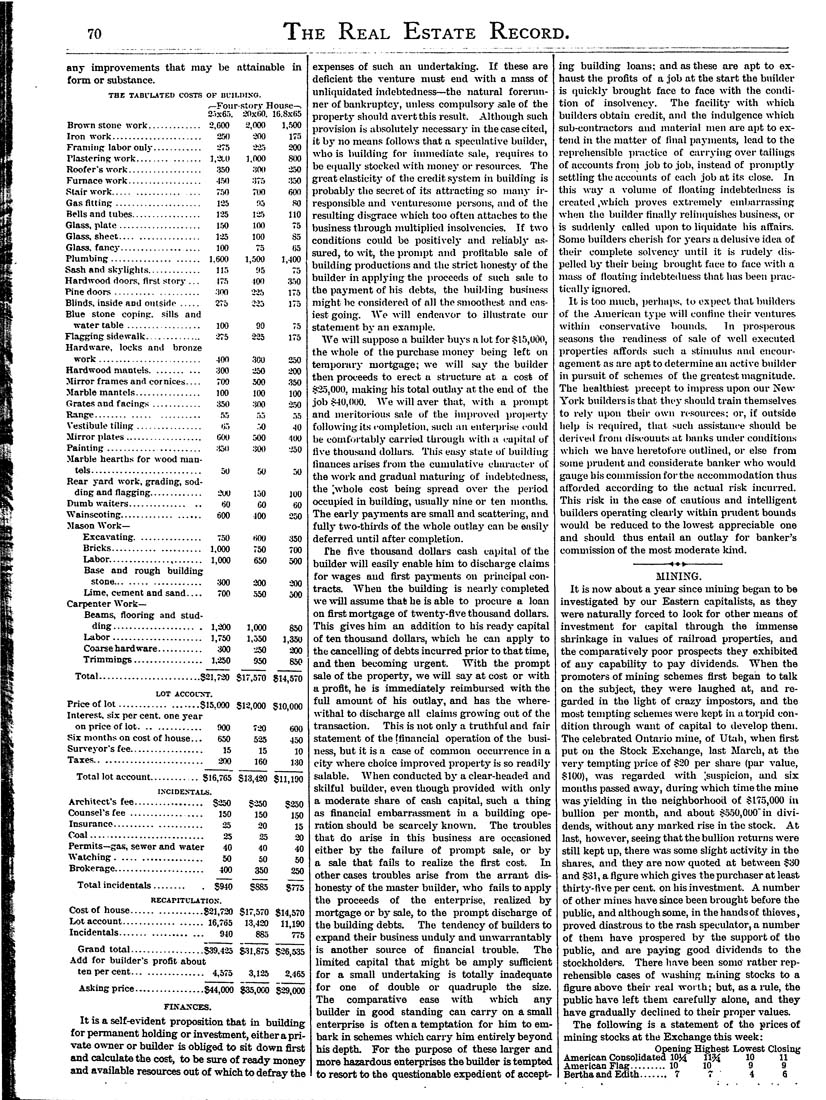
70 The Real Estate Record. any improvements that may be attainable in form or substance. THE TABl'LATED COSTS OF nL-lLI)IXO. ^Four-storv House—, 2:.x65. aoxm. l().8.\ti5 Brown stone work............. 2,600 2,000 L.'iOO Iron work....................., 2.''j0 -.JOO 175 Framing labor only............ 275 'J-i's 200 Plastering work........ ....... 1,'XO 1,000 800 Roofer's work.................. .3,50 :i00 '250 Furnace work.................. 4.50 .175 :550 Stair work.................... 7,50 7(10 600 Gas fitting..................... 125 03 80 Bells and tubes................. V25 l-i5 110 Glass, plate.................... 1,50 100 75 Glass, sheet................... 125 100 S5 Glass, fancy...............___ 100 75 65 Plumbing..................... 1,600 1,500 1,-100 Sash and skylights............. 115 1(5 75 Hardwood doors, first storj-... 175 100 ;i.50 Pine doors.................... 'lOO 'iib 175 Blinds, inside and outside..... 275 225 175 Blue stone coping, sills and water table.................. 100 90 75 Flagging sidewalk.............. 275 2-25 175 H.irdware, locks and bronze work......................... 400 .300 250 Hardwood mantels........... 300 -250 200 Jlirror frames and cornices___ 700 500 ,350 Marble mantels................ lOO IOO 100 Grates and facing.s............ 350 ;i00 2,50 Range....................... ,55 55 .55 A'estibule tiling................ 65 7,0 40 Mirror plates................... 000 500 ■■100 Painting............ .......... :i5il :J0O rioO JIarble hearths for wood man¬ tels........................... 50 50 50 Bear yard work, grading, sod¬ ding and flagging............. 200 150 100 Ehimb waiters................ 60 60 60 Wainscoting................... 600 400 -250 JIason Work- Excavating................ 750 600 350 Bricks..................... 1,000 750 700 Labor....................... 1,000 650 500 Base and rough building stone.................... 300 200 -200 Lime, cement and sand___ 700 .550 500 Carpenter Work- Beams, flooring and stud¬ ding..................... 1,200 1,000 850 Labor...................... 1,750 1,550 1,350 Coarse hard ware.......___ 300 -250 300 Trimmings................. 1,-250 950 850 Total.........................§21,720 $17,570 gl4,570 LOT ACCOC>T. Priceoflot...................815,000 Sl-2,000 §10,000 Interest, si.v per cent, one year on priee of lot.............. 900 <-20 600 Six months on cost of house... 650 5-25 450 Surveyor's fee.................. 15 15 jq Taxes.......................... 200 160 130 Total lot account............ §16,765 §13,420 §11,100 INCIDENTALS. Architect's fee................. §250 §250 §250 Counsel's fee .................. 150 150 150 Insurance..................... iS 20 15 Coal............................ 25 25 20 Permits—gas, sewer and water 40 40 40 Watching.................... 50 50 50 Brokerage...................... 400 350 250 Total incidentals......... §940 §885 §775 RECAPITULATION. Cost Of house.................§21,720 §17,570 §14,570 Lot account................... 16,765 1-3,420 11,190 Incidentals................... 940 885 775 Grand total..................§39,4-25 §31,875 §-26,5-35 Add for builder's profit about tenpercent................. 4,575 3,125 2.465 Askingprice.................§44,000 §35,000 §29,000 FIXAXCES. It is a self-evident proposition that in building for permanent holding or investment, either a pri¬ vate ow-ner or builder is obliged to sit down first and calculate the cost, to be sure of ready money and available resources out of which to defray the expenses of such an undertaking. If these are deficient the venture must end with a mass of unliquidated indebtedness—the natural forerun¬ ner of bankruptcj', unless compulsory sale of the property should avert this result. Although such provision is absolutelj'- necessarj- in the case cited, it by no means follows that a speculative builder, who is building for iiiiiiiediate sale, requires to be eiiuallj- stocked with money or resources. The great elasticity of the credit system in building is probablj'- the secret of its attracting so many ir¬ responsible and veuturesoiue persons, and of the resulting disgrace which too often atttiches to the business through multiplied insolvencies. If two conditions could be positivelj- and reliably' as- sm-ed, to wit, the prompt and profitable sale of building productions and the strict honest)- of the builder in applj-ing the proceeds of such sale to the payment of his debts, the building busincivs might be considered of all the smoothest and eas¬ iest going. AVe will endeavor to illustrate oiir statenient by an example. We will suppose a builder buys a lot for Sl,5,000, the whole of the purchase money being left on teraporarj- mortgage; we will say the builder then prot^eeds to erect a structure at a cost of §-3.5,000, making his total outlay at the end of the job .*^0,000, We will aver that, with a prompt and meritorious sale of the improved property following its completion, such an eiitet-pri.se could be comfortably carried through with a capital of five thousand dollai-s. This eiLsy state of building finances arises from the cumulative character of the work and gradual maturing of indebtedness, the [whole cost being spread over the period occupied in building, usually nine or ten months. The early payments are small and scattering, and fully two-thii-ds of the whole outlay can be easilj' deferred until after completion. The five thousand dollars cash capital of the builder will easily enable him to discharge claims for wages aud first payments on principal con¬ tracts. When the building is nearly completed w-e will assume that he is able to procure a loan on first mortgage of twenty-five thousand dollars. This gives him an addition to his ready capital of ten thoustmd dollai-s, which he can apply to the cancelling of debts incurred prior to that time, and then becoming urgent. With the prompt sale of the property, we will say at cost or with a profit, he is immediately reimbui-sed with the fuU amount of his outlay, and has the where¬ withal to discharge all claims growing out of the transaction. This is not only a truthful and fair statement of the [financial operation of the busi¬ ness, but it is a case of common occurrence in a city where choice improved property is so readily salable. When conducted bj- a clear-headed and skilful builder, even though provided with only a moderate share of cash capital, such a thing as financial embarrassment in a building ope¬ ration should be scarcely known. The troubles that do arise in this business are occasioned either by the failure of prompt sale, or by a sale that fails to realize the first cost. In other cases troubles arise from the arrant dis¬ honesty of the master builder, who fails to apply the proceeds of the enterprise, realized by mortgage or by sale, to the prompt discharge of the building debts. The tendency of builders to expimd their business unduly and unwarrantably is another source of financial trouble. The limited capital that might be amply sufficient for a small undertaking is totally inadequate for one of double or quadruple the size. The comparative ease with which any builder in good standing can carry on a small enterprise is often a temptation for him to em¬ bark in schemes which carry him entirely beyond his depth. For the purpose of these larger and more hazardous enterprises the builder is tempted to resort to the questionable expedient of accept¬ ing building loans; and as these are apt to ex¬ haust tlie profits of a job at the start the builder is quicklj- brought face to face w-ith the condi¬ tion of insolvency. The facility with which builders obtain credit, antl the indulgence w-hich sub-contractors and material men are apt to ex¬ tend in the matter of final iiaj-ments, lead to the reprehensible practice of ctirryiug over tailings of accounts from job to job, instead of promptly settling the accounts of each job at its close. In this wtiy a volume of floating indebtedness is created .which proves extremely embarrassing when tho builder finally reliiuxuishes business, or is sudtlenly called upon to liquidate his affairs. Some buildei-s cherish for yeai-s a delusive idea of their complete solvencj- until it is rudely di-s- pelled by their being brought face to face with a mass of floating indebteduess that has been prac- tictillj' ignored. It is too much, perhaps, to expect that buildei-s of the American type will confine their ventures within conservative bounds. In jirosperous seasons the readiness of sale of well executed properties affords such a stimulus and encour¬ agement as are apt to deterniine an active builder in pursuit of schemes of the greatest magnitude. The healthiest precept to impress upon our New York buildei-s is that they should train themselves to rely upon their own resources; or, if outside help is required, that such assistance should be derived from disi-ouuts at banks under conditions which we have heretofore outlined, or else from some prudent and considerate banker who would gauge bis commission for the accommodation thus afforded according to the actual risk incurred. This risk in the case of cautious and intelligent builders operating cleai-ly within pnident bounds would be reduced to the lowest appreciable one and should thus entail an outlay for banker's commission of the most moderate kind. MINING. It is now about a year since mining began to be investigated by our Eastern capitalists, as they were naturally forced to look for other means of investment for capital through the immense shrinkage in values of railroad properties, aud the comparatively poor prospects they exhibited of any capability to pay dividentis. When the promoters of mining schemes first began to talk on the subject, they were laughed at, and re¬ garded in the light of crtxzy impostoi-s, and the most tempting schemes were kept in a toi-jiid con¬ dition through want of capital to develop them. The celebrated Ontario mine, of Utah, when first put on the Stock Exchange, last March, at tho very tempting price of §20 per share (pai- value, §100), was regarded with [suspicion, and six months passed avi'ay, during which time the mine was yielding in the neighborhood of §175,000 iu bullion per month, and about §550,000" in divi¬ dends, without any marked rise in the stock. At last, however, seeing that the bullion returns were still kept up, there w-as some slight activity in the shares, and they are now quoted at between §30 and §'31, a figure which gives the purchaser at least thirtj--five per cent, on his investment. A number of other mines have since been brought before the public, and although some, in the hands of thieves, proved diastrous to the rash speculator, a number of them have prospered by the support of tbe public, and ai-e paying good dividends to the stockholders. There have been some' i-ather rep¬ rehensible cases of washing mining stocks to a figure above their real worth; but, as a i-ule, the public have left them cai-efully alone, and they have gradually declined to their proper values. The following is a statement of the prices of mining stocks at the Exchange this week: Opening Highest Lowest Closing American Consojidated lOJ^ ""' American Flag......... 10 Bertha and Edith. Jo«