
Columbia University Libraries Digital Collections: The Real Estate Record
Use your browser's Print function to print these pages.
Real estate record and builders' guide: v. 27, no. 691: June 11, 1881
Text version:
Please note: this text may be incomplete. For more information about this OCR, view About OCR text.
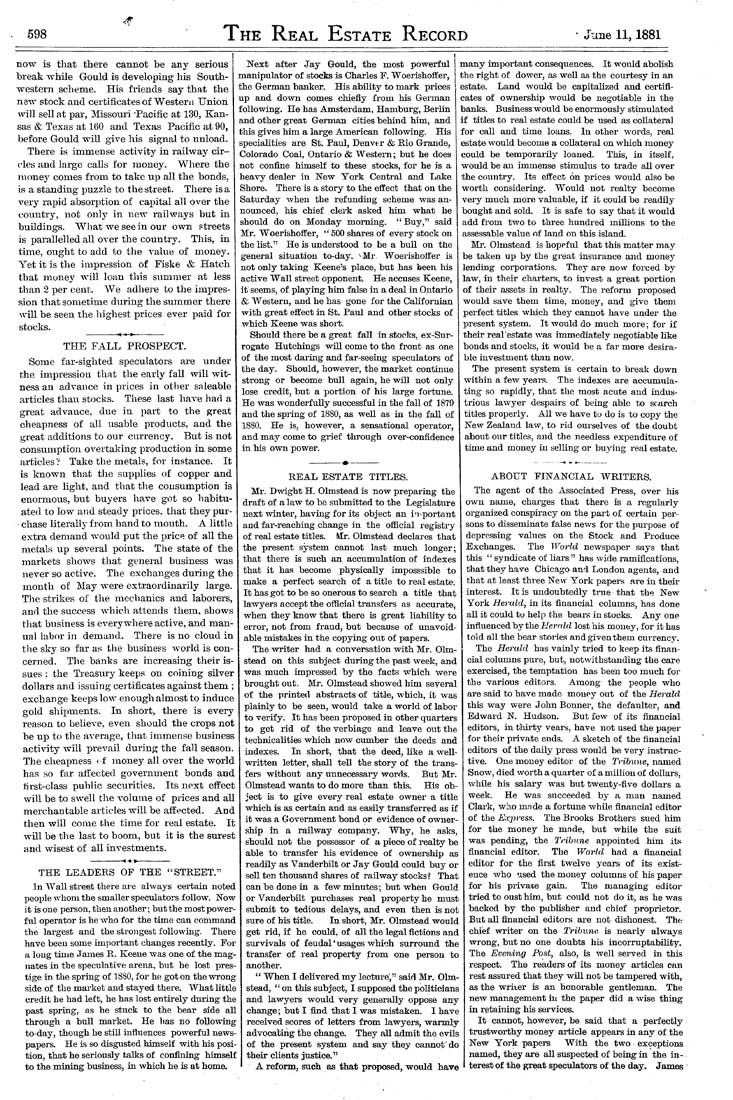
-/ff^ 598 The Real Estate Record June 11,1881 now is that there cannot be any serious break while Gould is developing his South¬ western scheme. His friends say that the new stock and certificates of Western Union will sell at par, Missouri -Pacific at 130, Kan¬ sas & Texas at 160 and Texas Pacific at 90, before Gould will give his signal to unload. There is immense activity in railway cir¬ cles and large caUs for money. Where the money comes from to take up all the bonds, is a standing puzzle to the street. There isa very rapid absorption of capital all over the country, not only in new railways but in buildings. What we see in our own streets is parallelled all over the country. Tliis, in time, ought to add to the value of money. Yet it is the impression of Fiske & Hatch that money will loan this summer at less than 2 per cent. We adhere to the impres¬ sion that sometime during the summer there wiU be seen the highest prices ever paid for stocks. -------------< . >------------- THE FALL PROSPECT. Some far-si.ghted speculators are under the impression that the early fall will wit¬ ness an advance in prices in other saleable articles than stocks. These last have had a great advance, due in part to the great cheapness of all usable products, and the great additions to our currency. But is not consumption overtaking production in some articles V Take the metals, for instance. It is known that the supplies of copper and lead are light, aud tbat the consumption is enormous, but buyers have got so habitu¬ ated to low and steady prices, that theypur- • chase literally from hand to mouth. A little extra demand would put the jprice of all the metals up several points. The state of the markets shows that general business was never so active. The exchanges during the month of May were extraordinarily large. The strikes of the mechanics and laborers, and the success which attends them, shows that business is everywhere active, and man¬ ual labor in demand. There is no cloud in the sky so far as the business world is con¬ cerned. The banks are increasing their is¬ sues : the Treasuiy keeps on coining silver dollars and issuing certificates against them ; exchange keeps low enough almost to induce gold shipments. In short, there is every reason to believe, even should the crops not be up to the average, that immense business activity will prevail during the fall season. The cheapness < f money all over the world has so far affected government bonds and first-class public securities. Its next effect will be to swell the volume of prices and all merchantable articles will be affected. And then will come the time for real estate. It will be the last to boom, but it is the surest and wisest of all investments. THE LEADERS OF THE "STREET." In Wall street there are always certain noted people whom the smaller speculators follow. ISTow it is one person, then another; but the most power¬ ful operator is he who for the time can command the largest and the strongest following. There have beeu some im]iortant changes recently. For a long time James R. Keene was one of the mag¬ nates in the speculative arena, but he lost pres¬ tige in the spring of 1880, for he got on the wrong side of the market and stayed there. What little credit he had left, he has lost entirely during the past spring, as he stuck to the bear side all through a bull market. He has no following to-day, though he stiU influences powerful news¬ papers. He is so disgusted himself with his posi¬ tion, that he seriously talks of confining himself to the mining busiuess, in which he is at home. Next after Jay Gould, the most powerful manipulator of stocks is Charles F. WoerishoflEer, the German banker. His ability to mark prices up and down comes chiefly from his German following. He has Amsterdam, Hamburg, Berlin and other great German cities behind him, and this gives him a large American following. His specialities are St. Paul, Denver & Rio Grande, Colorado Coal, Ontario & Western; but he does not confLae himself to these stocks, for he is a heavy dealer in New York Central and Lake Shore. There is a story to the effect that on the Saturday when the reftmding scheme was an¬ nounced, his chief clerk asked him what he should do on Monday morning. " Buy," said Mr. Woerishoffer, " 500 shares of every stock on the list." He is understood to be a bull on tlie general situation to-day. ^Mr. Woerishoffer is not only taking Keene's place, but has beeu his active Wall street opponent. He accuses Keene, it seems, of playing him false in a deal in Ontario & Western, and he has gone for the Californian with great effect in St. Paul and other stocks of which Keene was shoit. Should there be a great fall in stocks, ex-Sur¬ rogate Hutchings will come to the front as one of the most daring and far-seeing speculators of the day. Should, however, the market continue strong or become bull again, he wUl not only lose credit, but a portion of his large fortune. He was wonderfully successful in the fall of 1879 and the spring of 1880, as well as in the fall of 1880. He is, however, a sensational operator, and may come to grief through over-confidence in his own power. -------.*.------ REAL ESTATE TITLES. Mr. Dwight H. Olmstead is now preparing the draft of a law to be submitted to the Legislature next winter, having for its object an i'vportant and far-reaching change in the official registry of real estate titles. Mr. Olmstead declares that the present system cannot last much longer; that there is such an accumulation of indexes that it has become physically imposssible to make a perfect search of a title to real estate. It has got to be so onerous to search a title that lawyers accept the official transfers as accurate, when they know that there is great liability to error, not from fraud, but because of unavoid¬ able mistakes in the copying out of papers. The writer had a conversation with Mr. Olm¬ stead on this subject during the past week, and was much impi-essed by the facts which were brought out. Mr. Olmstead showed him several of the printed abstracts of title, which, it was plainly to be seen, would take a world of labor to verify. It has been proposed in other quarters to get rid of the verbiage and leave out the technicalities which now cumber the deeds and indexes. In short, that the deed, like a well- written letter, shall teU the story of the trans¬ fers without any unnecessary words. But Mr. Olmstead wants to do more than this. His ob¬ ject is to give every real estate owner a title which is as certain and as easily transferred as if it was a Government bond or evidence of owner¬ ship in a railway company. Why, he asks, should not the possessor of a piece of realty be able to transfer his evidence of ownership as readily as Vanderbilt or Jay Gould could buy or sell ten thousand shares of railway stocks? That can be done in a few minutes; but when Gould or Vanderbilt purchases real property he must submit to tedious delays, and even then is not sure of his title. In short, Mr. Olmstead would get rid, if he could, of all the legal fictions and survivals of feudal'usages which surround the transfer of real property from one person to another. " When I delivered my lectui-e," said Mr. Olm¬ stead, " on this subject, I supposed the politicians and lawyers would very generally oppose any change; but I find that I was mistaken. I have received scores of letters from lawyers, warmly advocating the change. They aU admit the evils of the present system and say they cannot'do their clients justice." A reform, such as that proposed, would have many important consequences. It would abolish the right of dower, as well as the courtesy in an estate. Land would be capitalized and certifi¬ cates of ownership would be negotiable in the banks. Business would be enonnously stimulated if titles to real estate could be used as collateral for call and time loans, lu other words, real estate would become a collateral on which money could be temporarily loaned. This, in itself, would be an immense stimuliis to trade all over the country. Its effect on prices would also be worth considering. Would not realty become very much mdre valuable, if it could be readily bought and sold. It is safe to say that it would add from two to three hundred millions to the assessable value of land on this island. Mr. Olmstead is hopeful that this matter may be taken up by the great insurance and money lending corporations. They are now forced by law, in their charters, to invest a great portion of their assets in realty. The reform proposed would save them time, money, and give them perfect titles which they cannot have under the present system. It would do much more; for if their realestate was immediately negotiable like bonds and stocks, it would be a far more desira¬ ble investment than now. The present system is certain to break down within a few years. The indexes are accumula¬ ting so rapidly, that the most acute and indus¬ trious lawyer despairs of being able to search titles properly. All we have to do is to copy the New Zealand law, to rid ourselves of the doubt about our titles, and the needless expenditure of time and money in selling or buying real estate. ABOUT FINANCIAL WRITERS. The agent of the Associated Press, over his own name, charges that there is a regularly organized conspiracy on the part of certain per¬ sons to disseminate false news for the purpose of depressing values on the Stock and Produce Exchanges. The World newspaper says that this " syndicate of liars " bas wide ramifications, that they have Chicago and I-ondon agents, and that at least three New York papers are in their interest. It is undoubtedly true that the New York Herald, in its financial columns, has done all it could to help the bears in stocks. Any one influenced by the Herald lost his money, for it has told all the bear stories and given them currency. The Herald has vainly tried to keep its finan¬ cial columns pure, but, notwithstanding the care exercised, the temptation has been too much for the various editors. Among the people who are said to have made money out of the Herald this way were John Bonner, the defaulter, and Edward N. Hudson. But few of its financial editors, in tliirty vears, have not used the papei' for their private ends. A sketch of the financial editors of the daily press would be very instruc¬ tive. One money editor of the Tribune, named Snow, died worth a quarter of a million of dollars, while his salary was but twenty-five dollars a week. He was succeeded by a man named Clark, who made a fortune while financial editor of the Exjjress. The Brooks Brothers sued him for the money he made, but while the suit was pending, the Tribune apijointed him its financial editor. The World had a financial editor for the first twelve years of its exist¬ ence who used the money columns of his paper for his private gain. The managing editor tried to oust him, but could not do it, as he was backed by the publisher and chief proprietor. But all financial editors ai-e not dishonest. The chief writer on the Tribune is nearly always wrong, but no o.ne doubts his incorruptability. The Evening Post, also, is well served in this respect. The readers of its money articles can rest assured that they will not be tampered with, as the writer is an honorable gentleman. The new management in the paper did a wise thing in retaining his services. It ca,nnot, however, be said that a perfectly trustworthy money article appears in any of the New York papers With the two exceptions named, they are all suspected of being in the in- terest of the great speculators of the day. James