
Columbia University Libraries Digital Collections: The Real Estate Record
Use your browser's Print function to print these pages.
Real estate record and builders' guide: v. 28, no. 716: December 3, 1881
Text version:
Please note: this text may be incomplete. For more information about this OCR, view About OCR text.
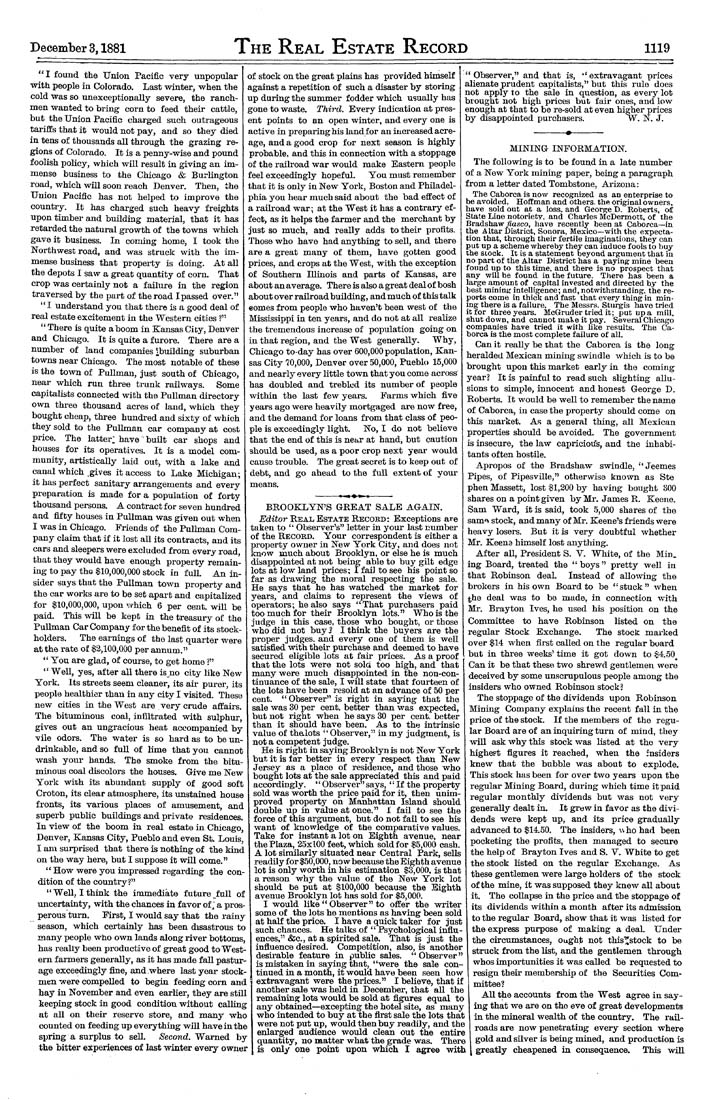
December 3,1881 The Real Estate Record 1119 "I found the Union Pacific very unpopular with people in Colorado. Last winter, when the cold was so unexceptionally severe, the ranch¬ men wanted to bring corn to feed their cattle, but the Union Pacific charged such outrageous tariffs that it would not pay, and so they died in tens of thousands all through the grazing re¬ gions of Colorado. It is a penny-wise and pound foolish policy, which will result in giving an im¬ mense business to the Chicago & Burlington road, which wUl soon reach Denver. Then, the Union Pacific has not helped to improve the country. It has charged such heavy freights upon timber and building material, that it has retarded the natural growth of the towns which gave it business. In coming home, I took the Northwesfc road, and was struck with the im¬ mense business that property is doing. At all the depots I saw a great quantity of corn. That crop was certainly not a failure in the region traversed by the part of the road I passed over." "I understand you that there is a good deal of real estate excitement in the Western cities ?" " There is quite a boom in Kansas City, Denver and Chicago. It is quite a furore. There are a number of land companies ^building suburban towns near Chicago. The most notable of these is the town of Pullman, just south of Chicago, near which run three trunk railways. Some capitalists connected with the Pullman directory own three thousand acres of land, which they bought cheap, three hundred and sixty of which they sold to the Pullman car company at cost price. The latter^ have built car shops and houses for its operatives. It is a model com¬ munity, artistically laid out, with a lake and canal which .gives it access to Lake Michigan; it has perfect sanitary arrangements and every preparation is made for a population of forty thousand persons. A contract for seven hundred and fifty houses in Pullman was given out when I was in Chicago. Friends of the Pulhnan Com¬ pany claim that if it lost all its contracts, and its cars and sleepers were excluded from every road, that they would have enough property remain¬ ing to pay the $10,000,000 stock in full. An in¬ sider says that the Pullman town property and the car works are to be set apart and capitalized for $10,000,000, upon Tvhich 6 per cent, will be paid. This will be kept in the treasury of the Pullman Car Company for the benefit of its stock¬ holders. The earnings of the last quarter were atthe rate of $2,100,000 per annum." " You are glad, of course, to get home ?" " Well, yes, after all there is no city like New York. Its streets seem cleaner, its air purer, its people healthier than in any city I visited. These new cities in the West are very crude affairs. The bituminous coal, infiltrated with sulphur, gives out an ungracious heat accompanied by vile odors. The water is so hard as to be un- drinkable, and so full of lime that you cannot wash your hands. The smoke from the bitu¬ minous coal discolors the houses. Give me New York with its abundant supply of good soft Croton, its clear atmosphere, its unstained house fronts, its various places of amusement, and superb pubhc buildings and private residences. In view of the boom in real estate in Chicago, Denver, Kansas City, Pueblo and even St. Louis, I am surprised that there is nothing of the kind on the way here, but I suppose it will come." " How were you impressed regarding the con¬ dition of the country?" "WeU, I think the immediate future_full of uncertainty, with the chances in favor of J a pros¬ perous turn. First, I would say that the rainy season, which certainly has been disastrous to many people who own lands along river bottoms, has really been productive of great good to West- em farmers generaUy, as it has made fall pastur¬ age exceedingly fine, and where last year stock¬ men were compeUed to begin feeding corn and hay in November and even earUer, they are stUl keeping stock in good condition without calling at all on their reserve store, and many who counted on feeding up everything wiU have in the spring a surplus to seU. Second. Warned by the bitter experiences of last winter every owner of stock on the great plains has provided himself against a repetition of such a disaster by storing up during the summer fodder which usually has gone to waste. Third. Every indication at pres¬ ent points to an open winter, and every one is active in preparing his land for an increased acre¬ age, and a good crop for next season is highly probable, and this in connection with a stoppage of the railroad war would make Eastern people feel exceedingly hopeful. You must remember that it is only in New York, Boston and Philadel¬ phia you hear much said about the bad effect of a raUroad war; at the West it has a contrary ef¬ fect, as it helps the farmer and the merchant by just so much, and really adds to their profits. Those who have had anything to seU, and there are a great many of them, have gotten good prices, and crops at the West, with the exception of Southern Illinois and parts of Kansas, are about an average. There is also a great deal of bosh about over railroad building, and much of this talk eomes from people who haven't been west of the Mississippi in ten years, and do not at all reahze the tremendous increase of population going on in that region, and fche West generally. "Why, Chicago today has over 600,000 population, Kan¬ sas City 70,000, Denver over 50,000, Pueblo 15,000 and nearly every little town that you come across has doubled and trebled its number of people within the last few years. Farms which five years ago were heavily mortgaged are now free, and the demand for loans from that class of peo¬ ple is exceedingly light. No, I do not believe that the end of this is near at hand, but caution should be used, as a poor crop next year would cause trouble. The great secret is to keep out of debt, and go ahead to the fuU extent of your means. "Observer," and that is, "extravagant prices alienate prudent capitalists," but this rule does not apply to the sale in question, as every lot brought not high prices but fair ones, and low enough at that to be re-sold at even higher prices by disappointed purchasers. W. N. J. BROOKLYN'S GREAT SALE AGAIN. E'ditor Real Estate Record: Exceptions are taken to " Observer's" letter in your last number of the Record. Your correspondent is either a property owner in New York City, and does not know much about Brooklyn, or else he is much disappointed at not being able to buy gilt edge lots at low land prices; I fail to see his point so far as drawing the moral respecting the sale. He says that he has watched the market for years, and claims to represent the views of operators; he also says "That purchasers paid too much for their Brooklyn lots." Who is fche judge in this case, those who bought, or those who did not buy 3 I think the buyers are the proper judges, and every one of them is well satisfied with their purchase and deemed to have secured eligible lots at fair prices. As a proof that the lots were not sold too high, and that many were much disappointed in the non-con¬ tinuance of the sale, I will state that fourteen of the lots have been resold at an advance of 50 per cent. "Observer" is right in saying that the sale was 30 per cent, better than was expected, but not right when he says 30 per cent, befcfcer than it should have been. As to the intrinsic value of thelots "Observer," in my judgment, is not a competent judge. He is right in saying Brooklyn is not New York but it is far better in every respect than New Jereey as a place of residence, and those who bought lots at the sale appreciated this and paid accordingly. '' Observer" says, '' If the property sold was worth the price paid for it, then unim¬ proved property on Manhattan Island should double up in value at once." 1 fail to see the force of this argument, but do not fail to see his want of knowledge of the comparative values. Take for instant a lot on Eighth avenue, near the Plaza, 25x100 feet, which sold for $5,000 cash. A lot similarly situated near Central Park, sells readily for $50,000, now because the Eighth avenue lot is only worth in his estimation $3,000. is that a reason why the value of the New York lot should be put at $100,000 because the Eighth avenue Brooklyn lot has sold for $5,000. I would like "Observer" to offer the writer some of the lots he mentions as having been sold at half the price. I have a quick taker for just such chances. He talks of " Psychological influ¬ ences," &c., at a spirited sale. That is just the influence desired. Competition, also, is another desirable feature in public sales. "Observer" is mistaken in saying that, "were the sale con¬ tinued in a month, it would have been seen how extravagant wei'e the prices." I believe, that if another sale was held in December, that aU the remaining lots would be sold at figures equal to any obtained—excepting the hotel site, as many who intended to buy at the first sale the lots that were not put up, would then buy readily, and the enlarged audience would clean out the entire quantity, no laatter what the grade was. There I is only one point upon which I agree with MINING INFORMATION. The following is to be found in a late number of a New York mining paper, being a paragraph from a letter dated Tombstone, Arizona: The Gaborca is now recognized as an enterprise to be avoided. Hoffman and others, the original owners, have sold out at a loss, and George D. Roberts, of State Liae notoriety, and Charles McDermott. of the Bradshaw fiasco, have recently been at Gaborca—in the Altar District, Sonora, Mexico—with the expecta¬ tion that, through their fertile imaginations, they can put up a scheme whereby they can induce fools to buy the siock. It is a statement beyond argument that in no part of the Altar District has a paying mine been found up to this time, and there is no prospect that any will be found in the future. Tiiere has been a large amount of capital invested and directed by the best mining intelligence; and, notwithstanding, the re¬ ports come in thick and fast that every thing in min¬ ing there is a failure. The Messrs. Sturgis have tried it for three years. McGruder tried it; put up a mill, shut down, and cannot make it pay. Several Chicago companies have tried it with like results. The Ga¬ borca is the most complete failure of all. Can it really be that the Caborca is the long heralded Mexican mining swindle which is to be brought upon this market early in the coming year? It is painful to read such .slighting allu¬ sions to simple, innocent and honest George D. Roberts. It would be well to remember the name of Caborca, in case the property should come on this market. As a general thing, all Mexican properties should be avoided. The government is insecure, the law capriciou's, and the inhabi¬ tants often hostile. Apropos of the Bradshaw swindle, " Jeemes Pipes, of Pipesville," otherwise known as Ste phen Massett, lost $1,200 by having bought 300 shares on a point given by Mr. James R. Keene. Sam Yf ard, it is said, took 5,000 shares of the sam*^ stock, and many of Mr. Keene's friends were heavy losers. But it is very doubtful whether Mr. Keena himself lost anything. After all, President S. V. White, of the Min. ing Board, treated the " boys " pretty well in that Robinson deal. Instead of allowing the brokers in his own Board to be "stuck" when the deal was to be made, in connection with Mr. Brayton Ives, he used his position on the Committee to have Robinson listed on the regular Stock Exchange. The stock marked over $14 when first called on the regular board but in three weeks' time it got down to S4.50_ Can it be that these two shrewd gentlemen were deceived by some unscrupulous people among the insiders who owned Robinson stock? The stoppage of the dividends upon Robinson Mining Company explains the recent fall in the price of the stock. If the members of the regu¬ lar Board are of an inquiring turn of mind, they will ask why this stock was listed at tho very highest figures it reached, when the insiders knew that the bubble was about to explode. This stock has been for over two years upon the regular Mining Board, during which time it paid regular monthly dividends but was not very generaUy dealt in. It grew in favor as the divi¬ dends were kept up, and its price gradually advanced to $14.50. The insiders, \\ ho had been pocketing the profits, then managed to secure the help of Brayton Ives and S. V. White to get the stock listed on the regular Exchange. As these gentlemen were large holders of the stock ofthe mine, it was supposed they knew all about it. The collapse in the price and the stoppage of its dividends within a month after its admission to the regular Board, show that it was fisted for the express purpose of making a deal. Under the circumstances, ought not thisl^stock to be struck from the list, and the gentlemen through whos importunities it was caUed be requested to resign their membership of the Securities Com¬ mittee? AU the accounts from the West agree in say- mg that we are on the eve of great developments in the mineral wealth of the country. The raU- roads are now penetrating every section where gold and sUver is being mined, and production is greatly cheapened in consequence. This wiU