
Columbia University Libraries Digital Collections: The Real Estate Record
Use your browser's Print function to print these pages.
Real estate record and builders' guide: [v. 30, no. 762: Articles]: October 21-28, 1882
Text version:
Please note: this text may be incomplete. For more information about this OCR, view About OCR text.
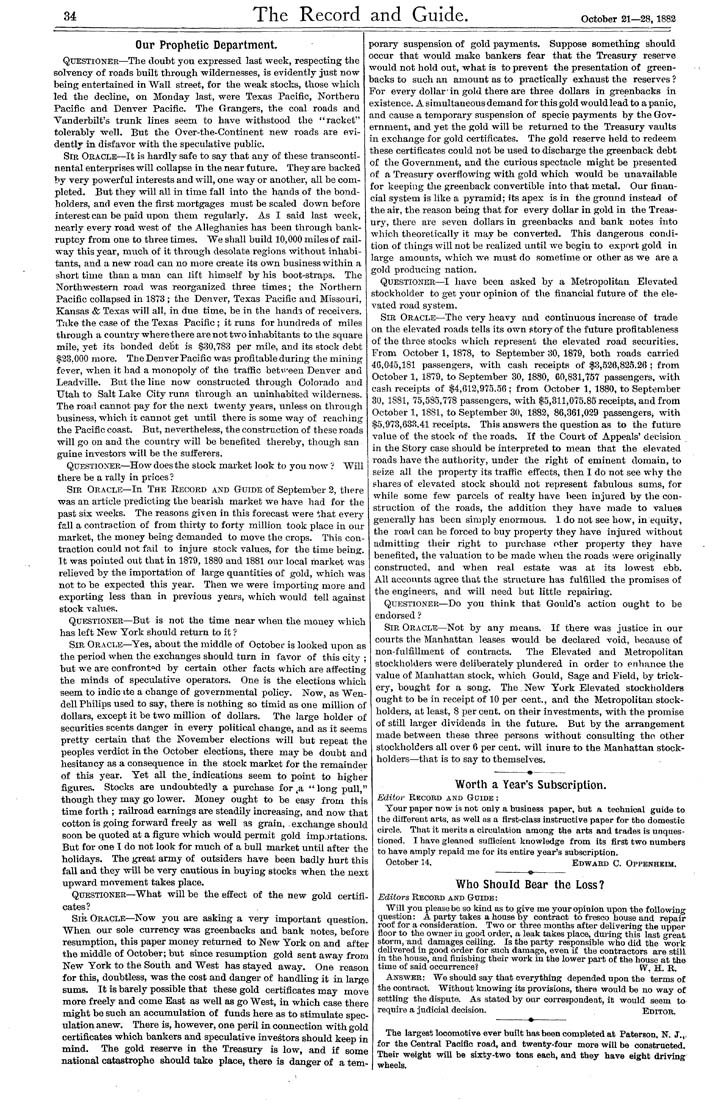
34 The Record and Guide. October 21—28,1882 Our Prophetic Department. QuESTiONEE—The doubt you expressed last week, respecting the solvency of roads built through wUdernesses, is evidently just now being entertained in WaU street, for the weak stocks, those which led the decline, on Monday last, were Texas Pacific, Northern Pacific and Denver Pacific. The Grangers, the coal roads and Vanderbilt's trunk lines seem to have withstood the "racket" tolerably well. But the Over-the-Continent new roads are evi¬ dently in disfavor with the speculative public. Sib Oeacle—It is hardly safe to say that any of these transconti¬ nental enterprises will collapse in the near future. They are backed by very powerful interests and will, one way or another, all be com¬ pleted. But they will all in time fall into the hands of the bond¬ holders, and even the first mortgages must be scaled down before interest can be paid upon them regularly. As I said last week, nearly every road west of the AUeghanies has been through bank¬ ruptcy from one to three times. We shall build 10,000 miles of rail¬ way this year, much of it through desolate regions without inhabi¬ tants, and a new road can no more create its own business within a short time than a man can lift himself by his boot-straps. The Northwestern road was reorganized three times; the Northern Pacific collapsed in 1873 ; the Denver, Texas Pacific and Missouri, Kansas & Texas will all, in due time, be in the hand?; of receivers. Take the case of the Texas Pacific ; it runs for hundreds of miles through a country where there are not two inhabitants to the square mile, yet its bonded debt is $30,783 per mile, and its stock debt $23,000 more. The Denver Pacific was profitable during the mining fever, when it had a monopoly of the traffic bet\''een Denver and Leadville, But the line now constructed through Colorado and Utah to Salt Lake City runs through an uninhabited wilderness. The road cannot pay for the next twenty years, unless on through business, which it cannot get until there is some way of reacliing the Pacific coast. But, nevertheless, the construction of these roads will go on and the country will be benefited thereby, tliough san guine investors will be the sufferers. Questioner—How does the stock market look to you now ? Will there be a rally in prices? Sir Oracle—In The Record and Guide of September 2, there was an article predicting the bearish market we have had for the past six weeks. The reasons given in this forecast were that every faU a contraction of from thirty to forty million took place in our market, the money being demanded to move the crops. This con¬ traction could not fail to injure stock values, for the time being. It was pointed out that in 1879, 1880 and 1881 our local market was relieved by the importation of large quantities of gold, which was not to be expected this year. Then we were importing more and exporting less than in previous years, which would tell against stock values. Questioner—But is not the time near when the money which has left New York should return to it ? Sir Oracle—Yes, about the middle of October is looked upon as the period when the exchanges should turn in favor of this city ; but w-e are confront'^d by certain other facts which are affecting the minds of speculative operators. One is the elections which seem to indie ite a change of governmental policy. Now, as Wen¬ dell Philips used to say, there is nothing so timid as one million of dollars, except it be two million of dollars. The large holder of securities scents danger in every political change, and as it seems pretty certain that the November elections will but repeat the peoples verdict in the October elections, there may be doubt and hesitancy as a consequence in the stock market for the remainder of this year. Yet all the. indications seem to point to higher figures. Stocks are undoubtedly a purchase for ,a " long pull," though they may go lower. Money ought to be easy from this time forth ; railroad earnings are steadily increasing, and now that cotton is going forward freely as well as grain, .exchange should soon be quoted at a figure which would permit gold imp>,»rtations. But for one I do not look for much of a buU market until after the holidays. The great army of outsiders have been badly hurt this fall and they will be very cautious in buying stocks when the next upward movement takes place. Questioner—What will be the effect of the new gold certifi¬ cates? Sir Oracle—Now you are asking a very important question. When our sole currency was greenbacks and bank notes, before resumption, this paper money returned to New York on and after the middle of October; but since resumption gold sent away from New York to the South and West has stayed away. One reason for this, doubtless, was the cost and danger of handling it in large sums. It is barely possible that these gold certificates may move more freely and come Easfc as well as go West, in which case there might be such an accumulation of funds here as to stimulate spec¬ ulation anew. There is, however, one peril in connection with gold certificates which bankers and speculative investors should keep in mind. The gold reserve in the Treasury is low, and if some national catastrophe should take place, there is danger of a tem¬ porary suspension of gold payments. Suppose something should occur that would make bankers fear that the Treasury reserve would not hold out, what is to prevent the presentation of green¬ backs to such an amount as to practically exhaust the reserves ? For every dollar in gold there are three dollars in greenbacks in existence. A simultaneous demand for this gold would lead to a panic, and cause a temporary suspension of specie payments by the Gov¬ ernment, and yet the gold will be returned to the Treasury vaults in exchange for gold certificates. The gold reserve held to redeem these certificates could not be used to discharge the greenback debt of the Government, and the curious spectacle might be presented of a Treasury overflowing with gold which would be unavailable for keeping the greenback convertible into that metal. Our finan¬ cial system is like a pyramid; its apex is in the ground instead of the air, the reason being that for every dollar in gold in the Treas¬ ury, there are seven dollars in greenbacks and bank notes into which theoretically it may be converted. This dangerous condi¬ tion of things will not be realized until we begin to exjiort gold in large amounts, which we must do sometime or other as we are a gold producing nation. Questioner—I have been asked by a Metropolitan Elevated stockholder to get your opinion of the financial future of the ele¬ vated road system. Sir Oracle-—The very heavy and continuous increase of trade on the elevated roads tells its own story of the future profitableness of the three stocks which represent the elevated road securities. From October 1, 1878, to September 30, 1879, both roads carried 40,045,181 passengers, with cash receipts of $3,526,825.26 ; from October 1, 1879, to September 30, 1880, 60,831,757 passengers, with cash receipts of $4,612,975.56 ; from October 1, 1880, to September 30, 1881, 75,585,778 passengers, with $5,811,075.85 receipts, and from October 1, 1881, to September 30, 1882, 86,361,029 passengers^ with $5,973,633.41 receipts. This answers the question as to the futilre value of the stock of the roads. If the Court of Appeals' decision in the Story case should be interpreted to mean that the elevated roads have the authority, under the right of eminent domain, to seize all the property its traffic effects, then I do not see why the shares of elevated stock should not represent fabulous sums, for while some few parcels of realty have been injured by the con¬ struction of the roads, the addition they have made to values generally has been simply enormous. 1 do not see how, in equity, the road can be forced to buy property they have injured without admitting their right to purchase other property they have benefited, the valuation to be made when the roads were originally constructed, and when real estate was at its lowest ebb. All accounts agree that the structure has fulfilled the promises of the engineers, and will need but little repairing. Questioner—Do you tliink that Gould's action ought to be endorsed ? Sir Oracle—Not by any means. If there was justice in our courts the Manhattan leases would be declared void, because of non-fulfillment of contracts. The Elevated and Metropolitan stockholders were deliberately plundered in order to enhance the value of Manhattan stock, which Gould, Sage and Field, by trick¬ ery, bought for a song. The.New York Elevated stockholders ought to be in receipt of 10 per cent., and the Metropolitan stock¬ holders, at least, 8 per cent, on their investments, with the promise of still larger dividends in the future. But by the arrangement made between these three persons without consulting tho other stockholders all over 6 per cent, will inure to the Manhattan stock¬ holders—that is to say to themselves. Worth a Year's Subscription. Editor PbECORD and Gcidb : Tour paper now is not only a business paper, but a technical guide to the different arts, as well as a first-class instructive paper for fche domestic circle. That ifc merits a circulation among fche arfcs and trades is unques¬ tioned. I have gleaned sufficient knowledge from ifcs first fcwo numbers to have amply repaid me for its entire year's subscription. October 14. Edward C. Oppenheim. Who Should Bear the Loss ? Editors Record and G-tjide: Will you please be so kind as to give me your opinion upon the following question: A party takes a house by contract to fresco house and repair roof for a consideration. Two or three months after delivering the upper floor to the owner in good order, a leak takes place, during this last great storm, and damages ceiling. Is the party responsible who did the work delivered in good order for such damage, even if the contractors are still in the house, and finishing their work in the lower part of the house at the time of said occurrence? W. H. R. Answer: We should say that everything depended upon the terms of the contract. Without knowing its provisions, there would be no way of settling the dispute. As stated by our correspondeot, ifc would seem to require a judicial decision. Editor. The largest locomotive ever built has been completed at Paterson, N. J.,, for the Central Pacific road, and twenty-four more will be constructed. Their weight will be sixty-two tons each, and they have eight driving wheels.