
Columbia University Libraries Digital Collections: The Real Estate Record
Use your browser's Print function to print these pages.
Real estate record and builders' guide: [v. 30, no. 768: Articles]: December 2-9, 1882
Text version:
Please note: this text may be incomplete. For more information about this OCR, view About OCR text.
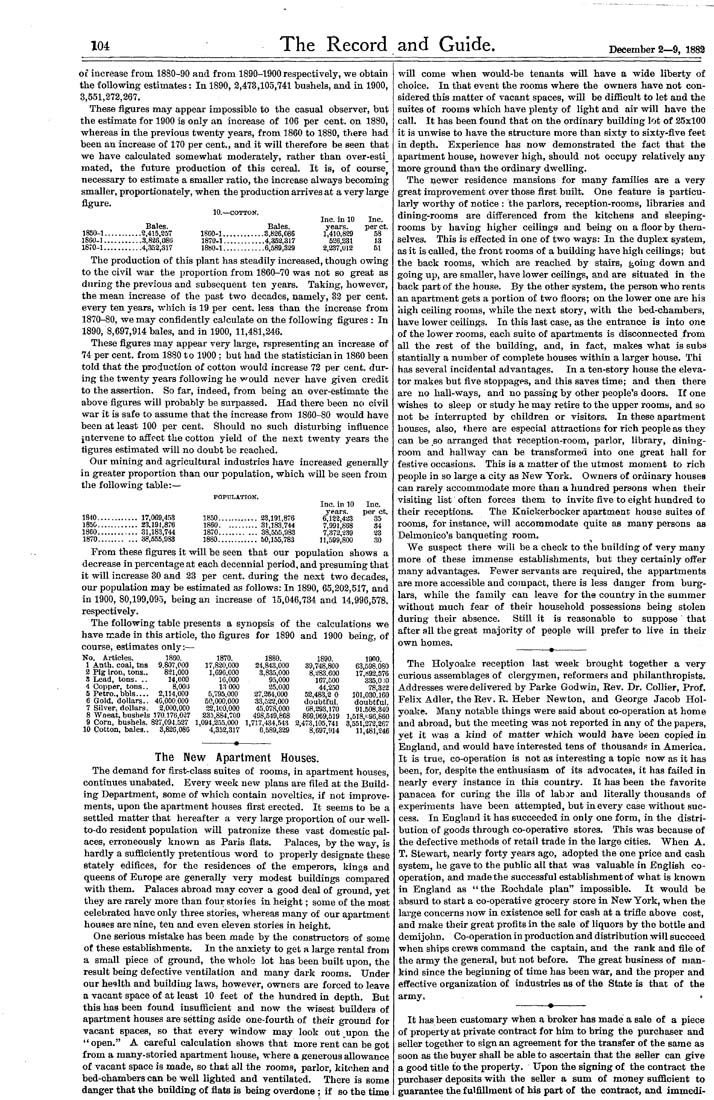
104 The Record and Guide. Decembers—9, 1882 of increase from 1880-90 a.nd from 1890-1900 respectively, we obtain the following estimates: In 1890, 2,473,105,741 bushels, and in 1900, 3,551,272,267. These figures may appear impossible to the casual observer, but the estimate for 1900 is only an increase of 106 per cent, on 1880, whereas in the previous twenty years, from 1860 to 1880, there had been an increase of 170 per cent., and it will therefore be seen that we have calculated somewhat moderately, rather than over-esti_ mated, the future production of this cereal. It is, of course necessary to estimate a smaller ratio, the increase always becoming smaller, proportionately, when the production arrives at a very large figure. 10.—COTTON. Inc. in 10 Inc. Bales. Bales. years. perct. 1850-1...........2,415,257 1800-1............3.826,086 1,410.829 58 1860-1...........3,826,080 1870-1............4,352,317 526,231 13 1870-1...........4,352,317 1880-1............6,589,329 2,237,012 51 The production of this plant has steadily increased, though owing to the civil war the proportion from 1860-70 was not so great as during the previous and subsequent ten years. Taking, however, the mean increase of the past two decades, namely, 33 per cent, every ten years, which is 19 per cent, less than the increase from 1870-80, we may confidently calculate on the following figures : In 1890, 8,697,914 bales, and in 1900, 11,481,246. These figures may appear very large, rspresenting an increase of 74 per cent, from 1880 to 1900 : but had the statistician in 1860 been told that the piroduction of cotton would increase 72 per cent, dur¬ ing the twenty years following he would never have given credit to the assertion. So far, indeed, from being an over-estimate the above figures will probably be surpassed. Had there been no civil war it is safe to assume that the increase from 1860-80 would have been at least 100 per cent. Should no such disturbing influence intervene to affect the cotton yield of the next twenty years the figures estimated will no doubt be reached. Our mining and agricultural industries have increased generally in greater proportion than our population, which will be seen from the following table:— POPULATION. Inc. in 10 Inc. 1840............ 17,069,453 1850............ 23.191,876 1860............ 31,18.3,744 1870........... 38,555,983 1850............ 23,191,876 1860..........31,183,744 1870........... 38,555,983 1880............ 50,155,783 years. per ct. 6,122,423 35 7,991,868 34 7,372,239 23 11,599,800 30 From these figures it will be seen that our population shows a decrease in percentage at each decennial period, and presuming that it will increase 30 and 23 per cent, during the next two decades, our population may be estimated as follows: In 1890, 65,202,517, and in 1900, 80,199,095, being an increase of 15,046,734 and 14,996,578. respectively. The following table jjresents a synopsis of the calculations we have made in this article, the figures for 1890 and 1900 being, of course, estimates only:— No. Articles. 1860. 1 Anth. coal, tns 9.807,000 2 Pig iron, tons.. 821,000 5 Lead, tons. .. 14,000 4 Copper, tons.. 8,000 6 Petro.,bbls.... 2,114,000 6 Gold, dollars.. 40,000.000 7 Silver, dollars. 2,000,000 1870. 1880. 1890. 1900. 17.820,000 24,843,000 39,748,800 63,598.080 1,696.000 3,835,000 8,283.600 17,892.576 10,000 95,000 167,500 335,0)0 13 000 25.000 44,250 78,322 5.795.000 27,264,000 52,483,2 0 101,030,160 50,000,000 33,522,000 doubtful. doubtful. 22,100,000 45,078,000 08,293,170 91.508,840 8 Woeat. bushels 170.176,027 235,884,700 498,.549,fi68 869,969,519 1,518,1:96,860 9 Corn, bushels. 827,094.527 1,094,255,000 1,717,434,.543 2,473,105,741 3,551,272,267 10 Cotton, bales.. 3,826,080 4,352,317 0,589.329 8,697,914 11481246 The New Apartment Houses. The demand for first-class suites of rooms, in apartment houses, continues unabated. Every week new plans are filed at the Build¬ ing Department, some of which contain novelties, if not improve¬ ments, upon the apartment houses first erected. It seems to be a settled matter that hereafter a very large proportion of our well- to-do resident population will patronize these vast domestic pal¬ aces, erroneously known as Paris flats. Palaces, by the way, is hardly a suflaciently pretentious word to properly designate these stately edifices, for the residences of the emperors, kings and queens of Europe are generally very modest buildings compared with them. Palaces abroad may cover a good deal of ground, yet they are rarely more than four stoiies in height; some of the most celebrated have only three stories, whereas many of our apartment houses are nine, ten and even eleven stories in height. One serious mistake has been made by the constructors of some of these establishments. In the anxiety to get a large rental from a small piece of ground, the wholo lot has been built upon, the result being defective ventilation and many dark rooms. Under our heqlth and building laws, however, owners are forced to leave a vacant space of at least 10 feet of the hundred in depth. But this has been found insuflacient and now the wisest builders of apartment houses are setting aside one-fourth of their ground for vacant spaces, so that every window may look out upon the "open." A careful calculation shows that more rent can be got from a many-storied apartment house, where a generous allowance of vacant space is made, so that all the rooms, parlor, kitchen and bed-chambers can be well lighted and ventilated. There is some danger that fche building of flats is being overdone ; if so the time will come when would-be tenants will have a wide liberty of choice. In that event the rooms where the owners have not con¬ sidered this matter of vacant spaces, will be difficult to let and the suites of rooms which have plenty of light and air will have the call. It has been found that on the ordinary buildiug lot of 25x100 it is unwise to have the structure more than sixty to sixty-five feet in depth. Experience has now demonstrated the fact that the apartment house, however high, should not occupy relatively any more ground than the ordinary dwelling. The newer residence mansions for many families are a very great improvement over those first built. One feature is particu¬ larly worthy of notice : the parlors, reception-rooms, libraries and dining-rooms are differenced from the kitchens and sleeping- rooms by having higher ceilings and being on a floor by them¬ selves. This is effected in one of two ways: In the duplex system, as it is called, the front rooms of a building have high ceilings; but the back rooms, which are reached by stairs, going down and going up, are smaller, have lower ceilings, and are situated in the back part of the house. By the other system, the person who rents an apartment gets a portion of two floors; on the lower one are his high ceiling rooms, while the next story, with the bed-chambers, have lower ceilings. In this last case, as the entrance is into one of the lower rooms, each suite of apartments is disconnected from all the rest of the building, and, in fact, makes what is subs stantially a number of complete houses within a larger house, Thi has several incidental advantages. In a ten-story house the eleva¬ tor makes but five stoppages, and this saves time; and then there are no hall-ways, and no passing by other people's doors. If one wishes to sleep or study he may retire to the upper rooms, and so not be interrupted by children or visitors. In these apartment houses, also, there are especial attractions for rich people as they can be so arranged that reception-room, parlor, library, dining- room and hallway can be transformed into one great hall for festive occasions. This is a matter of the utmost moment to rich people in so large a city as New York. Owners of ordinary houses can rarely accommodate more than a hundred persons when their visiting list often forces them to invite five to eight hundred to their receptions. The Kuickerbocker apartmeut house suites of rooms, for instance, will accommodate quite as many persons as Delmonico's banqueting room. We suspect there will be a check to the building of very many more of these immense establishments, but they certainly offer many advantages. Fewer servants are required, the appartments are more accessible and compact, there is less danger from burg¬ lars, while the family can leave for the country in the summer without much fear of their household possessions being stolen during their absence. Still it is reasonable to suppose that after all the great majority of people will prefer to live in their own homes. —-----—•--------- The Holyoake reception last week brought together a very curious assemblages of clergymen, reformers and philanthropists. Addresses were delivered by Parke Godwin, Rev. Dr. Collier, Prof. Felix Adler, the Rev. R. Heber Newton, and George Jacob Hol¬ yoake. Many notable things were said about co-operation at home and abroad, but the meeting was not reported in any of the papers, yet it was a kind of matter which would have been copied in England, and would have interested tens of thousands in America. It is true, co-operation is not as interesting a topic now as it has been, for, despite the enthusiasm of its advocates, it has failed in nearly every instance in this country. It has been the favorite panacea for curing the ills of labor and literally thousands of experiments have been attempted, but in every case without suc¬ cess. In England it has succeeded in oniy one form, in the distri¬ bution of goods through co-operative stores. This was because of the defective methods of retail trade in the large cities. When A. T, Stewart, nearly forty years ago, adopted the one price and cash system, he gave to the public all that was valuable in English co¬ operation, and made the successful establishment of what is known in England as "the Rochdale plan" impossible. It would be absurd to start a co-operative grocery store in New York, when the large concerns now in existence sell for cash at a trifle above cost, and make their great profits in the sale of liquors by the bottle and demijohn. Co-operation in production and distribution will succeed when ships crews command the captain, and the rank and file of the army the general, but not before. The great business of man¬ kind since the beginning of time has been war, and the proper and effective organization of industries as of the State is that of the army, « --------•-------- It has been customary when a broker has made a sale of a piece of property at private contract for him to bring the purchaser and seller together to sign an agreement for the transfer of the same as soon as the buyer shall be able to ascertain that the seller can give a good title to the property. Upon the signing of the contract the purchaser deposits with the seller a sum of money sufficient to guarantee the fulfillment of his part of the contract, and immedi-