
Columbia University Libraries Digital Collections: The Real Estate Record
Use your browser's Print function to print these pages.
Real estate record and builders' guide: v. 34, no. 875: December 20, 1884
Text version:
Please note: this text may be incomplete. For more information about this OCR, view About OCR text.
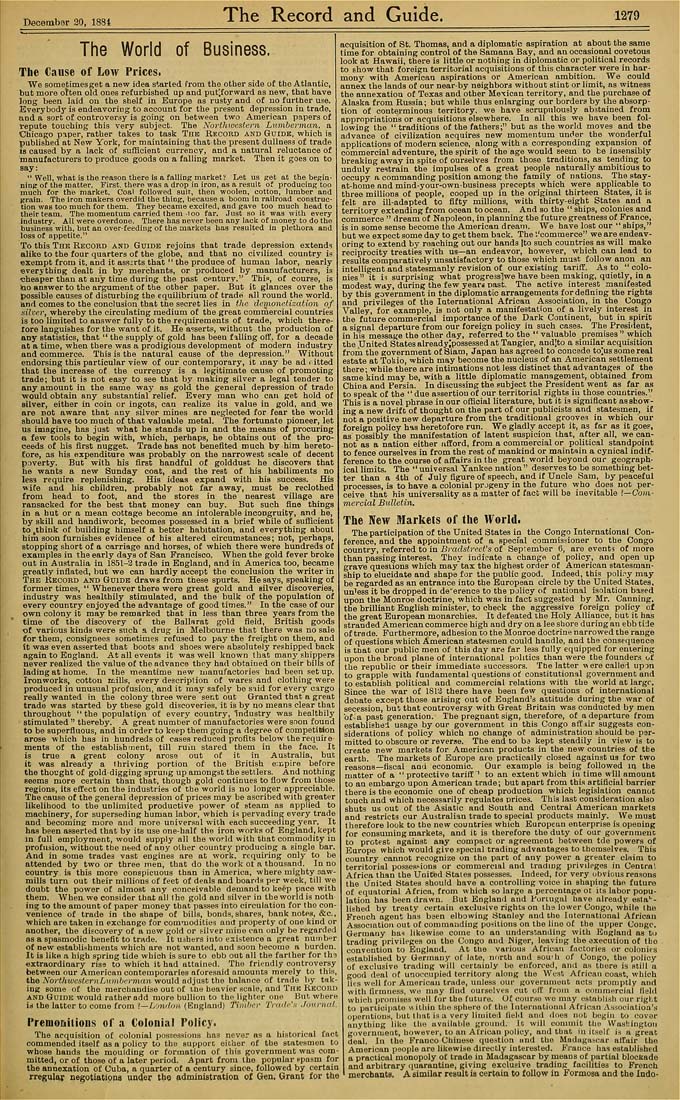
iecembar 30, 1884 The Record and Guide. 1279 The World of Business. The Cause of Low Prices. We sometimesget a new idea started from the other side of tbo Atlantic, but more otten old ones refurbished up and put^forward as new, that have long been laid on the shelf in Europe as rusty and of no further use. Everybody is endeavoring to account for the present depression in trade, and a sort of controversy is going on between two American papers of repute touching this very subject. The Northwestern Lmnberman. a Chicago paper, rather takes to task Toe Record and Guide, whicb is published at New York, for maintaining that the present dullness of trade ie caused by a lack of sufficient currency, and a natural reluctance of manufacturers to produce goods on a falling raarket. Then it goes on to say: " Well, what is the reason ihere is a. falling market? Let ns get at the begin- nine of the matter. First, there was a drop in iron, as a result of producing too much for the market. Coal followed suit, then woolen, cotton, lumber and grain. The iron makers overdid the thing, because a boom in railroad construc¬ tion was too much for them. They became excited, and gave too much head lo their team. The momentum carried them loo far. Just so it was with every Industry. All were overdone. There has never been any lack of money to do the business with, but an over-feeding of the markets has resulted iu plethora and loss of appetite." To this The Record and Guide rejoins that trade depression extends alike to the four quarters of tbe globe, and that no civilized country is exempt from it, and it assorts that " the produce of human labor, nearly everything dealt iu by merchants, or produced by manufacturers, is cheaper thau at auy time during the past century." This, of course, is too answer to the argument of the other paper. But it glances over the possible causes of disturbing tbe equilibrium of trade all round the world, and comes to the conclusion that the secret lies in the demonetization of silver, whereby tbe circulating medium of tbe great commercial countries is too limited to answer fully to the requirements of trade, whicb there¬ fore languishes for the want of it. He asserts, without tho production of any statistics, that " the supply of gold has been falling off, for a decade at a time, when there was a prodigious development of modern industry and commerce. This is the natural cause of the depression." Without endorsing this particular view of our contemporary, it raay be ad ritted that the increase of the currency is a legitimate cause of promoting trade; but it is not easy to see that by making silver a legal tender to any amount in the same way as gold the general depression of trade would obtain any substantial relief, Every raan who can get hold of silver, eitber in coin or ingots, can realize ils value in gold, and we are rot aware that any silver mines are neglected for fear the world should have too ranch of that valuable raetal. The fortunate pioneer, let us imagine, has just what he stands up iu and the means of procuring a few tools to begin with, which, perhaps, he obtains out of the pro¬ ceeds of his first nugget. Trade has not beneflted much by him hereto¬ fore, as his expenditure was probably on the narrowest scale of decent poverty. But with his first handful of golddust he discovers that he wants a new Sunday coat, and the rest of his habiliments no less require replenishing. His ideas expand with his success. His wife and his children, probably not far away, must be reclothed from head to foot, and the stores in the nearest viUage are ransacked for the best that money ean buy. But such fine things in a hut or a mean cottage become an intolerable incongruity, and he, by skill and handiwork, becomes possessed in a brief wbile of sufficient to,thiuk of building himself a better habitation, and everything about him soon furnishes evidence of his altered circumstances; not, perhaps, stopping short of a carriage aud horses, of which there were hundreds of examples iu the early days of San Franciaco. When tbe gold fever broke ont iu Australia in 1851-2 trade in England, and in America too, became greatly inflated, hut we cau hardly accept the conclusion the writer in The Record and Guide draws from these spurts. He says, speaking of former times, " Whenever there ^vere great gold and silver discoveries, industry was healthily stimulated, and the bulk of the population of every country enjoyed the advantage of good times." In the case of our own colony it may be remarked that in less than tbree years from the time of tbe discovery of the Ballarat gold field, British goods of various kiuds were such a drug in Melbourne tbat there was no sale for them, consignees sometimes refused to pay the freight on tbem, and it was even asserted that boots and shoes were absolutely reshipped back again to England, At all events it was well known that many shippers never realized the value of tbe advance thoy had obtained on their bills of lading at bome. In the meantime new manufactories had been setup. Ironworks, cotton rcills, every description of wares and clothing were produced in unusual profusion, and it may safely be siid for every cargo really wanted in the colony three were sent out Granted that a great trade was started by these gold discoveries, it is by no means clear that throughout " the population of every country, Industry was healthily stimulated " thereby. A great number of manufactories were soon found to be superfluous, and in order to keep them going a degree of competition arose which has in hundreds of cases reduced profits below the require¬ ments of the establish rnent, till ruin stared thera in the face. It is true a great colony arose out of it in Australia, but it was already a thriving portion of tbe British e;npire before tbe thought of gold-digging sprung up amongst tbe settlers. And nothing seems more certain than that, though gold continues to flow from those regions, its effect on tbe industries of the world is uo longer appreciable. The cause of the general depression of prices may be ascribed with greater likelihood to the unlimited productive power of steam as applied to machinery, for superseding human labor, which is pervading every trade and becoming more and more universal with each succeeding year. It bas been asserted tbat by its use one-balf the iron worhs of England, kept in full employment, would supply all the wo.'-ld with that commodity iu profusion, without tbe need of any olher country producing a single bar. And in some trades vast engines are at work, requiring only to be attended by two or three men, that do the work ot a thousand. In no country is this more conspicuous than in America, where mighty oaw- mills turn out their millions of feet of deals and boards per week, till we doubt the power of almost any conceivable demand to keep pace witb them. Wben we consider that all the gold and silver in tbe world is noth¬ ing to tbe amount of paper money tbat passes into circulation for Iho con¬ venience of trade in tbe shape of bills, bonds, shares, bank notes, &c., wbich are taken in exchange for com-uodities aud properly of one kind or another, the discovery of a uew gold or tilver niioe can only be regarded ns a spasmodic benefit to trade. It ushers into existence a great nutiib''r of now establishments whicb are not wanted, and soon become a burden. It is like a high spring tide which is sure to obb out all tbe farther for ths extraordinary rise to which it had attained. The friendly controversy between our American contemporaries aforesaid amounts merely to this, the iVoi-(/iwe,steriiLitjn()p»'mcm would adjust the balance of trade by tnk- ing some of the merchandise out of ihe heavier scale, and The Record AND Guide would rather add more bullion to thp lighter one Hut where is the latter to come from 'i.—Lomlon (England) Timber Trade'x .fournal. I'remoihilious of a Colonial Policy. The acquisition of colonial possessions has never as a historical fact commended itself as a policy to the support either of tbe statesmen to whose bauds tbe moulding or formation of this government was com¬ mitted, or of those of a later period. Apart from the popular spasm for the annexation of Cuba, a quarter ol a century since, followed by certain rregular negotiation under the adminifltratioa ot Gen. Grant for the acquisition of St. Thomas, and a diplomatic aspiration at about the same time for obtaining control of the Samana Bay, and an occasional covetous look at Hawaii, there is little or nothing in diplomatic or political records to show that foreign territorial acquisitions of tbis character were in har¬ mony with American aspirations or American ambition. We could annex tbe lands of our near-by neighbors without stint or limit, as witness the annexation of Texas and other Me-^ican territory, and the purchase of Alaska from Russia; but while thus enlarging our borders by tbe absorp¬ tion of conterminous territory, we have scrupulously abstained from appropriations or acquisitions elsewhere. In all this we have been fol¬ lowing the "traditions of tbe fathers;" but as theworld moves and tbe advance of civilization acquires new momentum under tbe wonderful applications of modern science, along with n corresponding expansion of commercial adventure, tbe spirit of the age would seem to be insensibly breakiug away in spite of ourselves from those traditions, as tending to unduly restrain tbe impulses of a great people naturally ambitious to occupy a commanding position among the family of nations. The stay- at-home and mind-your-own-business precepts which were applicable to three millions of people, cooped up in the original thirteen States, itis felt are ill-adapted to fifty millions, with thirty-eight States and a territory extending from ocean to ocean. And so the " ships, colonies and commerce "dream of Napoleon, in planning the future greatness of France, is in some sense become the Americau dream. We have lost our " ships," but we expect some day to get them back. The i'eomraerce" we are endeav¬ oring to extend by rraaching out our hands |to sucb countries as will make reciprocity treaties with us—au endeavor, however, wbich can lead to results comparatively unsatisfactory to those which must follow anon an intelligent and statesmanly revision of our existing tariff. As to "colo¬ nies" it ii surprising what progresslwe bave been making, quietly, in a modest way, during the few years past. The active interest manifested by this government in the diplomatic arrangements for defining tbe rigbts and privileges of the International African Association, in the Congo Valley, for example, is not only a manifestation of a lively interest in the future commercial importance of the Dark Continent, but in spirit a signal departure from our foreign policy in such cases. The Presiilent, in his message the other day, referred to tbe " valuable premises " which the United States alreadyjpossessed at Tangier, andlto a similar acquisition from the government of Siam, Japan has agreed to concede to^us some real estate at Tobio, which may become tbe nucleus of an Americau settlement there; wbile there are intimations not leas distinct that advantages of the same kind may be, with a little diplomatic management, obtained from China and Persia. In diacussing the subject the President went as far as to speak of the " due assertion of our territorial rights iu those countries." This is a novel phrase in our official literature, but it ia significant as show¬ ing a new drift of thought on tbe part of our publicists and statesmen, if not a positive new departure from the traditional grooves in which our foreign policy has heretofore run. We gladly accept it, as far as it goes, as possibly the manifestation of latent suspicion that, after all, we can¬ not as a nation either afford, from a commercial or political standpoint to fence ourselves in from tbe rest of mankind or maintain a cynical indif¬ ference to the course of affairs in the great world beyond our geograph¬ ical limits. The " universal Yankee nation " deserves to be something bet¬ ter than a 4th of July flgure of speech, and il Uncle Sam, by peaceful processes, is to have a colonial prjgeny in tho future wbo does not per¬ ceive that his universality as a matter of fact will be inevitable S—Co/ii- mercial Bulletin. The New Markets of the World. Theparticipation of the United States in tbe Congo International Con¬ ference, and the appointment of a special commissioner to the Congo country, referred to in iJrarfsfrecCs of September (5, are events of more than passing interest. They indicate a change of policy, and open up grave queaiions which may'tax the highest order of American statesman¬ ship to elucidate aud shape for the public good. Indeed, this poli.-y may be regarded as an entrance into the European circle by the United Statea, unless it be dropped in de"erencs to the pjiicy of national isolation baaed upon tbe Monroe doctrine, which was in fact suggested by Mr. Canning, tbe brilliant English minister, to check the aggressive foreign policy of the great European monarchies. It defeated the Holy Alliance, but it has stranded Auierican commerce high and dry ona lee shore during an ebbtide of trade. Furthermore, adhesion to the Monroe doctrine narrowed the range of questions wbich American statesmen could handle, and the consequence is that our public men of this day are far less fully equipped for eniering upon the broad plane of international politics tban were the founders of the republic or their immediate successors. The latter were called up^u to grapple witb fundamental questions of constitutional government and to establish political and commercial relations with the world at largr. Since tbe war of 1S12 there have been few questions of international debate except those arising out of England's attitude during the war of secession, but that controversy with Great Britain was conducted by men of a past generation, Tbe pregnant sign, therefore, of a departure from established usage by our government in this Congo affair suggests con¬ siderations of policy which no change of administration should be per¬ mitted to obscure or reverse. The end to ba kept steadily in view is to create new markets for American products in the new countries of the earth. The markets of Europe are practically closed against ua for two reasons—fiscal aod economic. Our example is being followed in the matter of a "protective tariff ' to an extent which in time will amount to an embargo upon American trade; but apart from this artificial barrier there is tbe economic one of cheap production wbich legislation cannot touch and which necessarily regulates prices. This last consideration also shuts us out of the Asiatic and South and Central American markets and restricts our Australian trade to special products mainly. We must therefore look to tbe new countries wbich European enterprise is opening for consuming markets, and it is therefore the duty of our governmenc to protest against any compact or agreement between tda powers of Europe which would give special trading advantages to themselves. This country cannot recognize on the part ot any power a greater clnim to territorial possessions or commercial and trading privileges in Central Africa than tbe United Stales possesses. Indeed, tor very obvious reasons the Jnited States should have a controlling voice in shaping the futuro of equatorial Africa, from wbich so large a percentage ot its labor popu¬ lation has been drawa. But England and Portugal have already esta*-- lished by treaty certain exclusive rights on tha lower Cougo, while lhe French agent has been elbowing Stanley and tbe International African Association out of commanding pO'^itions on the lino of the upper Cougc. Germany ha-i likewise come to an understanding with Etigland as tit trading privileges on the Congo and Niger, leaving the execution of tho convention to Englaud. At the various Afrbaii fucLories or colonies established by Germany of late, north and souih of Congo, the policy of exclusive trading will certaiuly lie enforced, and as there is still a good deal of unoccupied territory along the West African coast, whicb lies well for American trade, unless our goverumuut acts promptly and with iiriuuess, wu may tlnd ourselves cut off from a commercial field which promiaes well for the future. Of conr.se wo may establish our right to parlicijiate w itliin tbo sphere of the International African Association's operations, but Ihat is a very limited lield and does nut begin to cover anythiug like tho uvailuble groiuid. It will commit the Wasbington giivernuient, however, lo au African policy, and that in itself is a great deal. In the Franco Chinese question and the Madagascar affair tbe American people are likewiae directly interested. France has established a practical monopoly of trade in Madagascar by naeans of partial blockade and arbitrary quarantine, giving exclueive trading facilities to French ' mercbants, A eimilar result is certain to follow in Formosa and tbe indo-