
Columbia University Libraries Digital Collections: The Real Estate Record
Use your browser's Print function to print these pages.
Real estate record and builders' guide: v. 34, no. 875: December 20, 1884
Text version:
Please note: this text may be incomplete. For more information about this OCR, view About OCR text.
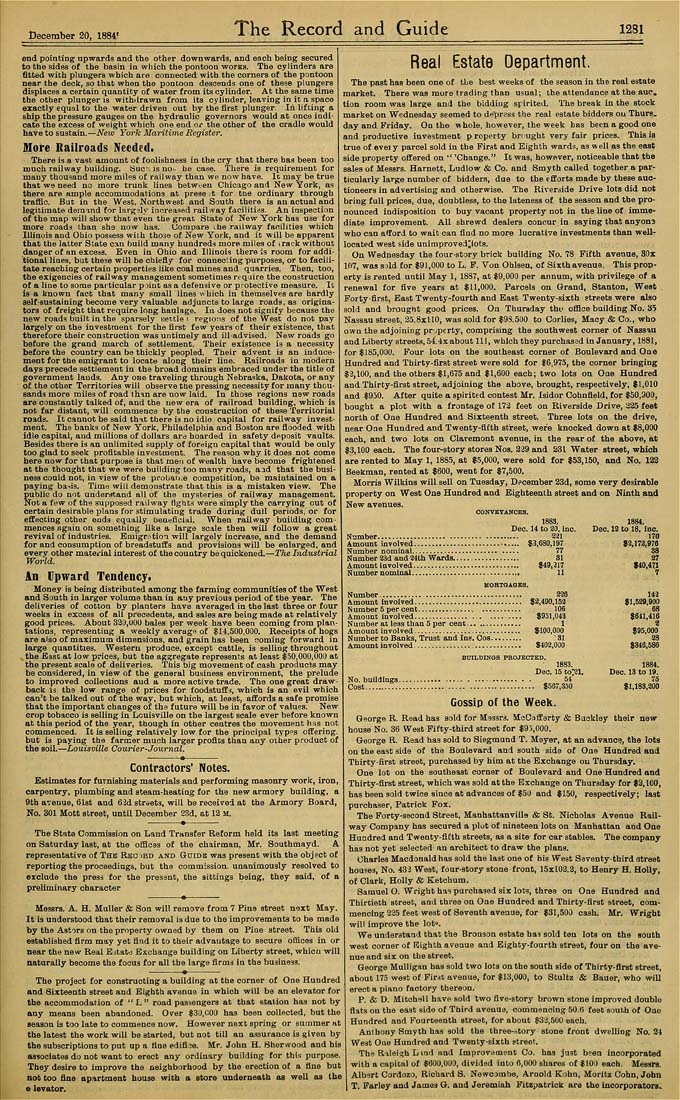
December 20, 1884' The Record and Guide 1281 end pointing upwards and the other downwards, and each being secured to the sides of the basin in which tbe pontoon worKs, The cylinders are fitted with plungers whicb are connected with the corners of the pontoon near the deck, so that when the pontoon descends one ot those plungers displaces a certain quantity of water from its cylinder. At the same time the other plunger is withdrawn from its cylinder, leaving in it a space exactly equal to tbe water driven out by the flrst plunger. In lifting a ship the pressure gauges on the hydraulic governors would at once indi¬ cate the excess of weight which one end or the other of the cradle would have to sustain.—.Welti York Maritime Register, More Railroads Needed. There is a vast amount ol foolishness in the cry that there haa been too much railway bnilding. SuCiisnoi. he case. There is requirement for mauy thousand more miles of railway than we now have. It may be true that wo need no more trunk lines betwoea Chicago and New York, as tbere are ample accomoiodations at prese >t for the ordinary through traffic. But in the West, Northwest and South tbere is an actual and legitimate deramd for largely increased railway facilities. An inspection of the map will sbow that even the great State of New York has use lor more roads tban she now bas. Compare iho railway faeilities which Illinois and Ohio possess wilh those of New York, aud it will be apparent tbat the latter State can build many hundreds more miles of • rack without danger of an excess. Even in Ohio and Illinois tbere is room for oddi- 'tional lines, but these will be chiefly for connecting purposes, or to facili¬ tate reaching certain properties like coal mines aud quarries. Then, too, tbe exigencies of railway management sometimes require tbe construction ot a tine to some particular priint as a defensive or protective measure. Ii> is a known fact that many small lines which in themselves are hardly sell-sustaining become very valuable adjuncts to large roads, as origina¬ tors of freight that require long haulage. In does not signify because the new roads built in tho sparsely uettle i regions of the West do not pay largely on the investment for the first few years of their existence, that therefore their construction was untimely and ill-advised. Now roads go before tbe grand march of settlement. Their existence is a necessity before the country can be thickly peopled. Their advent is an induce¬ ment for tbe emigrant to locatti along their line. Railroads in modern days precede settlement in the broad domains embraced under the title of government lauds. Any one traveling through Nebraska, Dakota, or any of the other Territories will observe the pressing necessity for many thou¬ sands more miles of road thin are now laid. In those regions new roads are constantly talked ol, and the uew era of railroad building, which is not far distant, will commence by the construction of these Territorial roads. It cannot be said tbit there is no idle capital for railway invest¬ ment. Tbe bauks of Now York, Philadelphia and Boston are flooded with idle capital, and millions of dollars are boarded iu safety deposit vaults. Besides there is an unlimited supply of foreign capital that would be ouiy too glad to seek profitable investment. The reason why it does not come here now for that purpose is that mea of wealth bave become frightened at tbe thought that we were building too mauy roads, aad that tbe busi¬ ness could not, in view of the probaii.e competition, be maintained on a paying ba^is. Tim» will demonstrate that this is a mistaken view. The public do not understand all of the mysteries of railway management. Not a few of tha supposed railway flgbts were simply the carrying out of certain desirable plans for stimulating trade during dull periods, or for effecting other ends equally beuoficial. Whea railway buildiug com¬ mences again on something like a large scale tben will follow a great revival of industries. Emigre tion will largely increase, and the demand for and consumption of breadstuffs and provisions will be enlarged, and every other material interest of the country be quickened.—The Industrial World, An Upward Tendency. Money is being distributed among the farming communities of the West and South in larger volume than in auy previous period of the year. Tho deliveries of cotton by planters have averaged in tbe last three or four weeks in excess of all precedents, and sates are being made at relatively good prices. About 330,000 bales per week have been coming from plan¬ tations, representing a weekly average of $14,500,000. Receipts of hogs are also of maximum dimensions, aad grain bas been coming forward in large quantities. Westeru produce, except cattle, is selling throughout the East at low prices, but tbe aggregate represents at least $50,000,OOJ at the present scale of deliveries. This big movemeat of cash products may be considered, in view of the general business environment, the prelude to improved collections aud a more active trade. The one great draw¬ back is the low range of prices for foodstuffs, which is an evil which can't be talked out of the way, but which, at least, affords a safe promise that the important changes of tha future will be ia favor of values. New crop tobacco ia seliing in Louisville on the largest scale ever before known at this period of the year, though iu other centres the movement h'ls not commenced. It is selling relatively low for the principal types offering, but is paying the farmer much larger profits thau any other product of the soiL—Louisville Courier-Journal. Contractors' Notes. Estimates for furnishing materials and performing masonry work, iron, carpentry, plumbing and steam-heating for the new armory building, a 9tb aveuue, 61st and eMstroeta, will be received at the Armory Board, No. 301 Mott street, until December 23d, at IS M. Real Estate Department. The past has been one of the best weeks of tbe season in the real estate market. There was more trading than usual; the attendance at the aue. tion room was large and the bidding spirited. The break in the atock market on Wednesday seemed to de'pnjss the real estate bidders ou Thurs. day and Friday. On tbe whole, however, the week has been a good one and productive investment property brnugbt very fair prices, This is true of evei y parcel sold in the First and Eighth wards, as n ell as the east side property offered on " 'Change." It was, however, noticeable that tbe sales of Messrs. Harnett, Ludlow & Co, and Smyth called together a par¬ ticularly large number of bidders, due to the efforts made by these auc¬ tioneers in advertising and otherwise. The Riverside Drive lots did not bring full prices, due, doubtless, to tbe lateness of tbe aeason and the pro¬ nounced indisposition to buy vacant property not ia tbe line of imme¬ diate improvement. All shrewd dealers concur in saying that anyons who can aTord to wait can fiad no more lucrative investments than well- located west side unimproved^lots. Ou Wednesday tbe four-story brick building No. 78 Fifth avenue, SOx 107, was Slid for $91,000 to L. P. Von Ohlsen. of Sixthavenue, This prop¬ erty is rented until May 1, 1887, at $9,000 per annum, with privilege of a renewal for flve years at $11,000. Parcels on Grand, Stanton, Weat , Forty-flrst, East Twenty-fourth and East Twenty-sixth streets were also sold and brought good prices. On Thursday thy offlce building No. 35 Nassau street, 35.8x110, was sold for $93,500 to Corlies, Macy & Co., who own the adjoining prjpsrty, comprising the southwest corner of Nassau and Liberty streets, 54.4x about 111, wbich they purchased in January, 1881, for $185,000. Four lots on the southeast corner of Boulevard and One Hundred and Thirty-flrst street were sold for $6,975, the corner bringing $3,100, and the others $1,675 and $1,600 each; two lots ou One Hundred aad Thirty-first street, adjoining the above, brougbt, respectively, $1,010 and $950. After quite a spirited contest Mr. Isidor Cohnfield, for $50,900, bought a plot with a frontage of 173 feet oa Riverside Drive, 325 feet north of Oae Hundred and Sixteenth street. Three lots oa the drive, near One Hundred and Twenty-flfth street, were knocked down at $8,000 each, and two lots on Claremont avenue, in the rear of the above, at $3,100 each. The four-story stores Nos. 329 and S3l Water street, which are rented to May 1, 1885, at $5,000, were sold for $53,150, and No. 123 Beetman, rented at $600, went for $7,500. Morris Wilkina will sell on Tuesday, Dpcember 23d, some very desirable property on West One Hundred and Eighteenth street and on Ninth and New avenues. CONVKTANCES. The State Commission on Land Transfer Reform held its last meeting on Saturday laat, at tb© offices of tbe chairman, Mr. Southmayd. A representative of The Rec ied and GnroB was present with the object of reporting the proceedings, but tha commission, unanimously resolved to exclude the press for the present, the sittings being, tbey said, of a preliminary character ---------•--------- Messrs. A. H. Muller Sc Son will remove from 7 Pine street next May, It is understood that their removal is due to the improvements to be made by the Aatirs on theproperty owned by them on Piue street. Thia old established firm may yet find it to their advautage to secure offices in or near tbe new Real Eitato Eiccbange building on Liberty street, which will naturally become the focus for all tbe large firms in the business. 1883. Dec. 14 to 20. inc. Niimber...................................... 331 Amount iavolved.............................. $3,680,197 Number nominal............................. 77 Number 33d and 34th Wards................... 31 Amount Involved.............................. $49,3i7 Number nominal............................... 11 MOBTOAans. Number............ ........................... 228 Amount Involved.............................. $2,400,152 Numbers percent. Amount involved................ . . Number at less than 5 per cent....... Amount involved...................... Number to Banks, Trust and Ins. Cos. Amount involved..................... 106 $931,043 1 $100,000 •31 $103,000 1884. Dec. 12 to 18, inc. 170 $3,172,978 3S 27 $40,471 7 142 $1,520,900 68 $641,413 3 $95,000 23 $343,586 1884. Dec. 13 to 19. 75 $1,183,200 The project for constructing a building at the corner of One Hundred and Sixteenth street and Eighth avenue ia which will be an elevator for the accommodation of " L" road passengera at that station has not by any means baen abandoned. Over $30,000 has been collected, but the season is too late to commence now. However next spring or summer at the latest the work will ba started, but not till an assurance is given by the subscriptions to put up a fine edifi;©. Mr. Jobn H. Sherwood and bis associates do not waat to erect aoy ordiaary building for this purpose. They desire to improve the neighborhood by the erection of a fine but not too fine ap.artment house with a store underneath as well as the e levator. BUILDINOS PROJECTED. 1883. Dec. 15 to:21. No. buildings................................ 54 Cost.............................................. $567,350 Gossip of the Week. George R. Read bas sold for Messrs, McCafferty & Buckley their new house No. 36 West Fifty-third street for $95,000, George R, Read bas sold to Siegmund T. Meyer, at an advance, the lots ou the east side of the Boulevard and south side of One Huadred aud Thirty-first street, purchased by him at the Exchange ou Thursday. One lot on the southeast corner of Boulevard and One Huodred and Thirty-first street, which was sold at the Exchange on Thursday for $3, ICO, has been sold twice aince at advances of $50 and $150, respectively; last purchaser, Patrick Fox. The Forty-second Street, Maahattanvitla Sc Sfc. Nicholas Avenue Rail¬ way Company has secured a plot of nineteen lots on Maahattaa and One Hundred and Twenty-fifth streets, as a site for car stables, Tbe company has not yet selected au architect to draw the plans. Charles Macdonald has sold tho last one of his West Seventy-third street houses. No. 432 West, four-story stone front, 15x103.3, to Henry H. Holly, of Clark, Holly Sc Ketchum, Samuel 0. Wright has purchased six lots, three on One Hundred and Thirtieth street, and three on One Huadred and Thirty-first street, com¬ mencing 225 feet west of Seventh avenue, for $31,500 cash, Mr. Wright will improve the iot=. We understand tbat the Bronson estate bas sold teu lots on the south west corner of Rightb avenue and Eighty-fourth atraet, four on the ave¬ nue ond six oa the street. George Mulligan has sold two lots on the south side of Thirty-flrst street, about 175 west of Firnt aveoue, for $13,000, to Stultz & Bauer, who will erect a piano factory thereon. P. Sc D. Mitchell have sold two five-story brown stone Improved double flats ou the east side of Third aveuue, commencing ."iO.B feet south of One Hundred and Fourteenth street, for about $3'i,500 each. Anthony Smyth has sold the three-.story atone front dwelling No. 34 West Oue Hundred and Twenty-sixth street, Tbe Rileigb Liud and Improvement Co. bas just b;ea incorporated with a capita! of $600,000, divided into 6,000 shares of $100 each, Messrs, Albert Cordozo, Ricbard S. Newcombe, Arnold Kohn, Moritz Cohn, John T. Farley and James G. aad Jeremiah Fitzpatrick are tho incorporators.