
Columbia University Libraries Digital Collections: The Real Estate Record
Use your browser's Print function to print these pages.
Real estate record and builders' guide: v. 34, no. 876: December 27, 1884
Text version:
Please note: this text may be incomplete. For more information about this OCR, view About OCR text.
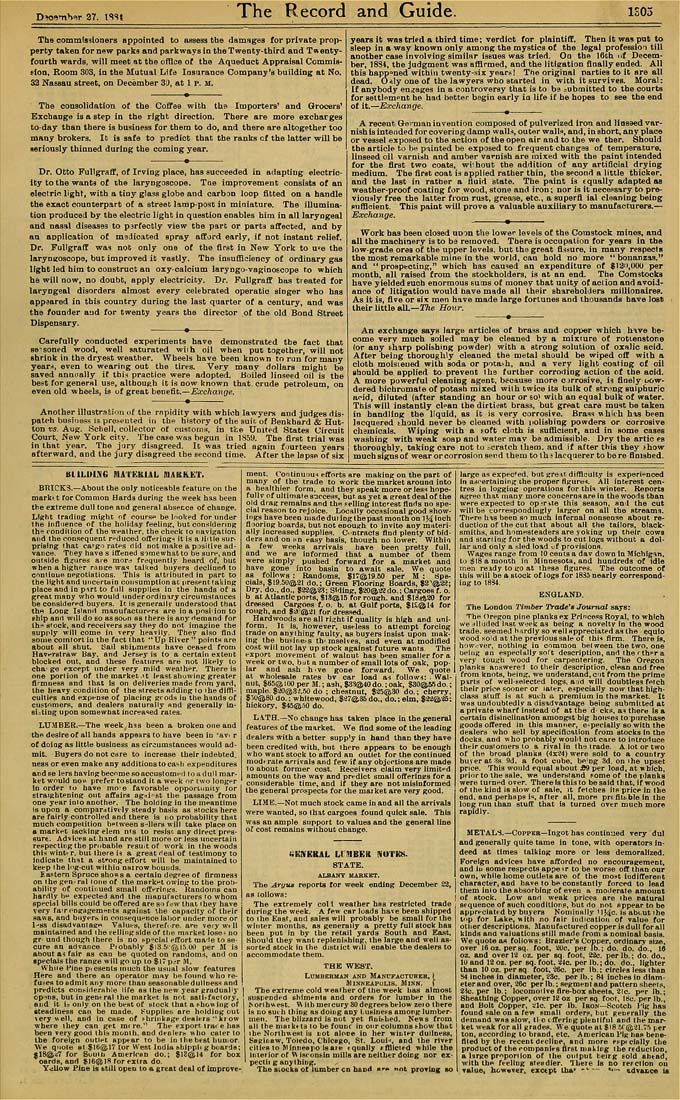
DTO9mb=ir 37. I'^^l The Record and Guide. 1S05 The commissioners appointed to assess the damages for private prop- perty taken for new parks and parkwavs in the Twenty-third and Tnenty- fourth wards, wilt meet at the oflice of the Aqueduct Appraisal Ccmmls- slon. Room 303, iu the Mutual Life Insurance Company's building at No. 32 Nassau street, on December 3l), at 1 p. m. The consolidation of the Coffee with the Importers' and Grocers' Exchange is a step in the rigbt direction. There are more excbarges to-day than there is busiaess for them to do, and there are altogether too many brokers. Ib is safe to predict that the ranks cf the latter will be iieriously thinned during the coming year. Dr. Otto Fullgraff, of Irving place, has succeeded in adapting electric¬ ity to the wants of Che laryngoscope. Toe improvement consists ot an electric light, with a tiny glass globe and carbon loop fitted on a handle tbe exact counterpart of a street lamppost in miniature. The illumina¬ tion produced by the electric light in question enables bim in ail laryngeal and nasal diseases to perfectly view the part or parts affected, aud by an application of msiicated spray afford early, if not instant relief. Dr. Fullgraff was not only one of the first in New York to u^e the laryngoscope, but improved it vastly. The insufficiency of ordinary gas light led bim to construct an oiycalcium laryngo-vaginoscope to which he will now, no doubt, apply electricity. Dr, Fullgraff has treated for laryngeal disorders almost every celebrated operatic singer who has appaared in tbis country during the last quarter of a century, and was the founder aud for twenty years tbe director of the old Bond Street Dispensary. --------_»----_---- Carefully conducted experiments have demonstrated the fact tbat se'soned wood, well saturated wiih oil when put together, will not shrink in the dryest weather. Wheels have been known to run for many years, even to wearing out tbe tires. Very many dollars might be saved annually if tbis practice were adopted. Boiled linseed oii is the best for general use, altboueh it is now known that crude petroleum, on even old wheels, is of great benefit.—£'a:c A colore. Another illustratiou of the rnpidity with which lawyers and judges dis¬ patch business is pres-ented iu tbe history of tbe suir, of Benkhard & But¬ ton vs Aug. Schell, collector ot customs, in tte United States Circuit Court, New York city. The case was begun in 1859. The first trial was in that year. The jury disagreed. It was tried again f lurteen years afterward, and the jury disagreed tbe second time. After the lapse of six years it was tried a third time; verdict for plaintiff. Then it was put to sleep in a way known only among the mystics of the legal profession till another case involving similar issues was tried. On the 16tb i.t Decem¬ ber, ISSl, tbe judgment was affirmed, and tbe litigation finally ended. All this happ''ned witbiu twenty-sis years! The original parties to it are alt dead. (jAlyonaof tbe lawyers who started in with it survives. Moral: If anybody engages in a controversy that is to be submitted to the courts for settlement be had better begin early ia life if he hopes to see the end of it.—Exchange. A recent German invention composed of pulverized iron and linseed var¬ nish is intended for covering damp walls, outer walls, and, in short, any place or veasel exposed to the action of tbe open air and to tbe we ther. Should the article to be piinted be exposed to frequent charges of temperature, linseed oil varnish and amber vavoish are mixed with the paint intended for the first two coats, wiihout tbe addition of any artlGcial drying medium. The first coat is applied rather thin, tbe second a little thicker, and the last in ratber a Huid state. The paint is tqually adapted as weather-proof coating for wood, stone and iron; nor is it necessary to pre¬ viously free the latter from rust, grease, etc., a superfi iaI cleaning being pufBcient. This paint will prove a valuable auxiliary to manufacturers.— Exchange. Work has been closed ud'>q the lower levels of the Comstock mines, and all tbe machinery is to ba removed. There is occupation for years in the low-grade ores of the upper levels, but the great fissure, in many respects the most remarkable mine in the world, can bold no more "bonanzas." and "prospecting," which has caused an expenditure of $12i>,000 per month, all raised from the stockholders, is at an end. The Comstocks have yielded such enormous sums of money tbat unity of action and avoid¬ ance of litigation would have made all their shareholders millionaires. As It is, five or six men have made large fortunes and thousands have losfi their little oiL—The Hour. An exchange says large articles of brass and copper which hive be¬ come very much soiled may be cleaned by a mixture ot rottenstona (or any (harp polishing powder) with a strong solution of oxalic acid. After being thoroughly cleaned the metal should be wiped off with a cloth molsieued with soda or potash, and a very light coaling of oil should be applied to prevent Ibe further corroding action of tbe aold. A more powerful cleaning agent, because more orrosive, is finely uow- dered bichromate of potash mixed wilh twice its bulk of strong sulphuric ai'id, diluted (after standing au bourorso> wiih an equal bulk of water. This will instantly cioan the dirtiest brass, but great cara must be taken in handling the liquid, as it is very corrosive. Brasi which has been lacquered tbould never be cleaned witb iiolisbing powders or corrosive chsmicats. Wiping with a soft clnth is sufficient, and in some cases washing with weak soap and water may be admissible. Dry tbe artices thoroughly, taking care not to scratch them, and it after this they thow much signs of wear or corrosion send tbem tolhslacquerertobere finished. ULILUUG fllA'tKKUL SIAUKET. BRICKS.—About the only noticeable feature on lhe marktt for Common Bards during the week has been the extreme dull tone and general absence of change. Light trading might nf ooursp be inoked for under the iriflcience of the holiday feeling, but considering lh« condiiion of the weather, the cheek to navigation and the consequent, reduced offeriogi it is a liitle sur¬ prising that cafg'j ratfs did rot make a pi5sitive ad¬ vance. They have s ifEened somewliatlo be surp, and outside figures are mora fraquenlly heard of. but Tctaen a higher ranee waa talked buyers decliae'l Co cr>ntiuue negotiations. This is attrihuted in part to Ibe light and unccrtttia consumption at [>resi>ntFaliing place and in pirt to full supplies in tbe hands of a great many who would under ordinary circumstances be considered buyers. It is general! p understood that the Long Island manufactnrTs are ina pnsMon to ship and wdl do so as soun as there is any neaiand for (h^ s'ocb, and receivers say tlify do not imagine tbe Btipi'ly will come in very heavily. They also flnJ some comiorlia the fact that "Up River" polnti are about oil shut. tJail sbipmenis have ceased from Havt-rslraw Uay. and Jersey is to a certain evtetit blocited o^tt, and Ihese features are not iikely lo cba'ge except under very mild weather. There is one portion of the market .'I least shuwing greater flrtncess and th&t Is on deliveries made frnm yard, lhe heavy condiiion of the streets adding lo the diffl' cuities and expense of placing grods in the hands of custnmers. and dealers naturally nnd generally in¬ sisting upon somewuat incr^a'ied rales. LUMBER.—The week, has been a broken one and thedesireoEall hands appearslo have been in 'avi r of doing as little busiaess as circumstances would ad¬ mit. Buyers do not cure to increase their iadebted. ness or even make any additions to casb expenditures andee lers having becfimeao accustomed to a dnll mar¬ ket would now prefer tosland it a week nr two longer In order to have mo'e favorable opportunity ror Etraightening out affairs agii"st the passage from one year inio another. The holding in the meantime iaupon a comparatively steady basis as stocks here are fairly controlled and there is no probability thst mucli compeiition between s-llers will take place on amarket lacking elem n's to resist any direct pres¬ sure. Advices iit hand are still more or less uncertain reppectiDg tbe probable resmt of work in lhe woods lhl^* wint- r. but there U b. great f'eal of testimony to IndiuaCe that a at''ongefforE will be maintained tu keep the Ing-cut withio nmrow houncls. Eastcn Spruce stions a certain degree of firmness on the geni-ral tone of the market owing to the proti- ftbility ot continued small offerings. Kandoms can hardly tl" expected and the niannfacturers to whom epfciul bills could be offered are an few thai they have very fE'rengagemeiits against ibe capacily o'f Iheir saws, and buyt-rb in consequence lalior under more or 1-SS disadvaniag« Values, tberefi.re. are very will maintained and ibe celling side of the market lose-; no gr'uod though Ibere is no speciHl effort made to se¬ cure an advance. Probably ti3.5i'@15.0() per M is about 8^ fair as can be quoted on randoms, and on Specials the range will go up loSlTp^r M, While fine picsenta much the usual slow features Here and there an operator ma.y be found u lio re¬ fuses to admit any more than seasonable dullnes.s and predicts (!on^iderfihle life as the new year gradualiy cpins, but in general the market Is not saii.-fHctory, and it 1? only on the best of stock tbat a tliou Ing of steadiness can be made. Supplies are holding out very Hell, and in case of i-hrhiliage dealers "Ikow where tbey can gel mire." The export irai e lias been very good tbb munlh. and dealern v, ho cater to lhe foreign outlet appear lo be in tlie b«st liuuior "We quote at SIti®lT (Or West India hbl)>pli g bbards; {]S(Stt7 for Suuiii Anierlcen do.; $13i^l4 for box oarda, and $16®1S for extra do. Y.;llow Fine is btill open lo a great deal of Improve¬ ment, Corjtinuou'i efforts are making on the part of many of tbe trade to work the market arouna into a healthier form, and tbey speak more or lesi hope- full v of ultimate success, biitasyeiaereatdealof the old drag remains and tht^ ^^eiling intoreat finds no spe¬ cial reason to rejoice. Locally occasional good show¬ ings have been made dutiogthepast month on l!4 loch fl'»oring boards, but not eoough to invite any materi¬ ally increased suppliea. C^>ntracts flnd plenty of bid¬ ders aod on Hn easy basis, thoush no lower. 'Withi'i a few weeks arrivals bave been pretty full. and we are Informed that a number of them were simply pushed forward for a market and have gone into basin to await sale. We quote as follows ; Randoms, 8ir@I9.B0 per M ; Spe¬ cials, 8i9.50©ai do.; Green Flooring Boards, Z2'&2ii; Dry. do., do.. Sa-JiaaS; Siding, iao^-iUdo.: Cargoes f. o. b at Allantic ports, S18@15 for rough, and $ld(ft20 for drefised Cargoes f.o. b. at Gulf ports, $li@14 for rough, and ga'fii^l for dressed. Hardwoods are all ri^ht if quality is high and uni¬ form. It Is. however, useless to attempt forcing trade on anything faulty, as buyers insist upon mak¬ ing the bnsine.'-s themselves, and even at modified cost will not lay up stock against future wants The export movement of walnut has been smaller for a week or two. bjt a number of small lots of oak, pop¬ lar and ash h 've gone forward. We quote ai wholesale rates bv car load a-i follows: . Wal¬ nut. $ti5@i00 per M.; ash, ?.^:i@40do.: oak, 330®Mdo,: maple. 8iJ0@3J..W do ; chestnut, 835®i30 do.; cherry, J)0@80do.: whitewood, $-i7(^3bao.. do.; elm, $WiSiiS; hickory. $45©aO do. LiTH.—No change has taken place in the general features of the market. We find some of the leading dealers with abetter supp'y in hand than they have been credited with, bnt ihere appears to be enough who want stock to afford an outlet for the continued mod> rate arrivals and few if any objections are made lo about former cost. Receivers claim very limited amounts ou tbe wav and predict small offerings for a considerable time, and if they are not misinformed the general prospects for the mai ket are very good, LTME^.—Not much stock came in and all the arrivals were wanted, so that cargoes found quick sale. This vras an ample support to values and the general line of cost remains wiihout cbange. UKNEKAL LrmBEK NUTKK. STATE. jlLbany markkt. The Argtu reports tor week endiog December 'iH, as lollows: The extremely coll weather haa restricted trade during Ibe week. A few car loads have been shipped to lhe East, and sales will probably be small fur the winter montbs. as generally a pretty full slock haa been put in by tbe retail yards South and Ea,st. Khould they want replenishing, the large and well as¬ sorted atock Id the distiictwill enable tbe dealers to accommodate thera. THE VFEST, LUUBERMAH AND MilNCFACniBER, I IMiNNEAPOLia. Mink. | The extreme cold weaiher of Ibe week lias almost snapended sblments and orders for lumber in the ^o^lbv^efit. W itb meicury SO degrees below zero there is no euch thing as doing any Lucinet^s among lumber¬ men. Tlie blizzard is not yet flnifbed. News from all the niBi ki-ts to be founc in onr columns thovi tbut lhe Nortbuesi is tiot alone in her wiLter dullness, Segiuaw, Toledo, Chicago, St. Lotil-i. and the river cities to Mlnneapo isate i qually afflicted while the iiiieiior of ^ iseontln milts are neither doing nor ex- pectli g anything. The avocha ol lumber cn hand "■"" "ot proving so large as expected, but grei,r. difficulty is experienced In ascertaining the proper flgurea. All interest cen¬ tres in logging operations for thi^ winter. Reporta agree ihat many more concerns are in the woods tban were expected to np-rite this season, anil the cut will be correspondingly larger on all the streams. There bis been so much infernal nonsense about re¬ duction of the cut that about all the tailors, black¬ smiths, and homesteaders are yohing up their cowa and starting for the woods to cut logs without a dol¬ lar and only a ded load \i{ provisions. VVages ranga from 10 cents a dav down InMIchi^in. to$l8araonth in Minnesota, and hundreds of idle rr-.en rexdyiogoat these flgures. Tbe outcome of tbis will be a stock of logs for 18S5 nearly correspond¬ ing to IBM. ENGLAND. The London Timber Trade'» Journal aays: Thf Oregon pine planks ex Princess Royal, to which we.fil'ided last wyeii as being a novelty in the wood trade, seemed Ivirdly so well appreciated as the equio wood KO-d at Ihe previous aale of thi't firm. There Is. ht>wi:ver, nothing in common between the two. one being an especially soft description, and the f thera very lough wood for carpentering. The Oregon planka auswerel to tbeir description, clean and free from knots, being, we noderatand, cut from the prime parts of well-selected logs, arjd will doubtless fMch their price sooner or later, especially now Ibat high- cla. value, hciwvver, ezctpt Lha* ''— ^"^ advance ia