
Columbia University Libraries Digital Collections: The Real Estate Record
Use your browser's Print function to print these pages.
The Record and guide: v. 35, no. 877: January 3, 1885
Text version:
Please note: this text may be incomplete. For more information about this OCR, view About OCR text.
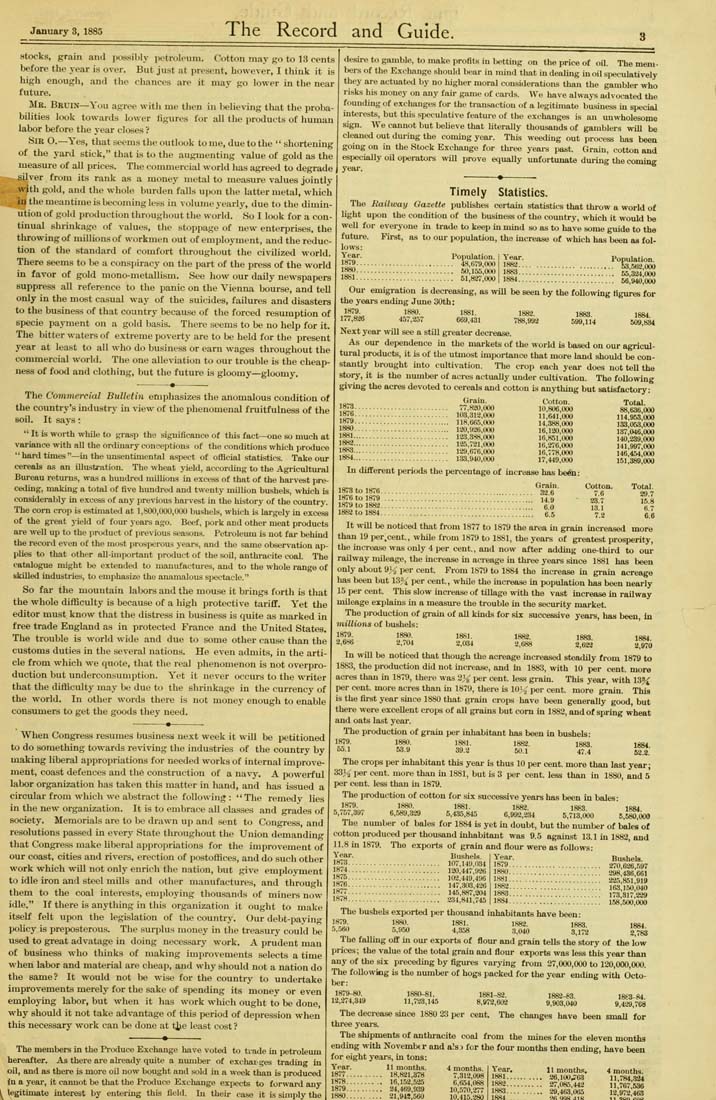
January 3, 1885 The Record and Guide. 3 stocks, grain and po.ssibly potrolcuni. Cotton may go to 13 cents tefore tlie year is over. But just at present, however, I think it is high enough, and the cliancos are it may go lower in tlie near future. Mr. Bruin—You agree with me tlien in telie\'ing that the proba¬ bilities look towards lower figures for all tlie products of human labor tefore the year closes ? Sir O.—Yes, that seems the outlook to me, due to the " shortening of the yard stick," that is to the augmenting value of gold as the measure of all prices. The commercial world has agreed to degrade silver from its rank as a money metal to measure values jointly with gold, and the wliolo burden ftills upon the latter metal, which iu the meantime is U'coming less in volume yearly, due to the dimin¬ ution of gold production tliroughout tlie world. So I look for a con¬ tinual shrinkage of values, tlie stojipage of new entcrjirises, the throwing of millions of workmen out of employment, and the reduc¬ tion of the standard of comfort throughout the civilized world. There seems to be ;i conspiracy on tlie part of the press of the world in favor of gold mono-metallism. See how our daily newspapers suppress all reference to the panic on the Vienna bourse, and tell only in the most casual way of the suicides, failures and disasters to the business of that country because of tlie forced resumption of specie payment on a gold basis. Tlierc seems to be no help for it. The bitter waters of extreme poverty are to te held for the present year at least to all who do business or earn wages throughout the commercial world. The one alleviation to our trouble is the cheap¬ ness of food and clothing, but the future is gloomy—gloomy. The Commercial Bulletin emphasizes the anomalous condition of the country's industry in view of the phenomenal fruitfulness of the soil. It says: " It is worth while to grasp the significance of this fact—one so much at variance with all the ordiuary conceptions of the conditions which produce " hard times "—in the unsentimental aspect of official statistics. Take our cereals as an illustration. The wheat jield, according to the Agricultural Bui-eau retuius, was a hundred millions in excess of that of the haivest pre- ceduig, making a total of five hundred and twenty million bushels, which is considerably in excess of any previous haivest in the history of the coimti-y. The corn crop is estimated at 1,800,0(X),(J0(J bushels, which is largely in excess of the great jield of four years ago. Beef, i)ork and other meat products are well up to the product of previous seasons. Petroleum is not far behind the record even of the most prosperous yeai-s, and the same observation ap¬ plies to that other aU-mijiortant product of the soil, anthracite coal. The catalogue might bo extended to manufactures, and to the whole range of skilled industries, to emiihasize the auamalous spectacle." So far the mountain laters and the mouse it brings forth is that the whole difficulty is because of a high protective tariff. Yet the editor must know tliat the distress in business is quite as marked in free trade EngLand as in protected France and the United States. The trouble is world wide and due to some other cause than the customs duties in the several nations. He even admits, in the arti¬ cle from which we quote, that the real phenomenon is not overpro¬ duction but underconsumption. Yet it never occurs to the writer that the difficulty may te due to the shrinkage in the currency of the world. In other words there is not money enough to enable consumers to get the goods they need. desire to gamble, to make i.roflts in U'ttiiig on the price ot oil. The mem¬ bers of the Exchange should bear in mind that in dealing in oil speculatively they are actuated by no higher moral considerations than the gambler who risks his money on any fair game of cards. We have always advocated the founding of exchanges for the transaction of a legitimate business m special interests, but this .speculative feature of the exchanges is an unwholesome sign. We cannot but believe that hterally thousands of gamblers will be cleaned out during the coming year. This weeding out process has been going on in the Stock Exchange for thi-ee years jjast. Grain, cotton and especially oil operators ivill prove equally unfortunate during the coming year, --------•-------- Timely Statistics. The Railway Gazette jmblishes certain statistics that throw a world of light upon the condition of the business of the country, which it would be well for everyone in trade to keep m mind so as to have some guide to the future. Fii-st, as to our population, the increase of which has been as fol¬ lows: Year. Population. 1»"9........................... 4S,6r9,(XX1 1«80........................... 80,]55,a)0 1*51........................... 61,82T,IX]0 Om- emigration is decreasing, as will be seen by the following figures for the years ending June SOth: ISrs). 18S0. 1881. 1882 1883 177,826 457,257 669,431 788,992 599,114 Next year will see a still greater decrease. As our dependence m the markets of the world is based on our agricul¬ tural products, it is of the utmost importance that more land should be con¬ stantly brought into cultivation. The crop each year does not tell the story, it is the nmnbor of acres actually under cultivation. The following giving the acres devoted to cereals and cotton is anj-thing but satisfactory; Graiu. .................... 77,820,000 .................... 103,312,000 ..................... 118.065,000 Year. Population. 63,5t JgJJ........................... 65,324,000 IS*!........................... 56,940,000 1884. 509,834 1873 1876 1879 1880. ..................... 120,926,000 1*11........................... 123,388,000 1882.......... 1883.................. IS.'H................... 12.5,721,tXW 129,076,000 133.riatioiis for the improvement of our coast, cities and rivers, erection of postoffices, and do such other work which wUl not only enrich the nation, but give employment to idle iron and steel mills and other manufactures, and tlirougli them to the coal interests, employing thousanils of miners now idle." If there is anything in this organization it ouglit to make itself felt upon the legislation of the country. Our debt-paying policy is preposterous. The surplus money in the treasury could be used to great advatage in doing necessary work. A prudent man of business who thinks of making improvements selects a time when labor and material are cheap, and why should not a nation do the same? It would not be wise for the country to undertake improvements merely for the sake of spending its money or even employmg labor, but when it lias work wliich ought to be done, why should it not take advantage of this period of depression when this necessary work can te done at t^e least cost ? The members in the Produce Exchange have voted to tl-ade in petroleum hereafter. As there are already quite a number of exchaiges trading in oil, and as there is more oil now bought and sold in a week than is produced tn a year, it cannot be that the Produce Exchange exjiects to forward any I legitimate interest by entering this field. lu their case it is simply the In different periods the percentage of increase has been: 1873tol876..................... %%"■ 1876tol879 ..................... ............... 149 1879 to 1882....................... ............... 60 1862 to 1884..........................'..'.'.'.'.['.'.'.'.'.'.'.'". 6.5 It wiU te noticed that from 1877 to 1879 the area in grain mcreased more than 19 per.cent., while from 1879 to 1881, the years of greatest prosperity, the incroa-se was only 4 per cent., and now after adding one-third to om- railway mileage, the increase ui acreage in three years suice 1881 has been only about 9}^ per cent. From 1879 to 1884 the increase m gram acreage has been but ISJi jier cent., while the increase in population has been nearly 15 per cent. This slow increase of tillage with the vast increase in railway mileage explains in a measme the trouble in the security market. The production of gram of all kinds for six successive years, has been, In millions of bushels: 1881. 1882. 1883. 1884. 2,034 2,688 2,623 2,970 In will be noticed that though the acreage increased steadily from 1879 to 1883, the production did not increase, and In 1883, with 10 per cent, more acres than in 1879, there was 2}-^ per cent, less gram. This year, with 138^ percent, more acres than in 1879, there is 10'.; j)er cent, more graiu. This is the first year since 1880 that grain crops have been generally good, but there were excellent crops of all grains but com in 1882, and of spring wheat and oats last year. The production of grain per inhabitant has been in bushels: 1879. im 1881. 1883. 1883. 1884. 55.1 53.9 39.2 60.1 47.4 Ja^. The crops per inhabitant this year is thus 10 per cent, more than last year; 33}4 per cent, more than in 1881, but is 3 per cent, less than in 1880, and 5 per cent, less than in 1879. The production of cotton for six successive years has been in bales: 1879. 1880. 1881. 1882 1883 ' 1SR4 6,757,397 6,589,329 6,435,845 6,992,2*4 5,713,000 5,580:000 The number of bales for 1884 is yet in doubt, but the number of bales of cotton produced per thousand inhabitant was 9.,5 against 13.1 in 188-2, and 11.8 in 1879. The exjwrts of grain and flour were as follows: Year. Bushels. 1873......................... 107,149,034 1874......................... 120,447,9-36 1876......................... 102,449,496 1876......................... 147,303,4-26 1877......................... 145,887,-204 1878......................... 234,841,745 Year. 1879... 1880... 1881... 1882. 1883. Bushels. 270,626,597 298,436,661 2-25,851,919 163,150,(M0 173,.317,2-29 1884......................... 158,600i000 The bushels exported jier thousand inhabitants have been: 1879 1880. 1881. 1S82. 18a3. 1884 5,i,H0 5,9.60 4,358 3,040 3,172 2^ The falling oflf in om- exports of flour and grain tells the story of the low jirices; the value of the total grain and flour exports was less this year than any of the six preceding by figures varying from 27,000,000 to 1-20,000,000. The following is the number of hogs packed for the year ending with Octo- ter: 1881-^2. 1882-83. 18f3-84. 8,973,602 9,903,tMO 9,429,768 The decrease since 1880 23 per cent. The changes have been small for three years. The shipments of anthracite coal from the mines for the eleven months ending with Novembtr and a!8j for the four months then ending, have been for eight years, in tons: Tear. 11 months. 4 months. 1877.......... J?'??!.?™ 7,312,098 1879-80. 12,274,349 1878.......... 16,162;525 18T9.......... 24,469,939 1880.......... 21,94S,560 6.654,088 10,570,-377 10.415.280 Year, 1881... 1882... 1883... 1884 . 11 months. 26,100^-63 27,085,442 29,463,065 •?ii "HIH J 1« 4 months. 11,784,.334 11,767,536 12,972,463