
Columbia University Libraries Digital Collections: The Real Estate Record
Use your browser's Print function to print these pages.
The Record and guide: v. 35, no. 893: April 25, 1885
Text version:
Please note: this text may be incomplete. For more information about this OCR, view About OCR text.
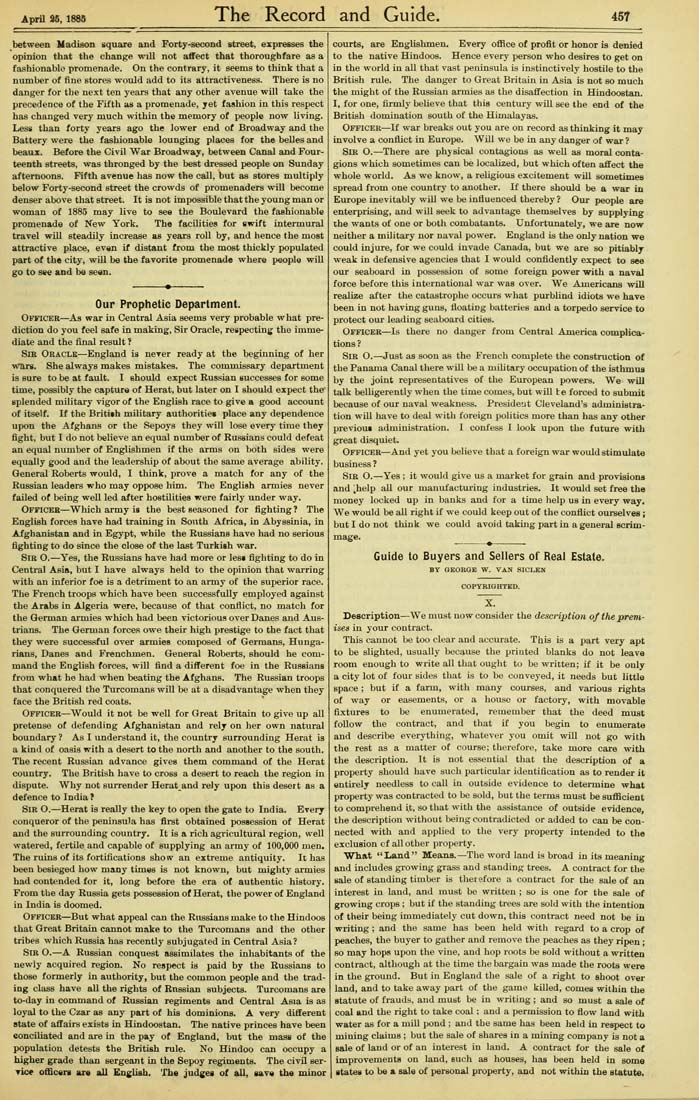
April 96, 1885 The Record and Guide. 467 between Madison square and Forty-second street, expresses the opinion that the change will not affect that thoroughfare as a fashionable promenade. On the contrary, it seems to think that a number of fine stores would add to its attractiveness. There is no danger for the next ten years that any other avenue will take the precedence of the Fifth as a promenade, yet fashion in this respect has changed very much within the memory of people now living. Less than forty years ago the lower end of Broadway and the Battery were the fashionable lounging places for the beUes and beaux. Before the Civil War Broadway, between Canal and Four¬ teenth streets, was thronged by the best dressed people on Sunday afternoons. Fifth avenue has now the call, but as stores multiply below Forty-second street the crowds of promenaders will become denser above that street. It is not impossible that the young man or woman of 1885 may live to see the Boulevard the fashionable promenade of New York. The facUities for swift intermural travel will steadily increase as years roU by, and hence the most attractive place, even if distant from the most thickly populated part of the city, wiU be the favorite promenade where people wiU go to see and be seen. Our Prophetic Department. Officer—As war in Central Asia seems very probable what pre¬ diction do you feel safe in making. Sir Oracle, respecting tho imme¬ diate and the final result ? Sir Oracle—England is never ready at the beginning of her wars. She always makes mistakes. The commissary department is sure to be at fault. I should expect Russian successes for some time, possibly the capture of Herat, but later on I shovdd expect the splended military vigor of the English race to give a good account of itself. If the Britith military authoritiei place any dependence upon the Afghans or the Sepoys they will lose every time they fight, but I do not believe an equal number of Russians could defeat an equal number of Englishmen if the arms on both sides were equally good and the leadership of about the same average ability. General Roberts would, I think, prove a match for any of the Russian leaders who may oppose him. The English armies never failed of being well led after hostUities were fairly under way. Offickh—Which army is the best seasoned for fighting ? The English forces have had training in Soiith Africa, in Abyssinia, in Afghanistan and in Egypt, whUe the Russians have liad no serious fighting to do since the close of the last Turkish war. Sib O.—Yes, the Russians have had more or lesi fighting to do in Central Asia, but I have always held to the opinion that warring with an inferior foe is a detriment to an army of the superior race. The French troops which have been successfully employed against the Arabs in Algeria were, because of that conflict, no match for the German armies which had been victorious over Danes and Aus- trians. The German forces owe their high prestige to the fact that they were successful over armies composed of Germans, Hunga¬ rians, Danes and Frenchmen. General Roberts, should he com¬ mand the English forces, will find a different foe in the Russians froni what he had when beating the Afghans. The Russian troops that conquered the Turcomans wiU be at a disadvantage when they face the British red coats. Officer—Would it not be well for Great Britain to give up all pretense of defending Afghanistan and rely on her own natural boundary ? As I understand it, the country surrounding Herat is a kind of oasis with a desert to the north and another to the south. The recent Russian advance gives them command of the Herat country. The British have to cross a desert to reach the region in dispute. Why not surrender Herat_and rely upon this desert as a defence to India ? Sir O.—Herat is reaUy the key to open the gate to India. Every conqueror of the peninsula has first obtained possession of Herat and the surrounding country. It is a rich agricultural region, well watered, fertUe and capable of supplying an army of 100,000 men. The ruins of its fortifications show an extreme antiquity. It has been besieged how many times is not known, but mighty armies had contended for it, long before the era of authentic history. From tlie day Russia gets possession of Herat, the power of England in India is doomed. Officer—But what appeal can the Russians make to the Hindoos that Great Britain cannot make to the Turcomans and the other tribes which Russia has recently subjugated in Central Asia? Sir O.—A Russian conquest assimUates the inhabitants of the newly acquired region. No respect is paid by the Russians to those formerly in authority, but the common people and the trad¬ ing class have aU the rights of Russian subjects. Turcomans are to-day in command of Russian regiments and Central Asia is as loyal to the Czar as any part of his dominions. A very different state of affairs exists in Hindoostan. The native princes have been eonciUated and are in the pay of England, but the mass of the population detests the British rule. No Hindoo can occupy a higher grade than sergeant in the Sepoy regiments. The civU ser- Tic« officers are all English. The judges of aU, save the minor courts, are Englishmen. Every office of profit or honor is denied to the native Hindoos. Hence every person who desires to get on in the world in aU that vast peninsula is instinctively hostile to the British rule. The danger to Great Britain in Asia is not so much the might of the Russian armies as the disaffection in Hindoostan. I, for one, firmly beUeve that this century wUl see the end of the British domination south of the Himalayas. Officer—If war breaks out you are on record as thinking it may involve a conffict in Europe. WUl we be in any danger of war ? Sir O.—There are physical contagions as weU as moral conta¬ gions which sometimes can be localized, but which often affect the whole world. As we know, a reUgious excitement wUl sometimes spread from one country to another. If there should be a war in Europe inevitably wiU we be influenced thereby? Our people are enterprising, and wiU seek to advantage themselves by supplying the wants of one or both combatants. Unfortunately, we are now neither a military nor naval power. England is the only nation we could injure, for we could invade Canada, but we are so pitiably weak in defensive agencies that I would confidently expect to see our seaboard in possession of some foreign power with a naval force before this international war was over. We Americans wiU realize after the catastrophe occurs what purbUnd idiots we have been in not having guns, floating batteries and a torpedo service to protect our leading seaboard cities. Officer—Is there no danger from Central America complica¬ tions ? Sir O.—Just as soon as the French complete the construction of the Panama Canal there wUl be a miUtary occupation of the isthmus by the joint representatives of the European powers. We wiU talk beUigerently when the time comes, but wiU te forced to submit because of our naval weakness. President Cleveland's administra¬ tion wiU have to deal with foreign politics more than has any other previous administration. I confess I look upon the future with great disquiet. Officer—And yet you believe that a foreign war would stimiUate business ? Sib O.—Yes ; it would give us a market for grain and provisions and .help aU our manufacturing industries. It woiUd set free the money locked up in banks and for a time help us in every way. We would be all right if we could keep out of the conflict ourselves; but I do not think we could avoid taking part in a general scrim¬ mage. Guide to Buyers and Sellers of Real Estate. BY GEOBOE W. VAN SICi:.EN COPYRIGHTED. Description—We must now consider the description of tlie prem¬ ises in your contract. This cannot be too clear and accurate. This is a part very apt to be sUghted, usually because the printed blanks do not leave room enough to write all that ought to be written; if it be only a city lot of four sides that is to be conveyed, it needs but little space ; but if a farm, with many courses, and various rights of way or easements, or a house or factory, with movable fixtures to be enumerated, remember that the deed must foUow the contract, and that if you begin to enumerate and describe everything, whatever you omit wiU not go with the rest as a matter of course; therefore, take more care with the description. It is not essential that the description of a property should have such particular identification as to render it entu-ely needless to caU in outside eWdence to determine what property was contracted to be sold, but the terms must be sufficient to comprehend it, so that with the assistance of outside evidence, the description without being contradicted or added to can be con¬ nected with and applied to the very property intended to the exclusion cf all other property. What "Land" Means.—The word land is broad in its meaning and includes growing grass and standing trees. A contract for the sale of standing timber is therefore a contract for the sale of an interest in land, and must be written ; so is one for the sale of growing crops ; but if the standing trees are sold with the intention of their being immediately cut down, this contract need not be in writing ; and the same has been held with regard to a crop of peaches, the buyer to gather and remove the peaches as they ripen ; so may hops upon the vine, and hop roots be sold without a written contract, although at the time the bargain was made the roots were in the ground. But in England the sale of a right to shoot over land, and to take away part of the game kiUed, comes within the statute of frauds, and must be in writing ; and so must a sale of coal and the right to take coal ; and a permission to flow land with water as for a niiU pond ; and tbe same has been held in respect to mining claims ; but the sale of shares in a mining company is not a sale of land or of an interest in land. A contract for the sale of improvements on land, such as houses, has been held in some states to be a sale of personal property, and not within the statute.