
Columbia University Libraries Digital Collections: The Real Estate Record
Use your browser's Print function to print these pages.
The Record and guide: v. 35, no. 897: May 23, 1885
Text version:
Please note: this text may be incomplete. For more information about this OCR, view About OCR text.
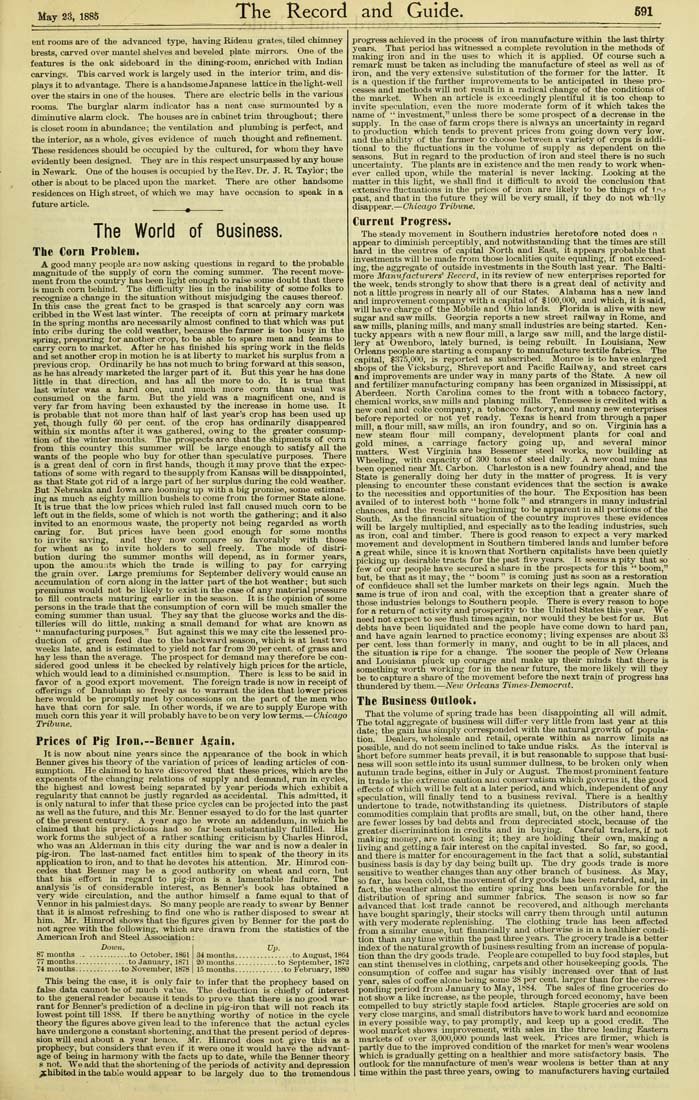
May 23, 1885 The Record and Guide. 691 ent rooms are of the advanced type, having Rideau grates, tUed chimney brests, carved over mantel shelves and beveled plate mirrors. One of the features is the oak sideboard in the dining-room, enriched with Indian carvings. Tbis carved work is largely used in the interior trim, and dis¬ plays it to advantage. There is a handsome Japanese lattice in the Ught-weU over the stairs in one of the houses. There are electric bells in the various rooms. The burglar alarm indicator has a neat case surmounted by a diminutive alarm clock. The houses are in cabinet trim throughout; there is closet room in abundance; the ventilation and plumbing is perfect, and the interior, as a whole, gives evidence of much thought and refinement. These residences should be occupied by the cultured, for whom they have evidently been designed. They are in this respect unsurpassed by any house in Newark. Oue of the houses is occupied bj' the Rev. Dr. J. R. Tayior; the other is about to be placed upon the market. There are other handsome residences on High street, of which we may have occasion to speak in a future article. --------•-------- The Worlcl of Business. The Corn Problem. A good many people are now asking questions in regard to the probable magnitude of the supply of corn the coming summer. The recent move¬ ment from the countrj' has been light enough to raise some doubt that there is much corn behind. The difficulty lies in the inabUity of some folks to recognize a change in the situation mthout misjudging the causes thereof. In this case the great fact to be grasped is that scarcely any corn was cribbed in the West last winter. The receipts of com at primary markets In the spring raonths are necessarily almost confined to that which was put into cribs during the cold weather, because the farmer is too busy in the spring, preparing for another crop, to be able to spare men and teams to carry com to market. After he has finished his spring work in the flelds and set another crop in motion he is at liberty to mai-ket his surplus from a previous crop. Ordinarily he has not much to bring forward at this season, as he has already marketed the larger part of it. But this year he has done little in that direction, and has aU the more to do. It is true that last winter was a hard one, imd much more corn than usual was consumed on the farm. But the yield was a magnificent one, and is very far from having been exhausted by the increase in home use. It is probable that not more than half of last year's crop has been used up yet, though fully 60 per cent, of the crop has ordinarUy disappeared within six months after it was gathered, owing to the greater consump¬ tion of the winter months. The prospects are that the shipments of corn from this country this summer will be large enough to satisfy all the wants of the people who buy for other thau speculative purposes. There is a great deal of corn iu fli-st hands, though it may prove that the expec¬ tations of some with regard to the supply from Kansas wiU be disappointed, as that State got rid of a large part of her surplus during the cold weather. But Nebraska and Iowa are looming up with a big promise, some estimat>- iug as much as eighty miUiou bushels to come trom the former State alone. It is true that the low prices which ruled last fall caused much com to be left out in the fields, some of which is not worth the gathering; and it also invited to an enormous waste, the jiroperty not being regarded as worth caring for. But prices have been good enough for some months to invite saving, and they now compare so favorably with those for wheat as to invite holders to sell freely. The mode of distri¬ bution during the summer months wiU depend, as in former j'ears, upou the amounts which the trade is wiUing to pay for carrying the grain over. Large prenuums for September deUvery would cause an accumulation of com along in the latter part of the hot weather; but such premiums would not be likely to exist in the case ot any material pressure to ffll contracts maturing earUer in the season. It is the opinion of some persons in the trade that the consumption ot corn wiU be much smaUer the coming summer than usual. They say that the glucose works and the dis- tUleries wiU do little, making a small demand for what are known as " manufacturing purposes." But against this we may cite the lessened pro¬ duction of green feed due to the backward season, which is at least two weeks late, and is estimated to yield not far from 30 per cent, of gra.ss and hay less than the average. The prospect for demand may therefore be con¬ sidered good unless it be checked by relatively high prices for the article, which would lead to a diminished ccnsumption. There is less to be said in favor of a good export movement. The foreign trade is now in receipt of offermgs of Danubian so freely as to warrant the idea that lower prices here would be promptly met by concessions on the part of the men who have that corn for sale. In other words, if we are to supply Europe with much corn this year it wUl probably have to be on very low terms.—Chicago Tribune. Prices of Pig Iron.—Benner Again. It is now about nine years since the appearance of the book iu which Benner gives his theory of the variation of prices of leading articles of con¬ sumption. He claimed to have discovered that these prices, which are the exponents of the changing relations of supply and demand, run in cycles, the highest and lowest being separated by year periods which exhibit a regularity that cannot be justly regarded as accidental. This admitted, it is only natural to infer that these price cycles can be projected into the past as well as the future, and this Mr. Benner essayed to do for the last quarter of the present century. A year ago he wrote an addendum, in which he claimed that his predictions had so far been substantiallj' fullilled. His work forms the subject of a rather scathing criticism bj- Charles Hinrod, who was an Alderman in this city duriug the war aud is now a dealer in pig-h-on. The last-named fact entitles him to speak of the theory in its application to iron, and to that he devotes his attention. Mr. Himrod con¬ cedes that Benner may be a good authority on wheat and corn, but that his effort in regard to pig-u-on is a lamentable failm-e. The analysis 'is of considerable interest, as Benner's book has obtained a very wide circulation, and the author himseU a fame equal to that of Vennor in his palmiest daj-s. So many people are ready to swear by Benner that it is almost refreshing to find one who is rather disposed to swear at him. Mr. Himrod shows that the figures given by Benner for the past do not agree with the foUowing, which are drawn from the statistics of the American Ii-oh and Steel Association: Up, 34 niouths................to August, 1864 •20 months............to September, 187-2 15 months..............to February, 1880 Volvn. 87 montlis ..............to October, 18G1 77 months...............to January, 1871 74 mouths.............to November, 1878 | This being the case, it is only fair to infer that the prophecy based on false data canuot be of much value. The deduction is chiefly of interest to the general reader because it tends to prove that there is no good war¬ rant for Benner's prediction of a decline in pig-iron that wUl not reach its lowest point tiU 1888. If there be anything worthy of notice in the cycle theory the flgures above given lead to the inference that the actual cycles have undergone a constant shortening, and that the present period of depres¬ sion wUl end about a year heuce. Mr. Himrod does not give this as a prophecy, but considers that even if it were one it would have the advant¬ age of being in harmony with the facts up to date, whUe the Benner theory s not. We add that the shortening of the periods of activity and depression JShibited iu the table would appear to ba largely due to the tremendous progi-ess achieved in the process of iron manufacture within the last thirty yeai-s. That period has witnessed a complete revolution in the methods of making iron and in the uses to which it is applied. Of course such a remark must be taken as including the manufacture of steel as weU as of u-on, and the very extensive substitution of the former for the latter. It is a question if the further improvements to be anticipated in these pro¬ cesses and methods wUl not result iu a radical change of the conditions of the market. When an article is exceedingly plentiful it is too cheap to invite speculation, even the more moderate form of it which takes the name of '* investment," unless there be some prospect of a decrease in the supply. In the case of farm crops there is always an uncertainty in regard to production which tends to prevent prices from going doivu very low. and the ability of the farmer tio choose between a variety of crops is addi¬ tional to the fluctuations in the volume of supply as dependent on tha seasons. But in regard to the production of iron aud steel there is no such uncertainty. The plants are in existence and the men ready to work when¬ ever called upon, whUe the material is never lacking. Looking at the matter in this light, we shaU flnd it difficult to avoid the conclusion that extensive fluctuations in the prices of iron are Ukely to be things of 1-^^ past, and that in the future they wiU be very smaU, it they do not wholly disappear.—Chicago Tribune. Current Progress. The steady movement in Southern industries heretofore noted does n appear to diminish perceptibly, and notwithstancUng that the times are stUl hard in the centres of capital North and East, it appears probable that investments wUl be made from those localities quite equaling, if not exceed¬ ing, the aggregate of outside investments in the South last year. The Balti¬ more Manufacturers' Record, in its review of new enterprises reported for the week, tends strongly to show that there is a great deal of activity and not a Uttle progress in nearly all of our States. A labama has a new land and improvement company with a capital of $100,000, and which, it is said, will have charge of the Mobile and Ohio lauds. Florida is alive with new sugar and saw mUls. Georgia reports a new street railway in Rome, and saw mills, planing miUs, and many small industries are being started. Ken¬ tucky appeai-s with a new flour mill, a large saw niUl, and the large distU- lery at Owenboro, lately burned, is being rebuUt. In Louisiana, New Orleans people are starting a company to manufacture textUe fabrics. The capital, $37.5,0110, is reported as subscribed. Monroe is to have enlarged shops of the Vicksburg, Shreveport and Paciflc Railway, and street cars and improvements are mider way in many parts of the State. A new oU and fertilizer manufactm-ing company has been organized in Mississippi, at Aberdeen. North CaroUna comes to the front with a tobacco factory, chemical works, saw mills and planing mUls. Tennessee is credited-with a new coal and coke company, a tobacco factory, and many new enterprises before reported or not yet ready. Texas is heard from through a paper mill, a flom- mill, saw mUls, an iron foundry, and so on. Virginia has a new steam flour null company, development plants for coal and gold mines, a carriage factory going up, and several minor matters. West Virginia has Bessemer steel works, now buUding at Wheeling, with capacity of 300 tons of steel daily. A new coal mine has been opened near Mt. Carbon. Charleston is a new foundry ahead, and the State is generallj' doing her duty in the matter of progi-ess. It is very pleasing to encounter these constant evidences that the section is awake to the necessities and opportunities of the hour. The Exposition has been avaUed of to uiterest both "home folk" and strangei-s in many industrial chances, and the results are beginniug to be appaj-ent in all portions of the South. As the flnancial situation of the country improves these evidences ■wiU be largely multipUed, aud especially as to the leading industries, such as iron, coal and timber. There is good reason to expect a very marked movement aud development in Southern timbered lands and lumber before a great whUe, since it is known that Northern capitalists have been quietly picking up desirable tracts for the past flve years. It seems a pity that so few of our people have secured a share in the prospects for this " boom," but, be that as it may, the " boom " is coming just as soon as a restoration of confidence shall set the lumber markets on their legs again. Much the same is true of iron and coal, with the exception that a greater share of those industries belongs to Southern people. There is every reason to hope for a return of activity and prosperity to the United States this year. We need not expect to see flush times again, nor would they be best for us. But debts have been liquidated aud the people have come down to hard pan, and have again learned to practice economy; living expenses are about 33 per cent, less than formerly iu many, and ought to be in all places, and the situation is ripe for a change. The sooner the people of New Orleans and Louisiana pluck up courage and make up theu- minds that there is something worth working for in the near future, the more Ukelj' wUl they be to capture a share ot the movement before the next tram of progress has thundered by them.—Neiv Orleans Tinies-Democrat. Tlie Business Outlooli. That the volume of spruig trade has beeu disappointing aU wiU admit. The total aggregate of business will differ very little from last year at this date; the gain has simply corresponded with the natm-al growth of popula¬ tion. Dealers, wholesale and retaU, operate within as narrow hmits as possible, and do not seem inclined to take undue risks. As the interval is short before summer heats prevaU, it is but reasonable to suppose that busi¬ ness wUl soon settle into its usual summer duUness, to be broken only when autumn trade begins, either in July or August. The most prominent featui-e in trade is the extreme caution aud conservatism which governs it, the gooti effects of which wiU be felt at a later period, aud which, independent of any specidation, will finaUy tend to a business revival. There is a healthy undertone to trade, notwithstanding its quietness. Distributors of staple commodities complain that profits are small, but, on the other hand, there are fewer losses by bad debts and from depreciated stock, because of the greater discrhuination in crecUts and in buyuig. Careful traders, if not making money, ai-e not losing it; they are holding theu- own, making a living and getting a fair interest on the capital invested. So far, so good, and there is matter for encouragement in the fact that a solid, substantial business basis is day by day being built up. The dry goods trade is more sensitive to weather changes than any other branch of business. As May, so far, has been cold, the movement of dry goods has been retarded, and, in fact, the weather almost the entire sjiring has been unfavorable for the distribution of spriug and summer fabrics. The season is now so far advanced that lost trade caimot be recovered, and although merchants have bought sparingly, their stocks wiU carry them through untU autumn with very moderate replenishing. The clothing trade has been affected from a similar cause, but financiaUy and otherwise is in a healthier condi¬ tion than any time within the past three years. The grocery trade is a better index of the natural growth of business resulting from au uicrease of popula¬ tion than the dry goods trade. People are compelled to buy food staples, but can stint themselves iu clothing, eai-pets and other housekeeping goods. The consumption of coffee and sugar has visibly iucreased over thai} of last year, sales of coffee alone being some 38 per cent, larger than for tbe con-es- ponduig period from January to May, 1884. The sales of fine groceries do not show a like increase, as the people, through forced economy, have been compelled to buy strictly staple food articles. Staple gi-oceries are sold on very close margins, and small distributors have to work hard and economize in every possible way, to pay promptly, aud keep up a good credit. The wool market shows improvement, with sales in the three leading Eastern markets of over 3,000,000 pounds last week. Prices are firmer, which is partly due to the improved condition of the market for men's wear woolens which is gradually getting on a healthier and more satisfactory basis. The outlook for the manufacture of men's wear woolens is better than at any time within the past three yeai-s, owing to manufacturers having cmtaUed