
Columbia University Libraries Digital Collections: The Real Estate Record
Use your browser's Print function to print these pages.
The Record and guide: v. 35, no. 897: May 23, 1885
Text version:
Please note: this text may be incomplete. For more information about this OCR, view About OCR text.
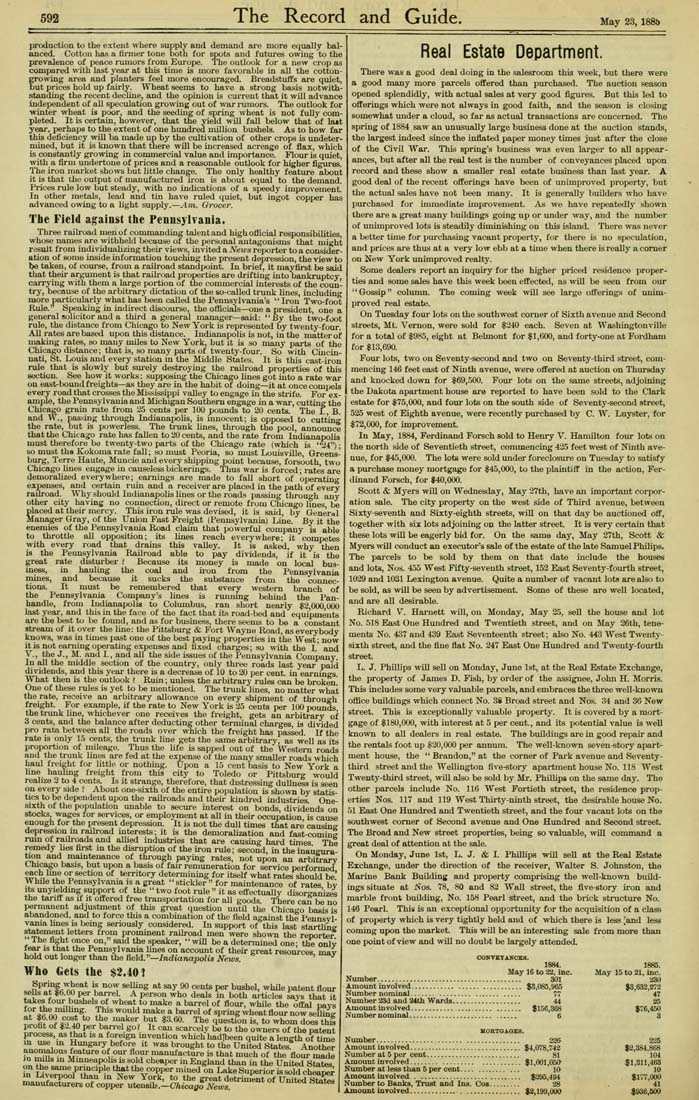
692 The Record and Guide. May 23, 1886 production to the extent where supply and demand are more equally bal¬ anced. Cotton has a fli-mer tone both for spots and futures owing to the prevalence of peace rmnors from Emope. The outlook for a new crop as compared w-ith last year at this time is more favorable in all the cotton- f rowing area and planters feel more encouraged. Breadstuffs are quiet, ut prices hold up fairly. Wheat seems to have a strong basis notwith¬ standing the recent decline, and the opinion is current that it wUl advance independent of aU speculation growing out of war rumors. The outlook for ■winter wheat is poor, and the seeding of spring wheat is not fully com¬ pleted. It is certain, however, that the yield wiU faU below that of lajt year, perhaps to the extent of one hundred iiulUon biLshels. As to how far this deficiency -will ba made up by the cultivation of other crops is undeter¬ mined, but it is known that there wUl be iucreased acreage of flax, which is constantly grovring in commercial value and importance. Flour is quiet, with a firm undertone of prices and a reasonable outlook for higher figures. The iron market shows but little change. The only healthy feature about it is that the output of manufactured u-on is about equal to the demand. Prices rule low but steady, with no indications of a speedy improvement. In other metals, leail and tin have ruled quiet, but ingot copper has advanced owing to a light supply.—Ajn, Grocer, Tlie Field against tlie Pennsylvania. Three raih-oad meu of commanding talent and high official responsibiUties, whose names are withheld because of the personal antagonisms that might result from individuaUzing their views, invited a News reporter to a consider¬ ation of some inside information touching the present depression, the view to he taken, of com-se, from a railroad standpoint. In brief, it mayfirst be said that their argument is that railroad properties are drifting into bankruptcy, caiTying with them a lai-ge portion of the commercial interests of the coun¬ try, because of the arbitrary dictation ot the so-called trunk lines, including more particularly what has been caUed the Pennsylvania's " Iron Two-foot Rule.'' Speaking in indirect discourse, the officials—one a president, one a general solicitor and a third a general mauager—said: "By the two-foot rule, the distance from Chicago to New York is represented by tweuty-four. AU rates are based upou this distance. Indianapolis is not, in the matterof making rates, so many mUes to New York, but it is so many parts of the Chicago distance; that is, so many parts of twenty-four. So with Cincui- nati, St. Louis and every station in the Middle States. It is this cast-iron rule that is slowly but surely destroying the raUroad properties of this section. See how it works: supposuig the Chicago Unes got iuto a rate war on east-bound freights—as they are iu the habit of doing—it at once compels every road that crosses the Mississippi valley to engage in the sti-ife. For ex¬ ample, the Pennsylvania and Michigan Southern engage in a war, cutting the Chicago grain rate from 35 cents per 100 pounds to 30 cents. The I, B. and W., pas-ing through IndianapoUs, is innocent; is opposed to cutting the rate, but is powerless. The trunk lines, through the pool, announce that the Chicago rate has faUen to 30 cents, and the rate from Indianapolis must therefore bo twenty-two parts of the Chicago rate (which is "34"); so must the Kokoma rate faU; so must Peoria, so must LouisvUle, Greens¬ burg, Terre Haute, Muncie and every shipping point because, forsooth, two Chicago lines engage in causeless bickerings. Thus war is forced; rates are demoraUzed everywhere; earnings are made to fall short of operating expenses, and cei-taiu ruin and a receiver are placed in the path of every railroad. Why should IndiauapoUs Unes or the roads passing through any other city having no counection, direct or remote from Chicago lines be placed at their mercy. This iron rule was devised, it is said, by General Manager Gray, of the Uiuon Fast Freight (Pennsylvania) Line. By it the enemies of the Pennsylvania Road claim that powerful company is able to throttle aU opposition; its lines reach everywhere; it competes with every road that drains this vaUey. It is asked, why then is the Pennsylvania RaUroad able to pay dividends, if it is the great rate disturber ; Because its money is made on local bus¬ iness, iu hauling the coal and irou frora the Pennsylvania mines, and because it sucks the substance from the connec¬ tions. It must be remembered that every western branch of the Pennsylvania Company's lines is running behind the Pan¬ handle, from Indianapolis to Columbus, ran short neai-ly $3,000 IXK) last year, and this in the face of the fact that its road-bed and equipments are the best to be found, aud as for business, there seems to be a constant stream of it over the line: the Pittsburg & Fort Wayne Road, as everybody knows, was in times jiast one of the best paying properties in the West- now it is not earning operating expenses and fixed charges; so with the I.' and v., the J., M. and I., and all the side issues of the Pennsylvania Company In all the middle section of the country, only three roads last year paid dividends, and this year there is a decrease of 10 to 30 per cent, in earnings What then is the outlook ( Ruin; unless the arbitrary rules can be broken One of these rules is yet to be mentioned. The trank hnes, no matter what the rate, receive an arbitrary aUowance on every shipment of through freight. For example, if the rate to New York is 35 cents per 100 pounds the trunk line, whichever one receives the freight, gets an arbitrary of 3 cents, and the balance after deducting other terminal charges, is divided pro rata between aU the roads over which the freight has passed. If the rate is only 15 cents, the trunk Une gets the same arbitrary, as weU as its proportion of mUeage. Thus the Ufe is sapped out of the Western roads and the trunk lines are fed at the expense of the many smaller roads which haul freight for Uttle or nothmg. Upon a 15 cent basis to New York a Une haulmg freight from this city to Toledo or Pittsburg would realize 3 to 4 cents. Is it strange, therefore, that distressing duUness is seen on every side 1 About one-sixth of the entire population is shown by statis¬ tics to be dependent upon the raUroads and then- kiudred industries One- sixth of the population unable to secure interest on bonds, dividends on stocks -wages for services, or employment at aU m their occupation, is cause enough for the present depression. It is not the duU tunes that are causme depressiou in raUroad mterests; it is the demoraUzation and fastK:ommi nun of raUi-oads and alUed industries that are causmg haid tunes The remedy Ues first in the dismption of the iron rule; second, hi the inaugura¬ tion and mamtenance of through paymg rates, not upon au arbitrarv Chicago basis, but upon a basis of fair remuneration for service performed WU-, "u oi;section of territory determining for itself what rates should be' WhUe the Pennsylvania is a great "stickler" for maintenance of rates bv ite unyi^ding support of the " two foot rule " it as effectually disorganizes the tariff as if it offered free transportation for aU goods. There can be no permauent adjustment of this great question untU the Chicago basis is abandoned, and to force this a combination of the field against the Pennsvl- vania hues is bemg seriously considered. Iu support of this last startUnc fJS.u i",*^ letters from promment raUroad men were shown the renorter The fight once on," said the speaker, " wUl be a detenmned one; the onj-y rear is that the Pennsylvania lines on account of their great resources mav hold out longer than the field. "—/ndianaTiofisA'ews. ' ^ Who Gets the $2,401 c»ui'll°fc'S^** 'f "'''T ^I^S ^* ^y ^ ^"^ pe'" busl^el. '^'^e patent flour sells at fb.lW per ban-el. A person who deals m both articles iTys that it tak^ four busheb of wheat to make a barrel ot flour, while the offal pays !?'■*« m"^^; Ju'^ "'T''* ^^l^ '^'■'^' °f ^'•i°g ^"1"^' flour now sefiSg ll3^e «^?j5i ^ *k'' "?''*'; ^"' *^'*- The question is, to whom does thfi Sr^ic * V't? r^ ^r'""^-^°'- ^' ''^ scarcely be to the owners of the patent process, as that is a foreign mvenbon which hadlbeen quite a length of time ^.^!, "* Hungary before it was brought to the United States Anotltor bf^l^ i M^'"™ "r"""" flour manufactm-e is that much of the flour made m nuUs m Mmneapolis is sold cheaper iu England thau m the United States on the same princip e that the copper mined on Lake Superior ^soUch^Mr Zn-rT*^' ""i" "• ^«" Y"'"''' ^ t''* great deta-hnent of uS^S^te^ manufacturers of copper utensUf.—CAtca(/o News. vjmieu aiatea Real Estate Department. There was a good deal doing in the salesroom this week, but there were a good many more parcels offered tlian purchased. The auction season opened splendidly, with actual sales at very good figures. But this led to offerings which were not always in good faith, and the season is closing somewhat uuder a cloud, so far as actual transactions are concerned. The spruig of 1884 saw an unusually large business done at the auction stands, the largest indeed siuce the inflated paper money times just after the close of the Civil War. This spring's business was even larger to all appear¬ ances, but after aU the real test is the number of conveyances placed upon record and these show a smaUer real estate business than last year. A good deal of the recent offerings have been of unimproved property, but the actual sales have not been many. It is generaUy buUders who have purchased for immediate improvement. As we have repeatedly shown there are a great many buildings going up or under way, and the number of unimproved lots is steadUy diminishing on this island. There was never a better time for purchasing vacant propertj-, for there is no siieculation, and prices are thus at a very low ebb at a tune when there is reaUy a comer on New York unimproved realty. Some dealers report an inquiry for the higher priced residence proper¬ ties and some sales have this week been effected, as wiU be seen from our "Gossip" column. The coming week wiU see largo offerings of unim¬ proved real estate. On Tuesday four lots on the southwest comer of Sixth avenue and Second streets, Mt. Vemon, were sold for $340 each. Seven at Washingtonville for a total of $985, eight at Belmont for $1,C00, and forty-one at Fordham for $13,090. Four lots, two on Seventy-second and two on Seventy-third street, com¬ mencing 146 feet east of Ninth avenue, were offered at auction on Thursday and knocked down for $69,.500. Four lote on the same sh-eete, adjoining the Dakota apartment house are reported to have been sold to the Clark estate for $75,000, and four lote on the south side of Seventy-second street, 525 west of Eighth avenue, were recently purchased by C. W. Luyster, for $72,000, for improvement. In May, 1884, Ferdinand Forsch sold to Henry V. HamUton four lote on the north side of Seventieth street, commencing 435 feet west of Nmth ave¬ nue, for $45,000. The lote were sold under foreclosure ou Tuesday to satisfy a purchase money mortgage for $45,000, to the plaintiff in the action, Fer- dmaud Forsch, for $40,000. Scott & Myers wiU on Wednesday, May 27th, have an important corpor¬ ation sale. The city property on the west side of Third avenue, between Sixty-seventh and Sixty-eighth streete, wiU on that day be auctioned otf, together with six lote adjoining on the latter street. It is very certain that these lote wUl be eagerly bid for. On the sarae day. May 27th, Scott & Myers will conduct an executor's sale of the estate of the late Sarauel PhiUps. The parcels to be sold by them on that date uiclude the houses and lote, Nos. 4.55 West Fifty-seventh street, 153 East Seveuty-fourth street, 1039 and 1031 Lexington avenue. Quite a number of vacant lote are also to be sold, as will be seeu by advertisement. Some of these are well located, and are aU desirable. Richard V. Harnett will, on Monday, May 35, seU the house and lot No. 518 East One Hundred and Twentieth street, aud on May 36th, tena- raeute No. 437 and 439 East Seventeenth street; also No. 443 West Twenty- sixth street, and the fine flat No. 347 East One Hundred and Twenty-foui-th street. L. J. Phillips will sell on Monday, June 1st, at the Real Estate Exchange, the property of James D. Pish, by order of the assignee, John H. Morris. This includes some very valuable parcels, and embraces the three weU-known office buildings which connect No. 38 Broad street and Nos. 34 aud 36 New street. This is exceptionally valuable property. It is covered by a mort¬ gage of $180,000, with interest at 5 per cent., and its potential value is weU known to all dealers in real estate. The buUdings are in good repair and the rentals foot up $30,000 per annum. The well-known seven-story apart¬ ment house, the " Brandon," at the comer of Park avenue and Seventy- third street aud the WeUington five-story apartment house No. 118 West Twenty-third street, will also be sold by Mr. PhiUips on the same day. The other parcels include No. 116 West Fortieth street, the residence prop¬ erties Nos. 117 aud 119 West Thirty-ninth street, the desirable house No. 51 East One Hundred and Twentieth street, and the four vacant lote on the southwest comer of Second avenue and One Hundred and Second street. The Broad and New street properties, being so valuable, wiU command a great deal of attention at the sale. On Monday, June 1st, L. J. & I. PhiUips -wUl seU at the Real Estate Exchange, under the direction of the receiver, Walter S. Johnston, the Marine Bank Building and property comprising the well-known buUd¬ ings situate at Nos. 78, 80 and 83 Wall street, the flve-story irou and marble front buUding, No. 158 Pearl street, aud the brick structure No. 146 Pearl. This is au exceptional opportunity for the acquisition of a class of property which is very tightly held and of which there is less [and less coming upon the market. This wUI be an interesting sale from more than one point of view and wiU no doubt be largely attended. CONTSTAHCES. 1884. May 16 to 23, inc. Number........................................ 301 Amount involved............................. $3,085,905 Number nominal............................ 77 Number 23d and SMth Wards................... 44 Amount involved.............................. $156,.368 Numbernominal............................. 6 UOHTOAOES. Number...................................... 22tJ Amomit involved............................... $4,078,742 Number at 5 per cent.......................... 81 Amount Involved............................ $1,001,050 Number at less than 5 per cent............... 10 Amount involved ............................. $295,4M Number to Banks, Trust and Ins. Cos......... 28 Amount involved............................. $2,199,000 1885. May 15 to 21, inc. 230 $3,632,272 47 25 $76,450 8 225 $2,384,868 104 $1,311,463 10 $177,000 41 4936,S0O