
Columbia University Libraries Digital Collections: The Real Estate Record
Use your browser's Print function to print these pages.
The Record and guide: v. 35, no. 898: May 30, 1885
Text version:
Please note: this text may be incomplete. For more information about this OCR, view About OCR text.
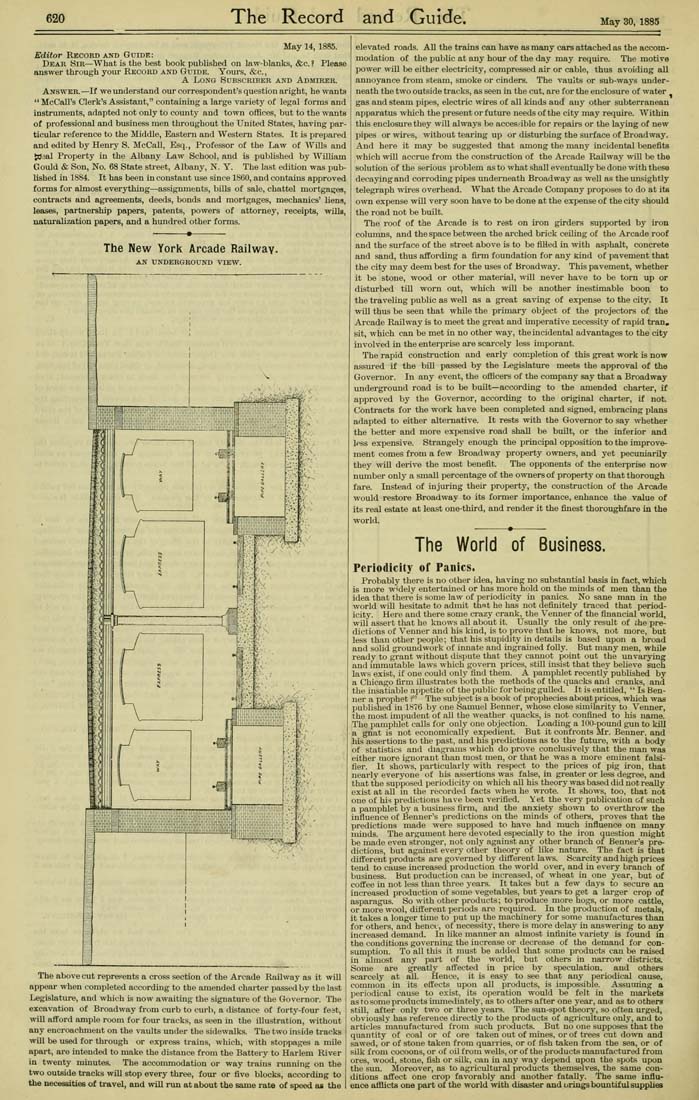
620 The Record and Guide. May 30, 1885 May 14, 1885. Editor Record and Guide: Dear Sir—What is the best book published on law-blanks, &c. ? Please answer through your Record and Gitide. Yours, &c., A Long Subscriber and Admirer. Answer.—If we understand our correspondent's question aright, he wants "McCall's Clerk's Assistant," containing a large variety of legal forms and instruments, adapted not only to county aud town offices, but to the wants of professional and business men throughout the United States, having par¬ ticular reference to the Middle, Eastern and Western States. It is prepared and edited by Henry S. McCall, Esq., Professor of the Law of WiUs and ►dial Property in the Albany Law School, and is pubUshed by William Oould & Son, No. 68 State street, Albany, N. Y. The last edition was pub¬ Ushed in 1884. It has been in coustaut use since 1800, and contains approved forms for almost everything—assignments, bUls of sale, chattel mortgages, contracts and agi-eements, deeds, bonds and mortgages, mechanics' Uens, leases, partnership papers, patents, powers of attorney, receipts, wills, naturalization papers, and a hundred other forms. The New York Arcade Railway. AN underground VIEW. The above cut represents a cross section of the Arcade Railway as it wiU appear when completed according to the amended chai-ter jiassedby the last Legislature, and which is now awaiting the signature of the Governor. The excavation of Broadway from curb to curb, a distance of forty-four feat, wiU afford ample room for four tracks, as seen in the Ulustration, without any eucroachmeut on the vaiUts under the sidewalks. The two inside tracks will be used for through or express trains, which, with stoppages a mile apart, are intended to make the distance from the Battery to Harlem River in twenty minutes. The accommodation or way trains runiung on the two outside tracks wUl stop every three, four or five blocks, according to the necessities of travel, and wiU run at about the same rate of speed aa the elevated roads. AU the trains can have as many cars attached as the accom¬ modation of the public at any hour of the day may require. The motive power wiU bo either electricity, compressed air or cable, thus avoiding all annoyance from steam, smoke or cinders. The vaults or sub-ways under¬ neath the two outside tracks, as seen in the cut, are for the enclosure of water gas and steam pipes, electric wUes of all kinds and auy other subterranean apparatus which the present or future needs of the city may require. Within this enclosure they will always be acces.'ible for repairs or the laying of new pipes or wires, without tearing up or disturbing the surface of Broadway. And here it may be suggested that among the many incidental benefits which wiU accrue from the construction of the Arcade RaUway will be the solution of the serious problem as to what shaU eventuaUy be done with these decaying and corroding pipes underneath Broadway as well as the unsightly telegraph wires overhead. What the Arcade Company proposes to do at its own expense will very soon have to be done at the expense of the city should the road not be built. The roof of the Arcade is to rest on iron girders supported by iron columns, and the space between the arched brick ceUing of the Arcade roof and the surface of the street above is to be tiUed in with asphalt, concrete and sand, thus affording a firm foundation for any kind of pavement that the city may deem best for the uses of Broadway. This pavement, whether it be stone, wood or other material, wiU never have to be torn up or disturbed tiU worn out, which wiU be another inestimable boon to the traveling public as well as a great saving of expense to the city. It wUl thus be seen that whUe the primary object of the projectors of the Ai'cade Railway is to meet the great and imperative necessity of rapid tran. sit, which can be met in no other way, the incidental advantages to the city involved in the enterprise are scarcely less imporant. The rapid constniction and early completion of this great work is now fissured if the bUl passed by the Legislatm-e meets the approval of the Governor. In any event, the officers of the company say that a Broadway underground road is to be buUt—according to the amended charter, if approved by the Governor, according to the original charter, if not. Contracts for the work have been completed and signed, embracing plans adapted to either alternative. It rests with the Governor to say whether the better and more exjiensive road shaU be buUt, or the inferior and less expensive. Strangely enough the principal opposition to the improve¬ ment comes from a few Broadway property owners, and yet pecuniarily they wiU derive the most benefit. The opponents of the enterprise now number only a small i>ercentage of the ownersof property on that thorough fare. Instead of injuring their property, the construction of the Arcade would restore Broadway to its former importance, enhance the value of its real estate at least one-third, aud render it the finest thoroughfare in the world. The World of Business. Periodicity of Panics. Probably there is no other idea, having no substantial basis in fact, which is more widely entertained or has more hold on the minds of men than the idea that there is some law of periodicity in panics. No sane man iu the world will hesitate to admit thnt he has not definitely traced that period¬ icity. Here and there some ci-azy crank, the Venner of the financial world, will assert that he knows all about it. Usually the only i-esult of che pre¬ dictions of Venner and his kind, is to prove that he knows, not more, but less than other people; that his stupidity in details is based upon a broad and soUd gi-oundwork of innate and uigrained foUy. But many men, whUe ready to grant without disijute that they cannot point out tbe unvarying and immutable laws which govern prices, stUl insist that they believe such laws exist, if one could only find them. A pamphlet recently published by a Chicago firm Ulustrates both the methods of the quacks and cranks, and the insatiable appetite ot the public for being gulled. It is entitled, " Is Ben¬ ner a prophet ?" The subject is a book ot prophecies about prices, which was published in 1876 by oue Samuel Benner, whose close similarity to Venner, the most impudent of all the weather quacks, is not confined to his name. The pamphlet calls for only one objection. Loading a 100-pound gun to kiU a gnat is uot economically expedient. But it confronts Mr. Benner. and his a,ssertions to the past, and his predictions as to the future, with a body of statistics and diagrams which do prove conclusively that the man was either more iguorant than most men, or that he was a more eminent falsi¬ fier. It shows, particularly with respect to the prices of pig iron, that nearly everyone of his assertions was false, in greater or less degi-ee, and that the supposed periodicity ou which all his theory was based did not reaUy exist at all in the recorded facts when he wrote. It shows, too, that not oue of his pretUctions have been verified. Yet the very publication of such a pamphlet bj' a business firm, aud the anxiety shown to overthrow the influence ot Benner's predictions ou the minds of others, proves that the predictions made were supposed to have had much influence on many uunds. The argument here devoted especiaUy to the iron question might be made even strouger, not only against auy other brauch of Benner's pre¬ dictions, but agaiust every other theory ot Uke nature. The fact is that different products are governed by different laws. Scarcity and high prices tend to cause iucreased production the world over, and in every branch of business. But production can be increased, of wheat in one year, but of coffee in not less thau three years. It takes but a few days to secure an increased production of some vegetables, but years to get a larger crop of asparagus. So with other products; to produce more hogs, or more cattle, or more wool, different periods are required. In the production of metals, it takes a longer time to put up the machinery for some manufactures than for others, and henci, ot necessity, there is more delay in answering to any increased demand. In like manner an almost infinite variety is found in the conditions governinsi the increase or decrease of the demand for con¬ sumption. To all this it must be added that some products cau be raised in almost any part ot the world, but others in narrow districts. Some are greatly affected in price by speculation, and others scarcely at aU. Hence, it is easy to see that auy periodical cause, common in its effects upou all products, is impossible. Assuming a periodical cause to exist, its operation would be felt in the markets as to some products irmnediately, as to others after one year, and as to others still, after only two or thi-ee years. The sun-spot theory, so otten urged, obviously has refereuce directly to the products of agriculture only, and to articles manufactured from such products. But no one supposes that the quantity of coal or of ore taken out of mines, or of trees cut down and sawed, or of stoue taken from quarries, or of fish taken from the sea, or of sUk from cocoons, or of oil from weUs, or of the products manufactured from ores, wood, stone, fish or silk, cau iu any way depend upon the spots upon the sun. Moreover, as to agricultural products themselves, the same con¬ ditions affect one crop favorably and auother fataUy. The same influ¬ ence aiflicts one part of the world with disaster and urings bountiful suppUes