
Columbia University Libraries Digital Collections: The Real Estate Record
Use your browser's Print function to print these pages.
The Record and guide: v. 36, no. 904: July 11, 1885
Text version:
Please note: this text may be incomplete. For more information about this OCR, view About OCR text.
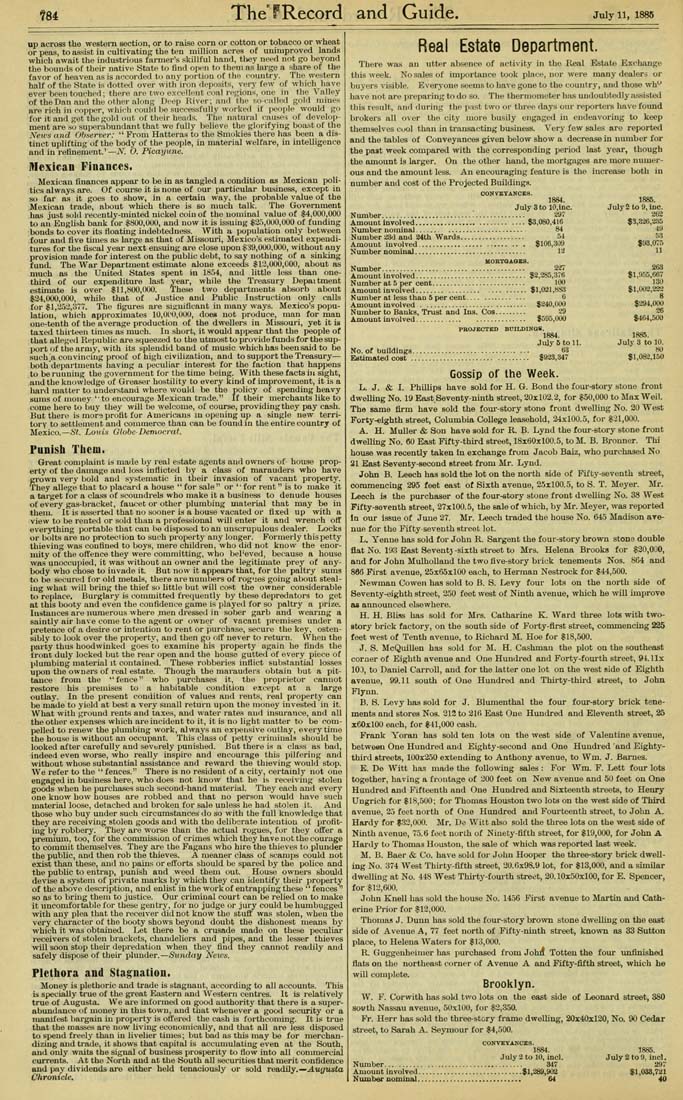
I8i The" FRecord and Guide. July 11, 1886 up across the western section, or to raise corn or cotton or tobacco or wheat or peas, to assist iu cultivating the ten million acres of unimproved lands which await the industrious farmer's skillful hand, tliey need not go beyond the bounds of their native State to find open to them as large a share of the favor of heaven as is accorded to any portion of the country. The western half of the State Is dotted over with iron deposits, very few of which have ever been touched; there are two excellent coal regions, one in the Valley of the Dan and the other along Deep River; and the so-called gold mines are rich in copper, which could be successfully worked if people would go for it aud get the gold out of their heads. The natural causes of develop¬ ment are so sui)erabundantthat we fully believe the glorifying boast of the News and Observer: " From Hatteras to the Smokies there has been a dis¬ tinct uplifting of the body of the people, in material welfare, in intelligence and in refinement.' —iV. O. Picayune. Mexican Finances. Mexican finances appear to be In as tangled a condition as Mexican poli¬ tics always are. Of course it is none of our particular business, except in so far as it goes to show, in a certain way, the probable value of the Mexican trade, about wliich there is so much talk. The Government has just sold recently-minted nickel coiu of the nominal value of $4,000,000 to an English bank for ^800,000, and now it is issuing $25,000,000 of funding bonds to cover its floating indebtedness. With a population only between four and five times as large as that of Missouri, Mexico's estimated expendi¬ tures for the fiscal year next ensuing are close upon $39,000,000, without auy provision made for interest on the public debt, to say nothing of a sinking fund. The War Department estimate alone exceeds $12,000,000, about as much as the United States spent in 1854, aud little less than one- third of our expenditure last year, while the Ti-easury Depaitment estimate is over $11,800,000. These two departments absorb about $24,oiX),000, while that of Justice and Public Instruction only calls for $1,2.52,377. The figures are significant in many ways. Mexico's popu¬ lation, which approximates 10,0l'0,000, does not produce, man for man one-tenth of the average production of the dwellers in Missouri, yet it is taxed thirteen times as much. In short, it would appear that the people of that alleged Republic are squeezed to the utmost to provide funds for the sup- I)ort of the army, with its splendid baud of music which has been said to be such a convincing proof of high civilization, aud to supix>rt the Treasury— bothdepartments having a peculiar interest for the faction that happens to be running the governmeut for the time being. With these facts iu si^ht, ,and the knowledge of Greaser hostility to every kind of improvement, it is a hard matter to understand where would be the policy of spending heavy sums of money ''to encourage Mexican trade." If their merchants like to come here to buy they will be welcome, of course, providing they pay c£ish. But there is more profit for Americans in opening up a single new terri¬ tory to settlement and commerce than can be found in the entire country of Mexico.—-SY. Louis Globe-Democrat. Punish Them. Great complaint is made by real estate agents and owners of- house prop¬ erty of the damage and loss inflicted by a class of marauders who have gi'own very bold and systematic in their invasion of vacant property. They allege that to placard a house '' for sale " or ' • for rent" is to make it a target for a class of scoundreb who make it a business to denude houses of every gas-bracket, faucet or other plumbing material that may be in them. It is asserted that no sooner is a house vacated or fixed up with a view to be rented or sold than a professional will enter it and wrench off everything portable that can be disposed to an unscrupulous dealer. Locks or bolts are no protection to such property any louger. Formerly this petty thieving was confined to boys, mere children, who did not know the enor¬ mity ot the offence they were committing, who beb'eved, because a house was unoccui)ied, it was without an owner and the legitiuiate prey of any¬ body who chose to invade it. But now it appears that, for the paltry sums to be secured for old metals, there are numbers of rog'ies going about steal¬ ing what will bring the thief so little but will cost the owner considerable to replace. Burglary is committ-ed frequently by these depredators to get at this booty and even the confidence game is played for so paltry a prize. Instances are numerous where men dressed in .sober garb and wearmg a saintly air bave come to the agent or owner of vacant premises under a pretence of a desu'e or intention to rent or purchase, secure the key, osten¬ sibly to look over the property, and then go off never to return. \Vhen the party thus hoodwinked goes to examine his property again he finds the front duly locked but the rear open and the house gutted of every piece of plumbing material it contained. These robberies inflict substantial losses upon the owners of real estate. Though the marauders obtain but a pit¬ tance from the '* fence" who purchases it, the proprietor cannot restore his premises to a habitable condition except at a large outlay. In the present coniiition of values and rents, real property can be made to yield at best a very small return upon the money invested in it. What with ground rents and taxes, and water rates aud insurance, and all the other expenses which are incident to it, it is no light matter to be com¬ pelled to renew the plumbing work, always an expensive outlay, every time the house is without an occupant. This class of i)etty criminals should be looked after carefully and sevbrely punished. But there is a class as bad, indeed even worse, who really inspire and encom'age this pilfering and without whose substantial assistance and reward the thieving would stop. We refer to the " fences." There is no resident of a city, certainly not one engaged in business here, who does not know that he is receiving stolen goods when he purchases such second-hand material. They each and every one know how houses are robbed and that uo person would have such material loose, detached and broken for sale uuless he had stolen it. Aud those who buy under such circumstances do so with the full knowledge that they ai*e receiving stolen goods and with tho deliberate intentiou of profit¬ ing by robbery. They ai-e worse than the actual rogues, for they offer a premium, too, for the commission of crimes which they have not the courage to commit themselves. They are the Fagans who hire the thieves to plunder the public, and then rob the thieves. A meaner class of scamps could not exist than these, aud no pains or efforts should be spared by the police and the pubUc to entrap, punish and weed them out. House ownei-s should devise a system of private marks by which they can identify their property of tho above description, and enlist in the work of entrapping these " fences " so as to bring them to justice. Om* criminal court can be relied on to make it uncomfortable for these gentry, for no judge or jury could behmnbugged with any plea that the receiver did not know the stuff was stolen, wheu the very chai'acter of the booty shows beyond doubt the dishonest means by which it was obtained. Let there be a crusade made on these peculiar receivers of stolen brackets, chandeliers aud pipes, and the lesser thieves will soon stop their depredation when they find they cannot readily and safely dispose of their plunder.—Sunday News. Plethora and Stagnation. Money is plethoric and trade is stagnant, accoi'ding to all accounts. This is specially true of the great Eastern and Western centres. It is relatively true of Augusta. We are informed on good authority that there is a super¬ abundance of money in this town, and that whenever a good security or a manifest bargain iu property is offered the cash is forthcoming. It is true that the masses are now living economicaUy, and that all are less disposed to spend freely than in livelier times; but bad as this may be for merchan¬ dizing and trade, it shows that capital is accumulating even at the South, and only waits the signal of business prosperity to flow into all commercial currents. At the North and at the South all securities that merit confidence and pay dividends are either held tenaciously or sold rea^lily.-^Augusta Chronicle. Real Estate Department. There was an utter absence of acti\ ity in tho Real Estate Exchange this week. No sales of importance took place, nor were many dealers or buyers visible. Everyone seems to have gone to the country, and those wh^ have not are preparing to do so. The thermometper has undoubteilly assisted this result, aufl during the p.ist two or three days our reporters have found brokers all o\cr the city more busily engaged in endeavoring to keep themselves cuol than in transacting business. Very few sales are reported and the tables of Conveyances given below show a decrease in number for the past week compared with the corresponding period last year, though the amount is larger. On the other hand, the mortgages are moro numer¬ ous and the amount less. An encouraging feature is the increase both in number and cost of tho Projected Buildings. CONVBYANCES. 1884. 1885. July 3 to 10,lnc, July 2 to It, inc. Number $3,: 263 4y $93,075 11 $l,n.55.667 130 $1,002,223 8 $294,000 26 $404,500 1885. July 3 to 10. HO $1,082,150 ___ 297 Amount involved.............................$3,080,416 Number nominal............................ 84 Number aS-J and 34th Wards.................. 54 Amount involved.......................... $100,309 Numi>er nominal...................... ........ 1^ UOBTGAOES. Number...................................... 227 Amount involved............................... $2,285,376 Number at 5 per cent.......................... ^00 Amount involved...........................$1,031,883 Number at less than 5 per cent............... 6 Amount involved ............................. $240,000 Number to Banks, Trust and Ins. Cos......... 29 Amount involved........ .................. $595,000 PROJECTED BmLDINQS. 1884. July B toll. No. of buildings................................ 63 Estimated coat ................................ $923,347 Gossip of the Week. L. J. & I. Phillips have sold for H. G. Boud the fom"-story stone front dwelling No. 19 East Seventy-nmth street, 20x102.2, for ;?50,000 to Max Weil. The same firm have sold the fom--story stone front dwelling No. 20 W^est Fort>'-eighth street, Columbia College leasehold, 24x100.5, for $21,000. A. H. Muller & Son have sold for R. B. Lynd the four-story stone front dwelling No. 60 East Fifty-third street, 18x60x100.5, to M. B. Bronner. Thi house was recently taken In exchange from Jacob Baiz, who purchased No 21 East Seventy-second street from Mr. Lynd. John B. Leech has sold the lot on the north side of Fifty-seventh street, commencing 295 feet east of Sixth avenue, 25x100.5, to S. T. Meyer. Mr. Leech is the purchaser of the four-story stone front dwelling No. 38 West Fifty-seventh street, 27x100.5, the sale of which, by Mr. Meyer, was reported in our issue of Juue 27. Mr. Leech ti-aded the house No. 645 Madison ave¬ nue for the Fifty-seventh street lot. L, Yenne has sold for John R. Sargent the four-story brown stone double flat No. 193 East Seventy -sixth street to Mrs. Helena Brooks for $20,000, and for John Mulhollaud the two five-story brick tenements Nos. 8G4 and 866 First avenue, 25x65x100 each, to Herman Nestrock for $44,500. Newman Cowen has sold to B. S. Levy four lots on the uorth side of Seventy-eighth street, 250 feet west of Ninth avenue, which he will improve as announced elsewhere. H. H. Bliss has sold for Mrs. Catharine K. Ward three lots with two- story brick factory, on the south side of Forty-first street, commencing 225 feet west of Tenth avenue, to Richard M. Hoe for $18,500. J. S. McQuillen has sold for M. H. Cashman the plot on the southeast corner of Eighth avenue and One Hundred and Forty-fourth street, 9-l.llx 103, to Daniel Carroll, and for the latter one lot on the west side of Eighth avenue, 99.11 south of Oue Hundred and Thirty-third street, to John Flynn. B. S. Levy has sold for J. Blumenthal the four four-story brick tene¬ ments and stores Nos. 212 to 216 East Oue Hundred and Eleventh street, 25 x60xl00 each, for $41,000 cash. Frank Yoran has sold ten lots on the west side of Valentine avenue, betwe«i One Hundred and Eighty-second and One Hundred 'and Eighty- third streets, 100x2.50 extending to Anthony avenue, to Wm. J. Barnes. E. De Witt has made the following sales : For Wm. F. Lett four lots together, having a frontage of 200 feet on New avenue and 50 feet on One Hundred and Fifteenth aud One Hundred and Sixteenth streets, to Henry Ungrich for $18,500; for Thomas Houston two lots on the west side of Third avenue, 25 feet north of One Hundred and Fom"teenth street, to John A. Hardy for $32,000. Mr. De Witt also sold the three lots on the west side of Ninth avenue, 75.6 feot north of Niuety-fifth street, for $19,000, for John A Hardy to Thomas Houston, the sale of which was reported last week. M. B. Baer & Co. have sold for John Hooper the three-story brick dweU¬ ing No. 374 West Thh-ty-fifth street, 20.6x98.9 lot, for $13,000, and a similar dwelling at No. 448 West Thh-ty-fouith street, 20.10x50x100, for E. Spencer, for $12,600. John Knell has sold the house No. 1456 First avenue to Martin and Cath¬ erine Pi-ior for $12,000. Thomas J. Dunn has sold the four-story brown stone dwelling on the east side of Avenue A, 77 feet north of Fifty-ninth street, known as S3 Sutton place, to Helena Waters for $13,000. R. Guggeuheimer has purchased from John Totten the fom* unfinished fiats on the northea.st corner of Avenue A and Fifty-fifth street, which he will complete. Brooklyn. W. F. Corwith has sold two lots on the east side of Leonard street, 380 south Nassau avenue, 50x100, for $2,350. Fr. Herr has sold the three-story frame dweUing, 20x40x120, No. 90 Cedar street, to Sarah A. Seymour for $4,500. CONVKYAUCE3. 1884. July 2 to 10, incl. Number.................................... 347 Amount involved.............................$1,289,902 Nunil>er nominai............................. 64 1885. July 2 to 9. incl. 297 $1,038,721 40