
Columbia University Libraries Digital Collections: The Real Estate Record
Use your browser's Print function to print these pages.
The Record and guide: v. 36, no. 915: September 26, 1885
Text version:
Please note: this text may be incomplete. For more information about this OCR, view About OCR text.
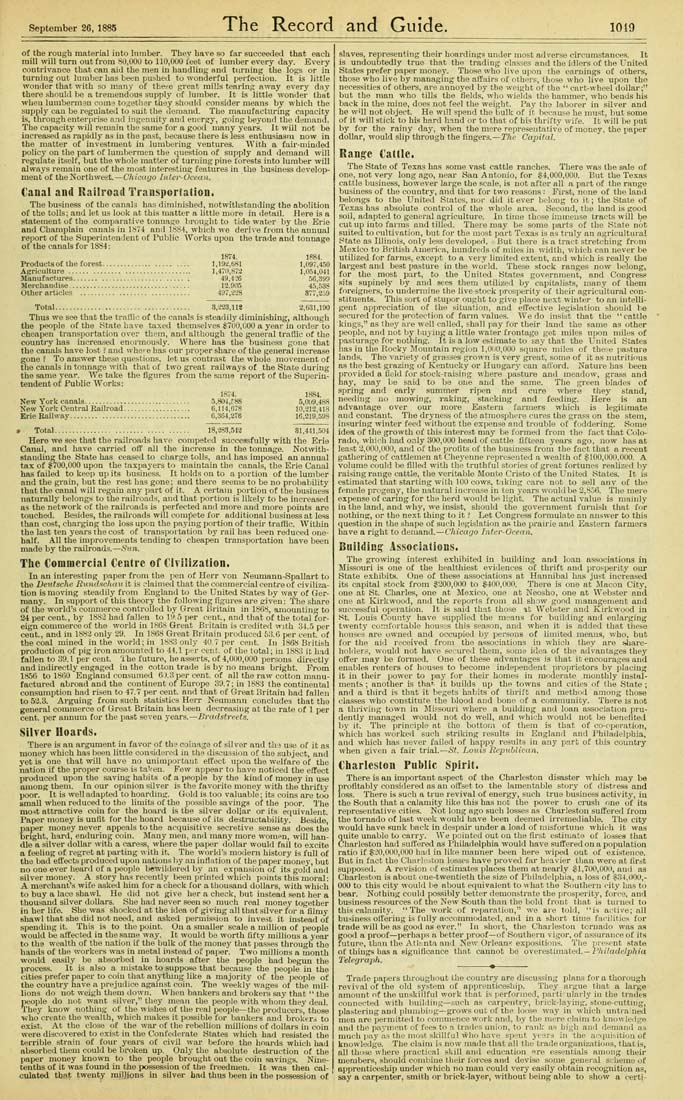
September 26, 1885 The Record and Guide. 1019 of the rough material into lumber. They have so far succeeded that each mill will turn out from 80,000 to 110,000 feet of lumber every day. Every conti'ivance that can aid the men in handling and turning the logs or in turning out lumber has been pushed to wonderful perfection. It is Uttle wonder that with so raany of the^e great mills tearing away every day there should be a tremendous suppl}' of lumber. It is Uttle wonder that wheu lunibermgu come to.^ether they should consider meaus by which the supply cau be regulated to suit the demand. The manufacturing capacity is, through enterprise and ingenuity and energy, going beyoud the demand. The capacity will remain the same for a good many years. It wUl not be iucreased as rapidly as iu the past, because there is less enthusiasm now in the matter of investment in lumbering ventures. "With a fair-nnnded policy on the part of lumbermen the question of supply and demand will regulate itself, but the whole matter of turning pine forests into lumber will always remain one of the most interesting features in the business develoi>- meut of the Northwest.—Chicago Inter-Ocean, Canal and Railroad Transportation. The bu'^iness of tbe canals has dimiiushed, notwithstanding the abolition of the tolls; and let us look at this matter a little more in detail. Here is a statement of the comparati\*e tonnage brought to tidewater by the Erie and Champlain canals in 1874 and 1884, which we derive fj'om the annual report of the Superintendent of PubUc Works upou the trade and tonnage of the canals for 1884: 1874. IP&l. Products of the forest....................... ],lftiJ,681 1,097,450 Agriculture ................................. 1,470,872 l,0.'i4,041 Manufactures.............................. 49,4-:;6 56,399 Merchandise.................................. 13.005 45,598 Other articles ............................. 497,228 877,309 Total............. ...................... 8,v'23,118 3,631,190 Thus we see that the trafUc of the canals is steadily diminishing, although the people of the State have taxed themselves ^700,000 a year in order to cheapen transportation over them, and although the geueral trafUc of the counti'y has iucreased enormously. Where has the business gone that the canals have lost ? and where has our proper share of the general increase gone ? To answer these questions, let us coutrast the whole movement of the canals in tonnage with that of two great railways of the State during the same year. We take the figui'es from the s^ime report of the Superin¬ tendent of Public Works: 1874. 18S4. New York canals.............................. 5,804,588 5,009,488 New York Central Railroad................... 6,114,078 10,313,418 Erie Railway................................. 0,364,276 16,310,598 » Total................................... 18,383,513 31,411,504 Here we see that the railroads have competed successfully with the Erie Canal, and have carried off all the increase in the tonnage. Notwith- stauding tho State has ceased tti charge tolls, and has Imposed an annual tax of i?700,000 upon the taxpayers to maintain the canals, the Erie Caual has failed to keep up its business. It holds on to a portion of the lumber and the grain, l:)ut the rest has gone; and there seems to be no probability that the canal will regain any part of it. A certam portion of the business naturally belongs to the railroads, and that portion is likely to be increased as the network of the railroads is perfected and more and more points aro touched. Besides, the raUroads will compete for additional business at less than cost, charging the loss upou the paying portion of theu* traffic. Within the last ten years tho cost of transportation bj'-rail has been reduced one- half. AU the improvements tending to cheapen transportation have been made by the railroads.—-S'toi. The Commercial Centre of Ciyilization. In an interesting paper from the pen of Herr vou Neumann-Spallart to the Deutsche Rundschau it is claimed that the commercial centre of civiliza¬ tion is moving steadily from England to the United States by way of Ger¬ many. In support of this theory the following figures are given: The share of the world's commerce controUed by Great Britain in 1868, amounting to 24 per cent., by 1883 had fallen to 19.5 per cent., and that of the total for¬ eign commerce of the world in 1868 Great Britain is credited with 34.5 per cent., and in 1882 only 29. In 1808 Greafc Britain produced 6;J.O per cenfc. of the coal mined iuthe world; in 1883 only 40.7 per cent. In 1868 British production of pig iron amounted to 44.1 per cent, of the total; iu 1883 ifc had fallen to 39.1 per cent, 'ihe futm-e, he asserts, of 4,000,000 persons directly and indirectly engaged in the cotton trade is by no means bright. From 1856 to 1860 England consumed 6.).3per cent, of all the raw cotton manu¬ factured abroad and the continent of Europe 39.7; iu 1883 the continental consumption had risen to 47.7 per cent, and that of Greafc Britain had fallen to 5'3.3. Arguing from such statistics Herr Neumann concludes that the general commerce of Great Britain has beeu decreasing afc fche rafce of 1 per cent, per annum for the past seven j'ears.—Bradstreets. Silver Hoards. There is an argument in favor of th? coinage of silver and the use of it as money which has boon Uttle considered in tho discussiou of the subject, and yet is oue that wiU have no unimportant effect upon tho welfare of the nation if the proper course is taVen. Few appear to have noticed the effect produced upon the saving habits of a people by the kind of money in use among them. In our opinion sUver is the favorite money with the thrifty poor. It is well adapted to hoarding. Gold is too valuable; its coins are too small wheu reduced to the Umits of the possible savings ofthe poor. The most attractive coin for the hoard is the silver dollar or its equivalent. Paper money is unfit for the hoard because of its destructability. Beside, paper money never appeals to the acquisitive secretive sense as does the bright, hard, enduring coin. Many men, and many more women, will han¬ dle a silver dollar with a caress, where the paper dollar would fail to excite a feeling of regret at parting ■\^•ith it. The world's modem history is full of the bad effects produced upon nations by an infiation of the paper mone3', but no one ever heard of a people l>ewildered by an exjiansiou of its gold and silver money. A story has recently been printed whi<'h p^tints this moral: A merchant's wife asked him for a check for a thousand doUars, with which to buy a lace shawl. He did not give her a check, but instead senfc her a thousand silver dollars. She had never seen so much real money together in her life. She was shocked at the idea of giving aU that silver for a filmy shawl that she did not need, and asked permissit.n to invest it instead of spending it. This is to the point. On a smaller scale a miUion of people would be affected in the same way. It would bo worth fifty millions a year to the wealth of the nation if tho bulk of the money that passes through the hands of the w^orkers was in metal instead of paper. Two milUons a month would easily be absorbed iu hoards after the people had begun the process. It is also a mistake to suppose that because the people in the cities prefer paper to coiu that anything like a majority of the people of the country have a prejudice against coin. The weekly wages ot the mil¬ lions do nofc weigh them down. When bankers and brokei-s say that " the people do not want silver," they mean the people with whom they deal. They know nothing of the wishes of the real people—the producers, those who create the wealth, which makes it possible for bankers and brokers to exist. At the close of the war of the rebellion mUIions of dollars iu coin were discovered to exist in the Confederate States which had resisted the terrible strain of four j'ears of civU war before the hoards which had absorbed them coiUd bo broken up. Only the absolute destruction of the paper money known to the people brought out the coiu savings. Nine- tenths of it was found in the possession of the freedmen. It was then cal¬ culated that twenty millions in silver had thus been in the possession of slaves, representing their hoardings under most adverse circumstances. Ifc is undoubtedly true that the trading classes and the idlers of the United States prefer paper money. Those who live upon the earnings of others, those who live by managing the affairs of others, those who live upon the necessities of others, are annoyed by tbe weight of tho " cart-wheel dollar;" bufc the mau who tills tho fields, who wields the hamraer, who beads his back in the mine, does not feel the weight. Pay tho laborer in silver and he w'll not object. He will spend the bulk of it because he must, but sorae of it wUl stick to his hard hand or to that of his thrifty wife. It will be put by for tho rainy day, when the mere representative of raoney, the paper doUar, would slip through the fingers.—T/jc Cajiital, Range Cattle. The State of Texas has some vast cattle ranches. There was the sale of one, not very long ago, uear San Antonio, for ^4,000,000. But the Texas cattle business, however large the scale, is not after all a part of the range business of tho country, and that for two reasons : First, none of the land belongs to the United Stales, nor did it ever belong to it; the State of Texas has absolute control of the whole area. Second, the land is good soil, adapted to genej-al agriculture. In time those immense tracts will be cut up iuto farms and tilled. There may be sorae parts of the State not suited to cultivation, but for the most pai*t Texas is as ti-uly an agricultural State as Illinois, ouly less developed. But there is a tract stretching from Mexico to British America, hundreds of miles in width, which can never be Utilized for farms, except to a very limited extent, and which is really the largest and best pasture in the world. These stock ranges now belong, for the most part, to the United States government, and Congress sits supinely by and sees them utilized by capitaUsts, many of them foreigners, to undermine the live-stock prosperity of their agricultural con¬ stituents. This sort of stupor ought to give place next wintej- to an intelli¬ gent appreciation of the situation, and effective legislation should be secured for the protection of farm values. We do insist thafc the "cattle kiugs," as Ihey are well called, shall pay for their land the same as other people, and not b3M»ujing a little wat«r frontage get miles upon miles of pasturage for nothing. It is a low estimate to say thafc the United States has in the Rocky Mountain region 1,01)0,000 scpiare miles of the^e pasture lands. The variety of grasses grown is very great, some of it as nutritious as the best grazing of Kentucky or Hungary can afford. Nature has been lirovided a field for stock-raising where pasture and meadow, grass and hay, may bo said to be one and the same. The green blades of spring and early summer ripen and cure where they stand, needing no mowing, raking, stacking and feeding. Hero is an advantage over our more Eastern farmers which is legitimate and constant. The dryness of the atmosphere cures the grass on tho stem, insuring winter feed without the expense and trouble of foddering. Some idea of the growth of this interest may he formed from the fact that Colo¬ rado, which had only 3*-)0,000 head of cattle fifteen years ago, now has afc least 2,000,000, and of the profits of the business from the fact that a recent gathering of cattlemen at Cheyenne represented a wealth of ^100,000.000. A volume could be filled with the truthful stories of great fortunes realized by raising range cattle, the veritable Monte Cristo of the Uiuted States. It is estimated that starting with 100 cows, t iking care nofc to sell any of the female progonj', the natural increase in ten years woulil be 2,856. The mere expense of caring for the herd would be light. The actual value is mainly in the land, and why, we insist, should the goverument furnish that for nothing, or tho next thiug to it ? Let Congress formulate an answer fco this question in the shape of such legislation as the prairie aud Eastern farmers have a right to demand.—Chicago Inter-Ocean. Building Associations. The growing interest exhibited in buildiug and loan associations in Missouri is one of the healthiest evidences of thrift aud prosperity our State exhibits. Oue of these associations at Hannibal has just iucreased its capital stock from $200,000 to §400,000. Tbere is one at Macon City, one at St. Charles, one at Mexico, ono at Neosho, one afc Webster and one at Kirkwood, and the reports from all show good management and successful operation. It is said thafc those afc Webster and Kirkwood in St. Louis County have supplied fche means for building aud enlarging twenty comfortable houses this season, and when it is added that these houses aro owned and occupied by persons of limited means, who, but for the aid received from tho associations iu w^hich they are ^are- holilers, would not have secured them, sorao idea of the advantages they offer may be formed. One of these advantages is that ifc encourages and enables renters of houses to become independent lirojjrietors by i)Iaciug ifc in fcheir power fco pay fur their homes in raodei'ate raouthly instal¬ ments ; another is tha*". it builds up the towns and cities of the State ; and a third is that ifc begets habits of thrift and method among those classes who constitute the blood and boue of a community. There is nofc a thriving town in Missouri where a building and loan association pru¬ dently managed would nofc do well, and which would nofc be benefited by it. The principle at the bottom of them is tbat of co-operation, which has worked such striking results in England and Philadelphia, and which has never failed of happy results in any parfc of this country when given a fair trial.—St. Louis Rejmblican. Charleston Public Spirit. There is an important aspect of the Charleston disaster which may be f)rofltably considered as an offset to the lamentable story of distress and OSS. There is such a true revival of energy, such true business acfcivity, in the South that a calamity Uke this has not the power to crush one of its representative cities. Not long ago such losses as Charleston suffered from the tornado of last week would have been deemed irremediable. The cifcy would have sunk back in despair under a load of misfortune which ifc was quite unable to carry. We pointetl out ou the fir^t estimate of losses that Clmrleston had sufi'ered as Philadelphia would have suffered on a population ratio if $20,000,000 had in like mauner been here wiped oufc of existence. But in fact tho Charleston losses have proved far heavier than were at first supposed. A revision i>f estimates places them at nearly :^1,700,001), aud as Charleston is about une-twentieth the size of PbiUdelphia, a loss of ?;34.000,- 000 to this city would I'O about eipiivalent to what the Southern cifcy has to bear. Nothing could possibly belter demon-strate the prosperity, force, and business resources of the New South than the bold front that is turned to this calamity. "The work of reparation," wo are told, "is arlive; all business offering is fully accommodated, and in a short timo facilities for trade will be as good as ever." In short, the Charleston tornado was as good a proof—perhaps a bettei- proof—of Southern vigor, of assurance of its future, than th« Athiiita and New Orleans expositions. The jiresent state of things has a significance that cannot bo overestimated. —P/n7arft'(p/iia Telcgrajih. Trade papers throughout fche country are discussing plans fora thorough revival of the old system of apprenticeship. They argue that a large amount nf the unskillful work that is iierformed, particularly in the trades connected with building—such as carpentry, brick-laying, stone-cuttmg, plastering aud plumbing—grows oufc of the loose way in which untrained meu are permitted to commence work and, by the mere claim to knowledge and the payment of fees to a trades uninn, to rank as high and demand as much pay as the most skillful wild have spi^ut ye;u-s in the acquisition of knowledge. The claim is n()w made that all the trade organizations, that is, all those where practical skill and education "re essentials among their members, should combine their forces and devise some geueral scheme of apprenticeship uuder which no mau could very easily obtain recognition as, say a carpenter, smith or brick-layer, without being able to show a certi-