
Columbia University Libraries Digital Collections: The Real Estate Record
Use your browser's Print function to print these pages.
The Record and guide: v. 36, no. 926: December 12, 1885
Text version:
Please note: this text may be incomplete. For more information about this OCR, view About OCR text.
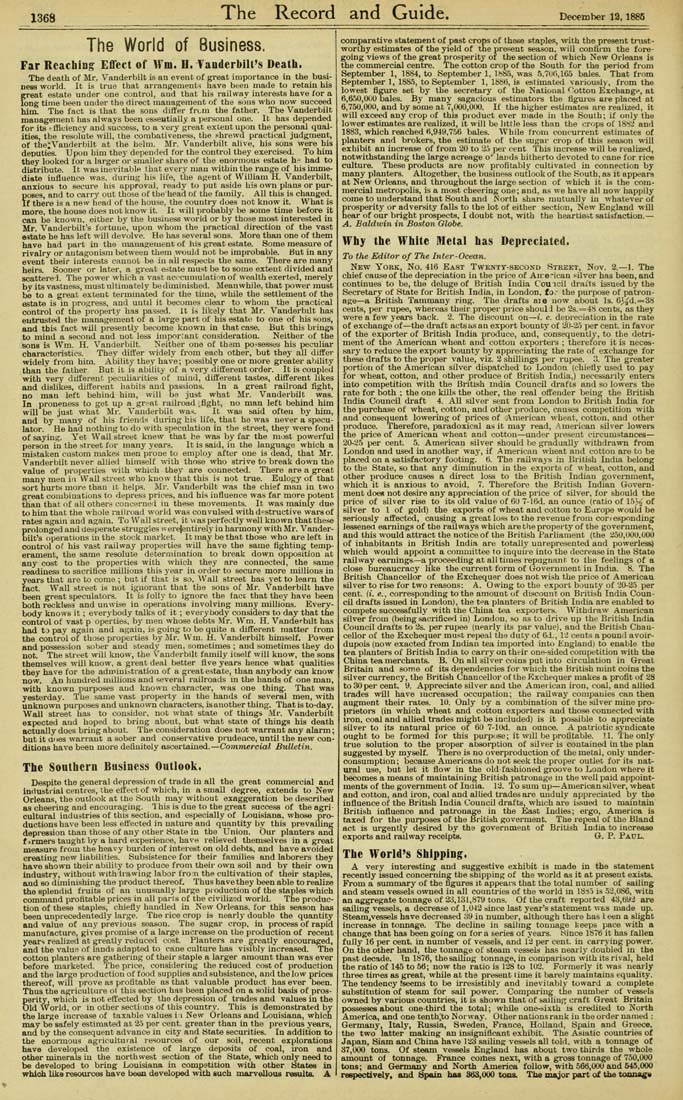
1368 The Record and Guide. December 13, 1886 The World of Business. Far Reaching Efiect of Wm. H. Tauderbilt's Death. The death of Mr. Vanderbilt is an event of great importance in the busi¬ ness world. It is true that arrangements have beeu made to retain his great estate under one control, aud that his railway interests have lor a long time been under the direct management of the sous who now succeed him. The fact is that the sons dift'er frcm the father. The Vanderbilt management has always been essentially a personal one. Ifc has depended for its t fficiency and success, to a very great extent upon the personal qual¬ ities, the i-esolute will, the combativeness, the shrewd practical judgment, of the;VanderbUt at the helm. Mr. VanderbUt alive, his sons were his deputies. Upon him they depended for the control they exercised. To him they looked for a larger or smaUer share of tho enormous estate h'^ had to distribute. It was inevitable that every mau within the range of his imme¬ diate influence was. duriug his life, the agent of William H. Vanderbilt. anxious to secure his approval, ready to put aside his owu plans or pur¬ poses, and to carry out those of the head of the family. All this is changed. If there is a new head of the house, the country does not know it. What is more, the house does not know ifc. It will probably be some time before it can be known, either by the business world or by those most interested in Mr, Vanderbilt's fortuue, upon whom the practical direction of the vast ©state he has left will devolve. He has several sons. More than one of them have had part in the management of his great estate. Some measure of rivalry or antagonism between thera would not be iraprobable. But in any event their interests cauuot be iu aU respects the same. There are many heirs. Sooner or later, a great estate raust be to some extent divided and scattered. The power which a vast acccunmlationof wealth exerted, merely by its vastness, raust ultimately be diminished. Meanwhile, that power must be to a great extent termmated for the tirae, while the settlement of the estate is in progress, and until it becomes clear to whom the practical control of tho property has passed, it is likely that Mr. VanderbUt has entrusted the management of a large part of his estate to one of his sons, and this fact wUl presently become known in that case. But this brings to mind a second and uot less impor.'ant consideration. Neither of the sons is Wm. H. Vanderbilt. Neither one of them po-sesses his peculiar characteristics. They differ widely from each other, but they all differ widely from him. Ability they have; possibly one or more greater abiUty than the father But it is ability of a very different order. It is coupled with very different i:)eculiarities of mind, differenfc tastes, different likes and dislikes, different habits and passions. In a great raUroad fight, no man leffc behind him, will be jusfc what Mr. Vanderbilt was. In proneness to gefc up a grr^afc railroad [.fight, no man left behind him will be just what Mr. VanderbUt wa-*. Ifc was said often by him, and by many of his friends during his life, that he was never a specu¬ lafcor. He had nothing to do with speculation in the street, they were fond of sayiug. Yet Wall street knew that he was by far the m.:«t powerful person in the street for many years. It is said, in the language which a mistaken custom makes men proue to employ after one is dead, that Mr. Vanderbilt never alUed himself with those who strive to break down the value of properties with which they are connected. There are a great many men ifi WaU street who kuow that this is nofc true. Eulogy of that sort hurts more thau it helps. Mr. Vanderbilt was the chief mau in two great combinations to depress prices, and his influence was far more potent than that of all others concerned iu these movements- It was mainly due to him tbat the whole railroad world was convulsed withd*^structive wars of rates again and again. To Wall street, ifc was perfectly well known that these Erolonged and desperate struggles ^^ ei'e|entirely in harmony with Mr. Vander- ilt's operations iu the stock market. It may be that those who are left in control of his vast railway properties will have the sarae fighting temp¬ erament, the same resolute determination to break down opposition at any cost to the properties with which they are connected, the same readiness to sacrifice mUlions this year in order to secure more millions in years tbat are to come ; but if that is so, Wall street has yet to learn the fact. Wall street is not ignorant that the sous of Mr. Vanderbilt have been great speculatoi'S. It is folly to ignore the face thafc they have been both reckless and unwise iu operations involving many miUions. Every¬ body knows it; everybody talks of it ; everybody considers to day thafc the control of vast p operties, by men whose debts Mr. Wm. H. VanderbUt has had t^ pay agam and agaiu, is going to be quite a different matter from the control of those properties by Mr. Wm. H. VanderbUt himself. Power and possession soijer aud steady raen. sometiraes ; and sometimes they do not. The street will know, the Vanderbilt faraUy itself will know, the sons themselves wUl kuow, a great deal better five years hence what qualities they have for the admiuiatiation of a great estate, than anybody can know now. An hundred milUons and several railroads in the bands of one man, with known purposes aud known character, was one thing. That was yesterday. The same vast property in the hands of several men, with unknown purposes and unknown characters, is another thing. That is to-day. WaU street has to consider, uot what state of things Mr. Vanderbilt expected aud hoped to bring about, but what state of things his death actuaUy does bring about. The consideratiou does not warrant any alarm; but it Ooes warraut a sober and conservative piiidence, until the new con¬ ditions have been more definitely ascertained.—Commercial Bulletin. The Southern Business Outlook. Despite the general depression of trade in all the great coraraercial and industrial centres, the effect of which, in a sraaU degree, extends to New Orleans, the outlook at the South raay without exaggeration be described as cheering aud encouraging. 1 his is due to the great success of the agri¬ cultural industries of this section, and especially of Louisiana, whose pro¬ ductions have been less effected in nature and quantity by this prevaiUng depression than those of any other State in the Union. Our planters and farmers taught by a hai'd experience, have relieved theraselves in a great measure from the heavy burden of interest on old debts, and have avoided creating new liabilities. Subsistence for their famiUes and laborers they have showu their ability to produce from their own soil and by their own industry, without with hawing labor fro-n the cultivation of their staples, and so diminishing the product thereof. Thus have they been able to realize the splendid fruits of au unusually large production of the staples which command profitable prices in all parts of the civilized world. The produc¬ tion of these staples, chiefly handled in New Orleans, for this season has been unprecedentedly large. The rice crop is nearly double the quantity and value of any previous season. The sugar crop, in process of rapid manufacture, gives promise of a large increase on the production of recent years realized at greatly reduced cost. Planters are greatly encouraged, and the value of lands adapted to cane culture has visibly increased. The cottou planters are gathering of their staple a larger araount than was ever before raarketed. The price, considering the reduced cost of production and the large production of food supplies and subsistence, and the low prices thereof, wiU prove as profitable as that valuable product has ever been. Thus the agriculture ol this section has been placed on a solid basis of pros¬ perity, which is not eft'ected by the depression of trades and values iu the Old World, or in other sections of this country. This is demonstrated by the large increase of taxable values ii New Orleans and Louisiana, which may be safely estimated afc 25 per cent, greater than in the previous years, and by the consequent advance in city and State securities. In addition to the enormous agricultural resources of our soil, recent explorations have developed the existence of large deposits of coal, iron and other minerals iu the northwest section of the State, which only need to be developed to bring Louisiana in competition with other States in which Uke resources have been developed with such m&rveUous results. A comparative statement of past crops of these staples, with the present trust¬ worthy estimates of the yield of tne present season, will confirm the fore¬ going views of the great prosperity or the section of which New Orleans is the commercial centre. The cotton crop of the South for the period frora September 1, 1884, to September 1. l^So, was .5.7u(l,l65 bales. That from September 1, 188.5, to September 1, 18bb, is estimated variousl>, from the lowest figm'e set by the secretary of the National Cotton Exchange, at 6,650,000 bales. Bj" many sagacious estimatoi-s the figures are placed at 6,7.50,000, and by some afc 7,000,000. If the higher estimates are realized, it will exceed any ci-op of this product ever made iu the South; if only the lower estimates are realized, it wUl be little less than the crops of 188:3 and 1883, which reached 6,949,7.56 bales. While from concurrent estimates of planters and brokers, the estimate of the sugar crop of this season vrill exhibit an increase of frora 20 to 35 per cent This increase will be reaUzed, notwithstanding the large acreage o*^^ lands hitherto devoted to cane for rice culture. These products are now profitably cultivated in connection by many planters. Altogether, the business outlook of the South, as it appears at New Orleans, and throughout the large section of which it is the com¬ mercial metropolis, is a most cheering one; and, as we have all now happily come to understand that South and North share mutually in whatever of Erosperity or adversity faUs to the lot of either section, New England will ear of our bright prospects, I doubt not, with the heartiest satisfaction.— A. Baldwin rn Boston Globe. Why the White Metal has Depreciated. To the Editor of The Inter-Ocean. New York, No. 416 East Twenty-second Street, Nov. 2.—I. The chief causeof the depreciation in the price of Ane-'ican silver has been, and continues to be, the deluge of British India Council draits issued by the Secretary of State for British India, in London, fo.' the purpose of patron¬ age—a British Tammany ring. The drafts aie uow about Is. 6^^d.=38 ceuts, i>er rupee, whereas their proper price shoull be 2s.=48 cents, as they were a few years back. 2. The discount on—i. e. depreciation in the rate of exchange of—the di'aft acts as an export bounty of 20-25 per cent, in favor of the exporter of British India produce, and, consequent!)', to tbe detri¬ ment of tne American wheat and cottou exportei"S ; therefore it is neces- sai')'" to reduce the export bounty by appreciating the rate of exchange for these drafts to the proper value, viz. 2 shiUings per rupee. 3. The greater portion of the American silver dispatched to London (chiefly used to pay for wheat, cotton, and other produce of British India,) necessarily entei-s iuto competition wifch tho British India Council di'afts and so lowers the rate for both ; the oue kUls the other, the real offender being the British India CouneU draft 4. AU sUver sent from London to British India for the purchase of wheat, cotton, and other produce, causes competition with and consequent lowering of prices of American wheat, cotton, and other produce. Therefore, paradoxical as it may read, Araerican silver lowei-s the price of American wheat and cotton—under present circurastances— 20-^^5 per cent. 5. American silver should be graduaUy withdrawn from London aud used in another way, if American wheat aud cottou are to be placed on a satisfactory footiug. 6. The raUways in Bi itish India belong to the State, so that any diminution in the exports of wheat, cotton, and other produce causes a direct loss to tho British Indian goveniment, which it is anxious to avoid. 7. Therefore tho British Indian Govern¬ ment doe« not desire any appreciation of the price of sUver, for should the price of silver rise to its old value of 60 7-I6d. an ounce (ratio of 153^ of silver to 1 of gold) the exports of wheat and cotton to Earope would be seriously affected, causing a great loss to the revenue from con esp>onding lessenert earnings of the raUways which are the property of the government, and this would attract the notice of the British Parliament (the 2.50,000.000 of inhabitants in British India are totally unrepresented and powerless) which would appoint a committee to iuquii-e into the decrease in the State raUway earnings—a proceeding at all times repagnanh to the feelings of a close bureaucracy like the current form of tiovernment in India. 8. The British ChanceUor of the Exchequer does not wish the price of Americau sUver to rise for two reasons: A. Owing to the export bounty of 20-25 per cent. (i. e., corresponding to the amount of discount on British India Coun¬ eU drafts issued in London), the t'^a planters of British India are enabled to compete successfully with the China tea exporters. Withdraw American silver from (being sacrificed in) London, so as to drive up the British India Council drafts to 2s. per rupee (nearly its par value), and the British Chau- ceUor of the Exchequer must repeal tho duty of 6d., 12 ceuts a pouutl avoir¬ dupois (now exacted from Indian tea imported into England) to enable the tea planters of British India to carry on their one-sided competition with the China tea merchants. B. On all silver coins put into circulation in Great Britain and some of its dei>endencies for which the British mint coins the sUver currency, the British ChanceUor ofthe Exchequer makes a profit of 28 to30per cent. 9. Appreciate silver and the American iion, coal, and allied trades wUl have increased occupation; the raUway companies can then augment their rates. 10. Only by a combination of the sUver mine pro¬ prietoi's (in which wheat and cotton exporters aud those connected with iron, coal and allied trades might be included) is it possible to appreciate silver to its natural price of 60 7-lOd. an ounce. A patriotic syndicate ought to be formed for this purpose; it will be profitable. 11. Theonly true solution to the proper absorption of silver is contained in the plan suggested by myself. There is no overproduction of the raetal, ouly under¬ consumption; because Americans do not seek the proper outlet for its uat¬ ural use, but let it flow in the old fashioned groove to London where it becomes a means of maintaining British patronage iu the well paid appoint¬ ments of the government of India. 12. To sum up—American silver, wheat and cotton, and iron, coal and alUed trades are miduly appreciated by the influence of the British India Council drafts, which are issued to maintain British influence and patronage iu the East Indies; ergo, America is taxed for the purposes of the British goverment. The repeal of tho Bland act is urgently desired by the government of British India to increase exports and railway receipts. G. P. Paul, The World's Shipping. A very interesting and suggestive exhibit is made in the statement recently issued concerning the shipping of tho world as it at present exists. From a summary of the figures it appears that the total number of saUing and steam vessels owned in all countries of the world in 18:S5 is .52,086, with an aggregate tonnage of 33,131,879 tons. Of the craft reported 43,692 are sailing vessels, a decrease of 1,042 since last year's statement was made up. Steam^vessels have decreased 39 in number, although there has leen a slight increase in tonnage. The decline in sailing tonnage keeps pace with a change that has been going on for a series of years. Since 1876 it has fallen fully 16 per cent, in number of vessels, and 12 per cent, in cai'rying power. On the other hand, the tonnage of steam vessels has nearly doubled iu the past decade. In 1876, the saiUug tonnage, in comparison with its rival, held tbe ratio of 145 to 56; uow the ratio is 128 to 102. Forraeriy it was nearly three times as great, whUe at the present lime ifc barelj' maintains equality. The tendency^ fseeras to be irresistibly and inevitably toward a complete substitution of steam for sail power. Comparing the number of vessels owned by various countries, it is shown that of sailing craft Great Britain possesses about one-third the total; whUe one-sixth is credited to North America, and one tenth^to Norway. Other nationsrank in the order named ; Germany, Italy, Russia, Sweden, Fiance, HoUand, Spain and Greece, the two latter making an insignificant exhibit. The Asiatic countries of Japan, Siam and China have 123 saUing vessels all told, with a tonnage of 37,000 tons. Of steam vessels England has about two thirds the whole amount of tonnage. France comes next, with a gross tonnage of 750,000 tons; and Grermany and North Araerica follow, with 566,000 and 545,000 respectively, and Spain bos 363,000 tons. The major part of the toxma^e