
Columbia University Libraries Digital Collections: The Real Estate Record
Use your browser's Print function to print these pages.
The Record and guide: v. 36, no. 928: December 26, 1885
Text version:
Please note: this text may be incomplete. For more information about this OCR, view About OCR text.
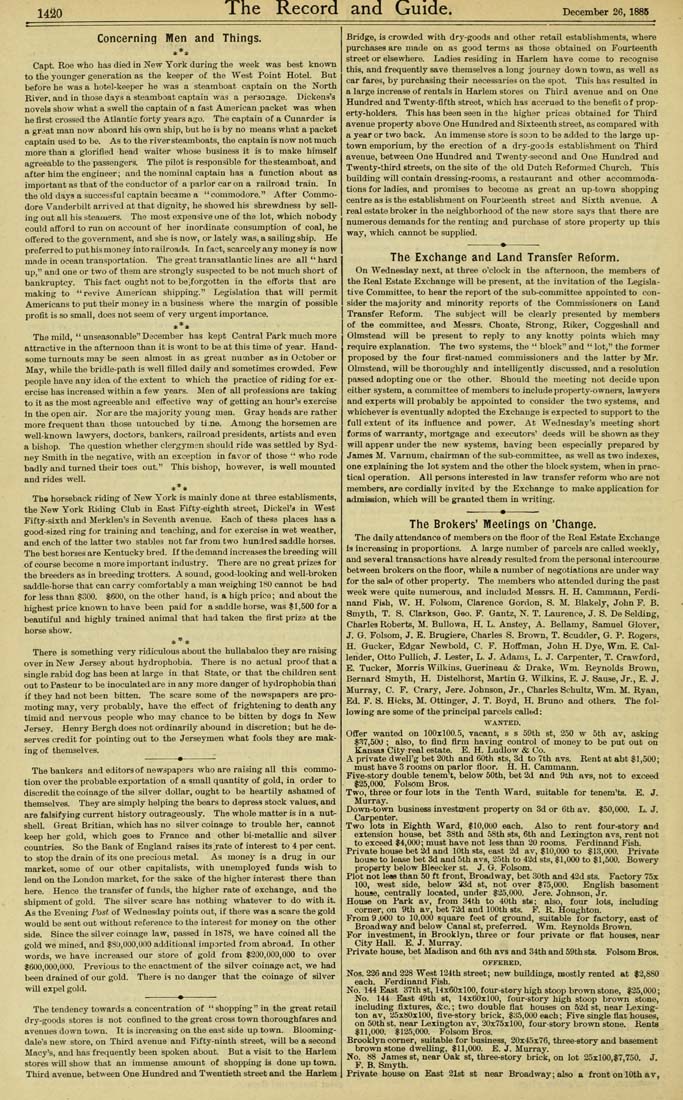
im The Record and Guide. December 26, 1885 Concerning Men and Things. *** Capt. Roe who has died in New York during the week was best known to the younger generation as the keeper of the West Point Hotel. But before he was a hotel-keeper he was a steamboat captain on the North River, and in those days a steamboat captain was a personage. Dickens's novels show what a swell the captain of a fast American packet was when he first crossed the Atlantic forty years ago. The captain of a Cunarder is a great man now aboard his own ship, but he is by no means what a packet captain used to be. As to the river steamboats, the captain is now not much more than a glorified head waiter whose business it is to make himself agreeable to the passengers. The pilot is responsible for the steamboat, and after him the engineer; and the nomiual captain has a function about as important as that of the conductor of a parlor car on a railroad train. In the old days a successful captain became a "commodore." After Commo¬ dore Vanderbilt arrived at that dignity, he showed his shrewdness by sell¬ ing out all his steamers. The most expensive one of the lot, which nobody could afford to run on account of her inordinate consumption of coal, he offered to the government, aud she is now, or lately was, a sailing ship. He preferred to put his money into railroads. In fact, scarcely auy money is now made in ocean transportation. The great transatlantic lines are all " hard up," and one or two of them are strongly suspected to be not much short of bankruptcy. This fact ought not to be;forgotten in the efforts that are making to "revive Americau shipping." Legislation that will permit Americans to put their money in a business where tho margin of possible profit is so small, does not seem of very urgent importance. *** The mUd, " unseasonable" December has kept Central Park rauch more attractive in the afternoon than it is wont to be at this time of year. Haud¬ some turnouts may be seen almost in as great uumber as in October or May, while the bridle-path is well filled daily and sometimes crowded. Few people have any idea of the extent to which the practice of riding for ex¬ ercise has increased within a few years. Men of all professions are taking to it as the most agreeable and effective way of getting an hour's exercise in the opeu air. Nor are the majority young meu. Gray heads are rather more frequent than those untouched by tijie. Among the horsemen are well-known lawyers, doctors, bankers, railroad presidents, artists and even a bishop. The question whether clergymen should ride was settled by Syd¬ ney Smith in the negative, with an exception in favor of those " who rode badly and turned their toes out." This bishop, however, is well mounted and rides well. *** Th« horseback riding of New York is mainly done at three establisments, the New York Riding Club in East Fifty-eighth street, Dickel'a in West Fifty-sixth and Merklen's in Seventh aveuue. Each of these places has a good-sized ring for training and teaching, aud for exercise in wet weather, and each of the latter two stables not far from two hundred saddle horses. The best horses are Kentucky bred. If the demand increases the breeding will of course become a more important industry. There are no great prizes for the breeders as in breeding trotters. A sound, good-looking and well-broken saddle-horse that can carry comfortably a man weighing ISO cannot be had for less than $300. $600, on the other hand, is a high price; and about the highest price known to have been paid for a saddle horse, was $1,500 for a beautiful and highly trained animal that had taken the first prize at the horse show. *"* There is something very ridiculous about the huUabaloo they are raising over in New Jersey about hydrophobia. There is no actual proof that a single rabid dog has been at large in that State, or that the children sent out to Pasteur to be inoculated are in any more danger of hydrophobia than if they had not been bitten. The scare some of the newspapers are pro¬ moting raay, very probably, have the effect of frightening to death any timid and nervous people who may chance to be bitten by dogs in New Jersey. Henry Bergh does not ordinarily abound in discretion; but he de¬ serves credit for pointing out to the Jerseymen what fools they are mak¬ ing of themselves. ---------•-------- The bankers and editors of newspapers who are raising all this commo¬ tion over the probable exportation of a small quantity of gold, in order to discredit the coinage of the silver dollar, ought to be heartily ashamed of themselves. They are simply helping the bears to depress stock values, and are falsifying current history outrageously. The whole matter is in a nut- sheU. Great Britian, which has no silver coinage to trouble her, cannot keep her gold, which goes to France and other bi-metallic and sUver countries. So the Bank of England raises its'rate of interest to 4 per cent, to stop the drain of its one precious metal. As money is a drug in our market, some of our other capitalists, with unemployed funds wish to lend on the London market, for the sake of the higher interest there than here. Hence the transfer of funds, the higher rate of exchange, aud the shipment of gold. The silver scare has nothing whatever to do with it. As the Evening Post of Wednesday points out, if there was a scare the gold would be seut out without reference to the interest for money on the other side. Since the silver coinage law, passed in 1878, we have coined all the gold we mined, and $80,000,000 additional imported from abroad. In other words, we have increased our sfcore of gold from $200,000,000 to over $600,000,000. Previous to tho enactment of the silver coinage act, we had been drained of our gold. There is no danger that the coinage of sUver wiU expel gold. .--------«--------- The tendency towards a concentration of "shopping" in the great retaU dry-goods stores is not confined to the great cross town thoroughfares and avenues down town. It is increasing on the east side up town. Blooming- dale's new store, on Third avenue and Fifty-ninth street, wUl be a second Macy's, and has frequently been spoken about. But a visit to the Harlem stores will show that an immense amount of shoppmg is done up town. Third avenue, between One Himdred and Twentieth street and the Harlem Bridge, is crowded with dry-goods and other retail establishments, where purchases are made on as good terms as those obtained on Fourteenth street or elsewhere. Ladies residing iu Harlem have come to recognise this, and frequently save themselves a long journey down town, as well as car fares, by purchasing their necessaries on the spot. This has resulted iu a large increase of rentals in Harlem stores ou Third avenue and on One Hundred and Twenty-fifth street, which has accrued to the benefit of prop¬ erty-holders. This has been seen in the higher prices obtained for Third avenue property above One Hundred and Sixteenth sfcreet, as compared with a year or two back. An immense store is soon to be added to the large up¬ town emporium, by the erection of a dry-goo Is establishment on Third aveuue, between One Huudred and Twenty-second and One Huudred and Twenty-third streets, on the site of the old Dutch Reformed Church. This building wUl contain dressing-rooms, a restaurant and other accommoda¬ tions for ladies, and promises to become as great an up-towu shopping centre as is the establishment on Fourteenth streefc and Sixth avenue. A real estate broker in the neighborhood of the new store says that there are numerous demands for the renting and purchase of store property up this way, which cannot be supplied. The Exchange and Land Transfer Reform. On Wednesday next, at three o'clock in the afternoon, the members of the Real Estate Exchange will be present, at the invitation of the Legisla¬ tive Committee, to hear the report of the sub-committee appointed to con¬ sider the majority and minority reports of the Commissioners on Land Transfer Reforra. The subject will be clearly presented by members of the committee, and Messrs. Choate, Strong, Riker, Coggeshall and Olmstead will be present to reply to any knotty points which may require explanation. The two systems, the " block" and " lot," the former proposed by the four first-named commissioners and the latter by Mr. Olmstead, will be thoroughly and intelligently discussed, and a resolution passed adopting one or the other. Should the meeting not decide upon either system, a committee of members to include property-owners, lawyers and experts will probably be appointed to consider the two systems, and whichever is eveniually adopted the Exchange is expected to support to the full extent of its influence and power. At Wednesday's raeeting short forms of warranty, mortgage and executors' deeds will be shown as they will appear under the new systems, having been especially prepared by James M. Varnum, chairman of the sub-com mittee, as well as two indexes, one explaining the lot system and the other the block system, when in prac¬ tical operation. All persons interested in law transfer reform who are not members, are cordially invited by the Exchange to make application for admission, which wUl be granted them in writing. The Brokers' Meetings on 'Change. The daily attendance of members on the floor of the Real Estate Exchange is increasing in proportions. A large number of parcels are called weekly, and several transactions have already resulted from the personal intercourse between brokers on the floor, while a number of negotiations are under way for the salft of other property. The members who attended during the past week were quite numerous, and included Messrs. H. H. Cammann, Ferdi¬ nand Fish, W. H. Folsom, Clarence Gordon, S. M. Blakely, John F. B. Smyth, T. S. Clarkson, Geo. F. Gantz, N. T. Laurence, J. S. De Selding, Charles Roberts, M. BuUowa, H. L. Anstey, A. BeUamy, Samuel Glover, J. G. Folsom, J. E. Brugiere, Charles S. Brown, T. Scudder, G. P. Rogers, H. Gucker, Edgar Newbold, C. F, Hoffman, John H. Dye, Wm. E. Cal¬ lender, Otto Pullich, J. Lester, L. J. Adams, L. J. Carpenter, T, Crawford, E. Tucker, Morris Wilkius, Guerineau & Drake, Wm. Reynolds Browu, Bernard Smyth, H. Distelhorst, Martin G. Wilkins, E. J. Sause, Jr., E. J. Murray, C. F. Crary, Jere. Johnson, Jr., Charles Schultz, Wm. M. Ryan, Ed. F. S. Hicks, M. Ottinger, J. T, Boyd, H. Bruno and others. The fol¬ lowing are some of the principal parcels caUed: WANTED. Offer wanted on 100x100.5, vacant, s s 59th st, 250 w 5th av, asking $37,500 ; also, to fiud firm having control of money to be put out on Kansas City real estate. E. H. Ludlow & Co. A private dwell'g bet 20th and 60th sts, 3d to 7th avs. Rent at aht $1,500; must have 3 rooms on parlor floor. H. H. Cammann, Five-story double tenem't, below SOth, bet 2d and 9th avs, not to exceed $25,000. Folsom Bros. Two, three or four lots iu the Tenth Ward, suitable for tenem'ts. E. J. Murray. Down-town business investment property on 3d or Bth av. $50,000. L. J. Carpenter. Two lots in Eighth Ward, $10,000 each. Also to rent four-story and extension house, bet 38th and 5Sth sts, 6th and Lexington avs, rent not to exceed $4,000; must have not less than 20 rooms. Ferdinand Fish. Private house bet 2d and 10th sts, east 2d av, $10,000 to $13,000. Private house to lease bet 3d aud Sth avs, 25th to 42d sts, $1,000 to $1,500. Bowery property below Bleecker st. J. G. Folsom. Plot not lesa than 50 ft front, Broadway, bet 30th and 42d sts. Factory 75x 100, west side, below 33d st, not over $75,000. English basement house, centrally located, under $25,000. Jere. Johnson, Jr. House on Park av, from 34rh to 40th sts; also, foiu- lots, includiug corner, on 9th av, bet 72d and 100th sts. F. R. Houghton. From 9,000 to 10,000 square feet of ground, suitable for factory, east of Broadway and below Canal st, preferred. Wra. Reynolds Brown. For investment, in Brooklyn, three or four private or flat houses, near City HaU. E. J. Murray. Private house, bet Madison and 6th avs and 34th and 59th sts. Folsom Bros. offered. Nos. 226 and 228 West 124th street; new buUdings, mostly rented at $2,880 each. Ferdinand Fish. No. 144 East 37th st, 14x60x100, four-story high stoop browustone, $25,000; No. 144 East 49th st, 14x60x100, four-story high stoop brown stone, including fixtures, &c.; two double flat houses on 52d st, near Lexing¬ ton av, 25x80x100, flve-story brick, $3.5,000 each; Five single flat houses, on SOthst. near Lexington av, 20x75x100, four-story brown stone. Rents $11,000. $12.5,000. Folsom Bros. Brooklyn corner, suitable for business, 20x45x76, three-etory and basement brown stone dweUing, $11,000. E. J. Murray. No. 88 James st, near Oak st, three-story brick, on lot 25xl00,$7,750. J. F. B. Smyth. Private house on East 21st st near Broadway; also a front on lOthav,