
Columbia University Libraries Digital Collections: The Real Estate Record
Use your browser's Print function to print these pages.
The Record and guide: v. 37, no. 934: February 6, 1886
Text version:
Please note: this text may be incomplete. For more information about this OCR, view About OCR text.
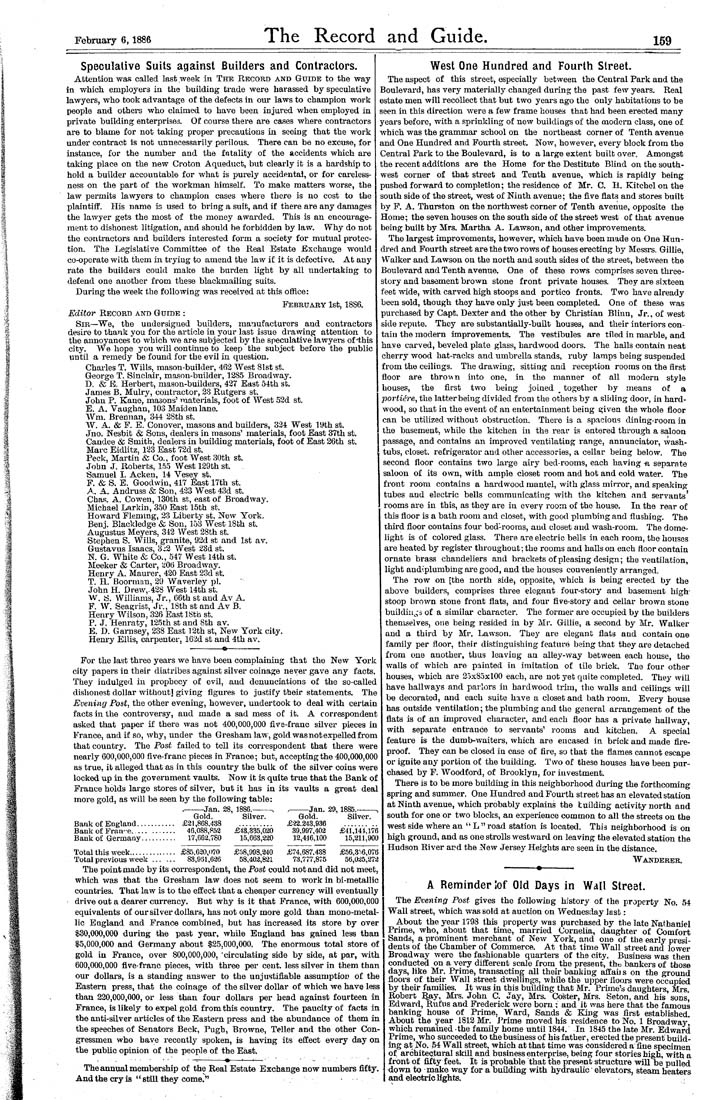
February 6,1886 The Record and Guide. 159 speculative Suits against Builders and Contractors. Attention was called last week in The Recobd and Guide to the way in which employers in the building trade were harassed by speculative lawyers, who took advantage of the defects in our laws to champion work people and others who claimed to have been injured when employed in private building enterprises. Of course there are cases where contractors are to blame for not taking proper precautions in seeing that the work under contract is not tmnecessarily perilous. There can be no excuse, for instance, for the number and the fatality of the accidents which are taking place on the new Croton Aqueducfc, but clearly it is a hardship to hold a builder accountable for what is purely accidental, or for careless¬ ness on the part of the workman himself. To make matters worse, the law permits lawyers to champion cases wheie there is no cost to the plaintiff. His name is used to bring a suit, and if there are any damages the lawyer gets the mosfc of the money awarded. This is an encourage¬ ment to dishonest litigation, and should be forbidden by law. Why do not the contractors and builders interested form a society for mutual protec¬ tion. The Legislative Committee of the Real Estafce Exchange would co-operate wifch fchem in trying to amend the law if it is defective. Afc any rate the builders could make the burden lighfc by all underfcaking to defend one another from these blackmaUing suits. Dui'ing the week the following was received at this office: February 1st, 1886. Editor Record and Guide : Sib—We, the undersigned builders, mauufacturers and contractors desire to thank you for the article in your lasfc issue drawing attenfcion to the annoyances to which we are subjected by the speculative lawyers of "this city. We hope you will continue to keep the subject before the public until a remedy be found for the evU in question. Charles T. WUls, mason-buUder, 462 West Slst st. George T. Sinclair, mason-builder, 1285 Broadway. D. & E. Herbert, mason-builders, 427 East 54th st. James B. Mulry, contractor, 23 Rutgers st. John P. Kane, masons' materials, foot of Wesfc i53d sfc. E. A. Vaughan, 103 Maiden lane. Wm. Brennan, 344 28fch sfc. W. A. & F. E. Conover, masons and buUders, 324 West 19th st. Jno. Nesbit & Sons, dealers in masons' materials, foot Easfc 87th st. Candee & Smith, dealers in building materials, foot of East 26th st. Marc Eidlitz, 123 East 72d st. Peck, Martin & Co., foot Wesfc 30fch sfc. John J. Roberts, 155 West 129th sfc. Samuel I. Acken, 14 Vesey st. F. & S. E. Goodwin, 417 East 17th st. A. A. Andruss & Son, 423 West 43d st. Chas. A. Cowen, ISOfch st, easfc of Broadway. Michael Larkin, 350 Easfc 15th st. How^ard Fleming, 23 Liberty st. New York. Benj. Blackledge & Son, 153 West 18bh sfc. Augusfcus Meyers, 342 Wesfc 28th st. Stephen S. WiUs, granifce, 92d sfc and 1st av. Gustavus Isaacs, 3j2 West 23d sfc. N. G. White & Co., 547 West 14th st. Meeker & Carter, JiOO Broadway. Henry A. Maurer, 420 East 23d st. T. H. Boorman, 29 Waverley pi. John H. Drew^.428 West 14th st. W. !S. Williams, Jr., 66th st and Av A. P. W. Seagrist, Jr., 18th st and Av B. Henry Wilson, 326 East ISth st. P. J. Henraty, 125th st and Sth av. E. D. Garnsey, 238 East 12th st. New York cifcy. Henry Ellis, carpenter, 162d st and 4th av. For the last three years we have been complaining that the New York city papers iu their diatribes against silver coinage never gave anj"- facts. They indulged in prophecy of evU, and denunciations of the so-called dishonest dollar -without] giving figures to justify their sfcafcements. The Evening Post, the other evening, however, undertook to deal with certain facts in the controversy, and made a sad mess of it. A correspondent asked thafc paper if fchere was nofc 400,000,000 five-franc silver pieces in France, and if so, why, under the Greshamlaw-, gold was not expelled from that country. The Post failed to tell its correspondent that there were nearly 600,000,000 five-franc pieces in France; but, accepting the 400,000,000 as true, it alleged thafc as in this country the bulk of the silver coins were locked up in the government vaults. Now it is quite true that the Bank of Prance holds large stores of silver, but it has in its vaults a great deal more gold, as wiU be seen by the following table: Gold. Bank of England........... £21,868,438 Bank of Fran-e............ 46,088,.«53 Bank of Germany.......... 17,662,780 -Jan. 28, 1886.- Total this week.............. £85,620,070 Total previous week...... 83,9S1,626 Silver. £43,335,626 15,663,220 £58,998,240 58,402,821 -Jan. 29,1885.- Gold. £22.243,936 39,997,402 12,446,100 £74,687.438 73,777,875 Silver. £41,141,176 15,211,900 £56,336,076 56,025,272 The point made by its correspondent, the Post could not and did not meet, which was that the Gresham law does not seem to work in bi-metallic countries. That law is to the effect that a cheaper currency wUl eventually drive out a dearer cm-rency. But why is it that France, with 600,000,000 equivalents of our silver dollars, has not only more gold than mono-metal¬ lic England and France combined, bufc has increased its store by o-s^er $30,000,000 during the past year, while England has gained less than $5,000,000 and Germany about $25,000,000. The enormous total store of gold in France, over 800,000,000, circulating side by side, at par, with 600,000,000 five-franc pieces, with three per cent, less silver in them than our dollars, is a standing answer to the unjustifiable assumption of the Eastern press, that the coinage of the silver dollar of which we have less than 220,000,000, or less than four dollars per head against fourteen in France, is likely to expel gold from this country. The paucity of facts in the anti-silver articles of the Eastern press and the abundance of them in the speeches of Senators Beck, Pugh, Browne, Teller and the other Con¬ gressmen who have recently spoken, is having its effect every day on the public opinion of the people of the East. The annual membership of the Real Estate Exchange now numbers fifty. And the cry is " still they come." West One Hundred and Fourth Street. The aspect of this street, especially between the Central Park and the Boulevard, has very materially changed during the past few years. Real estate men will recollect that but two years ago the only habitations to be seen in this direction were a few frame houses that h.id been erected many years before, with a sprinkling of new buildings of the modern class, one of which was the grammar school on the northeast corner of Tenth avenue and One Hundred and Fourth street. Now, however, every block from the Central Park to the Boulevard, is to a large extent builfc over. Amongst fche recent additions are the Home for the Destitute Blind on the south¬ west corner of that street and Tenth avenue, which is rapidly being pushed forward to completion; the residence of Mr. C. H. Kitchel on the south side of the street, west of Ninth avenue; the five flats and stores built by F. A. Thurston on the northwest corner of Tenth avenue, opposite the Home; the seven houses on the south side of the street west of that avenue being built by Mrs. Martha A. Lawson, and other improvements. The largest improvements, however, which have been made on One Hun¬ dred and Fourth street are the two rows of houses erecting by Messrs. Gillie, VV'alker and Lawson on the north and south sides of the streefc, between fche Boulevard and Tenth avenue. One of these rows comprises seven three- story and basement brown stone front private houses. They are sixteen feefc wide, with carved high stoops and portico fronts. Two have already been sold, though they have only just been completed. One of these was purchased by Capt. Dexter and the other by Christian Blinn, Jr., of west side repute. They are substantially-buUt houses, and their interiors con¬ tain the modern improvements. The vestibules are tiled in marble, and have carved, beveled plate glass, hardwood doors. The halls contain neat cherry wood hat-racks and umbrella stands, ruby lamps being suspended from the ceilings. The drawing, sitting and reception rooms on the first floor are throvAn into one, in the manner of all modern style houses, the first two being joined ^ together by means of a porti&re, the latter being divided from the ofchers by a sliding door, in hard¬ wood, so that in the event of an enfcerfcainmenfc being given fche whole floor can be ufcilized without obstruction. There is a spacious dining-room in the basement, while the kitchen in the rear is entered through a saloon passage, and contains an improved ventilating range, annunciator, wash- tubs, closet, refrigerator and ofcher accessories, a cellar being below. The second floor contains two large airy bed-rooms, each having -a separate saloon of its own, with ample closet room and hot and cold water. The front room contains a hardwood mantel, with glass mirror, and speaking tubes and electric bells communicating with the kitchen and servants' rooms are iu this, as they are in every room of the house. In the rear of this floor is a bath room and closet, with good plumbing and flushing. The third floor confcains four bed-rooms, aud closefc aud wash-room. The dome- light is of colored glass. There areelecfcric bells in each room, fche houses are heated by register throughout; the rooms and halls on each floor contain ornate brass chandeliers and brackets of pleasing design; the ventilation, light and'^plumbing ai-e good, and the houses conveniently arranged. The row on [the north side, opposite, which is being erected by the above builders, comprises three elegant four-story and basement high- stoop brown stone front flafcs, and four five-sfcory and cellar brown sfcone bui]din^;3 of a similar character. The former are occupied by the builders themselves, one being resided in by Mr. Gillie, a second by Mr. Walker and a third by Mr. Lawson. The}' are elegant flats and contain one family per floor, their distinguishing feature being that they are detached from one another, thus leaving an alley-way between each house, the walls of which are painted in imitation of tile brick. The four other houses, wbich are 35x8,5x100 each, are not yefc quite completed. They will have hallways and parlors iu hardwood trim, the walls and ceilings will be decorated, and each suite have a closet and bath room. Every house has outside ventilation; the plumbing and the general arrangement of the flats is of an improved character, and each floor has a private hallway, with separate entrance to servants' rooms and kitchen. A special feature is the dumb-waiters, which are encased in brick and made fire¬ proof. They can be closed in case of fire, so that the flames cannot escape or ignite any portion of the buUding. Two of these houses have been pur¬ chased by F. Woodford, of Brooklyn, for investment. There is to be more building in this neighborhood during the forthcoming spring and summer. One Hundred and Fourth street has an elevated station at Ninth avenue, which probably explains the tuUding activity north and south for one or two blocks, an experience common to all the streets on the west side where an " L " road station is located. This neighborhood is on high ground, and as one strolls westward on leaving the elevated station the Hudson River ard the New Jersey Heights are seen in the distance. Wanderer. A Reminder !of Old Days in Wall Street. The Evening Post gives the following history of the property No. 54 Wall street, which was sold at auction on Wednesday lasfc : Aboufc the year 1798 this property was purchased by the late Nathaniel Prime, who, aboufc that time, married Cornelia, daughter of Comfort Sands, a prominent merchant of New York, and one of the early presi¬ dents of the Chamber of Commerce. At that time Wall street and lower Broadway were the fashionable quarters of the city. Businass was then conducted on a very different scale from the present, tho bankers of those days, like Mr. Prime, transacting all their banking affaii s on the ground floors of their Wall street dwellings, whUe the upper floors were occupied by theii- famUies. It was in this building that Mr. Prime's daughteis, Mrs. Robert Ray, Mrs. John C. Jay, Mrs. Coster, Mrs. Seton, and his sons, Edward, Rufus aud Frederick were born ; and ifc was here that the famous banking house of Prime, Ward, Sands & King was first established. About the year 1812 Mr. Prime moved his residence to No. 1 Broadwayj which remained the family home until 1844. In 1845 the late Mr. Edward Prime, who succeeded to the business of his father, erected the present build¬ ing at No. 54 Wall street, which at that time was considered a fine specimen of architectural skUl and business enterprise, being four stories high, with a front of fifty feet. It is probable that the present structure wiU be pulled down to make way for a buUding with hydraulic elevators, steam heaters and electriclights.