
Columbia University Libraries Digital Collections: The Real Estate Record
Use your browser's Print function to print these pages.
The Record and guide: v. 37, no. 936: February 20, 1886
Text version:
Please note: this text may be incomplete. For more information about this OCR, view About OCR text.
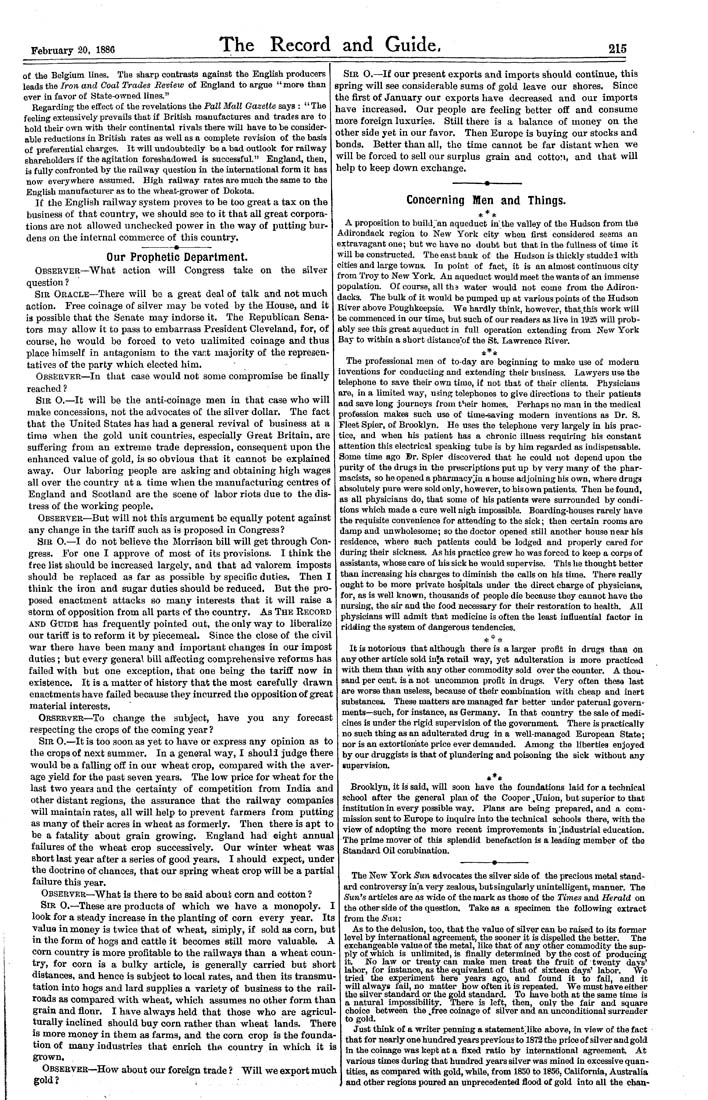
February 20, 1886 The Record and Guide. 215 of the Belgium lines. The sharp confcrasfcs againsfc the English producers leads the Iron and Coal Trades Review of England fco argue "more than ever in favor of State-owned lines." Regarding fche eifect of the revelations fche Pall Mall Gazette says : " The feeling extensively prevails fchafc if Brifcish manufactures and trades are to hold fcheir own with fcheir continental rivals fchere will have fco be consider¬ able reductions in British rates as well as a complete revision of the basis of preferential charges. It will undoubtedly be a bad outlook for railway shareholders if the agitation foreshadowed is successful." England, then, is fully confronted by the railway quesfcion in the international form ifc has now everywhere assumed. High railway rates are much the same fco fche English manufacfcurer as to the wheafc-grower of Dokota. If the English railway system proves to be too great a tax on the business of that country, we should see to ifc thafc all greafc corpora¬ tions are not allowed unchecked power in the way of putting bur¬ dens on the internal commerce of this country. Sm O.—If our present exports and imports should continue, this spring will see considerable sums of gold leave our shores. Since the firsfc of January our exports have decreased and our imports have increased. Our people are feeling better off and consume more foreign luxuries. Still there is a balance of money on the other side yet in our favor. Then Europe is buying our stocks and bonds. Better than all, the time cannot be far distant when we will be forced to sell our surplus grain and cofcto!i, and that wUl help to keep down exchange. Our Prophetic Department. Observer—What action will Congress take on the silver question ? Sir Oracle—There will be a great deal of talk and not much acfcion. Free coinage of silver may be voted by the House, and it is possible that the Senate may indorse ifc. The Republican Sena¬ tors may allow it to pass fco embarrass President Cleveland, for, of course, he would be forced to veto unlimited coinage and thus place himself in antagonism to the vant majorifcy of the represen¬ tatives of the party which elected him. Observer—In that case would nofc some compromise be finally reached ? Sib; O.—It will be the anti-coinage men in that case who will make concessions, not fche advocates of the silver dollar. The fact that fche United States has had a general revival of business at a time when the gold unifc countries, especially Greafc Britain, are suffering from an extreme trade depression, consequent upon the enhanced value of gold, is so obvious that it cannofc be explained away. Our laboring people are asking and obfcaining high wages all over the country afc a time when the manufacturing centres of England and Scotland are the scene of labor riots due to the dis¬ tress of the working people. Observer—But will not this argument be equally potent against any change in the tariff such as is proposed in Congress? Sir O.—I do not believe the Morrison bill will get through Con¬ gress. .For one I approve of mosfc of its provisions. I think the free list should be increased largely, and that ad valorem imposts should be replaced as far as possible by specific duties. Then I think the iron and sugar duties should be reduced. Bufc the pro¬ posed enacfcmenfc attacks so many interesfcs thafc ifc will raise a storm of opposition from all parts of the country. As The Record and Guide has frequently pointed out, the only way to liberalize our tariff is to reform ifc by piecemeal. Since the close of the civil war there have been many and important changes in our impost duties; bufc every general bill affecting comprehensive reforms has failed with but one exception, that one being the tariff now in existence. Ifc is a matter of history that the most carefully drawn enactments have failed because they incurred the opposition of great material interesfcs. Orserver—To change the subject, have you any forecast respecting the crops of the coming year ? Sir O.—Ifc is too soon as yet to have or express any opinion as to the crops of nexfc summer. In a general way, I shouli judge there would be a falling off in our w^heafc crop, compared with the aver¬ age yield for the past seven years. The low price for wheat for the lasfc two years and the certainty of competition from India and ofcher distant regions, the assurance that the railway companies will maintain rafces, all will help to prevenfc farmers from pufcting as many of their acres in wheat as formerly. Then there is apt to be a fatality about grain growing. England had eight annual failures of the wheat crop successively. Our winter wheat was short last year affcer a series of good years. I should expect, under the docfcrine of chances, that our spring wheat crop will be a parfcial failure this year. Observer—What is there to be said aboufc corn and cotton ? Sir O.—These are products of which we have a monopoly. I look for a steady increase in the planting of corn every year. Its value in money is twice that of wheat, sirnply, if sold as corn, but in the form of hogs and cattle it becomes still more valuable. A corn country is more profitable to the railways than a wheat coun¬ try, for corn is a bulky article, is generally carried but shorfc distances, and hence is subject to local rates, and then its transmu¬ tation into hogs and lard supplies a variety of business to the rail¬ roads as compared wifch wheat, which assumes no other form than grain and flour. I have always held that those who are agricul¬ turally inclined should buy corn rather fchan wheat lands. There is more money in them as farms, and the corn crop is the founda¬ tion of many indusfcries thiat enrich the country in which it is grown. Observer—How about our foreign trade ? Will we export much gold? Concerning Men and Things. *** A proposition to build'an aqueducfc in'fche valley of fche Hudson from the Adirondack region to New York cifcy when firsfc considered seems an extravaganfc one; bufc we have no doubt bufc thafc in fche fullness of fcime ifc will be constructed. The easfc bank of the Hudson is fchickly studded with cities and large towns. In poinfc of facfc, ifc is an almost continuous city from Troy to New York. An aqueducfc would meefc fche wants of an immense population. Of course, all fcha water would nofc come from the Adiron¬ dacks. The bulk of ifc would be pumped up at various poinfcs of the Hudson River above Poughkeepsie. We hardly think, however, that.this work will be commenced in our time, bufc such of our readers as live in 1925 will prob¬ ably see this great aqueducfc in full operation exfcending from New York Bay to within a short distance]of the Sfc. Lawrence Pdver. *** The professional men of to-day are beginning to make use of modern inventions for conducting and extending their business. Lawj^ers use tbe telephone fco save fcheir own fcime, if nofc fchafc of their clients. Physicians are, in a limited way, using fcelephones to give directions fco fcheir pafcients and save long journeys from their homes. Perhaps no man in tbe medical profession makes such use of time-saving modern inventions as Dr. S. Fleet Spier, of Brooklyn. He uses fche fcelephone very largely in his prac¬ tice, and when his patient has a chronic illness requiring bis consfcanfc afcfcenfcion fchis elecfcrical speaking tube is by him regarded as indispensable. Some time ago Br. Spier discovered fchat he could nofc depend upon the purifcy of fche drugs in fche prescriptions pufc up by very many of the phar¬ macists, so he opened a pharmacy;|in a house adjoining his own, where drugs absolutely pure were sold only, however, to his own pafcients. Then he found, as all physicians do, that some of bis pafcienfcs were surrounded by condi¬ fcions whieh made a cure well nigh impossible. Boarding-houses rarely have fche requisite convenience for afctending to the sick; fchen certain rooms are damp and unwholesome; so fche doctor opened sfcill another bouse near his residence, where such pafcienfcs could be lodged and properly cared for during fcheir sickness. As his practice grew he was forced to keep a corps of assistanfcs, whose care of his sick be would supervise. This he fchougbfc better than increasing his charges to diminish the calls on his time. There really oughfc fco be more private hospitals under fche direct charge of physicians, for, as is well known, thousands of people die because they cannofc have fche nursing, the air and the food necessary for fcheir restoration to health. All physicians will admit that medicine is often fche leasfc influenfcial factor in ridding fche system of dangerous tendencies, * * * Ifc is nofcorious thafc alfchough fchere is a larger profit in dmgs fchaa on any other article sold inja retail way, yefc adulteration is more pracfciced with them than wifch any ofcher commodity sold over fche counter. A thou¬ sand per cenfc. is a nofc uncommon proflfc in drugs. Very often these lasfc are worse than useless, because of their combinafcion with cheap and inerfc substances. These matters are managed far better under paternal govern¬ ments—such, for instance, as Germany. In thafc counfcry fche sale of medi¬ cines is under fche rigid supervision of fche govemmenfc. There is pracfcically no such thing as an adulterated drug ina well-managed European State; nor is an exfcorfcioriate price ever demanded. Among the liberties enjoyed by our druggists is thafc of plundering and poisoning fche sick wifchoufc any supervision. *** Brooklyn, ifc is said, wfll soon have the foundafcions laid for a fcechnical school affcer the general plan of tbe Cooper .TJnion, bufc superior fco fchat insfcitufcion in every possible way. Plans are being prepared, and a com¬ mission senfc to Europe to inquire into fche technical schools fchere, with fche view of adopting the more recent improvemenfcs in jindusfcrial educafcion. The prime mover of fchis splendid benefaction is a leading member of tbe Sfcandard OU combinafcion. The New York Sun advocates fche silver side of the precious mefcal stand¬ ard controversy in[a veiy zealous, bufc singularly unintelligent, manner. The Sun's articles are as wide of the mark as fchose of fche Times and Herald on the ofcher side of fche quesfcion. Take as a specimen the foUowing exfcracfc from the 5'ti?i: As to the delusion, too, that tbe value of sUver can be raised to ifcs former level by internafcional agreemenfc, fche sooner ifc is dispeUed fche better. The exchangeable value of the metal, Uke fchafc of any ofcher commodity the sup¬ ply of which is unlimited, is finaUy determined by the cosfc of producing ifc. No law or fcreafcy can make men treat the fruit of twenty days' labor, for instance, as the equivalent of fchat of sixteen days' labor. Wo tried the experiment here years ago, and foimd it to faO, and it wUl always faU, no matter how often it is repeated. We must have either tbe silver standard or the gold standard. To have both at the same fcime is a natural impossibilifcy. There is left, then, only the fair and square choice befcween fche ^free coinage of sUver and an unconditional surrender to gold. Jusfc think of a writer penning a statement'Uke above, in view of the fact fchafc for nearly one hundred years previous to 1872 fche price of sUver and gold in the coinage was kept afc a fixed rafcio by infcernafcional agreement. At various times during that hundred years silver was mined in excessive quan¬ tities, as conipared with gold, wbUe, from 1850 to 1856. CaUfomia, Australia and other regions poured an unprecedented flood of gold into aU the chan-