
Columbia University Libraries Digital Collections: The Real Estate Record
Use your browser's Print function to print these pages.
The Record and guide: v. 39, no. 984: January 22, 1887
Text version:
Please note: this text may be incomplete. For more information about this OCR, view About OCR text.
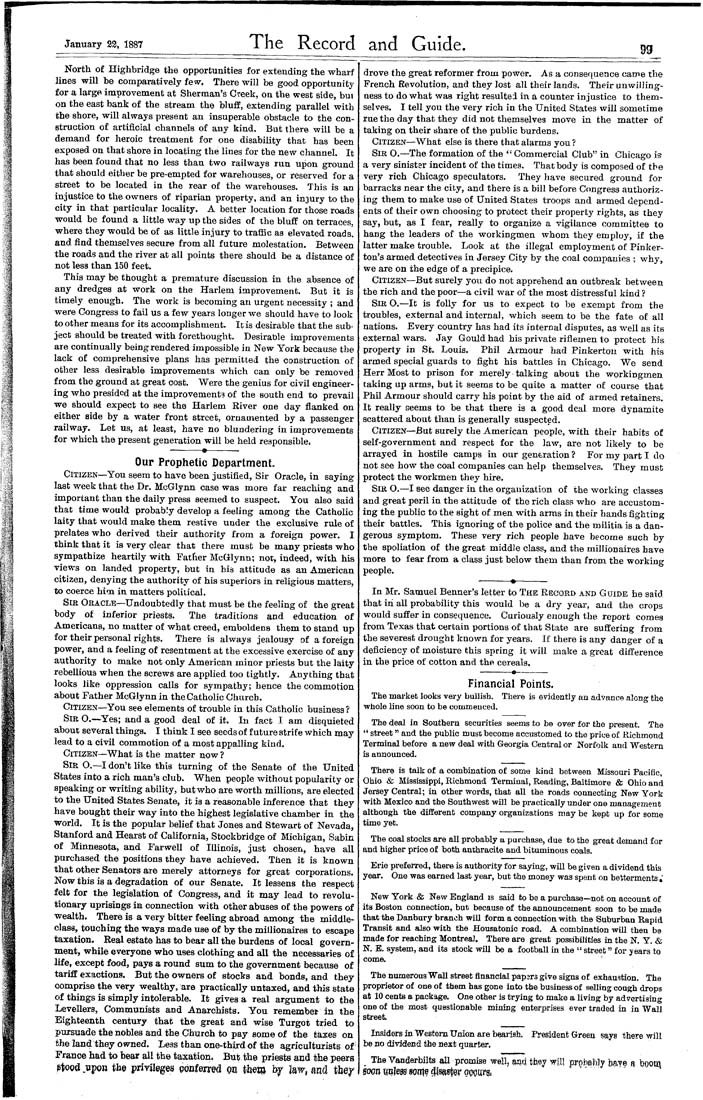
January 32, 1887 The Record and Guide. 93 North of Highbridge the opportunities for extending the wharf lines will be comparatively few. There will be good opportunity for a large improvement at Sherman's Creek, on the west side, bui on the east bank of the stream the bluff, extending parallel with the shore, will always present an insuperable obstacle to the con¬ struction of artificial channels of any kind. But there will be a demand for heroic treatment for one disability that has been exposed on that shore in locating the lines for the new channel. It has been found that no less than two railways run upon ground that should either be pre-empted for warehouses, or reserved for a street to be located in the rear of the warehouses. This is an injustice to the owners of riparian property, and an injury to the city in that particular locality. A better location for those roads would be found a little way up the sides of the bluff on terraces, where they would be of as little injury to traffic as elevated roads, and find themselves secure from all future molestation. Between the roads and the river at all points there should be a distance of not less than 150 feet. This may be thought a premature discussion in the absence of any dredges at work on the Harlem improvement. But it is timely enough. The work is becoming an urgent necessity ; and were Congress to fail us a few years longer we should have to look to other means for its accomplishment. It is desirable that the sub¬ ject should be treated with forethought. Desirable improvements are continually being rendered impossible in New York because the lack of comprehensive plans has permitted the construction of other less desirable improvements which can only be removed from the ground at great cost. Were the genius for civil engineer¬ ing who presided at the improvements of the south end to prevail we should expect to see the Harlem River one day flanked on either side by a water front street, ornamented by a passenger railway. Let us, at least, have no blundering in improvements for which the present generation will be held responsible. ------------c-----------. Our Prophetic Department. Citizen—You seem to have been justified. Sir Oracle, in saying last week that the Dr. McGlynn case was more far reaching and important than the daily press seemed to suspect. You also said that time would probably develop a feeling among the Catholic laity that would make them restive under the exclusive rule of prelates who derived their authority from a foreign power. I think that it is very clear that there must be many priests who sympathize heartily with Father McGlynn; not, indeed, with his views on landed property, but in his attitude as an American citizen, denying the authority of his superiors in religious matters, to coerce him in matters political. Sir Oracle—Undoubtedly that must be the feeling of the great body of inferior priests. The traditions and education of Americans, no matter of what creed, emboldens them to stand up for their personal rights. There is always jealousy of a foreign power, and a feeling of resentment at the excessive exercise of any authority to make not only American minor priests but the laity rebellious when the screws are applied too tightly. Anything that looks like oppression calls for sympathy; bence the commotion about Father McGlynn in the Catholic Church. Citizen—You see elements of trouble in this Catholic business ? Sir O.—.Yes; and a good deal of it. In fact I am disquieted about several things. I think I see seeds of future strife which may lead to a civil commotion of a most appalling kind. Citizen—What is the matter now ? Sir O.—I don't like this turning of the Senate of the United States into a rich man's club. When people without popularity or speaking or writing ability, but who are worth millions, are elected to the United States Senate, it is a reasonable inference that they have bought their way into the highest legislative chamber in the world. It is the popular belief that Jones and Stewart of Nevada, Stanford and Hearst of California, Stockbridge of Michigan, Sabin of Minnesota, and Farwell of Illinois, just chosen, have all purchased the positions they have achieved. Then it is known that other Senators are merely attorneys for great corporations. Now this is a degradation of our Senate. It lessens the respect felt for the legislation of Congress, and it may lead to revolu¬ tionary uprisings in connection with other abuses of the powers of wealth. There is a very bitter feeling abroad among the middle- class, touching the ways made use of by the millionaires to escape taxation. Real estate has to bear all the burdens of local govern¬ ment, while everyone who uses clothing and all the necessaries of life, except food, pays a. round sum to the government because of tariff exactions. But the owners of stocks and bonds, and they comprise the very wealthy, are practically untaxed, and this state of things is simply intolerable. It gives a real argument to the Levellers, Communists and Anarchists. You remember in the Eighteenth century that the great and wise Turgot tried to puisuade the nobles and the Church to pay some of the taxes on the land they owned. Less than one-third of the agriculturists of France had to bear all the taxation. But the priests and the peers Ptood .upon the privileges gdoferred ou them hf laWj md tlaef drove the great reformer from power. As a consequence came the French Revolution, and they lost all their lands. Their unwilling¬ ness to do what was right resulted in a counter injustice to them¬ selves. I tell you the very rich in the United States will sometime rue the day that they did not themselves move in the matter of taking on their share of the public burdens. Citizen—What else is there that alarms you ? Sir O.—The formation of the " Commercial Club" in Chicago is a very sinister incident of the times. That body is composed of tbe very rich Chicago speculators. They have secured ground for barracks near the city, and there is a bill before Congress authoriz¬ ing them to make use of United States troops and armed depend¬ ents of their own choosing to protect their property rights, as they say, but, as I fear, really to organize a vigilance committee to hang the leaders of the workingmen whom they employ, if the latter make trouble. Look at the illegal employment of Pinker- ton's armed detectives in Jersey City by the coal companies ; why, we are on the edge of a precipice. Citizen—But surely you do not apprehend an outbreak between the rich and the poor—a civil war of the most distressful kind ? Sir O.—It is folly for us to expect to be exempt from the troubles, external and internal, which seem to be the fate of all nations. Every country has had its internal disputes, as well as its external wars. Jay Gould had his private riflemen to protect his property in Sfc. Louis. Phil Armour had Pinkertou with his armed special guards to fight his battles in Chicago. We send Herr Most to prison for merely talking about the workingmen taking up arms, but it seems to be quite a matter of course that Phil Armour should carry his point by the aid of armed retainers. It really seems to be that there is a good deal more dynamite scattered about than is generally suspected. Citizen—But surely the American people, with their habits of self-government and respect for the law, are not likely to be arrayed in hostile camps in our generation ? For my part I do not see how the coal companies can help themselves. They must protect the workmen they hire. Sir O.—I see danger in the organization of the working classes and great peril in the attitude of the rich class who are accustom¬ ing the public to the sight of men with arms in their hands fighting their battles. This ignoring of the police and the militia is a dan¬ gerous symptom. These very rich people have become such by the spoliation of the great middle class, and the millionaires have more to fear from a class just below them than from the working people. In Mr. Samuel Benner's letter to The Record and Guide he said that iri all probability this would be a dry year, and the crops would suffer in consequence. Curiously enough the report comes from Texas that certain portions of that State are suffering from the severest drought known for years. If there is any danger of a deficiency of moisture this spring it will make a great difference in the price of cotton and the cereals. ----------«---------- Financial Points. The market looks very bullish. There is evidently an advance along the whole line soon to be commeuced. The deal in Southern securities seems to be over for the present. The " street" and the public must become accustomed to the price of Richmond Terminal before a new deal with Georgia Central or Norfolk and Western is announced. There is talk of a combination of some kind between Missouri Pacific, Ohio & Mississippi, Richmond Terminal, Reading, Baltimore & Ohio aud Jersey Central; in other words, that all the roads connecting New York with Mexico and the Southwest will be practically under one management although the different company organizations m.ay be kept up for some time yet. The coal stocks are all probably a purchase, due to the great demand for and higher price of both anthracite and bituminous coals. Erie pi'eferred, there is authority for saying, will be given a dividend this year. One was earned last year, but the money was spent on betterments,; New York & New England is said to be a purchase—not on account of its Boston connection, but because of the announcement soon to be made that the Danbury branch will form a connection with the Suburban Rapid Transit and also with the Housatonic road. A combination will then be made for reaching Montreal. There are great possibilities in the N. Y. & N. E. system, and its stock will be a football in the " street" for years to come. The numerous Wall street financial papars give signs of exhaustion. The proprietor of one o£ them has gone into tbe business of selling cough drops at 10 cents a package. One other is trying to make a living by advertising one of the most questionable mining enterprises ever traded in in Wall street. Insiders in Western Union are bearish. President Green says there will be no dividend tbe next quarter. _ The Vanderbilts all promise well, and ttiey will probably bay? n boom soon liioles© sonie disaster gcoursi