
Columbia University Libraries Digital Collections: The Real Estate Record
Use your browser's Print function to print these pages.
The Record and guide: v. 40, no. 1029: December 3, 1887
Text version:
Please note: this text may be incomplete. For more information about this OCR, view About OCR text.
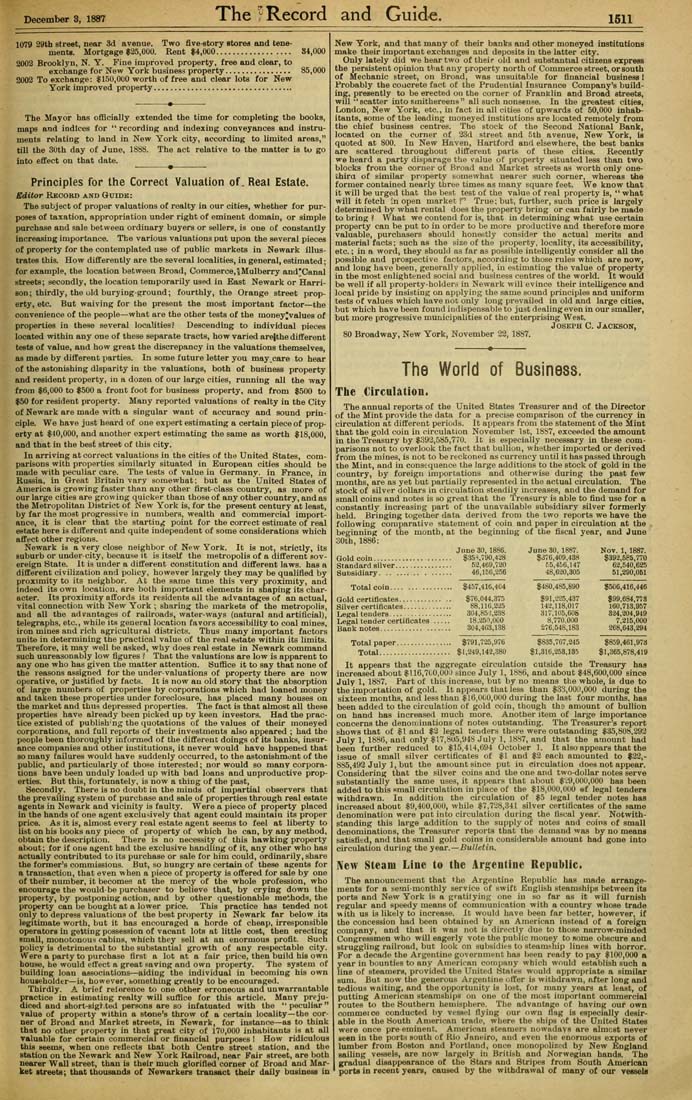
December 8, 1887 The 'Record and Guide. 1611 10T9 39th street, near Sd avenue. Two five-story stores and tene¬ ments. Mortgage $25,000, Rent $4,000.................. 84,000 2003 Brooklyn, N. Y. Fine improved property, free and clear, to exchange for New York business property................ 85,000 2002 To exchange: $150,000 worth of free and clear lots for New York improved property.................................. --------•-------- The Mayor has officially extended the time for completing the books, raaps and indices for " recording and indexing conveyances and instru¬ ments relating to land in New York city, according to limited areas," till the 30th day of June, 1888. The act relative to the matter is to go into effect on that date. -------------------------------------------------------------------------------------•-----------------------------------------------------------------------------------■ Principles for the Correct Valuation of. Real Estate. Editor Record and Guide: Tbe subject of proper valuations of realty in our cities, whether for pur¬ poses of taxation, appropriation under right of eminent domain, or simple purchase and sale between ordinary buyers or sellers, is one of constantly increasing importance. The various valuations put upon the several pieces of property for the contemplated use of public markets in Newark illus¬ trates this. How differently are the several localities, in general, estimated; for example, the location between Broad, Comraerce.^Mulberry and'Canal streets; secondly, the location temporarily used In East Newark or Harri¬ son; thirdly, the old burying-eround; fourthly, the Orange street prop¬ erty, etc. But waiving for the present the most important factor—the convenience of the people—what are the other tests of the money'values of properties iu these several localities? Descending to individual pieces located vpithin any one of these separate tracts, how varied are|tbe different teets of value, and how great the discrepancy in the valuations themselves, OS made by different parties. In some future letter you may .care to hear of the astonishing disparity in the valuations, both of businesa property and resident property, iu a dozen of our large cities, running all the way from $6,000 to $500 a front foot for business property, and from $500 to $50 for resident property. Many reported valuations of realty in the City of Newark are made with a singular want of accuracy and sound prin¬ ciple. We have just heard of oue expert estimating a certain piece of prop¬ erty at $40,000, and another expert estimating tbe same as worth $18,000, and that in the best street of this city. In arriving at correct valuations in the cities of the United States, com¬ parisons with properties similarly situated in European cities should be made with peculiar care. The tests of value iu Germany. In France, in Russia, in Great Britain vary soraewhat; but as the United States of America is growing faster than any other firstclass country, as more of our large cities are growing quicker than those of any otber country, and as the Metropolitan District of New York is, for the present century at least, by far the most progressive in numbers, wealth and commercial import¬ ance, it is clear that the starting point for the correct estimate of real estate here is different and quite independent of some considerations which affect other regions. Newark is a very close neighbor of New York. It is not, strictly. Its suburb or under-city, because It is itself the metropolis of a different sov¬ ereign State. It is under a different constitution and different laws, has a different civilization and policy, however largely tbey may be qualified by proxiraity to its neighbor. At tbe same time this very proximity, and indeed its owu location, are both important elements in shaping its char¬ acter. Its proximity affords its residents all the advantages of an actual, vital connection with New York ; sharing the markets of the metropolis, and aU the advantages of railroads, water-ways (natural and artificial), telegraphs, etc., while its general location favors accessibility to coal mines. Iron mines and rich agricultural districts. Thus many important factors unite in determining the practical value of the real e.state within its Umits. Therefore, it may well be asked, why does real estate in Newark command such unreasonably low figures ? Tbat the valuations are low is apparent to any one who has given the matter attention. Suffice it to say that none of the reasons assigned for the under-valuations of property there are now operative, or justified by facts. It is now au old story that tbe absorption of large numbers of properties by corporations which had loaned money and taken tbese properties under foreclosure, has placed many houses on the market and thus depressed properties. The fact Is that almost all these properties have already been picked up by keen investors. Had tbe prac¬ tice existed of publish'ng the quotations of the values of tbeir moneyed corporations, and full reports of their investments also appeared ; had tbe people been thoroughly informed of the different doings of its banks, insur¬ ance companies and other institutions, it never would have happened that so many failures would have suddenly occurred, to the astonisbmont of the public, and particularly of those interested; nor would so many corpora¬ tions have been unduly loaded up with bad loans and unproductive prop¬ erties. But this, fortunately, is now a thing of the past, Secondly. There is no doubt iu the minds of impartial observers that the prevailing system of purchase and sale of properties through real estate agents in Newark and vicinity is faulty. Were a piece of property placed in the hands of oue agent exclusively that agent could maintain its proper price. As it is, almost every real estate agent seems to feel at liberty to list on bis books any piece of property of wbich he can, by any method, obtain tbe description. There is no necessity of this hawking property about; for if one agent had the exclusive handling of it, any other who has actually contributed to its purchase or sale for him could, ordinarily, share the former's commissions. But, so hungry are certain of tbese agents for a transaction, that even when a piece of property is offered for sale by one of their number, it becomes at the mercy of the whole profession, who encourage the would-be purchaser to believe that, by crying down tbe property, by postponing action, and by other questionable methods, the property can be bought at a lower price. Thia practice haa tended not only to depress valuations of tbe best property in Newark far below ita legitimate worth, but it has encouraged a horde of cheap, irresponsible operators in getting possession of vacant lots at little cost, then erecting small, monotonous cabins, which they sell at an enormous profit. Such policy is detrimental to the substantial growth of any respectable city. Were a party to purchase first a lot at a fair price, then build his own bouse, he would effect a great saving and own property. Tbe system of building loau associations—aiding the individual iu becoming bis own householder—is, however, something greatly to be encouraged. Thirdly. A brief reierence to one other erroneous and unwarrantable practice in estimating realty will suffice for this article. Many preju¬ diced and short-sighted persons are so infatuated with the "peculiar" value of property witbin a stone^a throw of a certain locality—tbe cor¬ ner of Broad and Market streets, in Newark, for instance—as to think tbat no other property in that great city of 1T0,000 inhabitants is at all valuable for certain commercial or financial purposes ! How ridiculous thia seems, when one reflects that both Centre street station, and the station on tbe Newark and New York Railroad, near Fair street, are both nearer WaU street, than is their much glorified corner of Broad and Mar¬ ket streets; that thousands of Newarkers transact their daUy business in New York, and that many of their banks and other moneyed institutions make their important exchanges and deposits in the latter city. Only lately did we hear two of their old and substantial citizens expreaa the persistent opinion t^tat any property north of Commerce street, or south of Mechanic street, ou Broad, was unsuitable for financial business I Probably the coucrete fact of the Prudential Insurance Company's build¬ ing, presently to be erected on the corner of Franklin and Broad streets, will ''scatter into smithereens" all such nonsense. In tbe greatest cities, London, New York, etc., in fact in all cities of upwards of 50,000 inhab- itants, some of the leading moneyed institutions are located remotely from the chief business centres. The stock of the Second National Bank, located on the corner of 23d street and 5th avenue, New York, is quoted at SOO. In New Haven, Hartford and elsewhere, the best banks are scattered throughout different parts of these cities. Recently we heard a party disparage the value of property situated lesa than two blocks frora the corner of Broad and Market streeta aa worth only one- thira of similar property somewhat nearer such comer, whereas the former contained nearly three times as many square feet. We know that it will be urged tbat the best test of the value of real property is, *' what will it fetch In open market?" True; but, further, such price is largely determined by what rental does tbe property bring or can fairly be made to bring ? Wbat we contend for is, that in determining what use certain property can be put to in order to be more productive and therefore more valuable, purchasers should honestly consider the actual merits and material facts; such as the size of the property, locality, its accessibility, etc.; in a word, tbey should as far as possible intelUgently consider all the possible aud prospective factors, according to those rules wbich are now, and loug have been, generally applied, in estimating the value of property in the most enlightened social and business centres of the world. It would be well if all property-holders in Newark will evince their intelligence and local pride by insisting on applying the same sound principles and uniform tests of values which have not only long prevailed in old and large cities, but which have been found indispensable to just dealingeven in om' smaUer, but more progressive municipalities of the enterprising West. Joseph C. Jackson, 80 Broadway, New York, November 22, 188T. The World of Business. The Circulation. The annual reports of the Uuited States Treasurer and of the Director of the Mint provide the data for a precise comparison of the currency in circulation at different periods. It appears from the statement of the Mint that the gold coin in circulation November 1st, 18S7, exceeded the amount in the Treasury by $393,585,770. It is especially necessary in tbese com¬ parisons not to overlook the fact that bullion, whether imported or derived from the mines, is not to be reckoned as currency until it has passed through the Miut, and in consequence the large additions to the stock of gold in the country, by foreign importations and otherwise during the past few months, are as yet but partially represented in the actual circulation. Tbe stock of silver dollars in circulation steadily increases, aud the demand for small coins and notes is so great that the Treasury is able to find use for a constantly increasing part of the unavailable subsidiary silver formerly held. Bringing together data derived from the two reports we have the following comparative statement of coin and paper in circulation at the beginning of the month, at tbe beginniug of the fiscal year, and June SOth, 1886: June 30, 1886. June 30, 1887. Nov. 1, 1887. Gold coin..................... $35-<,790,428 $376,409,438 $393,585,770 Standard silver................ 52,469,720 55,456,147 62,540,625 Subsidiary................ 46,156,256 48,620,305 51,290,051 Totalcoin................ $457,4ltJ,4C4 $480,485,890 $506,416,446 Gold certificates.............. $76,044,375 $91,225,437 $99,684,773 Silver certificates.............. 88.116,2;i5 142,118,017 160,713,957 Le^al tenders................. 304,85 i,238 317.105,008 324,204,949 Legal tender certificates ..... 18,25^,000 8,770.000 7.315,000 Bank notes................... 304,463,138 276,548,183 268,643,294 Total paper................ $791,725,970 $835,767,245 $859,461,973 Total.................... $1,249,I42,.S80 $1,316,258,185 $1,365,878,419 It appears that the aggregate circulation outside the Treasury haa increased about $116,7CO,00:) since July 1, 18»6, and about $48,600,000 since July 1, 18S7. Part of this increase, but by no meana the whole, is due to the importation of gold. It appears that less than $33,000,000 during tbe sixteen months, aud less than $16,000,000 during the last four raonths, haa been added to the circulation of gold coin, though tho amount of bullion on hand has increased much more. Another item of large importance concerns the denonjiuations of notes outstanding. The Treasurer's report shows that of $1 and $2 legal tenders there were outstanding $35,808,292 July 1, 1886, and only $17,805,948 July 1, 18S7, and that the amount had been further reduced to $15,414,694 October 1. It also appears tbat the issue of small silver certificates of $1 and $2 each amounted to $22,- 885,492 July 1, but the amount since put iu circulation does not appear. Considering tbat the silver coins and tbe one and two-dollar notes serve substantially the same uses, it appears Ihat about $i9,000,000 bas been added to tbis small circulation in place of tbe $18,000,000 ®f legal tenders withdrawn. In addition the circulation of $5 legal tender notes bas increased about $9,400,000, while $7,728,341 silver certificates of the same denomination were put into circulation during the fiscal year. Notwith¬ standing this large addition to the supply of notes and coins of small denominations, the Treasurer reports that tbe demand was by no means satisfied, and that small gold coins in considerable amount had gone into circulation during the yea.r.—Bulletin. New Steam Line to the Argentine Republic. The announcement that *he Argentine Republic has made arrange¬ ments for a bemi-montbly service of swift English steamships between its ports and New York is a gratllying one in so far as it will furnish regular and speedy means of communication with a country whose trade with us is likely to increase. It would have been far better, however, if the concession had been obtained by an American instead of a foreign company, und that it waa not is directly due to those narrow-minded Congressmen who will eagerly vote the public money to some obscure and struggling railroad, but look on subsidies to steamssliip lines with horror. For a decade the Argentine government has been ready to pay $100,0(X> a year in bounties to any American cottipany which would establish such a line of steamers, provided the United States would appropriate a similar sum. But now the generous Argentine offer ia withdrawn, after long and tedious waiting, and the opportunity is lout, for many years at least, of putting American steamships on one of the most important commercial routes to the Southern hemisphere. The advantage of having our own commerce conducted by vessel flying our owu flag is especiaUy desir¬ able in the South American trade, where tbe ships of the United States were once pre eminent. American steamers nowadays are almnst never seen in tbe ports south of Rio Janeiro, and even the enormous exports of luraber from Boaton and Portland, once monopolized by New England sailing vessels, are now largely in British and Norwegian hands. The gradual disappearance of the Stars and Stripes from South Araerican ports in recent years, caused by tbe withdrawal of many of our vessels