
Columbia University Libraries Digital Collections: The Real Estate Record
Use your browser's Print function to print these pages.
Real estate record and builders' guide: v. 41, no. 1035: January 14, 1888
Text version:
Please note: this text may be incomplete. For more information about this OCR, view About OCR text.
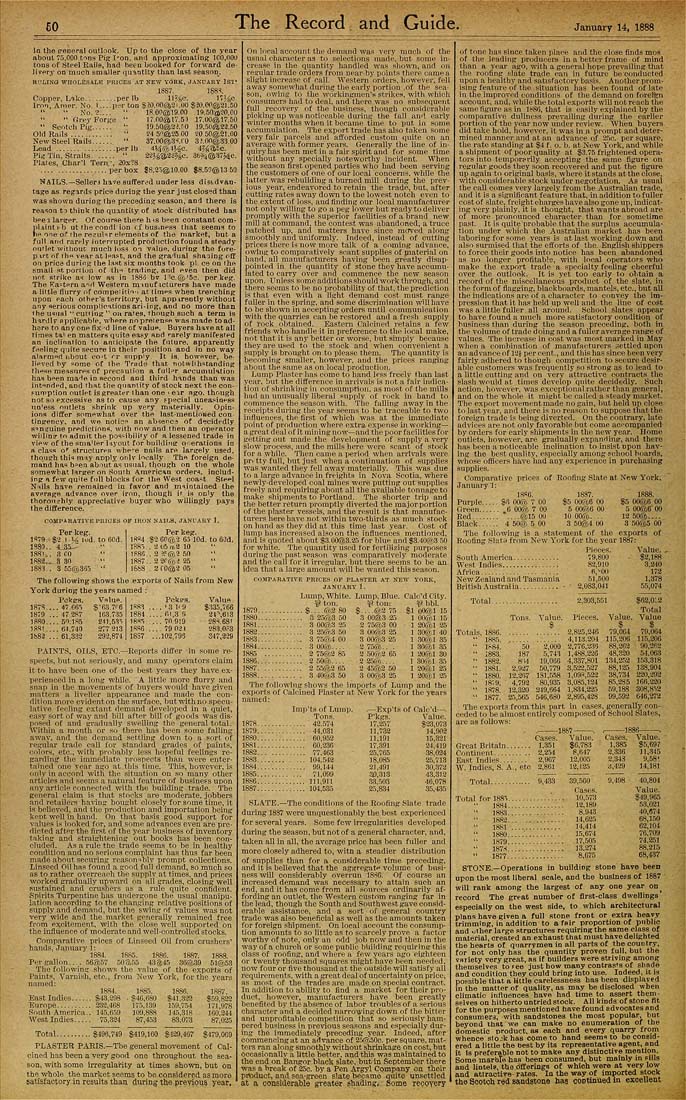
60 The Record and Guide. January 14, 1888 In the eeneral outlook. Up to tbe close of tbe year about 75,000 t'lns Pig I'on. and apprOKimating 100,600 tons of Steel Rails, had been booked for forward de¬ livery on much smaller quantity than last season, RULING WnOLESALE PRICES AT NEW YORK, JASDARY ISI" 1887. 188'*. Copper, Like.........per lb I'j^c. 17!.^c Iron, Amer. No. I ,...psr ton S30.O0(a2(.U0 S30.00@ai.50 " " No. 3..,. " ia.OP@I9.00 19,59;ai30.00 " fJivy Forge " 17.00(ai'i'.5) ]7.O0@17,50 " Scotch Pig...... •■ 19.aO(a3i,fO J9.5liia33.50 Old Rails............ - S4Si'ia25.00 20 50(2,21,00 NewSteel Rails...... " 37.00(fi3-*.l~0 3i.0n@33.00 Lead ................per lb i\4(g}iy,c. 4JgaEc. Pig Tin, Straits...... " 22'^®2i^^c. 3b^®37>ac. Piates, Charn Tern.^ 30x78 ..................per box $S.3:)@ilO.0O g8,55@135a NAILS.—Seller J ha7e aufferi?d under lesa distd^an- tage as regards price during the yearjust closed than was shown duriog Ihe preceding season, and there is reason tl think the quantity of stock distributed haa beei larger. Of course tbc-e h is been constant com¬ plaint i-b uttliecoodi ion tf bus.npsa that seems to lift one of ibe reffulflr elementa of tlie market, but a full and rarely interrupted production found a steady outlet without mucb loss ot value. durruK the fure- p irt of ih« vear at Ipast, and the gradual shaoing off oil price during tlie l.i-it six months look pi ceon'be small st portion of lb'' trading, and even then did not Birfke a^f low aa ia 1886 bv lie.©'5c. per keg. The Kastern aid Western miuuf icturers have made a little flurry of compeiitio'i at limPS when trenching upon each other's territory, but appirentiy without any serious couiplicitioDS ari-irg, and no more then Ihe usiih! ■■ culling " on rates, ihouRb eucb a term is hirdlv applicable, wbare nipreten^e waa made to ad¬ here to any onefix-'d line o£ value. Buyers bave at al! times tat en matters quite easy and rarely manifesied an inclination lo anticipate tbe future, appirentiy f.ieling q;iitesecui"e in thuir position aod In no way alarm'»ri about co-'t i"r supply It ia. however, be. Itpved by ^ome of tbe Trade (hat iiotiviih=tanding (besH measurps of precsuiion a Eiill^r accumulation has b»en mafle io second and third b'lnds than was intandpd, and Ibat tbe quanlily of slock next Ibe con- Fumption outlet is greater than one > eir ago. thr.ugh not an excessive as lo cause any fpecial uneasiness un'ess oiiilets shrink up very materially. Opin¬ ions differ somewhat over thf I ast-mentioned con- tine-encv. and wo notice an absence of decidedly s'niuine prpdictinns. with now and Ihen au operator wiilin? to admit the pos'ibiliiy of a lessened trade in view of tbe sma'ler liyout for biiildinc onerations in a cla'^a o' structurps wbe'e nails are largely used, Ibquffh tbi* mi»y anply onlv iocally. The foreign de¬ mand baf b»ea about ai usual, though on tbe whole somewhat lireer (in ptouih American order*, includ¬ ing a few quife fidl blocks for (lie West coa^t Steel Niils bave remained in favor and m^intaiaed tbe average advance over iron, though ii is only tbe tboroiiffbly appreciative buyer who willingly paya the difference. COMPARATIVE PRIOaS OF IRON NAII.S, JANl'ARV 1. Per keg. Per keg. I''7fi.-g2 1 U lud. toOOd. 1R04 83 G0©3 63 lOd, to OOd. 1330.. 4_35i; IRSn. 2(;5fj.2 10 1881.. 3 m " 1P8fi, , 2 !?Cij3 50 lK8a„ 3 30 1HS7. , SSCtTjli 35 " 1883.. 3 55^365 " 1688 . arO(gl3 05 ■' Tbe following shows tbe exports of Nails from New York during the yeara named : Pckea, Vnlue. Pckps. Value 187'!.... 47 661 e'll3.7i-6 I Hfll ... '3 11 9 8335,766 18;9 ... 47 287 163.735 1884. .... 61.3 S 31\(!13 1880,... 5n.1fi5 211.53=1 I8«5. ...70,919 98^.631 1881,,.. tl4.749 277 213 lAsg ... 79 031 983.0P3 lft82 ... 61,333 293.874 18S7. .,,103,793 347,239 PAINTS, OILS, ETC.—Reports differ in some re¬ spects, but not seriously, and many operators claim it to have been one of tlie best years tbey have ex¬ perienced in a long while. A little more flurry and snap ill tbe movements of buyers would have given matters a livelier appearance aud made tbe eou- flilion more evidentou the siuface, butwitbno specu¬ lative feeling extant demand developed in a tiuiet, easy sort of way and bill after bill of goods was dis- pnsed of and [.'fafliially swelling the general total. IV'itliiu a ranntli or so tbere bas been some falling away, and the demand settling down to a sort of regular trade call for standard grades of paints. i;i>lors, etc., with probably less ho])efiii feelings re¬ garding tbe immediate prospects than were enter¬ tained one year ago at tbis time. This, however, is only in accord witb tba situation ou so many other articles and seems a natural feature of business upon any article connected with the building trade. Tbe general claim is tbat stocks are moderate, jobbers and retailers having bought closely for some time, it is believed, and the production iuid importation being kept well in liantl. On that basis good support for v;iiiies is looked for, and some advances even are pre¬ dicted after tbe first of the year business of inventory taking and straiffbtening out books has been con- chided. As a rule the trade seems to be in healthy condition aud no serious complaint lias thus far been made about securing reasonablv prompt collections. Linseed Oil bas found a good full demand, so much so as to rather overreach tbe supply at times, and prices worked gradually upward on all grades, closing well Kiustained and crusliers as a rule quite confident. .Spirits Turpentine has undergone tbe usual manipu¬ lation according to tbe changing relative positions of supply and demand, but the swing of values was not very wide and the market generally remained free from e:;citement, witb the close well supported on the influence of moderate and well-control led stocks. Comparative prices of Linseed Oil fi'o;n cruslieis' hands, January 1: 188=1. 1R85, 1886. 1R87. 1888. Per gallon.,.. 56@57 50a55 43g45 80@39 51(g53 Tlie following shows the value of the exports of Paints, Varnish, etc, from New York, for the years named: 1884. 1885, 1836. 1887. East Indies......$43,298 . ^40,680 841.333 859;832 Europe.......... 333,468 175.139 159,754 171,978 South America.. 145,650 109,888 145,318 100;a44 Westlndies..... 75,324 87,453 &3.073 87,035 Total..........8^38,749 $419,160 $439,467 $479,009 PL.4.STElt PARIS.—Tbe general movement of Cal¬ cined bas been a very good ono throughout tbe sea¬ son, with some Irregularity at times shown, but on tbe whole tbe market seems to be considered as more satisfactory in results than during the previous year. On local account the demand waj" very much of the usual eliaraoter as to selections made, but some in¬ crease ill the quantity bandied was shown, antl on regular trade orders from uear-by points there came a slight increase of call. Tl'estern orders, bowever, fell away somewhat during the early portion .of tbe sea¬ son, owing to the workingmen's strikes, with which consumers bad to deal, and there was no subsequent full recovery of the business, tbough considerable picking up was noticeable during the fall and early winter months when it became time to put in some accumulation. The export trade has also taken some very fair iJarcels and afforded custom quite on an average with former years. Generally the line of in¬ quiry has been met in a fair spirit and for some time without any specially noteworthj' incident. When tbe season first opened parties wbo had been serving tbe customers of one of our local concerns, wbile the latter was rebuilding a burned mill during the prev¬ ious year, endeavored to retain tbe trade, hut, after cutting rates away down to the lowest notch even to the extent of loss, and findine our local manufacturer not only willing to go a ijeg lower but ready to deliver promptly with tbe superior facilities of a brand new mill at command, the contest was iibaudoned, a truce patched up. and matters ha\'e since mcri'ed along smoothly and tmiformly. Indeed, instead of cutting prices there is now more talk of a coming advance, owing to comparatively scant supplies of piaterial on band, all manufacturers having iieeu greatly disap¬ pointed in tbe quantity of stone they have accumu¬ lated to caiTy over and commence the new season upon. Unless some additions should work through, and there seems to be no probability of tiiat.tbeprediction is tbat even with a light demand cost must range fuller in the spring, and aome discii mi nation will bave to be shown in accepting orders until comniunication with the quarries can be restored and a fresh supply of rock obtained. Eastern Calcined retains a few friends who handle it in preference to tbe local make, not that it is any better or worse, but simply because tbey are used to the stock and when convenient a supply is brought on to please them. The quantity ia becoming smaller, however, and the prices ranging about the same as on local production. Lump Plaster has come to hand less freely tban last year, but tbe difference in arrivals is not a fair indica¬ tion of shfinkiiig in consumption, as most of tbe mills bad an unusualty libera! supply of rock in hand to commence the season witb. The falling away in the receipts during tiie year seems to he'traceable to two iufiuences. the first of whicb was at tbe immediate pobit of production where extra expense in woiking— agreat deal of it mining now—and the poor facilities ff>i' eetting out made the development of supply a very slow process, and the mills here were scant of stock for a while. 1'lieii came a period when arrivals were pri tty full, but just when a continuation of supplies was wanted they fell away materially. Tbis was due to a large advance in freights in Nova Scotia, where newly-developed coal mines were putting out supplies freely aud requiring about all the available tonnage to make shipments to Portland. The shorter trip and tbe better return protnptly diverted the raa.ior portion of tbe plaster vessels, and tbe result is that manufac¬ turers lierebave not within two-thirds as much stock on band as they did at tbis time last year. Cost of lump has increased also on the influences mentioned, and is (juoted about $3.00(ffia.35 for blue and 83.40@3 50 for white. Tin- quantity used tor fertiU^ing purposes during tbe past se;isiui was comparatively moderate and tbe call fur it invgiilar. but tbere seems to be au idea that a large amount will be wanted this season. COATTARATn'E PRICES OP PLASTER AT NHW TOnii, JiNl'AKY 1. Limip, White. Lump, Blue. Calc'dCity. '4 ton. l^ ton: ^ bbl, 1879.............S,..,®2 80 $....@'3 75 $1 oO@'l 15 1880............. 3 25(^3 50 3 00®3 25 1 OOiii'l 15 1881............. 3 00@3 35 2 7m.3 00 1 SOffll 35 1883-............ 3 A'i^a 50 3 00@'3 35 1 30(5-l 40 1883............. 375®400 3 00@-3 35 1 30(??'l 35 1884............. 300®.,.., 275@... 1 30(ffll 35 lSa5 ........... 3 75@3 85 2 50(g'3 65 1 2(mi 30 1880............. 350^.... 33.5a.-.. 1 30(3il 35 1887............ 3 55®3 65 3 45^.3 50 1 30(S1 25 1888........... 3 4Q^ti3 .50 3 00(&i3 25 1 yor.i;! 35 Tbe following shows the imports of Liunp and tbe exports of Calcined Plaster at New York for the years named: Imp'ts of Lump. Tons. 1878.............. 42.574 1879.............. -14,031 leeO.............. 60,953 1881.............. 00,336 1883............. 77.463 1683............ 104,543 1884.............. 99,144 1885............ 71,099 1880.............. 111,911 1887.............. 104,535 -—Esp'ts of Calc'd—, P'kgs. Value. 17.357 $33,073 11.733 14,003 11,191 15,321 17,591 24,419 35,765 38,034 18,0a5 3.5,713 21,491 30.372 3fl,313 43,313 -33,503 46,078 25,834 .35,4.35 SL.ATB.—The conditions of the Roofing Slate trade during 1837 were unquestionably the best experienced for several years. Some few irregularities developed during tbeseason, hut not of a general character, and, talien all in all, the average price has been fuller and more closely adhered to, witb a steadier distribution of supplies than for a considerable time preceding, and it is believed that the aggregatp volume of busi¬ ness will considerably overrun I8S0, Of course an increased demand was necessary to attain sucb an end, and it bas come from all sourees ordinarily af¬ fording an outlet, the Western custom ranging far in the lead, though the South and Southwest gave consid¬ erable assistance, and a sort of general country trade vuas also beneficial as well as the amounts taken for foreign shipment. On local account the consump¬ tion amounf.s to so little as to scarcely prove a factor worthy of note, only an odd job now and then in the way of acburcb or some public bbildJngroquir ine this class of roofing, and where a few years ttgo eighteen or twenty thousand sipiares might bave been needed, now four or five thonsanti at tbe outside will satisfy all requirements, with a great deal of uncertainty on price, as most of tbe trades are made on special contract. In addition to ability to find a market for tbeir pro¬ duct, however, manufacturers have been greatly benefited by the absence of labor troubles of a serious character and a decided narroij'ing down of (lie bit) er and unprofitable competition that so seriously ham¬ pered business in previous seasons and especially dur¬ ing the immediately preceding year. Indeed, after coinmencingat an advance of 35(i7i50e. per square, mat.- tors ran along smoothly without shriukage on cost, but occasionally a little better, and this was maintained to tbe end on Bangor black slate, but iu September there was a break of 35c. by a Pen Argyl Company on their product, and. sea-green slate became quite unsettled at a oonsiiierable greater ^haaingv gome recoyery of tone has since taken place and the close finds mos of the leading producers iu a better frame of mind than a year ago, with a general hope prevailing thiit tbe roofing slate trade can in future be conducted upon a healthy and satisfaotoiy basis. Another prom¬ ising feature of tbe situation has been found of late in the improved conditions of the demand on fureitju account, and, while the total exports wiU not reach tbe same figure as in lti80, tbat is easily explained by the comparative dullness prevailing during tbe earlier portion of tbe year now under review, Wiien buyers did take hold, howei-er, it was in a prompt and deter¬ mined manner and at an advance of 2,5c. per square, tbe rate standing at 84 f. o. b. at New York, and while a shipment of poor quaUty at $3.75 frightened opera¬ tors into temporprily accepting the same figure on regular goods tbey soon recovered and put tbe figure up again to original basis, where it stands at the close, witb considerable stock iiuder negotiation. As usual the call comes very largely from tbe Australian trade, and it is a significant featui* that, in addition to fuller costof slate, freight cbargesbave also gone up, indicate ing very plainly, it is thought, tbat wants abroad arr" of more pronounced character than for sometiia' past. It is quite probable tbat the surplus accumula¬ tion under which the Australian market bas been laboring for some years is at last working down and also surmised that tbe efforts of tbe English shippers to force their goods into notice has been abandoned as no longer profitable, witb local operators who make the export trade a specialty feeling cheerful over the outlook. It is yet too early to obtain a record of the miscellaneous product of the slate, in the form of flagging, blackboards, mantels, etc., but all the indications are of a character to convey tbe im¬ pression that it ha.= held up well and tbe line of cost was a little fuller all around. School slates appear to have found a mucb more satisfactory condition of business than during tbe season preceding, both in tbe volume of trade doing and a fuller average range of values. The increase in cost was most marked iu May when a cotnbiration of manufacturers settled upon an advanceof I3}per cent., and tbis bas since been very fairly adhered to though competition to secure desir¬ able customers was frequently so strong as to lead to a little cutting and on very attractive contracts the slash w(Mild at times develop quite decidedly. Sucb action, bowever, was exceptioiml rather than general, and on the whole it miirbt, be rjiud asteady market. Tbe export movementmade nu gain, but held up close to last year, and there is no reason to suppose that the foreign trade is being diverted. On the contrary, late advice.'i are not only favorable but come accompanied by orders for early shipments in the new year. Home outlets, bowever, are gradually expandiiip, and there bas been a noticeable inclination to insist upon hav¬ ing the best qiiality, especially among school boards, whose ofiicers have liad auy experience in purchasing supplies. Comparative prices of Roofing Slate at New York, January]: 18fi(5, 1837, 1888, Purple.....$6 00® 7 00 $5 OO^iG 00 85 00®B 00 Green...... .6 OO® 7 00 5 00@6 00 5 00®6' 00 Red............@15 00 MMjm- ■ 1350®.... Black...... 4 50®. 5 00 3 50®4 00 3 50®5 00 Tbe following is a statement nf tbe exports of Roofing Slata from New York for the year 1887: Pieces. Value, South America............. ';9,800 - $2,188 West Indies................ 82,910 3,340 Africa.................... 6,-Otl 172 New Zealand and Tasmania 51,600 1,378 BritishAustraiia........... -■ 3.083,041 55,074 Total. 2,303,551 Tous. Value, Pieces. $62,012 Total Value. Value Totals, 1880. "■ 1885, ■' ISRl. '• 1883. •■ 1883, '■ IflSl, ■• 1880. " 18; 9. •' 1878. ■' 1877, 50 2,000 187 5,743 H'l4 19,066 3,937 50,779 13.3ii7 181,558 4,793 80.935 13,330 319.664 25,565 540,080 The exports from this part in cases, generally con¬ ceded to beaimostentirely composed of School Slates, are as follows: - ,——1867 ——^ ,--------1886--------, Cases. Value. Cases, Value. 3,825,210 4,1W.304 2,776,2;J6 1,488.236 4,337,801 3.533,527 l,09a,,533 3,085,124 1.834,325 3,895,438 79,061 115,200 88.263 48,3S0 134.2.52 88,135 38,734 a5,2S5 59,183 99,593 79,064 115,306 90,2fi2 54.063 153.318 138,904 220,292 106.330 308,853 046,272 $6,783 8.647 12,005 13.135 Oreat Britain....... 1.351 Continent.......... 3.354 East Indies........ 3,907 W, Indies, S, A., etc 2,861 Total............ 9,433 39,500 Cases, Total for 1835................ 10,573 1SH4................ 13,189 1883............... 8.943 " 1KW2............. 14,62.5 " 188! .............. 14,414 1880.....■......... 15.674 1879................ 17,505 " 187.^................ 13.374 1877................ 8,675 1,385 3.330 2.343 a.420 9.498 $5,697 11,345 9,58'- 14,181 40,804 Value. $49,965 53,031 40,874 68,1.50 63,104 76.709 74.351 88,315 68,437 STONE.—Operations in building stone have been upon tbe most liberal scale, and the business of 1667 will rank among the largest of any one year on^ record The great number of flrst-class dwellings especially on tbe west side, to which architectural plans bave given a full stone front or extra beav.y trimming, in addition to a fair proportion of public and ^Iber large structures requiring the eame class of material, created an exhaust that must have delighted the haarta of quarrymen in all parts of tbe country, for not only bas the quantity proven full, but the variety very great, as if builders were striving among themselves to fee just how many contrasts of shade and condition tbey could bring into use. Indeed, it is possible that a little carelessness has been dlsplaved in the matter of quality, as may be disclosed when climatic influences have had time to assert them¬ selves on hitherto untried slock. Al! kinds of stone tit for the purposes mentioned have found advocates and consumers, with sandstones tbe most popular, but beyond tbat we can make no enumeration of the domestic product, as each and every quarry from whence slojk has come to band seemx to be consid¬ ered a little the beat by its representative agent, and It Is preferable not to make any distinctive mention. Some marble haa been consumed, but mainly in sills and lintels, tbe offeringa of which were at very low and attractive rates. In the way of imported stock the Scotch red santlstoae baa continued in excellent