
Columbia University Libraries Digital Collections: The Real Estate Record
Use your browser's Print function to print these pages.
Real estate record and builders' guide: v. 41, no. 1038: February 4, 1888
Text version:
Please note: this text may be incomplete. For more information about this OCR, view About OCR text.
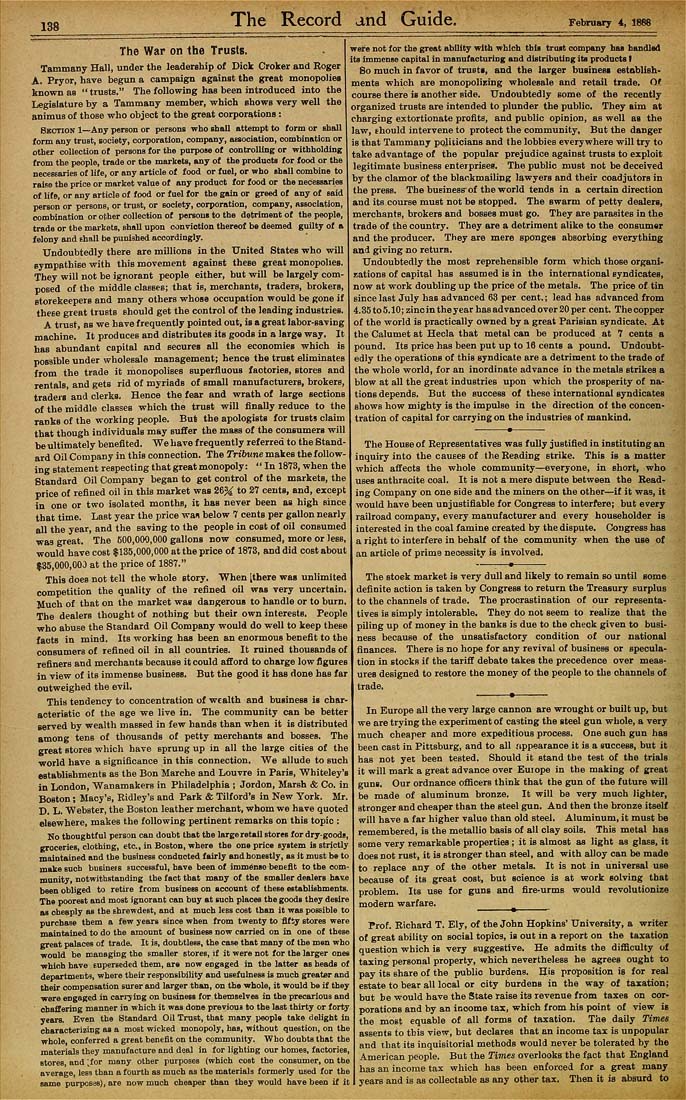
138 The Record and Guide. February 4, 1868 The War on the Trusts, Tammany Hall, under the leaderehip of Dick Croker and Roger A. Pryor, have begun a campaign against the great monopoliea known aa " truata." The following has been introduced into the Legislature by a Tammany member, which shows very well the animus of those who object to tbe great corporations : Section 1—Any person or personB who shall attempt to form or shall (orm any trust, society, corporation, company, aESOciation, combination or other collection of persona for the purpose of controlling or withholdine from the people, trade or the markets, any of the products for food or the neceeearies of life, or any article of food or fuel, or who shall combine to raise the price or market value of any product for food or the necesaaries of life, or any article of food or fuel for the gain or greed of any of said person or persoDS, or trust, or society, corporation, company, aseoclation, combination or other collection of persons to the detriment of the people, trade or the markets, shall upon conviction thereof be deemed guilty of a felony and Ehall be punished accordingly. Undoubtedly there are millions in the United States who will Bympatbise witb this movement against these great monopolies. They will not be ignorant people either, but will be largely com¬ posed of the middle claases; that ia, merchants, traders, brokera, storekeepers and many others whose occupation would be gone if these great trusts should get the control of the leading industries. A trust, aa we have frequently pointed out, is a great labor-saving machine. It produces and distributes its goods in a large way. It haa abundant capital and secureB all the economies which is possible under wholesale management; hence the trust eliminates from the trade it monopolises superfluous factories, etores and rentals, and gets rid of myriada of small manufacturers, brokers, traders and clerks. Hence the fear and wrath of large sections of the middle claases which the truat will finally reduce to the jranka of the working people. But the apologists for truats claim that though individuals may suffer the mass of the consumers will be ultimately benefited. We have frequently referred to the Stand¬ ard Oil Company in this connection. The Tribune makes the follow¬ ing statement reapecting that great monopoly: "In 1873, when the Standard Oil Company began to get control of the markets, the price of refined oil in thia market was 26X to 27 cents, and, except in one or two isolated montha, it haa never been as high since that time. Laat year tbe price wan below 7 cents per gallon nearly all the year, and tbe saving to the people in cost of oil consumed was great. The 500,000,000 gallons now consumed, more or less, would have cost $135,000,000 at the price of 1873, and did cost about $35,000,000 at the price of 1887." Thia does not tell the whole story. When [there waa unlimited competition the quality of the refined oil was very uncertain. Much of that on the market was dangerous to handle or to burn. The dealers thought of nothing but their own interests. People who abuse the Standard Oil Company would do well to keep these facts in mind. Its working haa been an enormous benefit to the consumers of refined oil in all countries. It mined thouaands of refiners and merchants becauae it could afford to charge low figures jn view of ita immense business. But the good it has done bas far outweighed tbe evil. Thia tendency to concentration of wealth and business is char¬ acteristic of the age we live in. The community can be better served by wealth maseed in few hands than when it ia distributed among tens of thousands of petty merchants and bosBes. The great stores which have sprung up in all the large citiea of the world have a significance in this connection. We allude to such eatablisbmenta as tbe Bon Marche and Louvre in Paris, Whiteley's in London, Wanamakers in Philadelphia ; Jordon, Marsh & Co. in Boaton; Macy's, Ridley's and Park & Tilford's in New York. Mr. D. L. Webster, the Boston leather merchant, whom we have quoted elsewhere, makes tbe following pertinent remarks on this topic : No thoughtful person can doubt that the largeretall Btores for dry-goods, groceries, clothing, etc., in Bo&ton, where the one price system is strictly maintained and the business conducted fairly and honestly, as it must be to make Buch busineES successful, have been of immenso benefit to the com¬ munity, notwithstanding the fact that many of the smaller dealers base been obliged to retire from business on account of these establishments. The poorest and most ignorant can buy at such places the goods they desire BB cheaply as the shrewdest, and at much less cost tban it was possible to purchase them a few years since when from twenty to fifty stores were maintained to do the amount of business now carried on in one of these great palaces of trade. It is, doubtless, the case that many of the men who would be managing tho smaller etores, if it were not for the larger ones which have superseded them, ara now engaged in the latter as heads of departments, where their responsibility and usefulness is much greater and their compensation surer and larger than, on the whole, it would be if they were engaged in carrying on business for themselves in the precarious aud ohafCering manner in which it was done previous to the last thirty or forty years. Even tbe Standard Oil Trust, that many people take delight in characterizing as a most wicked monopoly, has, without question, on the whole conferred a great benefit on tbe community. Who doubts that tha materials they manufacture and deal in for lighting our homes, factories, atores and '^ior many other purposes (which cost the consumer, on tbe average, less than a fourth as much as the materials formerly used for the same purposes), are now much cheaper than they would bave been if it were not for the great ability with which this trust company has handled its immense capital in manufacturing and distributing its products f So much in favor of trueti, and the larger business establish¬ ments which are monopolizing wholesale and retail trade. Of course there is another side, Undoubtedly some of the recently organized trusts are intended to plunder the public. They aim at charging extortionate profits, and public opinion, as well aa the law, chould intervene to protect tbe community. But the danger is that Tammany politicians and the lobbies everywhere will try to take advantage of the popular prejudice against trusts to exploit legitimate business enterprises. Tbe public must not be deceived by the clamor of tbe blackmailing lawyers and tbeir coadjutors in the press. Tbe business'of the world tends in a certain direction and its course must not be stopped. Tbe swarm of petty dealers, merchants, brokers and bosses muat go. They are parasites in the trade of the country. They are a detriment alike to the congum«r and tbe producer. They are mere sponges absorbing everything and giving no return. Undoubtedly the moat reprehensible form which thoae organi-i Kations of capital has aaaumed ia in tbe international syndicates,/ now at work doubling up the price of the metala. The price of tin; since last July has advanced 63 per cent.; lead baa advanced from-* 4.35 to 5.10; zinc in the year has advanced over 20 per cent. The copper of the world is practically owned by a great Parisian syndicate. At tbe Calumet at Hecla tbat metal can be produced at 7 cents a pound. Ita price haa been put up to 16 cents a pound. Undoubt¬ edly the operations of thia syndicate are a detriment to the trade of the whole world, for an inordinate advance iu the metals strikes a blow at all the great industries upon which the prosperity of na¬ tions depends. But the success of these internationat syudicatea ahowa bow mighty ia the impulae in the direction of the concen¬ tration of capital for carrying on the induatries of mankind. The House of Representatives waa fully justified in instituting an inquiry into the causes of the Reading strike. This is a matter which affects the whole community—everyone, in short, who uses anthracite coal. It is not a mere dispute between the Read^ ing Company on one side and the miners on the otber—if it was, it would have been unjustifiable for Congress to interfere; but every railroad company, every manufacturer and every householder is interested in the coal famine created by the dispute. Congress has a right to interfere in behalf of the community when the use of an article of prima necessity ia involved, The stock market is very dull and likely to remain so until some definite action is taken by Congress to return the Treasury surplus to the channels of trade. The procrastination of our representa¬ tives is simply intolerable. They do not seem to realize that the piling up of money in the banks is due to the check given to busi¬ ness because of the unsatisfactory coudition of our national finances. There is no hope for any revival of busineaa or specula¬ tion in stocks if tbe tariff debate takes the precedence over meaa- ures designed to restore the money of the people to tke channels of trade. __-------» In Europe all the very large cannon are wrought or built up, but we are trying the experiment of casting the steel gun whole, a very much cheaper and more expeditious process. One such gun haa been cast in Pittsburg, and to all ,'ippearance it is a success, but it has not yet been tested. Should it stand tbe test of the trials it will mark a great advance over Europe in the making of great guns. Our ordnance officers think that the gun of the future will be made of aluminum bronze. It will be very much lighter, stronger and cheaper than the steel gun. And then the bronze itself will bave a far higher value tban old steel. Aluminum, it muat be remembered, is tbe metallio basis of all clay soils. Tbis metal has some very remarkable properties ; it is almost aa light aa glasa, it does not ruat, it ia stronger than ateel, and with alloy can be made to replace any of the other metala. It is not in universal use becauee of its great oost, but science is at work solving that problem. Its use for guns and fire-urms would revolutionize modern warfare. Prof. Richard T. Ely, of the John Hopkins' Univeraity, a writer of great ability on social topics, is out in a report on the taxation question which is very suggestive. He admits the difficulty of taxing personal property, which nevertheless be agrees ought to pay its share of the public burdens. His proposition is for real estate to bear all local or city burdens in the way of taxation; but be would bave the State raise ita revenue from taxes on cor¬ porations and by an income tax, which from hia point of view is the most equable of all forms of taxation. The daily Tirnes assents fo tbis view, but declares tbat en income tax is unpopular and that its inquisitorial methods would never be tolerated by the American people. But the Times overlooks the f&ct that England has an income tax which has been enforced for a great many years and is aa collectable as any other tax. Then it is abaurd to