
Columbia University Libraries Digital Collections: The Real Estate Record
Use your browser's Print function to print these pages.
Real estate record and builders' guide: v. 44, no. 1128: October 26, 1889
Text version:
Please note: this text may be incomplete. For more information about this OCR, view About OCR text.
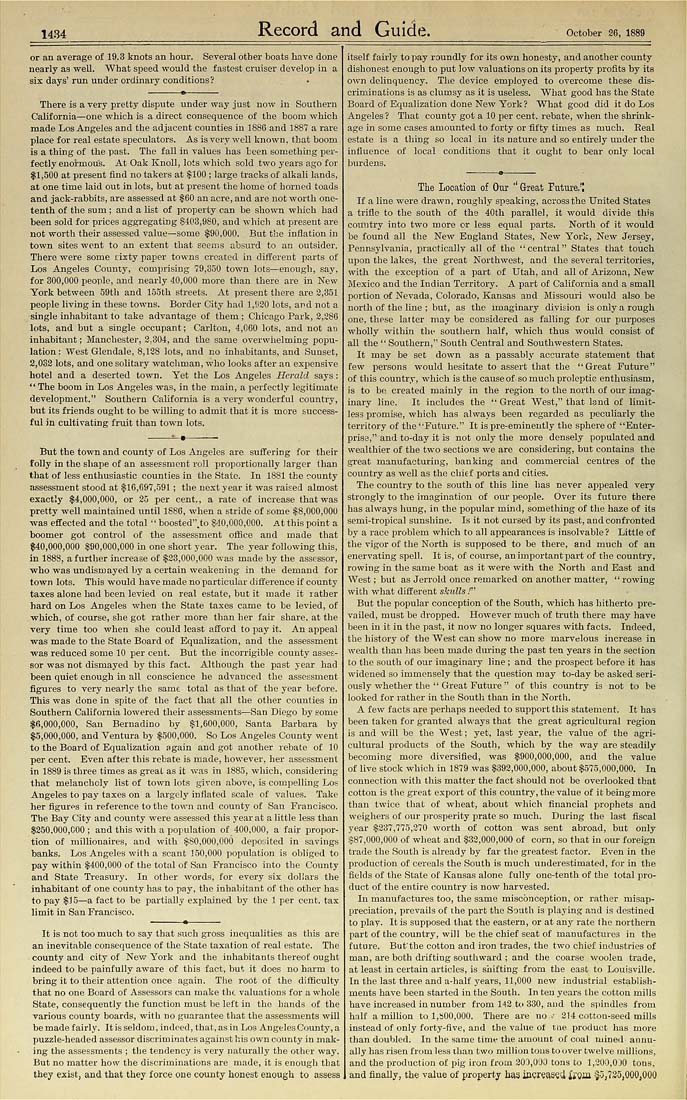
1434 Record and Guide. October 26, 1889 or an average of 19.3 knots an hour. Several other boats have done nearly as well. What speed would the fastest cruiser develop in a six days' run uuder ordinary conditious? There is a very pretty dispute under way just now in Southern California—one which is a direct consequence of the boom which made Los Angeles and the adjacent counties in 1886 and 1887 a rare place for real estate speculators. As is very well known, tbat boom is a thing of the past. The fall in values has been something per¬ fectly enormous. At Oak Knoll, lots which sold two years ago for $1,500 at present find no takers at $100 ; large tracks of alkali lands, at one time laid out in lots, but at present tbe home of horned toads and jack-rabbits, are assessed at $60 an acre, and are not worth one- tenth of the sum; and a list of property can he shown whicb had been sold for prices aggregating S403,9SO, aud whicb at present are not worth their assessed value—some $90,000. But the inflation in town sites went to an extent that seems absurd to an outsider. There were some tixty paper towns created in different parts of Los Angeles Couniy, comprising 79,350 town lots—enough, say, for 300,000 people, and nearly 40,000 more than there are in New York between 59fch and 155th streets. At present there are 2,351 peoi>le living in these towns. Border City had 1,'.)20 lots, and not a single inhabitant to take advantage of them ; Chicago Park, 2,286 lots, and but a single occupant; Carlton, 4,060 lots, and not an inhabitant; Manchester, 2.304, and the same overwhelming popu¬ lation; West Glendale, 8,128 lots, and no inhabitants, and Sunset, 2,032 lots, and one solitary watchman, who looks after an expensive hotel and a deserted town. Yet the Los Angeles Herald says: " The boom in Los Angeles was, in the main, a perfectly legitimate development." Southern California is a very wonderful country, but its friends ought to be wiUing to admit tbat it is more success¬ ful in cultivating fruit than town lots. But the town and county of Los Angeles are suffering for their folly in the shape of an assessment roll proportionally larger (ban tbat of less enthusiastic counties in the State. In 1881 tbo county assessment stood at $16,697,591 ; the next year ifc was raised almost exactly $4,000,000, or 25 per cent., a rate of increase that was pretty well maintained until ISSC, when a stride of some $8,000,000 was effected and the total " boosted".to $^10,000,000. Atthispoint a boomer got control of the assessment office and made that $40,000,000 $90,000,000 in one short year. The year following this, in 1888, a further increase of $23,000,000 was made by tbe assessor, who was undismayed by a certain weakening in the demand for town lots. This would have made no particular difference if county taxes alone had been levied on real estate, but it made it lather hard on Los Angeles when the State taxes cajue to be levied, of ■which, of course, she got rather more than her fair share, at the very time too when sbe could least afford to pay it. An appeal was made to the State Board of Equalization, and the assessment was reduced some 10 per cent. But the incorrigible county asses¬ sor was not dismayed by this fact. Although the past year had been quiet enough in all conscience he advanced the assessment figures to very nearly tbe same total as thafc of tho year before. This was done in spite of the fact that all the other counties in Southern California lowered their assessments—San Diego by some $6,000,000, San Bernadino by $1,600,000, Santa Barbara by $5,000,000, and Ventura by $500,000. So Los Angeles County went to tbe Board of Equalization again aud got another rebate of 10 per cent. Even after tbis rebate is made, however, her assessment in 1889 is three times as great as it was in 1885, which, considering that melancholy list of town lots given above, is compelling Los Angeles to pay taxes on a largely inflated scale of values. Take her flgures in reference to the town and county of San Francisco. The Bay City and county were assessed this year at a little less than $250,000,000 ; and tbis with a population of 400,000, a fair propor¬ tion of millionaires, and with $80,000,000 depo&ited in savings banks. Los Angeles with a scant 150,000 population is obliged to pay within $400,000 of the total of San Francisco into the County and State Ti-easury. In olher words, for every six dollars the inhabitant of one county has to pay, the inhabitant of the other bas to pay $] 5—a fact to be partially explained by the 1 per cent, tax limit in San Francisco. It is not too much to say that such gross inequahties as this are an inevitable consequence of the State taxation of real estate. The counfcy and cityof NewYork and the inhabitants thereof ought indeed to be painfully aware of this fact, but it does no harm to bring it to their attention once again, Tiie root of the difficulty that no one Board of Assessors can make the valuations for a whole State, consequently the function must be left in the bands of the various county boards, with no guarantee that the assessments will be made fairly. It is seldom, indeed, tbat, as in Los Angeles County, a puzzle-headed assessor discriminates against his own county in mak¬ ing the assessments ; tbe tendency is very naturally the other way. But no matter how the discriminations are made, it is enough that tbey exist, and that they force one county honest enough to assess itself fairly to pay roundly for its own honesty, and another county disliouest enough to put low valuations on its property profits by its own delinquency. The device employed to overcome these dis¬ criminations is as clumsy as it is useless. Wbat good has the State Board of Equalization done New York? What good did it do Los Angeles? That county got a 10 per cent, rebate, when the shrink¬ age in some cases amounted to forty or fifty times as much. Eeal estate is a thing so local iu its nature and so entirely uuder the influence of local conditions tbat it ought to bear only local burdens. The Location of Onr '' Great Futm-e.'! If aline were drawn, roughly speaking, across the United States a trifle to the south of the 40th parallel, it would divide this couutry into two more or less equal parts. North of it would be found all the New England States, New York, New Jersey, Pennsylvania, practically all of the "central" States tliat touch upon the lakes, the gi'eat Northwest, and the several territories, with the exception of a part of Utah, and all of Arizona, New Mexico and the Indian Territory. A part of California and a small portion of Nevada, Colorado, Kansas aud i\Iissom"i would also be north of the line ; but, as the imaginary division is only a rough one, these larter maybe considered as falling for our purposes wholly within the southern Iialf, which thus would consist of all the "Southern," Soutii Central and Southwestern States. It may be set down as a passably accurate statement that few persons would hesitate to assert that the "Great Future" of this country, whicb is the cause of ■ so much proloptic enthusiasm, is to be created mainly in the region to the north of our imag¬ inary line. It includes the "Great West," that land of limit¬ less promise, which has aUvays been regarded as peculiarly the territory of the '-Future." It is pre-eminently the sphere of "Enter¬ prise," and to-day it is not only the more densely populated and wealthier of the two sections we are considering, hut contains the gi-eat manufacturing, banking and commercial centres of the country as well as the chief ports and cities. The country to tbe south of this line bas never appealed very strongly to the imagination of our people. Over its future there bas always hung, in the popular mind, something of the haze of its semi-tropical sunshine. Is it not cursed hy its past, and confronted by a race problem which to all appearances is insolvable? Little of tbe vigor of the North is supposed to be there, and much of an enervating spell. It is, of course, au important part of the country, rowing in the same boat as it were with the North and East and West; but as Jerrold once remarked on another matter, "rowing n'ith what different skulls.'" But the popular conception of the South, which has hitherto pre¬ vailed, must be dropped. However much of truth there may have been in it in the past, it now no longer squares with facts. Indeed, the history of the West can show no more marvwlous increase in wealth than has been made during the past ten years in the section to tbe soutii of our imaginary line; and the prospect before it has widened so immensely that the question may to-day be asked seri¬ ously whetiier the " Great Future " of tbis country is not to be looked for rather in the South than in the Norfch. A few facts are perhaps needed to support this statement. It has been taken for granted always that the great agricultural region is and will be the West; yet, last year, the value of the agri¬ cultural products of the South, which by the way are steadily becoming more diversifled, was $900,000,000, and the value of live stock which in 1879 was $393,000,000, about $575,000,000. In connection with tliis matter the fact should not be overlooked tbat cotton is the great export of tbis country, the value of it being more than twice that of wheat, about which financial prophets and weighers of our prosperity prate so much. During the last fiscal year $2il7,775,270 worth of cotton was sent abroad, but ouly $87,000,000 of wheat aud $32,000,000 of corn, so that in om- foreign trade the South is already by far the greatest factor. Even in the production of cereals the South is much underestimated, for in the fields of the State of Kansas alone fully one-tenth of the total pro¬ duct of the entire country is uow harvested. In manufactures too, the same misconception, or rather misap- preciation, prevails of the part the Soutb is playing and is destined to play. It is supposed that the eastern, or at any rate Ihe northern part of tbe country, will be the chief seat of manufactures in the future. But'the cotton and iron trades, the two chief industries of man, are both drifting southward ; and the coarse woolen trade, at least in certain articles, is shifting from the east to Louisville. In the last three and a-balf years, 11,000 new industrial establish¬ ments have heen started in the South. In ten years the cotton mills bave increased in number from 142 to 330, and the spindles from half amillion tol,b00,000. There are uo..' 214 cotton-seed mills instead of only forty-five, aud the vahie of tiie product has more than doubled. In the same time the amount of coal mined annu¬ ally has risen from less than fcwo mUIion tons to