
Columbia University Libraries Digital Collections: The Real Estate Record
Use your browser's Print function to print these pages.
Real estate record and builders' guide: v. 45, no. 1141: January 25, 1890
Text version:
Please note: this text may be incomplete. For more information about this OCR, view About OCR text.
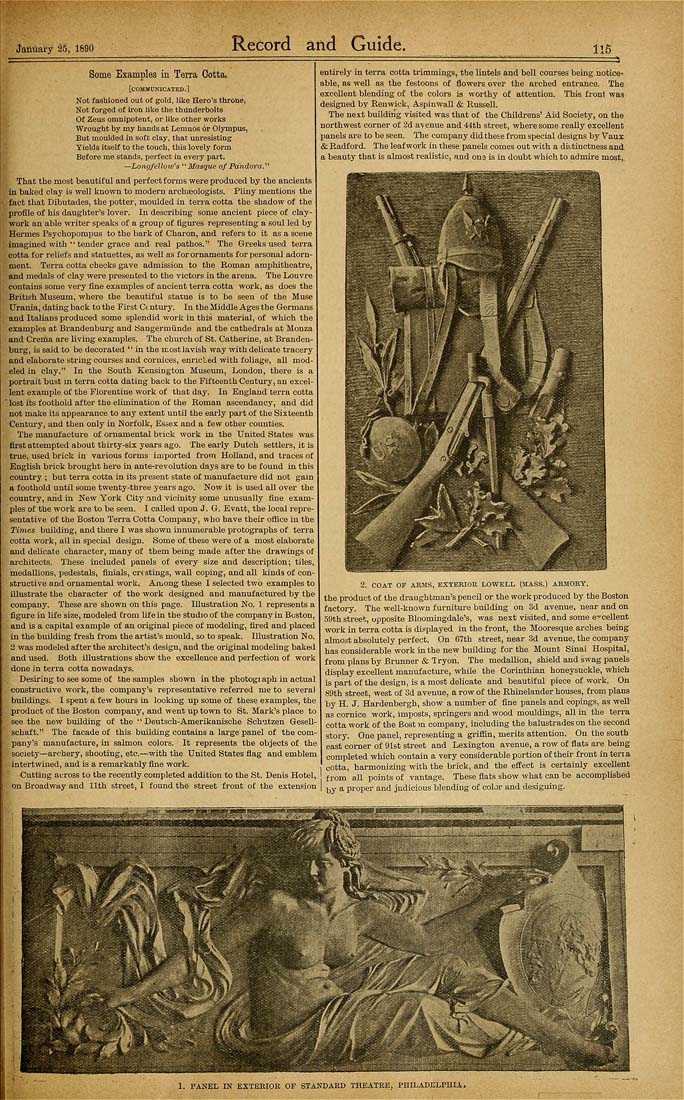
Jatiuaiy SS, 1890 Record and Guide. 116 Some Examples in Terra Ootta. [COMMOKtCATBD.l Not fashioned out of gold, like Hero's throne, Not forged of iron like tbe thunderbolts Of Zeus omnipotent, or like other works "Wrought by my bauds at Lemnos or Olympus, But moulded in soft clay, that unresisting Yields itself to the touch, this lovely foi-m Before me stands, perfect in evei-y part. —Longfellow''s ^'Masque of Pcindora.^' That the most beautiful and perfect forms were produced by the ancients in baited clay is well known to modern archisologists. Pliny mentions the fact that Dibutades, the potter, moulded in teri'a cotta tbe shadow of the pi-ofile of his daughter's lover. In describing some ancient piece of clay- work an able writer speaks of a group of flgm-es representing a sord led by Hei-mes Psychopompus to the bark of Charon, and refers to it as a scene imagined with " tender grace and real pathos." The Greeks used terra cotta for reliefs and statuettes, as weU as forornaments for personal adorn¬ ment. Terra cotta checks gave admission to the Roman amphitheatre, and medals of clay were presented to tbe victors iu the arena. Tbe Louvre contains some very flue examples of ancient terra cotta work, as does tbe British Museum, where the beautiful statue is to be seen of the Muse Urania, dating back to the First Ct ntury. In the Middle Ages the Germans and Italians produced some splendid work in this material, of which the examples at Brandeubm-g and Bangermuude and the cathedrals at Monza and Crema are living examples. The church of St, Catherine, at Branden¬ burg, is said to be decorated " in the mostlavish way witb delicate tracery and elaborate string courses and cornices, enncted with foliage, aU mod¬ eled in clay," In the South Kensington Museum, London, there is a portrait bust in terra cotta dating back to the Fifteenth Ceutm-y, an excel¬ lent example of the Florentine work of that day. In England terra cotta ■ lost its foothold after tbe elimination of the Roman ascendancy, and did not make its appearance to any extent uutU the early part of the Sixteenth Century, and then only in Norfolk, Essex and a few otber counties. The manufacture of ornamental brick work in the United States was fii-stattempted about thirty-six yeai-s ago. The eai-ly Dutch settlers, it is true, used brick in various forms imported from HoUand, and traces of English brick brought here in ante-revolution days are to be found in this country ; but terra cotta in its present state of manufacture did not gam a foothold until some twenty-three years ago. Now it is used all over the country, and iu New York City and vicinity some unusuaUy fiue exam¬ ples of tbe work are to be seen. I called upon J. G. Evatt, the local repre¬ sentative of tbe Boston Terra Cotta Company, who have tbeir office iu tbe Times buildiug, and there I was shown innumerable protograpbs of terra cotta work, all in special design. Some of these were of a most elaborate and delicate character, many of them being made after tbe drawings of architects. These included panels of every size and description; tiles, medallions, pedestals, finials, crtstings, wall coping, and all kinds of con¬ structive ond ornamental work. Among these I selected two examples to illustrate the character of the work designed and manufactured by the company. These are shown on this page. lUustration No. 1 represents a figure in life size, modeled from life In tbe studio of the company in Boston, aud is a capital example of an original piece of modeling, fired and placed in the building fresh from the artist's mould, so to speak. Illustration No, 3 was modeled after the architect's design, and the original modeling baked and used. Both illustrations show the excellence and perfection of work done in terra cotta nowadays. Desiring to see some o£ the samples shown intbe photogi aph in actual constructive work, tbe company's representative referred me to several buildings. I spent a few hours in looking up some of tbese examples, the product of the Boston company, and went up town to St. Mark's place to see the new buUding of the " Deutsch-Amerikanische Schutzen GeseU- schaft." The facade of this building contains a lai-ge panel of th© com¬ pany's manufacture, in salmon colors. It represents tbe objects of the society—arnhery, shooting, etc.—with the United States flag and emblem intertwined, aud is a remarkably fine work. Cutting across to the recently completed addition to the St. Dents Hotel, on Broadway and Ilth street, I found the street front of the extension entirely in terra cotta trimmings, the lintels and bell courses being.notice¬ able, as well as the festoons of flowers over the arched entrance. The excellent blending of the colors is worthy of attention. This froni was designed by Renwiek, Aspinwall & RusseU, The next building visited was that of the Childrens' Aid Society, on the northwest corner of Sd avenue and 44th street, where some really excellent panels are to he seen. The company did these from special designs by Vaux & Radford. Tbe leaf work in tbese panels comes out with a dit,tiuctness and a beauty that is almost realistic, and ona is in doubt which to admue most. 2, COAT of A-RJIS, KXTEKluU LuWKLL (ilASS.) AIUIOH.Y. the product of the draugbtman's pencil or the work produced by the Boston factory. Tbe well-known furnitm-e building on 3d avenue, near and on 59tb street, opposite Bloomiugdale's, was nest visited, and some e-cellent work in terra cotta is displayed in tbe front, the Mooresque arches being almost absolutely perfect. On ertb street, near 3d avenue, the company bas considerable work in tbe new buildmg for the Mount Sinai Hospital, from plans by Brunner & Tryon. The medaUion, shield and swag panels display excellent manufacture, whUe the Corinthian honeysuckle, which is part of the design, is a most delicate and beautiful piece of work. On 89th street, west of 3d aveuue, a row of the Rhineiander houses, from plans by H. J. Hardenbergh, show a number of fine panels and copings, as weU as cornice work, imposts, springers and wood mouldings, all in the terra cotta work of the Bost >n company, including the balustrades on the second story. One panel, representing a gi-iffin, merits attention. On the south east comer of 91st street and Lexington avenue, a row of flats are being completed which contain a very considerable portion of their front in terra cotta, harmonizing with tbe brick, and tbe effect is certainly exceUent from all points of vantage. These fiats show what can he accomplished j^y a proper and judicious blending of color and desiguing. 1. PANEL IN EXTERIOR OF STANDABD THEATRE, PUILADELPHU.