
Columbia University Libraries Digital Collections: The Real Estate Record
Use your browser's Print function to print these pages.
Real estate record and builders' guide: v. 46, no. 1184: November 22, 1890
Text version:
Please note: this text may be incomplete. For more information about this OCR, view About OCR text.
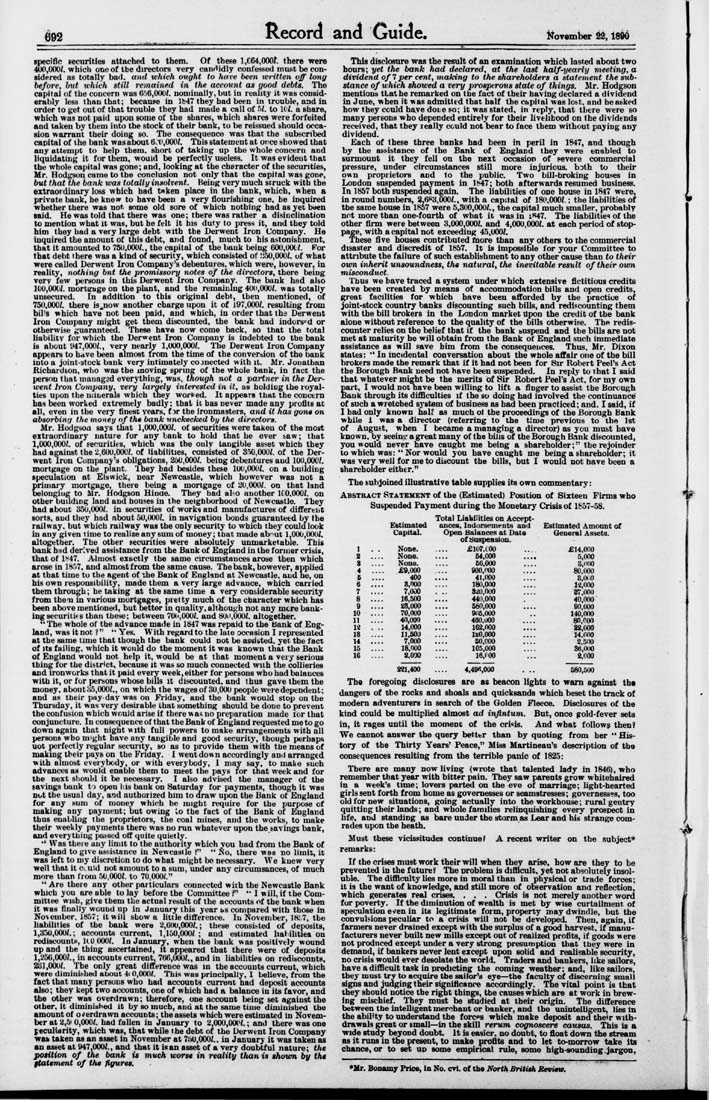
692 Record and Guide, itovember 22,18d6 speciflc securitiea attacbed to tbem. Of tbese l,e64,000f. tbere were «)0,0002. which one of tbe directors very canut 1,000,0002. altogetber. The otber securities were absolutely unmarketable. This bank had derived assistance from tfae Bank of England in tfae former crisis, that of 1847. Almost exactly tfae same circumstences arose then wbicfa arose in ISfi?. and almost from the same cause. Tbe bank, bowever, appUed at tfaat time to the agent of tbe Bank of England at Newcastle, aud he, on his own responsibility, made them a very large advance, which carried tbem through; he taking at tfae same time a very considerable security from tfaena m various mortgages, pretty mucb of the character whicfa has been above mentioned, but bettor in quality, although not any mere bank¬ ing securitifs than tbese; between 70li,0002. and S0(i,0002. altogetber. " Tbe whole of tfae advance made in 1847 was repaid to tbe Bank of Eng¬ land, was it not ?" " Yes. With regard to the late occasion I represent^ at tbe same time that though tfae bank could not be assisted, yet tfae fact of ite failing, wbicfa it would do tfae moment it was known tbat tfae Bank of England would not faelp it, would be at tfaat moment a very serious tfaing lor the district, because it was so much connected with the coUieries and ironworks tfaat it paid eve^ week, eitfaer lor persons wbo had balances witb it, or for persons whose bills it discounted, and tbus gave them tbe money, about 35,0002., on which tbe wages of 30,000 people were dependent; and as tbeir pay-day was on Friday, and the bank would stop on the Thursday, it was very desirable that something should be done to prevent the confusion which would arise il there was no preparation made for that conjuncture. In consequence of that the Bank of England requested me to go down again that night with full powers to make ari-angemente witfa all persons wfao m>ght bave any tangible and good security, though perhaps uot perfectly regular security, so as to provide them with the means of makmg tbeir pays on the Friday. I went don n accordingly and arranged witfa almost everybody, or with everybody, I may say, to make such advances as would enable tbem to meet tfae pays for tfaat week and for the next should it be necessary. I ^so advised the manager of the tavings bank to open his bank on Saturday for payments, though it was not the usual day, aud authorized him to draw upon tbe Bank of England for any sum of money whicb he might require for the purpose of making any payment; but owing to the fact of the Bank of England tbus enabling the proprietors, the coal mines, and tbe works, to make tbeir weekly payments tbere was no run wfaatever upon tfae savings bank, and everything passed off quite quietly. " Was tbere auy limit to tbe authority wbich you faad from the Bank of England to give assistance in Newcastle f " So, there was no limit, it was left to my discretion to do what migfat be necessary. We knew very well tfaat it Ct.uld not amount to a sum, under any circumsances, of mucn more tfaan from .50,0002. to 70,0002." " Are tfaere any otfaer particulars connected witfa tfae Newcastle Bank wfaich you are able to lay before the Committee f ** I will, if the Com¬ mittee wish, give tbem the actual result of the accounts ol the bank wben it was finally wound up in January tbis year bs compared vrith those in November, 1857; it will show a Uttle difference. In November, 1867, tbe UabiUties of tbe bauk were 2,600,0002.; these consisted of deposite, 1,350,0002.; accounte current, 1,150,0002 ; and estimated liabihtiea on rediscounts, 110 0002. In Januai^, wben the bank \»as positively wound up and the tfaing ascertained, it appeared tbat tfaere were of deposite l,256j0002., in accounts current, 766,(X)02., and in UabiUties on rediscounte, 231,O0o2. The only great difference was in tbe accounts current, wbicb were diminished about 4i 0,000£. This was principaUy, I beUeve, from the fact that many persons wbo had accounte cun-ent had deposit accoimte also; tbey kept two accounte, one of wbich had a balance in ite favor, and tbe otber was overdrawn; therefore, one account being set against the otfaer, it diminished it by so mucb, aud at tbe same time dinainisbed the amount of overdrawn accounte; tfae assete wbicfa were estimated In Novem¬ ber at 2,V 0,0002. faad faUen in January to 2.000,0002.; and tfaere was one peculiarity, wbicfa was, tfaat while tfae debt of tfae Derwent Iron Company was taken as an asset in November at 7.')U,0002.. in January it was taken as an asset at 947,0002., and that it is an asset of a very doubtful nature; the position of the bank is much toorse in reality than is shown by th* $taiement of ihe figures. This disclosure was tbe result of an examination whicb lasted about two hours; yet the bank had declared, at the last half-yearly meeting, a divitiend of 7 per cent, making to the shareholders a statement tlie sub¬ stance of which showed a very prosperous state of things. Mr. Hodgson mentions tLathe remarked on tbe fact ol their having declared a dividend in June, wfaen it vtas admitted tfaat hall tbe capital was lost, and he asked faow tfaey could faave doLe so; it was stated, in reply, tfaat tbere were so many persons wfao depended entirely for tbeir Uvelifaood on tbe dividends received, tfaat tbey really could not bear to face tfaem vritfaout paying any dividend. Each of these three banks bad been in peril in 1847, and thougfa by tbe assistance of the Bank of England they were enabled to surmount it they fell on tbe next occasion of severe commercial pressure, under circumstances stiU more injurious. b3th to their own proprietors and to the public. Two bUl-broking faouses in London suspended payment in 1847; both afterwards resumed business. In 1857 botb suspended again. The UabUities of one bouse in 1847 were, in round numbers, 2,6^3,0002., with a capital of 180,0002.; tbe liabilities of tbe same bouse in 1857 were 5,300,0002., tbe capitel mucfa smaUer, protmbly not more tban one-fourth of what it was in ifH7. Tfae UabUities ol tfae otfaer firm were between 3,000,0002. and 4,000,0002. at each period ol stq^h- page, with a capital not exceeding 45,0002. These five houses contributed fnore tban any others to tbe commercial disaster and discredit of 1857. It is impossible for your Committee to attribute the failure of such establishment to any otber cause tban to their oum inherit unsoundness, tlis natural, the inevitable result of their own misconduA:t. Thus we bave traced a system under which extensive fictitious credite bave been created by means ol accommodation bills and open credite, great lacilities for which have been afforded by tfae practice of joint-stock country banks discounting such bills, and rediscounting tfaem with tbe biU brokers in tbe London market Upon the credit ol tbe bank alone without reference to the quality of the bills otberwise. The redis- counter relies on tbe belief tbat if tbe bank buspend and tbe bUls are not met at maturity fae will obtain from tfae Bank of England sucfa immediate assistance as wUl save bim from tbe consequences. Tfaus, Mr. Dixon states: " In incidental conversation about tbe whole affair one of tbe bUl brokers made tfae remark tfaat il it had not been lor Sir Robert Peel's Act tfae Borough Bank need not have been suspended. In reply to that I said that whatever mieht be tbe merite bf Sir Robert Peel's Act, for my own murt, I would not nave been willing to lilt a finger to assist tfae Borough Bank through ite difficulties il the so doing had involved tfae continuance of sucfa a wretcfaed system of business as bad been practiced; and. I said, if I bad only known faalf as mucfa ol tfae proceedings of tfae Borougfa Bank while 1 waa a director (referring to the time previous to the 1st of August, when I became a managing a director) as you must faave known, by seeineagreat many of tfae bUis of the Borough Bank discounted, you would never have caught me being a shareholder;" the rejoinder to which was: " Nor wonld you bave caught me being a shareholder; it was very well for me to discount tfae bills, but I would not faave been a shareholder eitfaer." Tfae subjoined iUustrative table supplies its own commentary: Abstract Statement of the (Estimated) Position of Sixteen Firms wbo Suspended Payment during the Monetary Crisis of 1857-58. Total Liabilities on Accept¬ Estimated ances, Indorsements and Estimated Amount of CapitaL Open Balances at Date ofSuspeasion. Gteneral Assete. 1 . None. jei07.C00 £14,000 s None. 64,000 5,000 3 None. 66,000 8,000 4 £9,000 900,000 80,000 6 400 41,000 8,0C0 6 . 8,noo 180,000 1«,000 7 .. 7,000 ai«,ooo 87,000 8 .. 16,600 440,000 40,000 9 . 88,000 680,000 90,000 10 . 70,000 906,000 140,000 11 40,000 460,000 80,000 12 14,000 162,000 88,000 18 11,600 n!0,ooo 14.000 14 7,000 60,000 2,500 15 . 18,000 105,000 86,000 16 . 2,000 16,f00 8,000 821,400 .... 4,49A,000 . .. 560,500 The foregoing disclosures are as beacon lights to warn against ths dangers of the rocks and shoals and quicksands wbich beset tbe track of modern adventurers in search of tfae Gtolden Fleece. Disclosures of tfae kind could be multiplied almost ad infintum. But, once gold-fever set's in, it rages until tfae moment of tfae crisis. And wfaat follows then? We cannot answer tfae query better tfaan by quoting from ber " His¬ tory of the Thirty Years' Peace," Miss Martineau's description of the consequences resulting from the terrible panic of 1825: There are many now Uring (wrote that talented lady in 1846), wfao remember tbat year vritfa bitter pain. They saw parente grow whitefaaired in a week's time; lovers parted on tfae eve of marriage; Ugbt-hearted girls sent forth from home as governesses or seamstresses; governesses, too old for new situations, going actuaUy into the workhouse; rural gentry quitting tfaeir lands; and wfaole families relinquishing every prospect in life, and standing as bare under tbe storm as Lear and bis* strange com¬ rades upon the heath. Must theee vicissitudes continue? A recent writer on tbe subject* remarks: If the crises must work tbeir vrill when they arise, bow are they to be prevented in tbe future? The problem is difficult, yet not absolutely insol¬ uble. Tfae difflculty Ues more in moral tfaan in physical or ixade forces; it ia tfae want of knowledge, and stiU more of owervation and reflection, wbich generates real crises. . . . Crisis is not merely another word for povoty. If tbe diminution of wealth is met by wise curtailment of speculation even in ite legitimate form, property may dvrindle, but the convulsions pecuUar to a crisis will not be developed. Then, again, if farmers never drained except witb the surplus of a good faarvest, if manu¬ facturers never built new miUs except out of realized profite, if goods were not produced except under a very strong presumption tfaat they were in demand, if bankers never lent except upon solid and reaUsable security, no crisis would ever desolate the world. Traden and bankers, like sailors, have a difficult task in predicting tbe coming weather; and, likesaUors, tfaey must try to acquire tbe sailor's eye—tbe faculty of discerning small signs and judging their significance accordingly. The vital point is tbat tbey should notice tfae right tbings, tbe causes which are at work in brew¬ ing mischief. They must be studied at tbeir origin. The difference between tbe inteUigent merchant or banker, and the unintelUgent, lies in tbe ability to understand tbe forces which make deposit and their with¬ drawals great or smaU—in the skill rerum eognoscere cattscu. Thia is a wide study beycmd doubt. It ia easier, no doubt, to float down the stream as it runs in tbe raretent, to make proflte and to let to-morrow take ite chance, or to aee np some emi^ncal rule, acmie high-sounding .jargon, *Mr. Bonamy friea, in No. cri. of the North British Review. i? ^