
Columbia University Libraries Digital Collections: The Real Estate Record
Use your browser's Print function to print these pages.
Real estate record and builders' guide: v. 50, no. 1277: September 3, 1892
Text version:
Please note: this text may be incomplete. For more information about this OCR, view About OCR text.
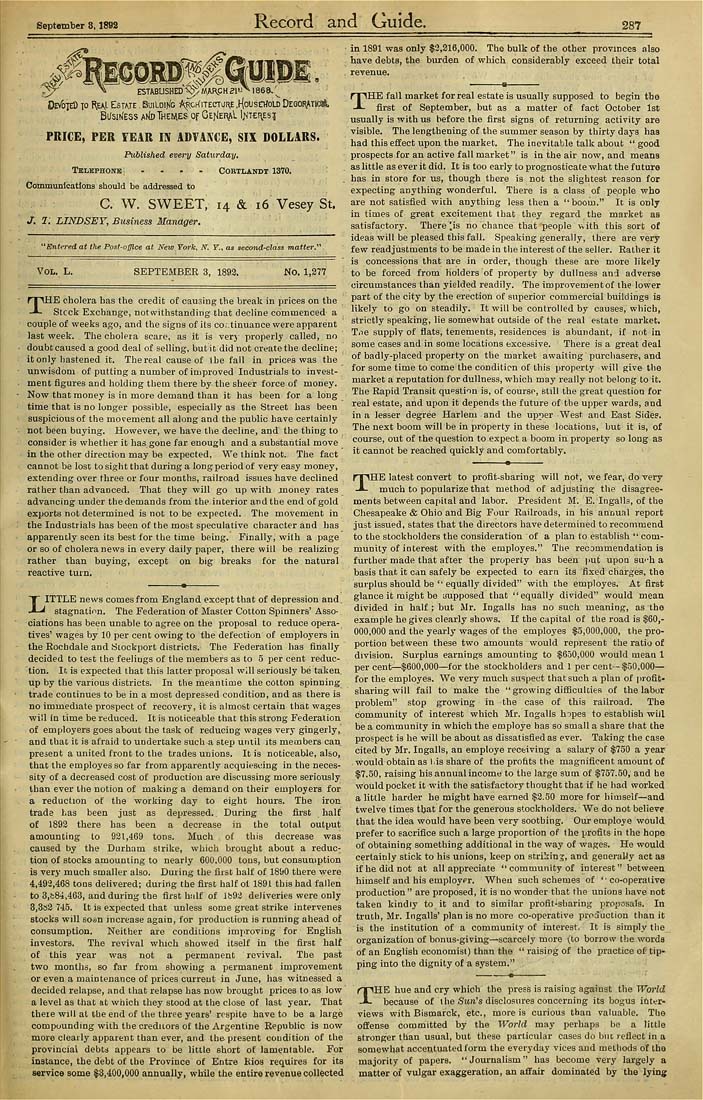
September 3, ÍMB Récord and GuÍde. 387 ESTABUSHED^ MAKCH511!^ 1869..^ OeV&TED TO R,EAsL EsWE , BuiLũlflo AR,tHlTECTai^E ,H0USE:ĩ/0LD DEGOfl^Tltaít BlI5Iî/ESS A^toĨHEMES Of CeíJeI^I 1^'T£I\ESĨ PRICE, PER FEAR IS ADVÂNCE, SIX DOLLARS. Pdblished every Satii.rda'y. TKLKPHONE; - - . - CORTLANDT 1370. Commuiilcatlotis should be addressed to C. W. SWEET, 14 & 16 Vesey St. J". î; LINDSEY, Busîness Manãger. ■ "Enteredat the Post-offlce at Ifew Tork, N. Y., aa seccmd-cldss matter.". VOL. L. SEPTEMBER 3, 1892. No. 1,277 THE cholera has the credit of causing the break ĩn prices on the Stcck Exchange, notwĩthstanding that decline commenced a couple of weeks ago, and tlie signa of iís cor.tinuaDce were appaient last week. The choleta ecare, as it is verj- properly called, no doubtcaused a good deal of selling. butit did not cneatetbe decline; itonly liastened it. Thereal cause of Ibe fall in prices was tbe unwisdom of putting a number of improved Industrials to invest- raent flgures aod bolding them tbere by the sheer force of money. Now thatmoney is in more demand tban it has been for a long time tbat is no longer possibie, especially as the Street bas been suspiciousof the movemenfc all along and the public bave certainly not been buying. However, we have the decliae, and the thing to coDSider is whether it bas gone far enough and a substantial move in the other direcLioQ may be espected, We ibink not. The fact cannot be lost tosight that duringa longperiodof very easy money, extending over tbree or four montbs, railroad issues bave declined ratiier than advanced. That they wiU go up wilh inoney rates advancing under thedemands from the interior and the end of gold exporta not determined is not to be expecled. The movement in the Industrials bas been of tbe most speculative character ãnd has appareutly scen its best for the time being. Finally, wĩth a page or BO of choleranews in every daily paper, tbere wiĩ! be realizÍDg rather tban buying, except on big breaks for the natural reactive turn, ■ in 1891 was only $'2,216,000. The bulk of the otber provmces also have debta, the burden of which conaiderably esceed tbeir total revenue. LITTLE news comesfrom England exceptthat of depressiou and. stagnatĩnn. The Federaiion of Masier Cotton Spinners' Asso- ciations has been unable to agree on tbe proposal to reduce opera- tives' wages by 10 per cent owing to tbe deí'ection of eroployers in the Bochdale and títockport distrlcts. The Federation has flnally decided to test Ihe feeliugs of the niembers as to 5 per cent reduc- 'tion. Ic is expected that this lacter proposal wili seriously bé talien. up by tbe various districts. In themeantiæe cbe cûtton spinning trade continues to be in a most depressed condition, and as tbere is no immediate prospect of recovery, it is almost certain that wages wiU in time be reduced. It is noticeable that this strong Federation of employers goes abuut tbe task of reducing wagea very gingerly, and that it is afraid to undertake such a etep uniil its members can preseDt a united front to the trades unions. It is notíceable, also, that tbe employes so far from apparently acquiescing in the neces- sity of a decreased cost of production are discussing more seriously tban ever the notion of making a demand on their employers for a reduction of tbe working day to eigbt hours. Tbe iron trade l.as been just as depressed. During the first half of 1892 there bas been a decrease in the total output amounting to 921,469 tons, Much of this decrease was caused by the Diirbam sirike, which brought about a reduc- tion of stocks amouniing to nearly 600.000 tons, but consumption is very much smaller also. During the fiist balf of 18íj0 there were 4,493,468 tocs delivered; during tbe first half ol 1891 tbis had falien to 3,e84,403, andduring tbe first hiilf of lb92 deliveries were only 8,3»3 745. It is expecfced that unless some great strike intervenes Btocks will soen increase again, for production is running ahead of consumption. Neitber are condiiĩons im]iroving for English investora. The revival whícb showed itself in tbe first balf of thig year was not a permanent revival. Tbe past two montiis, so far froui sbowiug a permanent improvement or even a mainleiiance of prices current in June, has wicueased a decíded relapge, and that relapse bas now brought prices to as low a level as that at which they stood at tbe close of last year, That theie wiil at tbe end of the three yeats' rcspite have to be a largé compuunding wiih the creditors of tbe Argentine Republic is now more cleaily apparent than ever, and tbe present coudition of tbe provincial debtd appears lo be litile sbort of iameniable. For instance, tbe debt of ihe Province of Entre Kios requires for its service some $8,400,000 annually, while the entire revenue collected THE fall market forreal estateisusually supposed to begin tbe flrst of September, but as a matter of fact October Ist usually is with us hefore the flrst signs of returning activity are viaible. The lengtheuing of the summer season by thirtydays has had thîs effect upon the market. The ioevitable talk about " good prospecta for an active fall market" is in tbe air now, and means aslittle asever itdid. It is too earlytoprognosfcicatewhatthefuture has in store for us, thougb there is not tbe slightest renson for expecting anytbíng wonderful. There is a class of people who are not satisfied witb anytbing lesa then a "boom." It is only ín tĩmes of great excitemenfc ihat they regard the market as aatisfactory. There'is no chance tbat people ■with tbĩs sort of ideas will be pleased tbisfall. Speaking generally, there are very few readjustments to be madein the interesfc of the seller. Ratber it íg concessions tbat are in order, though these are more likely to be forced from holders'of property by dullness and adverse circumstances than yielded readily. The improvementof ihe lower part of the city by the erection of superior commercial buildings is lîkeiy to go on steadily. It wiU be conlrolledby causes, which, strictly speaking, lie aomewhat outside of the real estate market. T.ie supply of flats, tenements, residences is abundant, if nnt in some cases and in some locations excessive. There is a great deal of badly-placed property on the market awaiting purchasers, and for some time to come the conditicn of tbis properfcy will give tbe market a reputation for duUness, which may really not belong to it. The Rapid Transît qupstion is, of coursc, still the great questioo for real estate, and upon it depends the future of tbe upper wards, gnd in a lesser degrée Harlem and tbe upoer West and East Sidee. The next boom will be in property in tbese locations, but it ĩa, of course, out of the question to expecfc a boom in property so loug as it cannot be reached quickly and comfortably. THE latesb convert to profit-sharing wiíl not, we fíar, do very much to popularizethat method of adjustíng the disagree- ments between capilal and labor. Fresident M. E. Ingalls, of the Chesapeake & Ohio and Big Four Railroads, iu his annual report just issued, states that the direcfcors bave defcermined to recommend to the stockholders the consideration of a plan to establish "com- munity of interesfc with the employes." The recDmmendafcion is furtber máde that after tbe pruperty bas been put upon sm-h a basis that ifc can safely be expected to earn its fixed charges, the Bui-plus should be " equally divided" with tbe employes. At first glance it might be uupposed that "equãlly divided" would mean divided in half ; but Mr. Ingaíls has no such meaniog, as the example hegives clearly shows. Ifthecapital of the road is $60,- 000,000 and the yearly wages of the employes |5,000,000, the pro- portioQ between tbese two amouuts wouid represent the ratio of division, Surplus earnings amountíng to $650,000 would mean 1 per cent—$600,000—for tbe stockholders and 1 per cent-$50,000— for the employes, We very much suspect thatsuch a plan of profît* sharing will fail to make tbe "growing difiSculties of the labur problem" stop growing in tbe case of this railroad, The community of interest which Mr. lugalls b:)pe3 to establish will be a coramunity in whicb tbe eojploye has so small a share that the prospect is he wiU be about as dlssatisfled as ever. Taking the case cîted by Mr. Ingalls, an employe receiving a salary of $750 a year vFould obtainas l.is share of tbe proûts the magnificenfc amouut of $7.50, raising bia annual income to the large sum of $757.50, and he wouldpocket it with the satisfactory thoughtthat if he had worked a little harder he might bave earned $2.50 more for himself—and twelve times tbat for the generous s'.ockholders. We do not belîeve fchat the idea would have been very sootbing. Our employe would prefer to sacrifîce such a large proportion of the profits in tbe hope of obtainiDg sometbing additional in tbe way of wages. He would certainly stick to his unions, keep on strikiQ^, and geuerally act as ifhedidnot at all appreciate "communityof interest" between himself and his employpr. Wheu such schemes of ' ■ co-operalive production" are proposed, it is no wonder that ihe unions have not taken kiudiy to it and to aimilar profit-sharing propDsals. In truth, Mr. Ingalls' plan Ía no more co-operative production than it is the institution of a communÍLy of interest. It ia simply the^ organízation of bonus-giving—scarcely more (to borrow (be words of an Engliah economisl) than the "raisingof the practice of tip- pinginto the dignityof aeystem." . '^ ■ THE hue and cry which the press is raĩaing agaÍDSt the World because of ihe Sittt's dísclosures concerning its bogus iQti;r- views with Bismarck, etc, more is curious than valuable. The oÊEense committed by the World may perbaps be a little stronger than usual, but theae particular cases do biic refiect in a Bomewhat accentuated form the everyday vices and melhods of Ihe majority of papera. "Journaliam" has become very largely a matter of vulgar exaggeration, an affair dominated by the lying