
Columbia University Libraries Digital Collections: The Real Estate Record
Use your browser's Print function to print these pages.
Real estate record and builders' guide: v. 53, no. 1372: June 30, 1894
Text version:
Please note: this text may be incomplete. For more information about this OCR, view About OCR text.
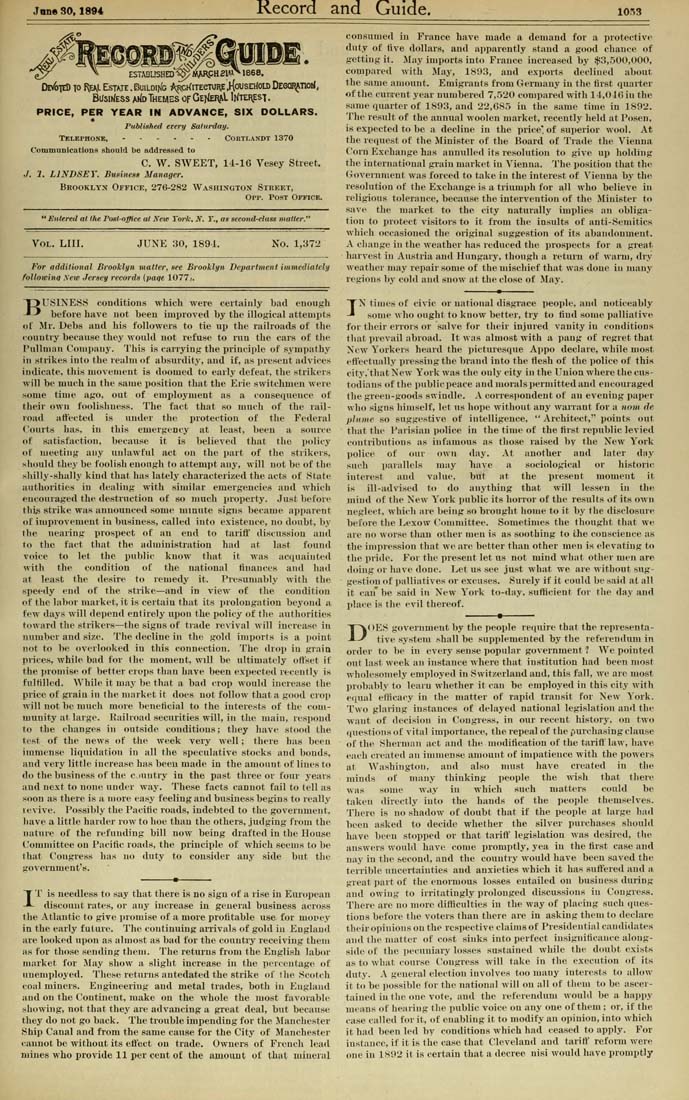
Jnn* 30,1894 Record and Guide. lO.'^S DevG-jeD to Re\l Estate . BuiLoiffc Appi^iTEeTui^ ,KousEriou) DESQFjjTiori, BUsii^ESs Alt) Themes ofGejJej^L lh/TEF)fsi. PRICE, PER YEAR IN ADVANCE, SIX DOLLARS. Published every Saturday, Telephone, ...... Cortlandt 1370 Communications should be addressed to C. -vv. SWEET, 14-16 Vesey Stieet. ./, 1. LINDSEY. Business Manager. Brooklyn Office, 276-282 Washington Street, Opp. Post Office. "Entered at Ihe Fost-office al New York. N. T., as secoiul-class matter." Vol. LIIL JUNE 30, 1891. No. 1,372 For aflditional Brooklyn matter, see Brooklyn Department immediately following Xew .Jersey records {page 1077). BU.SINESS coudition.s whicli were certainly bad enouj;h before hiive uot beeu improved by the illogical attempts of Mr. Debs aud his followers to tie up the railroads of the couutry because they would uot refuse to run the cars of the Pullman Company. This is carrying the principle of sympathy in .strikes into the realm of absurdity, aud if, as preseut advices indicate, this movement is doomed to early defeat, the strikers will be much iu the same position that the Erie switchmen were some time affo, out of eiuijloyment as a cousequeuce of their own foolisliuess. The fact that so much of the rail¬ road att'ected is luider the jjiotection of the Federal Courts has, in this emergency at least, beeu a source of satisfaction, because it is believed that the policy of meeting any unlawful act on the part of the strikers, should they be foolish euough to iittempt any, will not be of the shilly-shally kiud that has lately characterized the acts of State authorities iu dealing with simihir emergencies aud which encouraged the destructiou of so much proi)erty. Just before this strike was announced some minute signs became apparent of improvement in business, calletl into e.xisteuce, uo doubt, by the Hearing prospect of an end to taritt" discussion and to the fact that the administration had at last found voice to let the public kuow that it was acquaiuted with the condition of the national linances and had at least the desire to remedy it. Prcsunuibly with the speetly eud of the strike—antl in view of the condition of the labor maiket, it is certaiu that its i)rolougation beyond a few days will depend entirely upon the policy of tlie authorities towartl the strikers—the signs of trade revival will increase iu number and size. The decliue iu the gold imports is a point not to be overlooked iu this connection. The drop iu graia prices, while bad for (he moment, will be ultimately ott'set if the promise of bettei' crops thiin have been expected recently is fulfilled. While it may be that a bad crop would increase the price of grain iu the market it does uot follow that a good crop will not be much more beneticial to the interests of the com¬ munity at large. Railroad securities will, iu the maiu, respond to the changes iu outside conditions; tliey have stood the test of the news of the week very well; there has been immense liquidation in all the speculative stocks aud bonds, and very little increase has been raiide iu the amount of lines to do the business of the c.iuntry iu the past three or four yeais aud uext to none under way. These f.acts cannot fail to tell as soon as there is a more easy feeling and business begins to really revive. Possibly the Pacific roads, indebted to the government, have a little harder row to hoe than the others, judging from the nature of the refunding bill now beiug dr.afted iu the House Committee on Pacitic roads, the principle of wliich seems to be that Congress has uo duty to consider any .side but tlie government's. IT is needless to say that there is no sign of a lise in European discount riites, or auy increase in general business across the Atlantic to give jiromise of ii more protitable use for mouey in the early future. The continuiug arrivals of gold iu Eugland are looked upon as almost as bad for the countiy receiving them !is for those sending them. The returus from the English labor market for M;iy show a slight increase iu the percentage of uuemiiloyetl. These returns antedated the strike of Ihe Scotch coal miners. Engineering and metal trades, both in Eugland iind ou the Continent, make ou the whole the most favoiable showing, not thiit they are advancing a gi'eat deal, but because they do not go back. The trouble impending for the Jlaiichester Ship Caual aud from the same cause for the City of Mauchester caunot be without its ett'ect ou trade. Owners of French lead mines who provide 11 per cent of the ainouut ot that mineiiil consumed in Prance have made a deniand for a jirotective duty of tive dollars, and apparently stand a good chance of getting it. May imports iuto Fiance increased by .1^3,.500,000, compared with May, 1893, and exports declined about the same auumnt. Emigrants from Germany in the ttrst (luarter ofthe curient year numbered 7,.520 compared with 14,040 in the same quarter of 1893, and 22,68.5 iu the same time iu 1892. The result of the annual woolen market, recently held at Posen, is expected to be a decline in the priced of superior wool. At the request of the Minister of the Board of Trade the Vieuna Corn Exchange has annulled its resolution to give up holding the international grain market iu Vienna. The position that the Governmenf was forced to take iu the interest of Vienna by the resolution of the Exchange is a triumph for all who believe in religious tolerance, because the intervention of the Minister to save the market to the city uiiturally implies iin obliga¬ tion to protect visitors to it from the insults of iiuti-Seniitics which occasioned the original suggestion of its abandonment. A change iu the weiither has redui'ed the prospects for a great harvest iu Austria and Hungaiy, though a return of warm, dry weather may repiiir some of the mischief that was done iu many regions bv cold aud snow at the close of Mav. JN times of civic or national disgrace people, aud noticeably some who ought to know better, try to ttutl some palliative for their errors or salve for their injured vanity in conditions that jirevail abroad. It wns almost with a pang of regret that New Yorkers heard the picturesque A])po declare, while most ett'ectually pressing the brand into the ttesh of the police of this city,'that New York was the only city iu the Uuion where the cus¬ todians (»f the public peace and morals permitted aud encoiuaged the green-goods swindle. A corres|)ondent of an evening paper who signs himself, let us hope without any warrant for a nom de plitme so suggestive of intelligence, "Architect," points out that the Pari.sian police in the time of the ttrst republic levied contributions as infamous as those raised by the New York police of our owu day. At auother aud later day such iiarallels may liave a sociological or historic inteiest and value, but at the piesent moment it is ill-advised to do anything that will lessen iu the miud of the New York liublic its horror of the results of its owu neglect, which are being so brought home to it by the disclosure before the Lexow Ccjuimittee. Sometimes the thought that we are no worse thau other men is as soothing to the conscience as the iiupi'ession thiit we iire better thiin other meu is elevating to the pride. For the present let us not mind whiit other men are doiug ov have done. Let us see just what we jire without sug¬ gestion of palliatives or excuses. Surely if it could be said at all it can* be said in New York to-day, sulttcient for the day and place is the evil thereof. DOES government by the ))eople require that the representa¬ tive system shall be supplemented by the referendum in order to be in every sense popular government ? We pointed out hist week an instance where that institution had been most wholesomely employed in Switzerland and, this f;ill, we are most probably to learn whether it cau be employed in this city with eiiual efficacy in the matter of rapid trausit for New York. Two glaring instances of dehiyed national legishition and the want of decisiou in Congress, iu our recent history, on two questions of vital importance, the repeal of the purchasing clause ofthe Sliermau act and the luodificatiou of the tiiritt'law, have each created au immense amount of impatience with the powers at Washington, and also must have created iu the minds of many thinking people the msh that there was some way iu whicii such matters could be takeu directly into the hands of the people themselves. There is uo shadow of doubt that if the people iit large had been asked to decide whether the silver purchases should have been stopped or that taritt' legislation wiis desired, the answers would have come promjitly, yea in the ttrst case and nay in the second, and the country would have beeu saved the terrible uncertainties and anxieties which it has sutt'ered and a great part of the enormous losses entailed on business during aud owing to iiritatingly prolonged discussions in Congress. There are no more ditticulties in the way of placing such ques¬ tions before the voters than there are in asking them to declare their opiuious outhe respective claims of Presidential candidates and the lUiitter of cost sinks into perfect insiguittcance iilong¬ side of the pecuuiiiry lo.sses sustained while the doubt exi.sts as to what course Congress will take iu the execution of its duty. .\. geneiiil election involves too many iuterests to allow it to be Jiossible for the national will on all of tlieni to be ascer¬ tained iu the one vote, and the referendum would be a happy means of hearing the public voice on auy one of them ; or, if the case called for it, of enabling it to modify an opinion, into which it had been led by conditions which had ceased to apply. For instance, if it is the case thiit Cleveland iiud tiiritt' reform were one iu 1892 it is certain that a decree nisi would have promptly