
Columbia University Libraries Digital Collections: The Real Estate Record
Use your browser's Print function to print these pages.
Real estate record and builders' guide: v. 68, no. 1741: July 27, 1901
Text version:
Please note: this text may be incomplete. For more information about this OCR, view About OCR text.
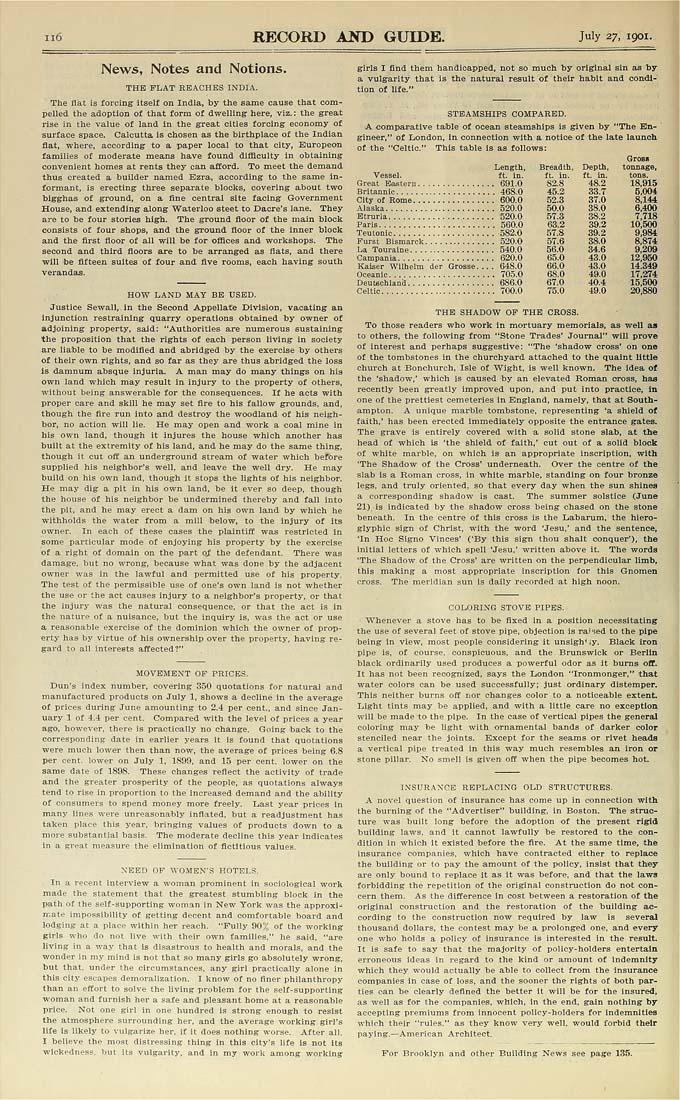
ii6 RECORD AND GUIDE. July 27, 1901. News, Notes and Notions. THE FLAT REACHES INDIA. The fiat is forcing itself on India, by the same cause that com¬ pelled the adoption of that form of dwelling here, viz.: the great rise in the value of land in the great cities forcing economy of surface space. Calcutta is chosen as the birthplace of the Indian flat, where, according to a paper local to that city, Europeon families of moderate means have found difficulty in obtaining convenient homes at rents they can afford. To meet the demand thus created a builder named Ezra, according to the same in¬ formant, is erecting three separate blocks, covering about two bigghas of ground, on a fine central site facing Government House, and extending along Waterloo ateet to Dacre's lane. They are to be four stories high. The ground floor of the main block consists of four shops, and the ground floor of the inner block and the first floor of all will be for oSices and workshops. The second and third floors are to be arranged as flats, and there will be flfteen, suites of four and five rooms, each having south verandas. HOW LAND MAY BE USED. Justice Sewall, In the Second Appellate Division, vacating an injunction restraining quarry operations obtained by owner of adjoining property, said: "Authorities are numerous sustaining the proposition that the rights of each person living in society are liable to be modified and abridged by the exercise by others of their own rights, and so far as they are thus abridged the loss is damnum absque injuria, A man may do many things on his own land which may result in injury to the property of others, without being answerable for the consequences. If he acts with proper care and skill he may set fire to his fallow grounds, and, though the fire run into and destroy the woodland of his neigh¬ bor, no action will lie. He may open and work a coal mine in his own land, though it injures the house which another has built at the extremity of his land, and he may do the same thing, though it cut off an underground stream of water which before supplied his neighbor's well, and leave the well dry. He may build on bis own land, though it stops the lights of his neighbor. He may dig a pit in his own land, be it ever so deep, though the house of his neighbor be undermined thereby and fall into the pit, and he may erect a dam on his own land hy which he withholds the water from a mill below, to the injury of its owner. In each of these cases the plaintiff was restricted in some particular mode of enjoying his property by the exercise of a right of domain on the part oi the defendant. There was damage, but no wrong, because what was done by the adjacent owner was in the lawful and permitted use of his property. The test of the permissible use of one's own land is not whether the use or the act causes injury to a neighbor's property, or that the injury was the natural consequence, or that the act is in the nature of a nuisance, but the inquiry is, was the act or use a reasonable exercise of the dominion which the owner of prop¬ erty has by virtue of his ownership over the property, having re¬ gard to all interests affected?" MOVEMENT OF PRICES. Dun's index number, covering 350 quotations for natural and manufactured products on July 1, shows a decline in the average of prices during June amounting to 2,4 per cent., and since Jan¬ uary 1 of 4.4 per cent. Compared with the level of prices a year ago, however, there is practically no change. Going back to the corresponding date in earlier years it is found that quotations were much lower then than now, the average of prices being 6.8 per cent, lower on July 1, 1899, and 15 per cent, lower on the same date of 1898. These changes reflect the activity of trade and the greater prosperity of the people, as quotations always tend to rise in proportion to the increased demand and the ability of consumers to spend money more freely. Last year prices In many lines were unreasonably Inflated, but a readjustment has taken place this year, bringing values of products down to a more substantial basis. The moderate decline this year indicates in a great measure the elimination of fictitious values. NEED OF WOMEN'S HOTELS. In a recent interview a woman prominent in sociological work made the statement that the greatest stumbling block in the path of the self-supporting woman in New York was the approxi^ mate impossibility of getting decent and comfortable board and lodging at a place within her reach, "Fully 90% of the working girls who do not live with their own families," he said, "are living in a way that is disastrous to health and morals, and the wonder in my mind is not that so many girls go absolutely wrong, but that, under the circumstances, any girl practically alone in this city escapes demoralization, I know of no finer philanthropy than an effort to solve the living problem for the self-supporting woman and furnish her a safe and pleasant home at a reasonable price. Not one girl in one hundred is strong enough to resist the atmosphere surrounding her, and the average working girl's life is likely to vulgarize her, if it does nothing worse. After all, I believe the most distressing thing in this city's life is not Its wickedness, but Us vulgarity, and in my work among working girls I find them handicapped, not so much by original sin aa by a vulgarity that is the natural result of their habit and condi¬ tion of life." STEAMSHIPS COMPARED. A comparative table of ocean steamships is given by "The En¬ gineer," of London, In connection with a notice of the late launch of the "Celtic." This table is as follows: Gross Breadth, Depth, tonnage, It. in. ft. ta. tons. 82.8 48.2 18,915 45.2 33.7 5,004 52.3 37,0 8,144 50.0 38.0 6,400 57.3 38.2 7,718 63.2 39.2 10,500 5T.8 39.2 9,984 57.6 38,0 8.874 56.0 34.6 9,209 65.0 43.0 12,950 66.0 43,0 14,349 68,0 49.0 17,2fr4 67,0 40,4 15,500 75.0 49.0 20,880 Length, Vessel, ft. in. Great Eastern................ 691,0 Britannic..................... 468.0 City of Rome................. 600.0 Alaska....................... 520.0 Etrurla...................... 520.0 Paris........................ 560.0 Teutonic..................... 582,0 Furst Bismarck............... 520-0 La Touraine.................. 540.0 Campania.................... 620.0 Kaiser Wilhelm der Grosse.,,. 648,0 Oceanic...................... 705.0 Deutschland.................. 686.0 Celtic........................ 70O.O THE SHADOW OP THE CROSS. To those readers who work in mortua.ry memorials, as well as to others, the following from "Stone Trades* Journal" will prove of interest and perhaps suggestive: "The 'shadow cross' on one of the tombstones in the churchyard attached to the quaint little church at Bonchurch, Isle of Wight, is well known. The idea of the 'shadow,' which is caused by an elevated Roman cross, has recently been greatly improved upon, and put into practice, In one of the prettiest cemeteries In England, namely, that at South¬ ampton. A unique marble tombstone, representing 'a shield of faith,' has been erected immediately opposite the entrance gates. The grave is entirely covered with a solid stone slab, at the head of which is 'the shield of faith,' cut out of a solid block of white marble, on which is an appropriate inscription, with 'The Shadow of the Cross' underneath. Over the centre of the slab is a Roman cross, in white marble, standing on four bronze legs, and truly oriented, so that every day when the sun shines a corresponding shadow is cast. The summer solstice (June 21), is indicated by the shadow cross being chased on the stone beneath. In the centre of this cross is the Labarum, the hiero¬ glyphic sign of Christ, with the word 'Jesu,' and the sentence, 'In Hoc Signo Vinces' ('By this sign thou shalt conquer'), the initial letters of which spell 'Jesu,' ■written above it. The words 'The Shadow of the Cross' are written on the perpendicular limb, this making a most appropriate inscription for this Gnomen cross. The meridian sun is daily recorded at high noon. COLORING STOVE PIPES,- Whenever a stove has to be fixed in a position necessitating the use of several feet of stove pipe, objection is raised to the pipe being in view, most people considering it unsigh' iy. Black iron pipe is. of course, conspicuous, and the Brunswick or Berlin black ordinarily used produces a powerful odor as it bums oft. It has not been recognized, says the London "Ironmonger," that water colors can be used successfully; just ordinary distemper. This neither burns off nor changes color to a noticeable extent. Light tints may be applied, and with a little care no exception will be made to the pipe. In the case of vertical pipes the general coloring may be light with ornamental bands of darker color stenciled near the joints. Except for the seams or rivet heads a vertical pipe treated in this way much resembles an iron or stone pillar. No smell is given off when the pipe becomes hot. INSURANCE REPLACING OLD STRUCTURES. A novel question of insurance has come up in connection with the burning of the "Advertiser" building, in Boston, The struc¬ ture was built long before the adoption of the present rigid building laws, and it cannot lawfully be restored to the con¬ dition in which it existed before the fire. At the same time, the insurance companies, which have contracted either to replace the building or to pay the amount of the policy, insist that they are only bound to replace it as it was before, and that the laws forbidding the repetition of the original construction do not con¬ cern them. As tbe difference in cost between a restoration of the original construction and the restoration of the building ac¬ cording to the construction now required by law is several thousand dollars, the contest may be a prolonged one, and every one who holds a policy of insurance is interested in the result. It is safe to say that the majority of policy-holders entertain erroneous ideas in regard to the kind or amount of indemnity which they would actually be able to collect from, the insurance companies in case of loss, and the sooner the rights of both par¬ ties can be clearly defined the better It will be for the Insured, as well as for the companies, which. In the end. gain nothing by accepting premiums from innocent policy-holders for indemnities which their "rules," as they know very well, would forbid their paying.—American Architect, Por Brooklyn and other Building News see page 135.