
Columbia University Libraries Digital Collections: The Real Estate Record
Use your browser's Print function to print these pages.
Real estate record and builders' guide: v. 69, no. 1772: March 1, 1902
Text version:
Please note: this text may be incomplete. For more information about this OCR, view About OCR text.
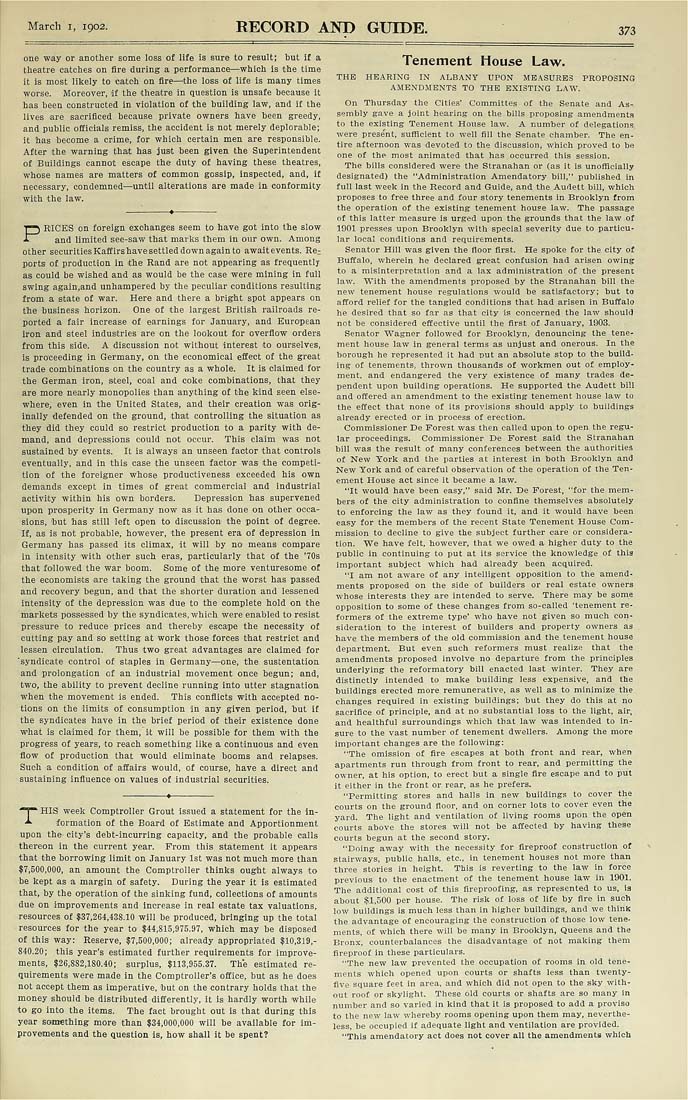
March i, 1902. ..-.,»!.-.-. f^ RECORD AND GUIDE. 373 one way or another some loss of life is sure to result; but if a theatre catches on fire during a performance—which is the time it is most likely to catch on fire—the loss of life is many times worse. Moreover, If the theaitre in question is unsafe because it has been constructed in violation of the building law, and if the lives are sacrificed because private owners have heen greedy, and public officials remiss, the accident is not merely deplorable; it has become a crime, for which certain men are responsible. After the warning that has juat been given the Superintendent of Buildings cannot escape the duty of having these theatres, whose names are matters of common gossip, inspected, and, if necessary, condemned—until alterations are made in conformity with the law. PRICES on foreign exchanges seem to have got into the slow and limited see-saw that marks them in our own. Among other securitiesKaffirshavesettleddownagainto awaitevents. Rer ports of production in the Rand are not appearing as frequently as could be wished and as would be the case were mining in full swing again.and unhampered by the peculiar conditions resulting from a state of war. Here and there a bright spot appears on the business horizon. One of the largest British railroads re¬ ported a fair increase of earnings for January, and European iron and steel industries are on the lookout for overflow orders from this side. A discussion not without interest to ourselves, is proceeding in Germany, on the economical effect of the great trade combinations on the country as a whole. It is claimed for the German iron, steel, coal and coke combinations, that they are more nearly monopolies than anything of the kind seen else¬ where, even in the United States, and their creation was orig¬ inally defended on the ground, that controlling the situation as they did they could so restrict production to a parity with de¬ mand, and depressions could not occur. This claim was not sustained by events. It is always an unseen factor that controls eventually, and in this case the unseen factor was the competi¬ tion of the foreigner whose productiveness exceeded his own demands except in times of great commercial and industrial activity within his own borders. Depression has supervened upon prosperity in Germany now as it has done on other occa¬ sions, hut has still left open to discussion the point of degree. If, as is not prohable, however, the present era of depression in Germany has passed its climax, it will by no means compare in intensity with other such eras, particularly that of the '70s that followed the war boom. Some of the more venturesome of the economists are taking the ground that the worst has passed and recovery begun, and that the shorter duration and lessened intensity of the depression was due to the complete hold on the markets possessed by the syndicates, which were enabled to resist pressure to reduce prices and thereby escape the necessity of cutting pay and so setting at work those forces that restrict and lessen circulation. Thus two great advantages are claimed for 'syndicate control of staples in Germany—one, the sustentation and prolongation of an industrial movement once begun; and, two, the ability to prevent decline running into utter stagnation when tbe movement is ended. This conflicts with accepted no¬ tions on the 'limits of consumption in any given period, but if the syndicates have in the brief period of their existence done what is claimed for them, it will be possible for them with the progress of years, to reach something like a continuous and even flow of production that would eliminate booms and relapses. Such a condition of affairs would, of course, have a direct and sustaining influence on values of industrial securities. THIS week Comptroller Grout issued a statement for the in¬ formation of the Board of Estimate and Apportionment upon the- city's debt-incurring capacity, and the prohable calls thereon in the current year. From this statement it appears that the borrowing limit on January 1st was not much more than $7,500,000, an amount the Comptroller thinks ought always to be kept as a margin of safety. During the year it is estimated that, by the operation of the sinking fund, collections of amounts due on improvements and increase in real estate tax valuations, resources of $37,264,438.10 will be produced, bringing up the total resources for the year to $44,815,975.97, which may be disposed of this way: Reserve, $7,500,000; already appropriated $10,319,- 840.20; this year's estimated further requirements for improve¬ ments, $26,882,180.40; surplus, $113,955,37. The estimated re¬ quirements were made in the Comptroller's office, but as he does not accept them as imperative, but on the contrary holds that the money should be distributed differently, it is hardly worth while to go into the items. The fact brought out is that during this year something more than $34,000,000 will be available for im¬ provements and the question is, how shall it be spent? Tenement House Law. THE HE.\RING IN ALB.4NY UPON ME.\SURE3 PROPOSING AMENDMENTS TO THE EXISTING LAW. On Thursday the Cities' Committes of the Senate and As¬ sembly gave a joint hearing on the bills proposing amendments to the existing Tenement House law. A number of delegations were present, suflicient to well fill the Senate chamber. The en¬ tire afternoon was devoted to the discussion, which proved to he one of the most animated that has occurred this session. The bills considered were the Stranahan or (as it is unofficially designated) the "Administration Amendatory bill," published in full last week in the Record and Guide, and the Audett bill, which proposes to free three and four story tenements in Brooklyn from the operation of the existing: tenement house law. The passage of this latter measure is urged upon the grounds that the law of 1901 presses upon Brooklyn with special severity due to particu¬ lar local conditions and requirements. Senator Hill was given the floor first. He spoke for the city of Buffalo, wherein he declared great confusion had arisen owing to a misinterpretation and a lax administration of the present law^. With the amendments proposed by the Stranahan bill the new tenement house regulations would be satisfactory; but to afford relief for the tangled conditions that had arisen in Buffalo he desired that so far as that city is concerned the law should not be considered effective until the first of January, 1903. Senator Wagner followed for Brooklyn, denouncing the tene¬ ment house law in general terms as unjust and onerous. In the borough he represented it had out an absolute stop to the build¬ ing of tenements, thrown thousands of workmen out of employ¬ ment, and endangered the very existence of many trades de¬ pendent upon building operations. He supported the Audett bill and offered an amendment to the existing tenement house law to the effect that none ol its provisions should apply to buildings already erected or in process of erection. Commissioner De Forest was then called upon to open the regu¬ lar proceedings. Commissioner De Forest said the Stranahan bill was the result of many conferences between the authorities of New Tork and the parties at Interest in both Brooklyn and New Tork and of careful observation of the operation of the Ten¬ ement House act since it became a law. "It would have been easy," said Mr. De Forest, "for the mem¬ bers of the city administration to confine themselves absolutely to enforcing the law as they found it, and it would have been easy for the members of the recent State Tenement House Com¬ mission to decline to give the subject further care or considerar tion. We have felt, however, that we owed a higher duty to the public in continuing to put at its service the knowledge of this important subject which had already been acquired. "I am not aware of any intelligent opposition to the amend¬ ments proposed on the side of builders or real estate owners whose interests they are intended to serve. There may be some opposition to some of these changes from so-called 'tenement re¬ formers of the extreme type' who have not given so much con¬ sideration to the interest of builders and property owners as have the members of the old commission and the tenement house department. But even such reformers must realize that the amendments proposed involve no departure from the principles underlying the reformatory bill enacted last winter. They are distinctly intended to make building less expensive, and the buildings erected more remunerative, as well as to minimize the changes required in existing buildings; but they do this at no sacrifice of principle, and at no substantial loss to the light, air, and healthful surroundings which that law was intended to in¬ sure to the vast number of tenement dwellers. Among the more important changes are the following: "The omission of fire escapes at both front and rear, when apartments run through from front to rear, and permitting the owner, at his option, to erect but a single fire escape and to put it either in the front or rear, as he prefers. "Permitting stores and halls in new buildings to cover the courts on the ground floor, and on corner lots to cover even the yard. The light and ventilation of living rooms upon the open courts above the stores will not be affected by having these courts begun at the second story. "Doing away with the necessity for fireproof construction of stairways, public halls, etc.. in tenement houses not more than three stories in height. This is reverting to the law in force previous to the enactment of the tenement house law in 1901, The additional cost of this fireproofing, as represented to us, is about $1,500 per house. The risk of loss of life by flre in such low buildings is much less than in higher huildings, and we think the advantage of encouraging the construction of those low tene- ments, of which there will be many in Brooklyn, Queens and the Bronx, counterbalances the disadvantage of not making them fireproof in these particulars. "The new law prevented the occupation of rooms in old tene¬ ments which opened upon courts or shafts less than twenty- five square feet in area, and which did not open to the sky with¬ out roof or skylight. These old courts or shafts are so many in number and so varied in kind that it is proposed to add a proviso to the new law whereby rooms opening upon them may. neverthe¬ less, he occupied if adequate light and ventilation are provided. "This amendatory act does not cover all the amendments which