
Columbia University Libraries Digital Collections: The Real Estate Record
Use your browser's Print function to print these pages.
Real estate record and builders' guide: v. 70, no. 1802: September 27, 1902
Text version:
Please note: this text may be incomplete. For more information about this OCR, view About OCR text.
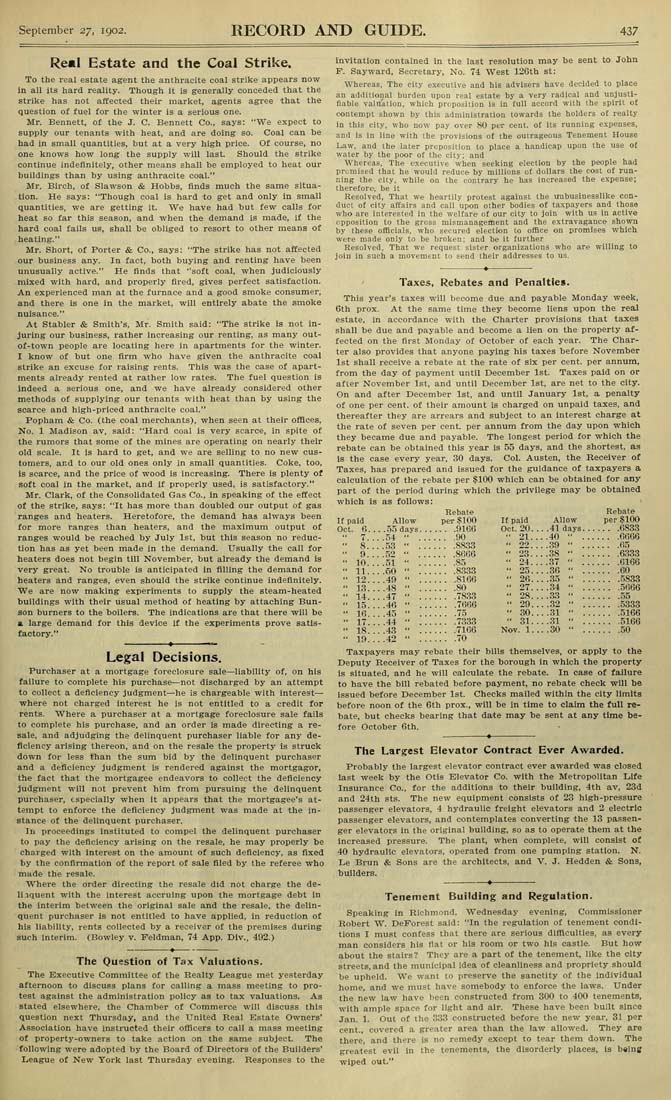
September 27, 1902. RECORD AND GUIDE. 437 Real Estate and the Coal Strike, To the real estate agent the anthracite coal strike appears now in all its hard reality. Though it is generally conceded that the strike has not affected their market, agents agree that the question of fuel for the winter is a serious one. Mr. Bennett, of the J. C. Bennett Co., says: "We expect to supply our tenants with heat, and are doing so. Coal can be had in small quantities, but at a very high price. Of course, no one knows how long the supply will last. Should the strike continue indefinitely, other means shall be employed to heat our buildings than by using anthracite coal." Mr, Birch, of Slawson & Hobbs, finds much the same situa¬ tion. He says; "Though coal is hard to get and only in small quantities, we are getting it. We have had but few calls for heat so far this season, and when the demand is made, if the hard coal fails us, shall be obliged to resort to other means of heating." Mr. Short, of Porter & Co., says: "The strike has not affected our business any. In fact, both buying and renting have been unusually active." He finds that "soft coal, when judiciously mixed with hard, and properly fired, gives perfect satisfaction. An experienced man at the furnace and a good smoke consumer, and there is one in the market, will entirely abate the smoke nuisance." At StalDler & Smith's, Mr. Smith said: "The strike is not in¬ juring our business, rather increasing our renting, as many out- of-town people are locating here in apartments for the winter. I know of but one firm who have given the anthracite coal strike an excuse for raising rents. This was the case of apart¬ ments already rented at rather low rates. The fuel question is indeed a serious one, and we have already considered other methods of supplying our tenants with heat than by using the scarce and high-priced anthracite coal." Popham & Co. (the coal merchants), when seen at their offices, No. 1 Madison av. said: "Hard coal is very scarce, in spite of the rumors that some of the mines are operating on nearly their old scale. It is hard to get. and we are selling to no new cus¬ tomers, ar.d to our old ones only in small quantities. Coke, too, is scarce, and the price of wood is increasing. There is plenty of soft coal in the market, and if properly used, is satisfactory." Mr. Clark, of the Consolidated Gas Co., in speaking of the effect of the strike, says: "It has more than doubled our output of gas ranges and heaters. Heretofore, the demand has always been for more ranges than heaters, and the maximum output of ranges would be reached by July 1st, but this season no reduc¬ tion has as yet been made in the demand. Usually the call for heaters does not begin till November, but already the demand is very great. No trouble is anticipated in fliling the demand for heaters and ranges, even should the strike continue indefinitely. We are now making experiments to supply the steam-heated buildings with their usual method of heating by attaching Bun- son burners to the boilers. The indications are that there will be a. large demand for this device if the experiments prove satis¬ factory." Lcgi ;al Decisions. Purchaser at a mortgage foreclosure sale—liability of, on his failure to complete his purchase—not discharged by an attempt to collect a deficiency judgment—he is chargeable with interest^ where not charged interest he is not entitled to a credit for rents. "Where a purchaser at a mortgage foreclosure sale fails to complete his purchase, and an order is made directing a re¬ sale, and adjudging the delinquent purchaser liable for any de¬ ficiency arising thereon, and on the resale the property is struck down for less than the sum bid by the delinquent purchaser and a deficiency judgment is rendered against the mortgagor, the fact that the mortgagee endeavors to collect the deficiency judgment will not prevent him from pursuing the delinquent purchaser, especially when it appears that the mortgagee's at¬ tempt to enforce the deficiency Judgment was made at the in¬ stance of the delinquent purchaser. In proceedings instituted to compel the delinquent purchaser to pay the deficiency arising on the resale, he may properly be charged with interest on the amount of such deflciency, as fixed by the conflrmation of the report of sale flled by the referee who made the resale. Where the order directing the resale did not charge the de- li.iquent with the interest accruing upon the mortgage debt in the interim between the original sale and the resale, the delin¬ quent purchaser is not entitled to have applied, in reduction of his liability, rents collected by a receiver of the premises during such interim. (Bowley v. Feldman. 74 App. Div,, 492.) The Question of Tax Valuations. The Executive Committee of the Realty League met yesterday afternoon to discuss plans for calling a mass meeting to pro¬ test against the administration policy as to tax valuations. As stated elsewhere, the Chamber of Commerce will discuss this question next Thursday, and the United Real Estate Owners' Association have instructed their officers to call a mass meeting of property-owners to take action on the same subject. The following were adopted hy the Board of Directors of the Builders' League of New York last Thursday evening. Responses to the invitation contained in the last resolution may be sent to John F. Sayward, Secretary, No. 14 West 126th st: Whereas, The city executive and his advisers have decided to place an additional burden upon real estate hy a very radical and unjusti¬ fiable valuation, which proposition is in full accord with the spirit of contempt shown by this administraliou towards the holders of realty in this city, who now pay over SO per cent, of its running expenses, and is in line with the provisions of the outrageous Tenement House Law, and the later proposition to place a handicap upon the use of water hy the poor of the cily; and Whereas, The executive when seeking election by the people had premised that he would reduce by millions ot dollars the cost of run¬ ning the city, while on the contrary he has increased the expense; therefore, be it Resolved, That we heartily protest against the irnbusinesslike con¬ duct of city affairs and call upon other bodies of taxpayers and those who are interested in the welfare ot our city to join with us in active opposition to the gross mismanagement and the extravagance shown by these officials, who secured election to office ou promises which were made only to be broken; and be it further Resolved. That -we request sister organizations who are willing to join in such a movement to send their addresses to us. Taxes, Rebates and Penalties. This year's taxes will become due and payable Monday week, 6th prox. At the same time they become liens upon the real estate, in accordance with the Charter provisions that taxes shall be due and payable and become a lien on the property af¬ fected on the flrst Monday of October of each year. The Char¬ ter also provides that anyone paying his taxes before November 1st shall receive a rebate at the rate of six per cent, per annum, from the day of payment until December 1st. Taxes paid on or after November 1st, and until December 1st, are net to the city. On and after December 1st, and until January 1st, a penalty of one per cent, of their amount is charged on unpaid taxes, and thereafter they are arrears and subject to an interest charge at the rate of seven per cent, per annum from the day upon which they became due and payable. The longest period for which the rebate can be obtained this year is 55 days, and the shortest, as is the case every year, 30 days. Col. Austen, the Receiver of Taxes, has prepared and issued for the guidance of taxpayers a calculation of the rebate per $100 which can be obtained for any part of the period during which the privilege may be obtained which is as follows: Rebate Rebate If paid Allow per $100 If paid Allow per $100 Oct. 0____55 days.......9166 Oct. 20____41 days.......fi833 " 7____.54 " .......90 " 21____40 " .......6666 " 8____53 " .......SR33 " 22____.^9 " .......6o " 9____52 " .......S666 " 23____38 " .......6333 " 10____.51 " .......85 " 24____37 " .......6166 '• 11....60 " .......8333 " 25....36 " .......60 " 12____49 " .......S166 " 26____35 " .......5833 " 13____48 " .......80 "27____34 " .......5666 " 14____47 " .......7833 " 28____.33 " .......55 " 15....46 " .......7666 " 29....32 " .......5333 " 16....45 " .......75 " 30....31 " .......5166 " 17....44 " .......7.333 " 31....-31 " .......5166 " 18____43 " .......7166 Nov. 1------30 " .......50 " 19____42 " .......70 Taxpayers may rebate their bills themselves, or apply to the Deputy Receiver of Taxes for the borough in which the property is situated, and he will calculate the rebate. In case of failure to have the bill rebated before payment, no rebate check will be issued before December 1st. Checks mailed within the city limits before noon of the 6th prox., will be in time to claim the full re¬ bate, but checks bearing that date may be sent at any time be¬ fore October 6th. _-----------------1——--------- The Largest Elevator Contract Ever Awarded. Probably the largest elevator contract ever awarded was closed last week by the Otis Elevator Co. with the Metropolitan Life Insurance Co., for the additions to their building, 4th av, 23d and 24th sts. The new equipment consists of 23 high-pressure passenger elevators, 4 hydraulic freight elevators and 2 electric passenger elevators, and contemplates converting the 13 passen¬ ger elevators in the original building, so as to operate them at the Increased pressure. The plant, when complete, will consist of 40 hydraulic elevators, operated from one pumping station. N. Le Brun & Sons are the architects, and V. J. Hedden & Sons, builders. Tenement Building and Regulation. Speaking in Richmond, Wednesday evening. Commissioner Robert W. DeForest said: "In the regulation of tenement condi¬ tions I must confess that there are serious difficulties, as every man considers his Hat or his room or two his castle. Eut how about the stairs? They are a part of the tenement, like the city streets, and the municipal idea of cleanliness and propriety should be upheld. We want to preserve the sanctity of the individual home, and we must have somebody to enforce the laws. Under the new law have been constructed from 300 to 400 tenements, with ample space for light and air. These have been built since Jan. 1. Out of the 333 constructed before the new year, 31 per cent., covered a greater area than the law allowed. They are there, and there is no remedy except to tear them down. The greatest evil in the tenements, the disorderly places, is b«inff wiped out."