
Columbia University Libraries Digital Collections: The Real Estate Record
Use your browser's Print function to print these pages.
Real estate record and builders' guide: v. 71, no. 1817: January 10, 1903
Text version:
Please note: this text may be incomplete. For more information about this OCR, view About OCR text.
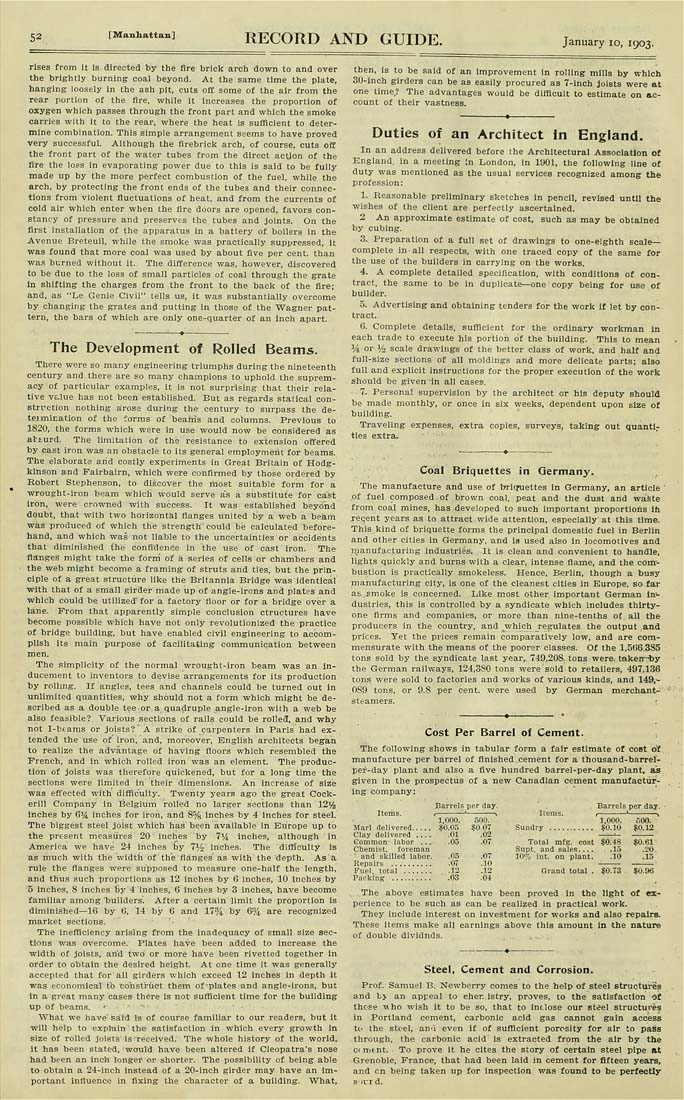
52 [Manhattan] RECORD AND GUIDE. January lo, 19037 rises from it is directed by the flre brick arch down to and over the brightly burning coal beyond. At the same time the plate, hanging loosely In the ash pit, cuts ofC some of the air from the rear portion of the flre, while It Increases the proportion of oxygen which passes through the front part and which the smoke carries with it to the rear, where the heat Is sufficient to deter¬ mine combination. This simple arrangement seems to have proved very successful. Although the flrebrick arch, of course, cuts off the front part of the water tubes from the direct action of the fire the loss in evaporating power due to this is said to be fully made up by the more perfect combustion of the fuel, while the arch, by protecting the front ends of the tubes and their connec¬ tions from violent fluctuations of heat, and from the currents of cold air which enter when the flre doors are opened, favors con¬ stancy of pressure and preserves the tubes and joints. On the first Installation of the apparatus in a battery of boilers in the Avenue Breteuil, while the smoke was practically suppressed, it was found that more coal was used by about five per cent, than was burned without it. The difference was, however, discovered to be due to the loss of small particles of coal through the grate In shifting the charges from the front to the back of the fire; and, as "Le Genie Civil" tells us. It was substantially overcome by changing the grates and putting In those of the Wagner pat¬ tern, the bars of which are only one-quarter of an Inch apart. The Development of Rolled Beams. There were so many engineering triumphs during the nineteenth century and there are so many champions to uphold the suprem¬ acy of particular examples, it is not surprising that their rela¬ tive VE-lue has not been established. But as regards statical con- strrction nothing arose during the century to surpass the de- teimlnation of the iorms of beams and columns. Previous to 1820, the forms which were in use would now be considered as alrturd. The limitation of the resistance to extension offered by cast Iron was an obstacle to its general employment for beams. The elaborate arid costly experiments in Great Britain of Hodg- kinson and Fairhairn, which were confirmed by those ordered by Robert Stephenson, to discov&r the most suitable form for a wrought-iron beam which would serve ais a substitute for cast iron, were crowned with success. It was established beyond doubt, that with two horizontal flanges united by a web a beam was produced of which the strength could be calculated before¬ hand, and which was not liable to the uncertainties or accidents that diminished fhe confidence in the use of cast iron. The flanges might take the form* of a series of cells or chambers and the web might become a framing of struts and ties, but the prin¬ ciple of a great structure like the Britannia Bridge was identical with that of a small girder made up of angle-irons and plates and which could be utilized" for a factory floor or for a bridge over a lane. From that apparently simple conclusion ctructures have become possible which have not only revolutionized the practice of bridge building, but have enabled civil engineering to accom¬ plish its main purpose of facilitating communication between men. The simplicity of the normal wrought-iron beam was an In¬ ducement to inventors to devise arrangements for Its production by rolling. If angles, tees and channels could be turned out in unlimited quantities, why should not a form which might be de¬ scribed as a double tee or a quadruple angle-iron with a web be also feasible? Various sections of rails could be rolled, and why not I-beams or joists?' A strike of carpenters in Paris had ex¬ tended the use of iron, and, moreover. English architects began to realize the advantage of having floors which resembled the French, and in which rolled iron was an element The produc¬ tion of joists was therefore quickened, but for a long time the sections were limited in their dimensions. An increase of size was effected with difficulty. Twenty years ago the great Cock¬ erill Company in Belgium rolled no larger sections than 12^^; inches by G'/i inches for iron, and 8% Inches by 4 inches for steel. The biggest steel joist which has been available in Europe up to the present measures 20 inches by TVi inches, although In America we have 24 inches by 71-^ Inches. The difficulty is as much with the width of the flanges' as with' the depth. As a rule the flanges were supposed to measure one-half the length, and thus such proportions as 12 inches by 6 inches, 10 Inches by ■5 inches, S inches by 4 inches, G'inches by 3 Inches, have become familiar among builders. After a certain limit the proportion is diminished—10 by 0, 14 by 0 and 17% by 6% are recognized market sections. • '. ' The inefficiency arising from the inadequacy of small size sec¬ tions was overcome. Plates have been added to increase the width of joists, and two or more have been rivetled together in order to obtain the desired height. At one time it was generally accepted that for all girders which exceed 12 inches in depth it was economical to construct thenrx of-plates and angle-irons, but In a great many cases there is not sufficient time for the building up of beams. ;>■ i ' -• What we have'sard is of course familiar to our readers, but it will help to explain'the satisfaction in which every growth In size of rolled joists is received. The whole history of the world. it has been stated, would have been altered if Cleopatra's nose had been an inch longer or shorter. The possibility of being able to obtain a 24-inch instead of a 20-inch girder may have an im¬ portant influence In fixing the character of a building. What, then, is to be said of an improvement in rolling mills by which 30-Inch girders can be as easily procured as 7-inch joists were at one time,? The advantages would be difficult to estimate on ac¬ count of their vastness. ---------------------1-------------------- Duties of an Architect in England. In an address delivered before the Architectural Association of England, in a meeting in London, In 11)01, the following line of duty was mentioned as the usual services recognized among the profession: 1. Reasonable preliminary sketches in pencil, revised until the wishes of the client are perfectly ascertained. 2 An approximate estimate of cost, such as may be obtained by cubing. 3. Preparation of a full set of drawings to one-eighth scale- complete in all respects, with one traced copy of the same for the use of the builders in carrying on the works. 4. A complete detailed speclflcatlon, with conditions of con¬ tract, the same to be in duplicate—one copy being for use of builder, 5. Advertising and obtaining tenders for the work if let by con¬ tract. 6. Complete details, sufficient for the ordinary workman in each trade to execute his portion of the building. This to mean % or Yi scale drawings of the better class of work, and half and full-size sections of all moldings and more delicate parts; also full and explicit instructions for the proper execution of the work should be given in al! cases. 7. Personal supervision by the architect or his deputy should be made monthly, or once in six weeks, dependent upon size of building. Traveling expenses, extra copies, surveys, taking out quanti¬ ties extra. ------------*------------ Coal Briquettes in Germany. The manufacture and use of briquettes in Germany, an article " of fuel composed-of brown coal, peat and the dust and waSte from coal mines, has developed to such important proportions ih recent years as to attract wide attention, especially at this time. This kind of briquette forms the principal domestic fuel in Berlin and other cities in Germany, and is used also in locomotives and manufacturing industries. It is clean and convenient to handle, lights quickly and burns with a clear, intense flame, and the com¬ bustion is practically smokeless. Hence, Berlin, though a busy manufacturing city, is one of the cleanest cities in Europe, so far as.smoke is concerned. Like m.ost other important German Im- dustries, this is controlled by a syndicate which includes thirty- one firms and companies, or more than nine-tenths of all the producers in the country, and _which jegulates the output and prices. Tet the prices remain comparatively low. and are com- ^M mensurate with the means of the poorer classes. Of the l,5f!6,3S5 ^| tons sold by the syndicate last year, 749.20S. tons were, takenHay the German railways. 124.3S0 tons were sold to retailers, 497.136 tons were sold to factories and works of various kinds, and 149,- 089 tons, or D.S per cent, were used by German merchant- -^ ' steamers. ; ---------_,----------- . Cost Per Barrel of Cement. The following shows in tabular form a fair estimate of cost of manufacture per barrel of finished cement for a thousand-barrel'- per-day plant and also a five hundred barrel-per-day plant, as given In the prospectus of a new Canadian cement manufactur¬ ing company; Barrels per day. Barrels per day. ■ Items. ,--------'-'^--------1 Items. i---------■--------, i.ooo. rm. 1.000. noo. Marl delivered..... .$(1.05 $0,07 Sundry ........... JO.IO $0.12 Clay delivered.....01 .02 ------^ --------- Common labor ... .03 .07 Total mfg. cost 50.-1S ?0.61' Chemist, foreman Supt. and sales..,. .11) .20. and sliilled labor. ,03 .07 10% int. on plant. .10 .15 Repairs ...........07 .10 -------- ---------■ Fuel, total........!2 ,12 Grand total . 50.73 $0.96 Pacldng ...........03 .04 , The above estimates have been proved In the light of ex¬ perience to be such as can be realized in practical work. They include interest on investment for works and also repairs. These items make all earnings above this amount In the nature of double dividnds. ;.. , Steel, Cement and Corrosion. Prof. Samuel B. Newberry comes to the help of steel structures and by an appeal to eher. Istry, proves, to the satisfaction of these «ho wish it to be so, that to inclose our steel structures in Portland cement, carbonic add gas cannot gain access tf the steel, anu even if of sufficient porosity for air to pass through, the carbonic acid Is extracted from the air by the cmtnt. ■ To prove It he cites the story of certain steel pipe at Grenoble, France, that had been laid in cement for fifteen years, and cn being taken up for inspection was found to be perfectly s ivrd.