
Columbia University Libraries Digital Collections: The Real Estate Record
Use your browser's Print function to print these pages.
Real estate record and builders' guide: v. 74, no. 1918: December 17, 1904
Text version:
Please note: this text may be incomplete. For more information about this OCR, view About OCR text.
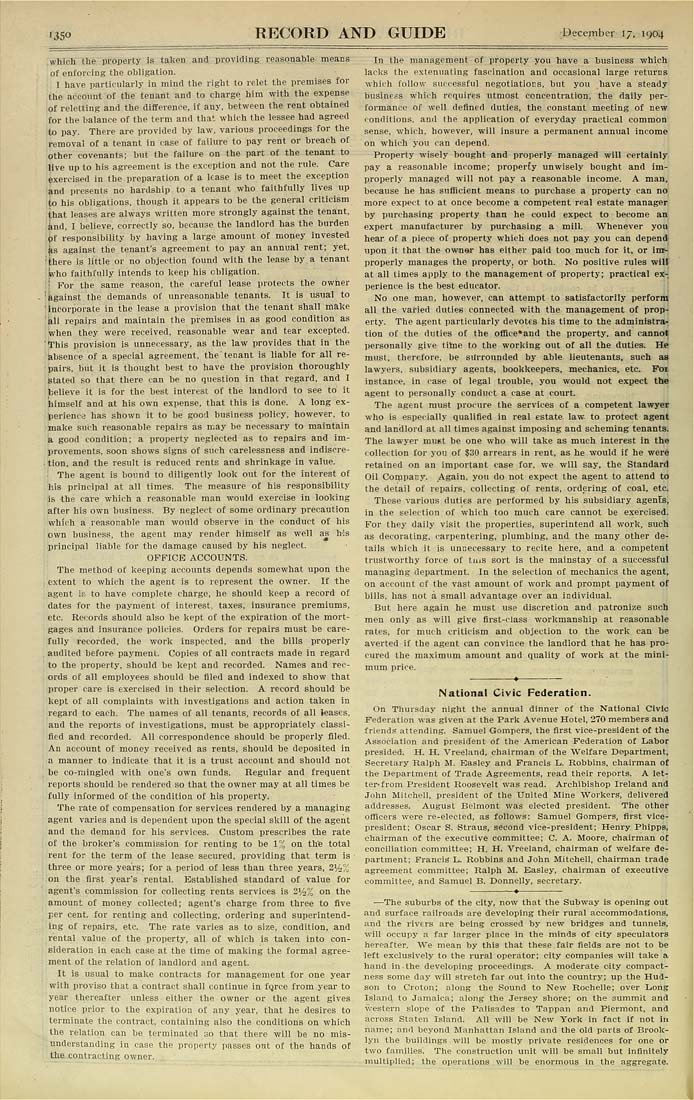
'3SO RECORD AND GUIDE December i/, 1904 .which the property is taken and providing reasonable means of enforcing the obligation. I have particularly iu mind the right to relet the premises for the account of the tenant and to charge him with the expense of reletting and the difference, if auy, between the rent obtained for the balance of the term and that which the lessee had agreed to pay. There are provided by law, various proceedings for the removal of a tenant in case of failure to pay rent or breach of other covenants; but the failure on the part of the tenant to live up lo his agreement is the exception and not the rule. Care exercised iu the preparation of a lease is to meet the exception and jnesents no hardship to a tenant who faithfully lives up to his obligations, though it appears to be the general criticism that leases are always written raore strongly against the tenant, ind. I believe, correctly so, because the landlord has the burden pf responsibility by having a large amount of money invested ^s against the tenant's agreement to pay an annual rent; yet, ■there is little or no objection found with the lease by a tenant B'ho faithfully intends to heep his obligation. ■ For the same reason, the careful lease protects the owner 'kgainst the demands of unreasonable tenants. It is usual to "Incorporate in the lease a provision that the tenant shall make 'bli repairs and maintaiu the premises in as good condition as when they were received, reasonable wear and tear excepted. ■^his provision is unnecessary, as the law provides that in the Absence of a special agreement, the" tenant is liable for all re¬ pairs, biit it is thought best to have the provision thoroughly Stated so that there can be no question in that regard, and I fcelieve it is for the best interest of the landlord to see to it himself and at his own expense, that this is done. A long ex- Jierience has shown it to be good husiness policy, however, to make such reasonable repairs as may be necessary to maintain a good condition; a property neglected as to repairs and im¬ provements, soon shows signs of such carelessness and indiscre- . tion, and the result is reduced rents and shrinkage in value. I The agent is bound to diligently look out for the interest of his principal at all times. The measure of his responsibility is the care which a reasonable man would exercise in looking after his own business. By neglect of some ordinary precaution which a reasonable man would observe in the conduct of his own business, the ageut may render himself as well as his ■principal liable for the damage caused by his neglect. OFFICE ACCOUNTS. The method of keeping accounts depends somewhat upon the extent to which the agent is to represent the owner. If the agent is to have complete charge, he should keep a record of dates for the payment of interest, taxes, insurance premiums, etc. Records should also be kept of the expiration of the mort¬ gages and insurance policies. Orders for repairs must be care¬ fully recorded, the work inspected, and the bills properly , audited before payment. Copies of all contracts made in regard to the property, should be kept and recorded. Names aud rec¬ ords of all employees should be filed and indexed to show that proper care is exercised in their selection. A record should be kept of all complaints with investigations and action taken in regard to each. The names of all tenants, records of all leases, aud the reports of investigations, must be appropriately classi¬ fied and recorded. Al! correspondence should be properly flled. An account of money received as rents, should be deposited in a manner to indicate that it is a trust account and should not be co-mingled with one's own funds. Regular and frequent reports should be rendered so that the owner may at all times be fully informed of the condition of his property. The rate of compensation for services rendered by a managing agent varies and is dependent upon the special skill of the agent and the demaud for his services. Custom prescribes the rate of the broker's commission for renting to he 1% on th'e total rent for the terra of the lease secured, providing that term is ■ three or more years; for a period of less than three years, 2V^% on the first year's rental. Established standard of value for agent's commission for collecting rents services is 214% on the amount of money collected; agent's charge from three to five per cent, for renting and collecting, ordering and superintend¬ ing of repairs, etc. The rate varies as to size, condition, and rental value of the property, all of which is taken into con¬ sideration in each case at the tirae of making the formal agree¬ ment of the relation of landlord and agent. It is usual to make contracts for management for one year with proviso that a contract shall continue in fqrce from year to year thereafter unless either the owner or the agent gives notice prior to the expiration of any year, that he desires to terminate the contract, containing also the conditions on which the relation can be terminated 30 that there will be no mis¬ understanding in case the property passes ont of the hands of the. .contracting owner. In the management of property you have a business" which, lacks the extenuating fascination and occasional large returns, which follow successful negotiations, but you have a steady business which requires utmost concentration, the daily per¬ formance.of well defined duties, the constant meeting of new conditions, and the application of everyday practical common sense, which, however, will insure a permanent annual income on which you can depend. Property wisely hought and properly managed will certainly pay a reasouable income; property unwisely hought and im¬ properly managed will not pay a reasonable income. A man, because he has sufficient means 10 purchase a property can no more expe<'t to at once become a competent real estate manager by purchasing property than he could expect to become an expert manufacturer by purchasing a mill. "Whenever you hear of a piece of property which does not pay you can dependi upon it that the ownar has either paid too much for it, or Inr- properly manages the property, or both. No positive rules will at all times apply to the management of property; practical ex¬ perience is the best educator. No one man, however, can attempt to satisfactorily perforut all the varied duties connected with the management of prop-; erty. The agent particularly devotes his time to the administra-; tion of the duties of the office'and the property, and cannot| personally give tihie to the working out of all the duties. He must, therefore, be surrounded by able lieutenants, such as lawyers, subsidiary agents, booklteepers, mechanics, etc. Foi instance, in case of legal trouble, you would not expect tbe agent to personally conduct a case at court. The agent must procure the services of a competent lawyer who is especially qualified in real estate law to protect agent and landlord at all times against imposing and scheming tenants. The lawyer muet be one who will take as rauch interest in the