
Columbia University Libraries Digital Collections: The Real Estate Record
Use your browser's Print function to print these pages.
Real estate record and builders' guide: v. 76, no. 1966: November 18, 1905
Text version:
Please note: this text may be incomplete. For more information about this OCR, view About OCR text.
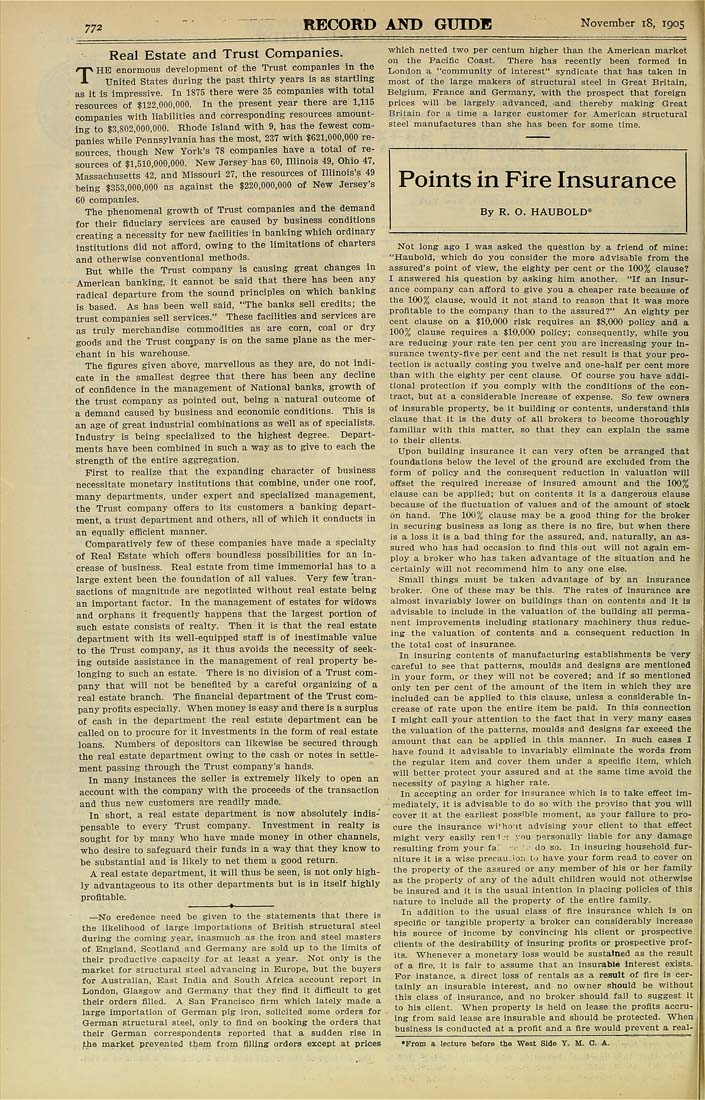
RECORD AND GUIDB vember iS, 1905 1 Real Estate and Trust Companies. THE enormous development of the Trust companies in the United States during the past thirty years is as startling as it is impressive. In 1875 there were 35 companies with total resources of $122,000,000. In the present year there are 1,115 companies with liabilities and corresponding resources amount¬ ing to $3,802,000,000. Rhode Island with 9, has the fewest com¬ panies while Pennsylvania has the most, 237 with $621,000,000 re¬ sources, though New York's 78 companies have a total of re¬ sources of $1,510,000,000. New Jersey has 60, Illinois 49, Ohio 47, Massachusetts 42, and Missouri 27, the resources of lUinois's 49 being $353,000,000 as against the $220,000,000 of New Jersey's 60 companies. The phenomenal growth of Trust companies and the demand for their fiduciary services are caused by business conditions creating a necessity for new facilities in banking which ordinary institutions did not afford, owing to the limitations of charters and otherwise conventional methods. But while the Trust conipany is causing great changes in American banking, it cannot be said that there has been any radical departure from the sound principles on which banking is based. As has been well said, "The banks sell credits; the trust companies sell services." These facilities and services are as truly merchandise commodities as are corn, coal or dry goods and the Trust company is on the same plane as the mer¬ chant in his warehouse. The flgures given above, marvellous as they are, do not indi¬ cate in the smallest degree that there has been any decline of confldence in the management of National banks, growth of the trust company as pointed out, being a natural outcome of a demand caused by business and economic conditions. This is an age of great industrial combinations as well as of specialists. Industry is being specialized to the highest degree. Depart¬ ments have been combined in such a way as to give to each the strength of the entire aggregation. First to realize that the expanding character of business necessitate monetary institutions that combine, under one roof, many departments, under expert and specialized management, the Trust company offers to its customers a banking depart¬ ment, a trust department and others, all of which it conducts in an equally efficient manner. Comparatively few of these companies have made a specialty of Real Estate which offers boundless possibilities for an in¬ crease of business. Real estate from time immemorial has to a large extent been the foundation of all values. Very few 'tran¬ sactions of magnitude are negotiated without real estate being an important factor. In the management of estates for widows and orphans it frequently happens that the largest portion of such estate consists of realty. Then it is that the real estate department with its well-equipped staff is of inestimable value to the Trust company, as it thus avoids the necessity of seek¬ ing outside assistance in the management of real property be¬ longing to such an estate. There is no division of a Trust com¬ pany that will not be benefited by a careful organizing of a real estate branch. The financial department of the Trust com¬ pany profits especially. When money is easy and there is a surplus of cash in the department the real estate department can be called on to procure for it investments in the form of real estate loans. Numbers of depositors can likewise be secured through the real estate department owing to the cash or notes in settle¬ ment passing through the Trust company's hands. In many instances the seller is extremely likely to open an account with the company with the proceeds of the transaction and thus new customers are readily made. In short, a real estate department is now absolutely indis¬ pensable to every Trust company. Investment in realty is sought for by many Who have made money in other channels, who desire to safeguard their funds in a way that they know to be substantial and is likely to net them a good return. A real estate department, it wili thus be seen, is not only high¬ ly advantageous to its other departments but is in itself highly profitable. ----------•---------- —No credence need be given to the statements that there is the likelihood of large importations of British structural steel during the coming year, inasmuch as the iron and steel masters of England, Scotland and Germany are sold up to the limits of their productive capacity for at least a year. Not only is the market for structural steel advancing in Europe, but the buyers for Australian, East India and South Africa account report in London, Glasgow and Germany that they flnd it difflcult to get their orders filled. A San Francisco flrm which lately made a large importation of German pig iron, solicited some orders for German structural steel, only to flnd on booking the orders that their German correspondents reported that a sudden rise in ^ha market prevented them from filling orders except at prices which netted two per centum higher than the American market on the Pacific Coast. There has recently been formed In London a "community of interest" syndicate that has taken in most of the large makers of structural steel in Great Britain, . Belgium. France and Germany, with the prospect that foreign prices will be largely advanced, ^and thereby making Great Britain for a time a larger customer for American structural steel manufactures than she has been for some time. Points in Fire Insurance By R. O, HAUBOLD* Not long ago I was asked the question by a friend of mine: "Haubold, which do you consider the more advisable from the assured's point of view, the eighty per cent or the 100% clause? I answered his question by asking him another. "If an insur¬ ance company can afford to give you a cheaper rate because of the 100% clause, would it not stand to reason that it was more profltable to the company than to the assured?" An eighty per cent clause on a $10,000 risk requires an $S,000 policy and a 100% clause requires a JLO,000 policy; consequently, while you are reducing your rate ten per cent you are increasing your in¬ surance twenty-flve per cent and the net result is that your pro¬ tection is actually costing you twelve and one-half per cent more than with the eighty per cent clause. Of course you have addi¬ tional protection if you comply with the conditions of the con¬ tract, but at a considerable increase of expense. So few owners of insurable property, be it building or contents, understand this clause that it is the duty of all brokers to become thoroughly familiar with this matter, so that they can explain the same to their clients. Upon building insurance it can very often be arranged that foundations below the level of the ground are excluded from the form of policy and the consequent reduction in valuation will offset the required increase of insured amount and the 100% clause can be applied; but on contents it is a dangerous clause because of the fluctuation of values and of the amount of stock on hand. The 100% clause may be a good thing for the broker in securing business as long as there is no fire, but when there is a loss it is a bad thing for the assured, and, naturally, an as¬ sured wbo has had occasion to flnd this out will not again em¬ ploy a broker who has taken advantage of the situation and he certainly will not recommend him to any one else. Small things must be taken advantage of by an insurance broker. One of these may be this. The rates of insurance are almost invariably lower on buildings than on contents and It ia advisable to include in the valuation of the building all perma¬ nent improvements including stationary machinery thus reduc¬ ing the valuation of contents and a consequent reduction In the total cost of insurance. In insuring contents of manufacturing establishments be very careful to see that patterns, moulds and designs are mentioned in your form, or they will not be covered; and if so mentioned only ten per cent of the amount of the item in which they are included can be applied to this clause, unless a considerable in¬ crease of rate upon the entire item be paid. In this connection I might call your attention to the fact that in very many cases the valuation of the patterns, moulds and designs far exceed the amount that can be applied in this manner. In such cases I have found it advisable to invariably eliminate the words from the regular item and cover them under a specific item, which will better protect your assured and at the same time avoid the necessity of paying a higher rate. In accepting an order for inaurance which is to take effect Im¬ mediately, it is advisable to do so with the proviso that you will cover it at the earliest possible moment, as your failure to pro¬ cure the insurance wi'hoit advising your client to that effect might very easily ren-l.'t ynu personally liable for any damage resulting from your faV ■•>.■ ' ■ do so. In insuring household fur¬ niture it is a wise precaution to have your form read to cover on the property of the assured or any member of his or her family as the property of any of the adult children would not otherwise be insured and it is the usual intention in placing policies of this nature to include all the property of the entire family. In addition to the usual class of fire insurance which is on specific or tangible property a broker can considerably increase his source of income by convincing his client or prospective clients of the desirability of insuring profits or prospective prof¬ its. Whenever a monetary loss would be sustained as the result of a fire, it is fair to assume that an Insurable Interest exists. For instance, a direct loss of rentals as a result of fire is cer¬ tainly an insurable interest, and no owner should be without this class of insurance, and no broker should fail to suggest It ; to his client. When property is held on lease the profits accru¬ ing from said lease are Insurable and should be protected. When business is conducted at a profit and a fire would prevent a real- »From 3 lecture before tie Wast Sifle T. M. O. A.