
Columbia University Libraries Digital Collections: The Real Estate Record
Use your browser's Print function to print these pages.
Real estate record and builders' guide: v. 79, no. 2028: January 26, 1907: Supplement
Text version:
Please note: this text may be incomplete. For more information about this OCR, view About OCR text.
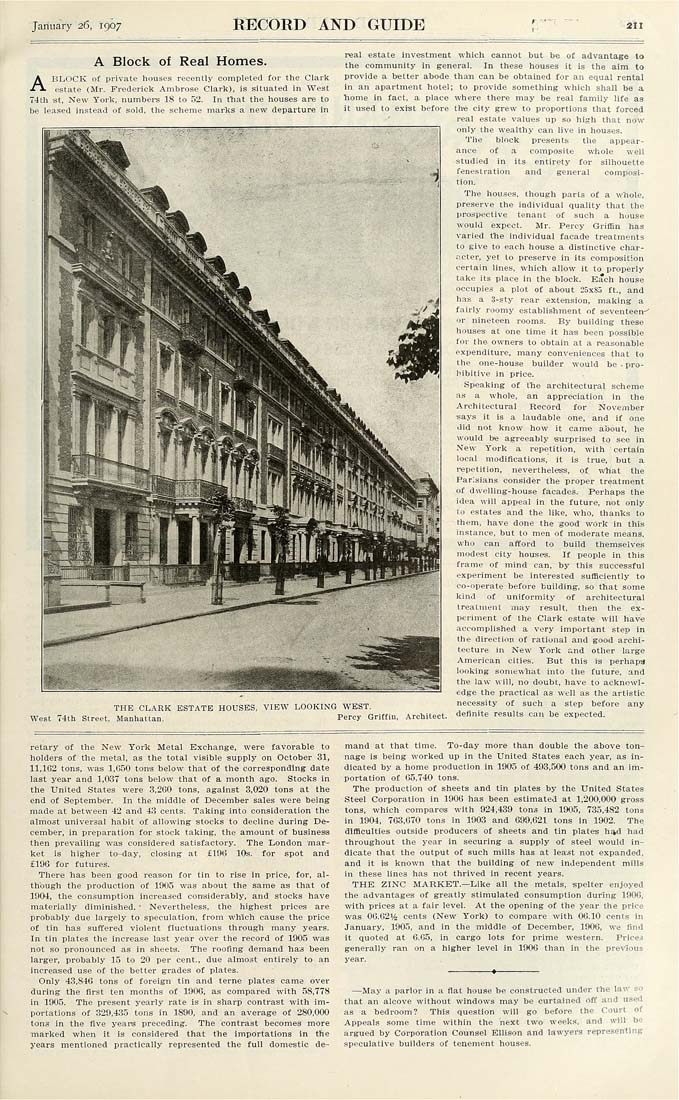
January 26, '1967 RECORD AND GUIDE 2ii A Block of Real Homes. A BLOCK of private houses recently completed for tiie Clark estate (Mr. Frederick Ambrose Clark), is situated in West 74t:h 1st, New Torli, numbere 18 to 52. In tiiat tlie houses are to be leased instead of sold, the scheme marks a new departure in THE CL.A.RK ESTATE HOUSES, VIEW LOOKING WEST. West. 74tli Street, Manhattan, Percy Griffin, Architect. real estate investment which cannot but be of advantage to the community in general. In these houses it is the aim to provide a better abode than can be obtained for an equal rental in an apartment hotel; to provide something which shall be a home in fact, a place where there may be real family life as it used to exist before the city grew to proportions that forced real estate values up so hi^h that now only the wealthy can live in houses. The block presents the appear¬ ance of a composite whole well studied in its entirety for silhouette fenestration and general composi¬ tion. The houses, though parts of a whole, preserve the individual quality that tbe prospective tenant of such a house would expect. Mr. Percy Griffin has varied the individual facade treatments to give to each bouse a distinctive char- iLcter, yet lo preserve in its composition certain hnes, which allow it to properly take its place in the block. Each house occupies a plot of about 25x85 ft., and has a 3-sty rear extension, making a fairly roomy establishment of seventeen-' or nineteen rooms. By building these houses at one time it has been possible loi- the owners to obtain at a ivasonable expenditure, many conveniences that to the one-house builder would be . pro¬ hibitive in price. .Speaking of fhe architectural scheme as a whole, an appreciation in the Archi tectural Record for November says it is a laudable one, and if one did not know how it came about, he would be agreeably surprised to see in New York a repetition, with certain local modifications, it is true, but a i-epetition. nevertheless, of what the Par:Bians consider the proper treatment of dwelling-house facades. Perhaps the idea will appeal in the future, not only to estates and the like, who, than'ks to them, have done the good work in this instance, but to men of moderate means, who can afford to build themselves modest city houses. If people in this frame of mind can, by this successful experiment be interested sufficiently to co-operate before building, so that some kind of uniformity of architectural treatment may result, then the ex¬ periment of the Clark estate will have accomplished a very important step in the direction of rational and good archi¬ tecture in New York and other large American cities. But this is perhaps looking soniew'hat into the future, and the law will, no doubt, have to acknowl¬ edge the practical as well as the artistic necessity of such a step before any definite results can be expected. retary of the New Torli Metal Exchange, were favorable to holders of the metal, as the total visible supply on October Sl, 11,162 tons, was 1,650 ton-s below that of the corresponding date last year and 1,037 tons below that of a month ago. Stocks in the United States were 3,260 tons, against 3,020 tons at the end of September. In the middle of December sales were being made at between 42 and 4i cents. Taking into consideration the almost universal habit of allowing stocks to decline during De¬ cember, in preparation for stock taking, the amount of business then prevailing was considered satisfactory. The London mar¬ ket is higher to-day, closing at £19l> 10s. for spot and fl96 for futures. There has been good reason for tin to rise in price, for, al¬ though the production of 1905 was about the same as that of 1904, the consumption increased considerably, and stocks have materially diminished. ■ Nevertheless, the highest prices are probably due largely to speculation, from which cause the price of tin has suffered violent fluctuations through many years. In tin plates the increase last year over the record of 1905 was not so pronounced as in sheet's. The roofing demand has been larger, probably 1.5 to 20 per cent., due almost entirely to an increased use of the better grades of plates. Only 43,846 tons of foreign tin and terne plates came over during the first ten months of 190G, as compared with 5S,778 in 1905. The present yearly rate is in sharp contrast with im- poi-tations of 320,435 tons in 1890, and an average of 280,000 tons in the five years preceding. The contrast becomes more marked when it is considered that the importations in the years mentioned practically represented the full domestic de¬ mand at that time. To-day more than double the above ton¬ nage is being worked up in the United States each year, as in¬ dicated by a home production in 190.J of 493,500 tons and an im¬ portation of 65,740 tons. The production of sheets and tin plates by the United States Steel Corporation in 1906 has been estimated at 1,200.000 gross tons, which compares with 924.439 tons in 1905, 735,482 tons in 1904, 763,670 tons in 1903 and 699,621 tons in 1902. The difflculties outside producers of sheets and tin plates had had throughout the year in securing a supply of steel would in¬ dicate that the output of such mills has at least not expanded, and it is known that the building of new independent mills in these lines has not thrived in recent years. THE ZINC MARKET.—Like all the metals, spelter enjoyed the advantages of greatly stimulated consumption during 1900. with prices at a fair level. At the opening of fhe year the price was 06.62^^ cents (New York) to compare with 06.10 cents in January, 1905, and in the 'middle of December. 1906, we find it quoted at 6.65, in cargo lots for prime western. Prices generally ran on a higher level in 1906 than in the previous year. —May a parlor in a flat house be constructed under the law so that an alcove without windows may be curtained off and used as a bedroom? This question will go before the Court of Appeals some time within the next two weeks, and will be argued by Corporation Counsel Ellison and lawyers representing speculative builders of tenement houses.