
Columbia University Libraries Digital Collections: The Real Estate Record
Use your browser's Print function to print these pages.
Real estate record and builders' guide: v. 82, no. 2104: July 11, 1908
Text version:
Please note: this text may be incomplete. For more information about this OCR, view About OCR text.
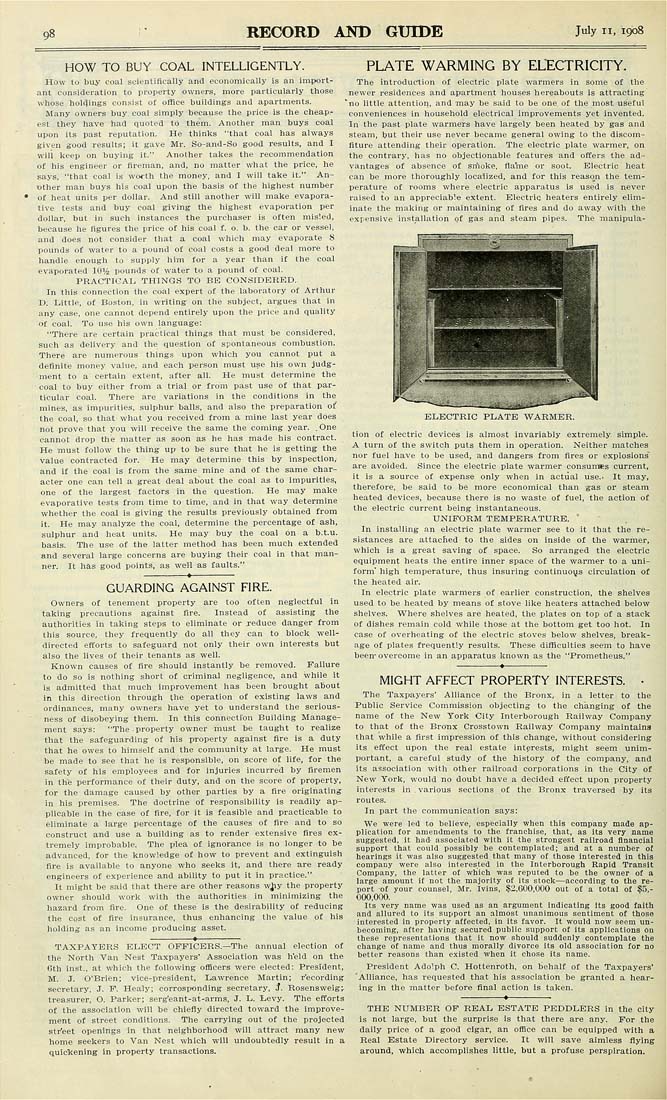
98 RECORD AND GUIDE July ri, 1908 HOW TO BUY COAL INTELLIGENTLY. How to buy coal scientifically and economically is an import¬ ant consideration to property owners, more particularly those whose holdings consist of office buildings and apartments. Many owners buy coal simply because the price is the cheap¬ est they have had quoted to them. Another man buys coal upon its past reputation. He thinks "that coal has always given good results; it gave Mr. So-and-So good results, and I will keep on buying it." Another takes the recommendation of his engineer or fireman, and, no matter what the price, he says, "that coal is wofth the money, and I will take it." An¬ other man buys his coal upon the basis of the highest number of heat units per dollar. And still another will make evapora¬ tive tests and buy coal giving the highest evaporation per dollar, but in such instances the purchaser is often misled, because he figures the price of his coal f. o, b. the car or vessel, and does not consider that a coal which may evaporate 8 pounds of water to a pound of coal costs a good deal more to handle enough to supply him for a year than if the coal evaporated lOM; pounds ot water to a pound of coai. PRACTICAL THINGS TO BE CONSIDERED. in this connection the coal expert of the laboratory of Arthur D. Little, of Boston, in writing on the subject, argues that in any case, one cannot depend entirely upon the price and quality of coal. To use his own language: "There are certain practical things that must be considered, such as delivery and the question of spontaneous combustion. There are numerous things upon which you cannot put a definite money value, and each person must use his own judg¬ ment to a certain extent, after all. He must determine the coal to buy either from a trial or from past use of that par¬ ticular coal. There are variations in the conditions in the mines, as impurities, sulphur balls, and also the preparation of' the coal, so that what you received from a mine last year does not prove that you will receive the same the coming year. ,One cannot drop the matter as soon as he has made his contract. He must follow the thing up to be sure that he is getting the value contracted for. He may determine this by inspection,- and if the coal is from the same mine and of the same char¬ acter one can tell a great deal about the coal as to impurities, one of the largest factors in the question. He may make evaporative tests from time to time, and in that way determine whether the coal is giving the results previously obtained from it. He may analyze the coal, determine the percentage of ash, sulphur and heat units. He may buy the coal on a b.t.u. basis. The use of the latter method has been much extended and several large concerns are buying their coal in that man¬ ner. It has good points, as well as faults," PLATE WARMING BY ELECTRICITY. The introduction of electric plate warmers in some of the newer residences and apartment houses hereabouts is attracting 'no little attention, and may be said to be one of the most useful conveniences in household electrical improvements yet invented. In the past plate warmers have largely been heated by gas and steam, but their use never became general owing to the discom¬ fiture attending their operation. The electric plate warmer, on the contrary, has no objectionable features and offers the ad¬ vantages of absence of srfioke, fla^e or soot. Electric heat can be more thoroughly localized, and for this reason the tem¬ perature of rooms where electric apparatus is used is never raised to an appreciable extent. Electric heaters entirely elim¬ inate the making or maintaining of fires and do away with the expensive installation of gas and steam pipes. The manipula- GUARDING AGAINST FIRE. Owners of tenement property are too often neglectful in taking precautions against fire. Instead of assisting the authorities in taking steps to eliminate or reduce danger from this source, they frequently do all they can to block well- directed efforts to safeguard not only their own interests but also the lives of their tenants as well. Known causes of fire should instantly be removed. Failure to do so is nothing short of criminal negligence, and while it is admitted that much improvement has been brought about in this direction through the operation of existing laws and ordinances, many owners have yet to understand the serious¬ ness of disobeying them. In this connection Building Manage¬ ment says: "The property owner must be taught to realize that the safeguarding of his piroperty against fire is a duty that he owes to himself and the community at large. He must be made to see that he is responsible, on score of life, for the safety of his employees and for injuries incurred by firemen in the performance of their duty, and on the score of property, for the damage caused by other parties by a flre originating in his premises. The doctrine of responsibility is readily ap¬ plicable in the case of flre, for it is feasible and practicable to eliminate a large percentage of the causes of fire and to so construct and use a building as to render extensive fires ex¬ tremely improbable. The plea of ignorance is no longer to be advanced, for the knowledge of how to prevent and extinguish fire is available to anyone who seeks it, and there are ready engineers of experience and ability to put it in practice." It might be said that there are other reasons wjiy the property owner should work with the authorities in minimizing the hazard from flre. One of these is the desirability of reducing the cost of flre insurance, thus enhancing the value of his holding as an income producing asset. ---•-'-'-'".■■i-ff--''- ELECTRIC PLATE WARMER. tion of electric devices is almost invariably extremely simple. A turn of the switch puts them in operation. Neither matches nor fuel have to be used, and dangers from fires or explosions" are avoided. Since the electric plate warmer consumes current, it is a source of expense only when in actual use.- It may, therefore, be said to be more economical than gas or steam heated devices, because there is no waste of fuel, the action of the electric current being instantaneous. UNIFORM TEMPERATURE. ' In installing an electric plate warmer see to it that the re¬ sistances are attached to the sides on inside of the warmer, which is a great saving of space. So arranged the electric equipment heats the entire inner space of the warmer to a uni¬ form' high temperature, thus insuring continuous circulation of the heated air. In electric plate warmers of earlier construction, the shelves used to be heated by means of stove like heaters attached below shelves. Where shelves are heated, the plates on top of a stack of dishes remain cold while those at the bottom get too hot. In case of overheating of the electric stoves below shelves, break¬ age of plates frequently results. These difficulties seem to have been-overcome in an apparatus known as the "Prometheus." TAXPAYERS ELECT OFFICERS.—The annual election of the North Van Nest Taxpayers' Association was h'eld on the Gth inst., at which the following ofQcers were elected: President, M. J. O'Brien; vice-president, Lawrence Martin; r'ecording secretary, J. P. Healy; corrospending secretary, J. Rosensweig;. treasurer, O. Parker; serg'eant-at-arms, J. L, Levy. The efforts of the association will be chiefly directed toward the improve¬ ment of street conditions. The carrying out of the projected str'eet openings in that neighborhood will attract many new home seekers to Van Nest which will undoubtedly result in a quickening in property transactions. MIGHT AFFECT PROPERTY INTERESTS. • The Taxpayers' Alliance of the Bronx, in a letter to the Public Service Commission objecting to the changing of the name of the New Tork City Interborough Railway Company to that of the Bronx Crosstown Railway Company maintains that while a first impression of this change, without considering its effect upon the real estate interests, might seem unim¬ portant, a careful study of the history of the company, and its association with other railroad corporations in the City of New Tork, would no doubt have a decided effect upon property interests in various sections of the Bronx traversed by its routes. In part the communication says: We were led to believe, especially when this corapany made ap¬ plication for ameudmeuts to the franchise, tbat, as its very name suggested. It had associated with it tbe strongest railroad financial support that could possibly be contemplated; and at a number of hearings it was also suggested that many of tliose interested in this company were also interested in the Interborough Rapid Transit Company, the latter of which was reputed to be the owner of a large amount if not the majority of its stock—according to the re¬ port of your counsel, Mr, Ivins, $2,600,000 out of a total of $5,- 000,000. Its very name was used as an argument indicating its good faith and allured lo its support an almost unanimous sentiment of those interested in properly affected, in its favor. It would now seem un¬ becoming, after having secured public support of its applications ou these representations that it now should suddenly contemplate the change of name and thus morally divorce its old association for no better reasons than existed when it chose its name. President Adolph C. Hottenroth. on behalf of the Taxpayers' Alliance, has requested that his association be granted a hear¬ ing in the matter before final action is taken. THE NUMBER OP REAL ESTATE PEDDLERS in the city is not large, but the surprise is that there are any. For the daily price of a good cigar, an offlce can be equipped with a Real Estate Directory service. It will save aimless flying around, which accomplishes little, but a profuse perspiration.