
Columbia University Libraries Digital Collections: The Real Estate Record
Use your browser's Print function to print these pages.
Real estate record and builders' guide: v. 88, no. 2278: November 11, 1911
Text version:
Please note: this text may be incomplete. For more information about this OCR, view About OCR text.
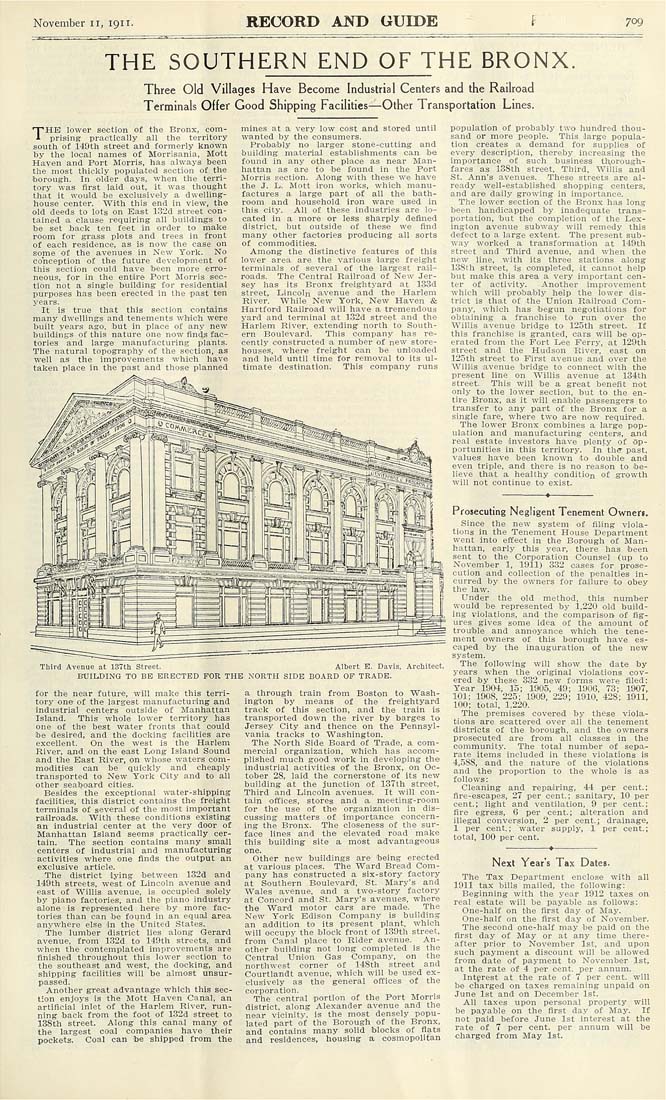
November ii, 1911. RECORD AND GUIDE K 709 THE SOUTHERN END OF THE BRONX. Three Old Villages Have Become Industrial Centers and the Railroad Terminals Offer Good Shipping Facilities^Other Transportation Lines. THE lower section of the Bronx, com¬ prising practically all the territory south of 149th street and formerly known by the local names of Morrisania, Mott Haven and Port Morris, has always been the most thickly populated section of the horough. In older days, when the terri¬ tory was first laid out, it was thought that it would be exclusively a dwelling- house center, "^''ith this end in view, the old deeds to lots on East 132fl street con¬ tained a clause requiring all buildings to be set .back ten feet in order to make room for grass plots and trees in front of each residence, as is now the case on some of the avenues in New York. No conception of the future development of this section could have heen more erro¬ neous, for in the entire Port Jlorris sec¬ tion not a single building for residential purposes has been erected in the past ten years. It is true that this section contains many dwellings anfl tenements which were huilt years ago. but in place of any new buildings of this nature one now flnds fac¬ tories and large manufacturing plants. The natural topography of the section, as well as the improvements which have taken place in the past and those planned mines at a very low cost and stored until wanted by the consumers. Probably no larger stone-cutting and building material establishments can toe found in any other place as near Man¬ hattan as are to be found in the Port Morris section. Along with these we have .the J. L. Mott iron works, which manu¬ factures a large part of all the bath¬ room and household iron ware used in this cily. All of these industries are lo¬ cated in a more or less sharply defined district, but outside of these we find many other factories producing all sorts of commodities. Among the distinctive features of this lower area are the various large freight terminals of several of the largest rail¬ roads. The Central Railroad of New Jer¬ sey has its Bronx freightyard at 133d street, Lincoln avenue anfl the Harlem River. While New York, New Haven & Hartford Raiiroad will have a tremendous yard and terminal at lo2d street and the Harlem River, extending north to South¬ ern Boulevard. This company has re¬ cently constructed a number of new store¬ houses, where freight can be unloaded and held until time for removal to its ul¬ timate destination. This company runs population of prohably two hundred thou¬ sand or more people. This large popula¬ tion creates a demand for supplies of every description, thereby increasing the importance of such business thorough¬ fares as ISSth street. Third, Willis and St. Ann's avenues. These streets are al¬ ready well-established shopping centers, and are daily growing in importance. The lower section of the Bronx has long been handicapped by inadequate trans¬ portation, hut the completion of the Lex¬ ington avenue subway will remedy this defect to a large extent. The present sub¬ way worked a transformation at 149th street anfl Third avenue, and when the new line, w-ith Its three stations along 138lh street, is completed, it cannot help but make this area a very important cen¬ ter of activity. Another improvement which will probably help the lower dis¬ trict is that of the Union Railroad Com¬ pany, which has begun negotiations for obtaining a franchise to run over the Willis avenue bridge to 125th street. If this franchise is granted, cars will be op- eratefl from the Fort Lee Ferry, at 129th street and the Hudson River, east on 125th street to First avenue and over the Willis avenue bridge to connect with the present line on Willis avenue at 134th street. This will he a great benefit not only to the lower section, but to the en¬ tire Bronx, as it will ena:hle passengers to transfer to any part of the Bronx for a single fare, -u'here two are now required. The lower Bronx combines a large pop¬ ulation and manufacturing centers, aJid real estate investors have plenty of op¬ portunities in this territory. In the past, values have heen known to double and even triple, and there is no reason to .be¬ lieve that a healthy condition of growth will not continue to exist. Third Avenue at 137th Street. Albert E. Davis, Architect. B'UILDING TO BB ERECTED POR THE NORTH SIDE BOARD OF TRADE. for the near future, will make this ten-i- tory one of the largest manufacturing and industrial centers outside of Manhattan Island. This whole lower tenatory has one of the best water fronts that could be desirefl, and the docking facilities are excellent. On the west is the Harlem Rivei-, and on the east Long Island Sound and the East River, on whose waters com¬ modities can be quickly and cheaply transported to New York Oity and to all other seaboard cities- Besides the exceptional water-shipping facilities, this district contains the freight terminals of several of the most important railroads. With these conditions existing an industrial center at the very door of Manhattan Island seems practically cer¬ tain. The section contains many small centers of influstrial and manufacturing activities where one flnds the output an exclusive article. The district lying between 132d and 149th streets, west of Lincoln avenue and east of Willis avenue, is occupied solely by piano factories, and the piano industry alone is represented here by more fac¬ tories than can be found in an equal area anywhere else an the United States. The lumber district lies along Gerard avenue, from 132d to 140th streets, and when the contemplatefl improvenients are flnished throughout this lower section to the southeast and west, the docking, and shipping facilities will be almost unsur¬ passed. Another great advantage which this sec¬ tion enjoys is the Mott Haven Canal, an artiflcial inlet of the Harlem River, run¬ ning hack from the foot of 132d street to 13Sth street, Along this canal many of the largest coal companies have their pockets. Coal can be shipped from the a through train from Boston to Wash¬ ington by means of the freightyard track of this section, and the train is transported down the river by barges to Jersey City and thence on the Pennsyl¬ vania tracks to Washington. The North Side Boarfl of Trade, a com¬ mercial organization, which has accom¬ plished much good work in developing the industrial activities of the Bronx, on Oc- toher 2S, laid the cornerstone of its new building at the junction of 137th street. Third and Lincoln avenues. It will con¬ tain offices, stores and a meeting-room for the use of the organization in dis¬ cussing matters of Importance concern¬ ing the Bronx. The closeness of the sur¬ face lines and the elevated road make this building site a most advantageous one. Other new buildings are being erected at various places. The Ward Bread Com¬ pany has constructed a six-story factory at Southern Boulevard, St. Mar>-'s and Wales avenue, and a two-story factory at Concord and St. Mary's avenues, where the Ward motor cars are made. The New York Edison Company is building an addition to its present plant, which will occupy the hlock front of ISOth street, from Canal place to Rider avenue. An¬ other Ibuilding not long completed is the Central Union Gas Company, on the nnrthwest corner of 14Sth street and Courtlandt avenue, which will be usefl ex¬ clusively as the general offices of the corporation. The central portion of the Port Morris district, along Alexander avenue and the near vicinity, is the most flensely popu¬ lated part of the Borough of the Bronx, and contains many solid hlocks of flats and residences, housing a cosmopolitan Prosecuting Negligent Tenement Owner*. Since the new system of fliing viola¬ tions in the Tenement House Department went into effect in the Borough of Man¬ hattan, early this year, there has been sent to the Corporation Counsel (up to November 1, 1911) 332 cases for prose¬ cution and collection of the penalties in¬ curred by the owners for failure to obey the law. Under the old method, this number would be represented by 1,220 old build¬ ing violations, and the comparison of fig¬ ures gives some idea of the amount of trouble and annoyance which the tene¬ ment owners of this borough have es¬ caped by the inauguration of the new system. The following will show the date hy years when the original violations cov¬ ered hy these 332 new forms were flled: Year 1904, 15; 1905, 49; 1006, 73; 1907, 101; 1908, 225; 1909, 229; 1910, 428; 1911, 100; total, 1,220. The premises covered by these viola¬ tions are scattered over all the tenement districts of the borough, anfl the owners prosecuted are from all classes in the community. The total num.ber of sepa- ra_te items inclufled in these violations is 4,aSS, anfl the nature of the violations and the proportion to the whole is as follows: Cleaning and repairing, 44 per cent; fire-escapes, 27 per cent.; sanitary, 10 per cent.; light anfl ventilation. 9 per cent.; fire egress, 6 pei- cent.; alteration and illegal conversion, 2 per cent.; drainage, 1 per cent,; "water supply, 1 per cent,; totail, 100 per cent. Next Year's Tax Dates. The Tax Department enclose with all 1911 tax bills mailed, the following: Beginning with the year 1912 taxes on real estate will be payable as follows; One-half on the first day of May. One-half on the first day of November. The second one-half may be paid on the first day of May or at any time there¬ after prior to November 1st, and upon such payment a discount will be allowed from flate of payment to November 1st, at the rate of 4 per cent, per annum. Interest at the rate of 7 per cent, will be chargefl on taxes remaining unpaifl on June 1st and on December 1st. All taxes upon personal property will be payable on the first flay of May. If not paid before June 1st interest at the rate of 7 per cent, per annum will he chargefl from May 1st.