
Columbia University Libraries Digital Collections: The Real Estate Record
Use your browser's Print function to print these pages.
Real estate record and builders' guide: v. 88, no. 2279: November 18, 1911
Text version:
Please note: this text may be incomplete. For more information about this OCR, view About OCR text.
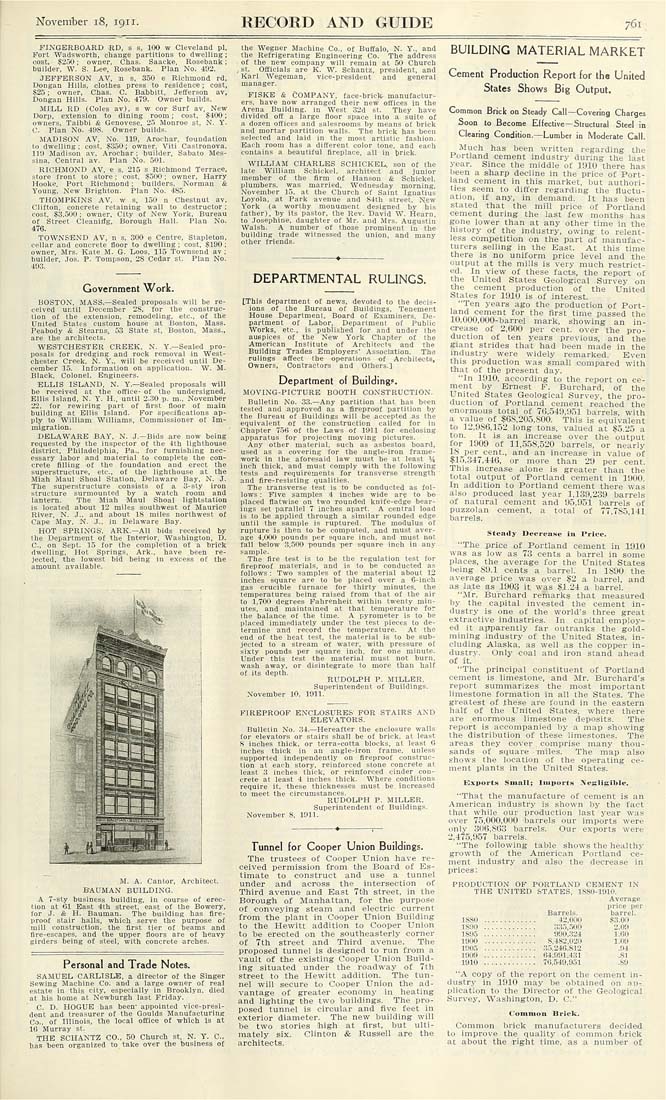
November iS, 1911. RECORD AND GUIDE 761 FINGERBOARD RD, s s, 100 w Cleveland pl. Fort Wadsworlh, change partitions lo dwelling; cost, $250; owner, Chas- Saacke, Rosebank; builder, W- S. Lee. Rosebauk. Plan No. 492. JEFFERSON AV. n s, 350 e Richmond rd, Dongan Hills, clothes press to residence; cost, $25 ; owner, Chas. C. Babbitt, Jefferson av, Dongan Hills. Plau No. 4T9- Owner builds. MILL RD (Coles av), s w cor Surf av. New Dorp, extension to dining room; cost, ,$400; owners, Taibbi St Genovese, 25 Mouroe st, N- Y- C. Plan No- 40S, Owner builds- MADISON AV, No. 119. Arochar. foundation to dwelling; cost, $350; owner. Viti Castronova, no Madisou av, Arochar; builder. Sabato Mes¬ sina, Ceutral av. Plan No. 501. RICHMOND AV. e s, 215 s Richmond Terrace, store front lo store; cost, -$-jtKI; owner, Harry Hooke, Port Ricbmond ; builders, Norman & Young, New Brighton. Plan No. 485- THOMPKINS AV. w s, 150 u Chestnut av. Clifton, concrete retaining wall to destructor; cosl, $3,500; owner. City of New York. Bureau of Sireet Cleaniilg, Borough Hall- Plan No, 476. TOWNSEND AV, n s. 300 e Centre, Staplelon, cellar aud concrete floor to dwelling; cost. ,$190; owner. Mrs, Kate M- G- Loos. 115 Townsend av ; builder, Jos- P. Torapson, 28 Cedar st. Plan No. 403. Government Work. BOSTON. MASS,—Sealed proposals will be re¬ ceived until December 28, for the construc¬ tion of the extension, remodeling, etc., of the United Slates custom house at Boston, Mass. Peabody Sc Stearns, 53 State st, Boston, Mass., are the architects- WBSTCHESTER CREEK. N. Y,—Sealed pro¬ posals for dredging aud rock removal in West¬ chester Creek. N- Y., will be received until De¬ cember 15. Information ou application. W- M. Black, Colonel, Engineers. ELLIS ISLAND, N- Y.—Sealed proposals will be received at the office- of the undersigned, Ellis Island, N. Y- H., until 2.30 p. ni., November 22, for rewiring part of first floor of main building at Ellis Island. For specifications ap¬ ply to Wiiiiam Williams. Commissioner of Im¬ migration. DELAWARE BAY. N- J.—Bids are now being requested by the inspector of the Ith lighthouse district, Philadelphia, Pa-, for furnishing nec¬ essary labor and material to complete the con¬ crete filiing of the foundation and erect the superstructure, etc., of lhe lighthouse at the Miah Maul Shoal Station, Delaware Bay, N, J, The superstructure consists of a 3-sty iron structure surmounted by a watch room and lantern. The Miah Maul Shoal lightstation is located about 12 miles southwest of Maurice River. N- J., and about IS miles northwest of Cape May, N. J-, in Delaware Bay. HOT SPRINGS', ARK.—All bids received by the Department of the Interior, Washington, D, C-, on Sept- 15 for the completion of a brick dwelling. Hot Springs. Ark., have been re¬ jected, the lowest bid heing in excess o! the amount available. M, A. Cantor. Architect, B'AUMAN BUILDING. A T-sty business building, in course of erec¬ tion at 61 East 4th street, east of the Bowery, for J. Sl H. Bauman. The building has fire¬ proof stair halls, wbich serve the purpose of mill construction, the first tier of beams and fire-escapes, and the upper floors are ot heavy girders being of steel, with concrete arches. Personal and Trade Notes. SAMUEL CARLISLE, a director of the Singer Sewing Machine Co. and a large owner of real estate in this city, especially in Brooklyn, died at his home al Newburgh last Friday. C- D. HOGUE has been" appointed vice-presi¬ dent and treasurer ot the Goulds Manufacturing Co., of Illinois, the local office of which is at 16 Murray st. THE SCHAKTZ CO., 50 Church st, N. Y. C, has been organized to take over the business of the Weguer Machine Co., of Buffalo, N, Y-. and Ihe Refrigerating Engineering Co. The address of the new company wiil remain al 50 Church , st- Officials are K- W. Schantz, president, and Karl Wegenian, vice-president and general manager. FISKE & COMPANY, face-brick manufactur¬ ers, have uow arranged tbeir new offices in the Arena Buiiding, in West 32d st. They have divided off a large lioor space into a suite of a dozen offices aud salesrooms by means of brick and mortar partition walls. The brick has been selected and laid in the most artistic fashion. Each room has a different color tone, and each contains a beautiful fireplace, all iu frick. WILLIAM CHARLES SCHICKEL, son of the late Wiiiiam Schickel, architect and junior member of the firm of Hanson Sc Schickel, plumbers, was married. Wednesday morning. November 15, al the Church of Saint Ignatius Loyola, al Park avenue and S4th street. New York (a worthy monument designed by his father), by its pastor, the Rev. David W. Hearn, to Josephine, daughter of Mr. and Mrs. Augustin Walsh. A number of those prominent in the building trade witnessed the union, and many other friends. DEPARTMENTAL RULINGS. [This department of news, devoted to the decis¬ ions of the Bureau o£ Buildings. Tenement House Department, Board of Examiners, De¬ partment of Labor, Department of Public Works, etc.. is published lor and under (he auspices of the New York Chapter of the American Inslitute of Architects and the Building Trades Employers' Association. The rulings affect the operations ot Architects, Owners, Contractors and Others.] Department o( Buildings. MOVING-PICTURE BOOTH CO.XSTRUCTION. Bulletin No. 33-—Any partition that has been tested and approved as a fireproof partition by the Bureau of Buildings will be accepted as the equivalent of the construction called for iu Chapter T56 of the Laws of 1011 tor enclosing apparatus for projecting moving pictures. Any other material, such as asbestos board, used as a covering for the angle-iron frame- 'work in the aforesaid law must be at least 'A inch thick, and must comply with the following tests and requirements for transverse strength and fire-resisting qualities. The transverse test is to be conducted as fol¬ lows : Five samples 4 inches wide are to be placed flatwise on two rounded knife-edge bear¬ ings set parallel 7 inches apart. A central load is to be applied through a similar rounded edge until Ihe sample is ruptured. The modulus ot rupture is then to be computed, and must aver¬ age 4,000 pounds per square inch, and must not fall below 3,500 pounds per square inch in any saniple- The fire test is lo be the regulation test for fireproof materials, and is to be conducted as follows : Two samples of the material about 12 inches square are to be placed over a G-inch gas crucible furnace for thirty minutes, the temperatures being raised trom that of the air to l.TOO degrees Fahrenheit within twenty min¬ utes, and maintained at that temperature for the balance ot tbe lime. A pyrometer is to be placed immediately under the test pieces to de¬ termine and record the temperature. At lhe end of the heat test, tlie material is to be sub¬ jected to a stream of water, with pressure of sixty pounds per square inch, for one minute. Under this test the material must not burn, wash away, or disintegrate to more thau half of its depth, RUDOLPH P. MILLER. Superintendent of Buildings. November 10, 1911- FIREPROOF ENCLOSURES FOR STAIRS AND ELEVATORS. Bulletin No. 34,—Hereafter the enclosure walls tor elevators or stairs shall be of brick, at least 8 inches thick, or terra-cotta blocks, at least 0 inches thick in an angle-iron frame, unless supported independently on fireproof construc¬ tion at each story, reiuforced stone concrele at least 3 inches thick, or reinforced cinder con¬ crete at least 4 inches thick- Where conditions require it. these thicknesses must be increased to meet the circumstances. RUDOLPH P. MILLER, Superintendent of Buildings. November 8, 1911. Tunnel for Cooper Union Buildings. The trustees of Cooper Union have re¬ ceived permission from the Board of Es¬ timate to construct and use a tunnel under and across the intersection of Third avenue and East Tth street, in the Borough of Manhattan, for the purpose o£ conveying steam and electric current from the plant in Cooper Union Building: to the Hewitt addition to Cooper Union to be erected on the southeasterly corner of Tth street and Third avenue. The proposed tunnel is designed to run from a vault of the existing- Cooper Union Build¬ ing situated under the roadway of Tth street to the He'witt addition- The tun¬ nel will secure to Cooper Union the ad¬ vantage of greater economy in heating and lighting the two buildings. The pro¬ posed tunnel is circular and flve feet in exterior diameter. The new building will be two stories high at first, but ulti¬ mately six, Clinton & Russell are the architects- BUILDING MATERIAL MARKET Cement Production Report for the United States Shows Big Output. Common Brick on Sieady Call—Covering Charges Soon to Become Effective—Structural Steel in Clearing Condilion.—Lumber in Moderate Call. ^luch has been written regarding the Portland cement industry during the last year. Since the middle of 1910 there has been a sharp decline in the price of Port¬ land cement in this market, but authori¬ ties seem to differ regarding the fluctu¬ ation, if any, in demand. It has been slated that the mill price of Portland cement during the last few months has gone lower than at any other time in the history of the industry, owing to relent¬ less competition on the part of manufac¬ turers selling in the East. At this time there is no uniform price level and the output at the mills is very much restrict- ecj. In view of these facts, the report of the United States Geological Survey on the cement production of the United Stales for IDltl is of interest. "Ten years ago the production of Port¬ land cement for the first time passed the 10,000,000'barrel mark, showing an in¬ crease of li,600 per cent, over the pro¬ duction of ten years previous, and the giant strides that had been made in the industry were widely remarked. Even this production was small compared with that of the present day. "In 1910, according to the report on ce¬ ment by Ernest F. Burchard, of the United States Geological Survey, the pro¬ duction of Porlland cement reached the enormous total of T6,a49,'-).ol barrels, with a value of .¥GS,20o,800. This is equivalent to 12,986,152 long tons, valued at $5.25 a ton. It is an increase over the output for 1909 of 11,558,520 barrels, or nearly 3^_per_cent-, and an increase in value of $lo,34T,446, or more than 29 per cent. This increase alone is greater than the total output of Portland cement in 1900. In addition to Portland cement there was also produced last year 1,1.S9,239 harrels of natural cemant and 95,951 barrels of puzzolan cement, a total of TT,TS5,141 barrels. Steiiily Deerease iu Prioe. "The price of Portland cement in 1910 was as low as T8 cents a barrel in some places, the average for the United States being S9-1 cents a barrel- In 1890 the average price was over S^2 a barrel, and as late as 1903 it was !|;1.24 a barrel. ' "Mr. Burchard remarks that measured by the capital invested the cement in¬ dustry is one of the world's three great extractive industries- In capital employ¬ ed it apparently far outranks the gold- mining industry of the United States, in¬ cluding Alaska, as well as the copper in¬ dustry. Only coal and iron stand ahead of it. "The principal constituent of Portland cement is limestone, and Mr. Burchard's report summarizes the most important limestone formation in all the States. The greatest of these are found in the eastern half of the Uniled States, where there are enormous limestone deposits. The report is accompanied by a map showing the distribution of these limestones- The areas they cover comprise many thou¬ sands of sciuare miles- The map also shows the location of the operating ce¬ ment plants in the Linited States- Kxport-s Suiatl; ImporLs Xejjlisible. ■"That the manufacture of cement is an American industry is shown by the fact that vi^Iiile our production last year was over To,000,000 barrels our imports were only_ 3116,86-'} barrels. Our exports were 2,47o,95T barrels- "The following table shows the healthy growth of the American Portland ce¬ ment industry and also the decrease in prices; PRODUCTION OF PORTLAND CEMENT IN THE UNITED STATES. lSSO-1910, Average price per Barrels. barrel. ISSO ............. 42,o;)0 .$3-00 1890 ............. :i:i3,mii 2.09 1895 ............. 900.324 ]-(iO 1900 ............. ,S,4S2,020 1.09 1905 ............. 35,240,812 .04 1009 ............. 04.9'n,431 .SI 1910 ............. 10,540,951 .89 "A copy of the report on the cement in¬ dustry in 1910 may be obtained on an- plication to the Director of the'Geological Survey, Washington, D. C-" ConiniuD Hrick. Common brick manufacturers decided to improve the ciuality of common iirick at about the right time, as a number of