
Columbia University Libraries Digital Collections: The Real Estate Record
Use your browser's Print function to print these pages.
Real estate record and builders' guide: [v. 89, no. 2298]: March 30, 1912
Text version:
Please note: this text may be incomplete. For more information about this OCR, view About OCR text.
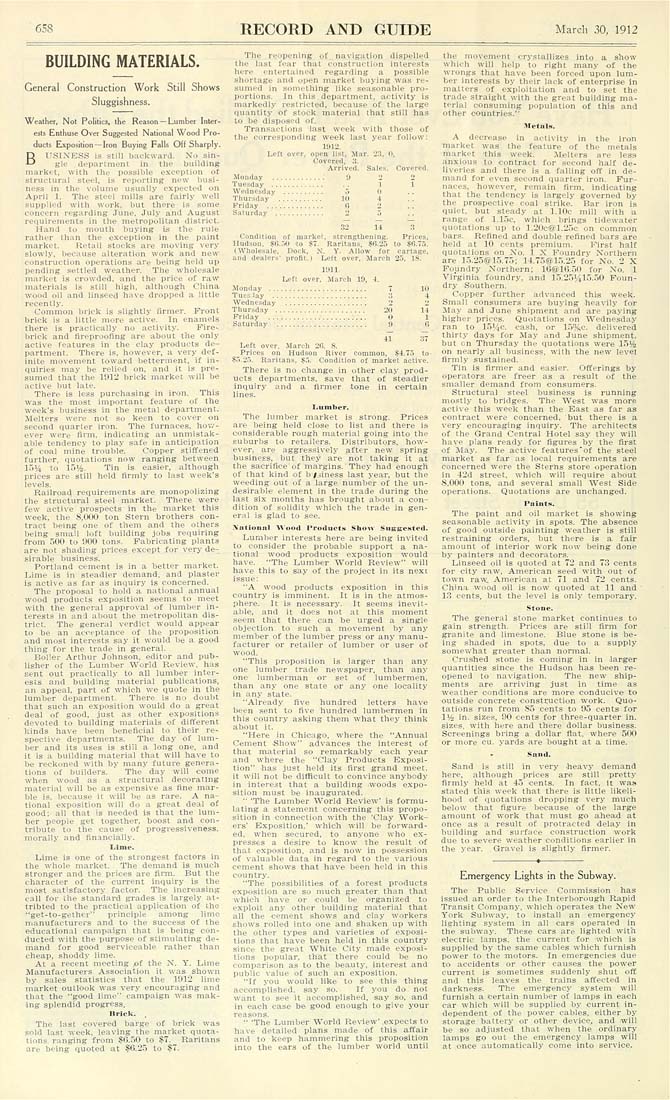
658 RECORD AND GUIDE March 30, 1912 BUILDING MATERIALS. General Construction Work Still Shows Sluggishness. Weather, Not Politics, the Reason —Lumber Inter¬ ests Enthuse Over Suggested National Wood Pro¬ ducts Exposition —Iron Buying Falls OH Sharply. D USIXESS is Still backward. No sin- ■'-' gle . deparlment in the building market, with the iiossible exception of structural sleel, is reporting new busi¬ ness in the volume usually expected on April 1. The steel mills are fairly well supplied witb work, but there is some concern regarding June, July and August requirements in the metropolitan districi. Hand to mouth buying Ik the rule ralher than the exception in tbe paint market. Retail stocks are moving very slowly, because alteration work and new construction operations are being held up pending settled weather. The wholesale market is crowded, and the price of raw materials is still higb. although China wood oil and linseed have dropped a little recently. Common brick is slightly firmer. Front brick is a little more active. In enamels there is practically no activity. Fire¬ brick and fireproofing are about the only active features in the clay products de¬ partment. There is, however, a very def¬ inite movement toward betterment, if in¬ quiries may be relied on, and it is pre¬ sumed that the 1912 brick market will be active but late. There is less purchasing in iron. This was the most importani feature of the week's business in the metal department. Melters were not so keen to cover on second quarter iron. The furnaces, hov/- ever were firm, indicating an unmistak¬ able tendency to play safe in anticipation of coal mine trouble. Copper stiffened further, quotations now ranging between 1514 to 15^. Tin is easier, although prices are stiU held firmly to last week's levels. Railroad requirements are monopolizing the structural sleel market. There were few active prospects in the market this week, the S,000 ton Stern brothers con¬ tract being one of them and the others being small loft building jobs requiring from oOO to 000 tons. Fabricating plants are not shading prices except for. very de¬ sirable business'. Portland cement is in a better market. Lime is in steadier deniand. and plaster is active as far as inquiry is concerned. The proposal to hold a national annual wood products exposition seems to meet with the general approval of lumber in¬ terests in and about tbe metropolitan dis¬ trict. Tile genera! verdict would appear to be an aci^-ptance of the proposition and most interests say it would be a good thing for the trade in general. Boiler Arthur Johnson, editor and pub¬ lisher of the Lumber World Review, has sent out practically to all lumber inter¬ ests and building material publications, an appeal, part of which we quote in the lumber department. There is no doubt that such an exposition would do a great deal of good, just as other expositions devoted to building materials of different kinds have been beneficial to tbeir re¬ spective departments. Tbe day of lum¬ ber and its uses is still a long one, and it is a building material that will have to be reckoned witb by many future genera¬ tions of builders. The day wil! come when wood as a structural decoratmg material will be as expensive as fine mar¬ ble is, because it will be as rare, A na¬ tional exposition will do a great deal of good; all that is needed is that the lum¬ ber people get together, boost and con¬ tribute to the cause of progressiveness. morally and financially. Lime. Lime is one of the strongest factors in the whole market. The deniand is much stronger and the prices are firm. But the character of the cun-ent inquiry is the most satisfactory factor. The increasing call for ihe standard grades is largely at- tribted to the practical application of the "get-to-gether" principle among lime manufacturers and to the success of the educational campaign that is being con¬ ducted with the purpose of stimulating de¬ mand for good serviceable rather than cheap, shoddy lime. At a recent meeting .of the N. Y. Lime Manufacturers Association it was shown by sales statistics that the 1012 lime market outlook was very encouraging and that the "good lime" campaign was mak¬ ing splendid progress. Rrick. The last covered barge of briek was sold last week. leaving_tbe market quota¬ tions, ranging from $6.o0 to .$7. Raritans are being quoted at $6.25 to $T. The reopening of navigation dispelled the last fear that construction interests here entertained regarding a possible shortage and open market buying was re¬ sumed in something like seasonable pro¬ portions. In this department, activity is markedly restricted, because of the large quantity of stock material that still has to be disposed of. Transactions last week with those of the corresponding week last year follow: 1912. Left over, open list, Mar. 23, 0. Covered. 3. Arrived. Sales. Covered. Monday ............; 0 2 2 Tuesday ............... 1 1 Wednesday .......... 5 IJ Thursday ........... 1(1 -1 i'Tiday .............. U 2 Salurday ............ 2 5 32 14 3 Condition of market, strengthening. Prices. Hudson. ¥tl.-"0 10 S^T. Raritans, .$(!.25 to SO.T.i. {Wliolesale, Dock, ,\. Y. Allow for cartage, and dealers' iirofit.) Left over, Marcli 25, 18. IDll. Left over, Mareh 19, 4. Monday ........................ T 10 TuesJay ....................... 3 4 Wednesday .................... 2 "J Thursday ...................... 20 14 Friday ........................ 0 1 Saturday ...................... fl G 41 31 Left over, Marcli 26, ,S. Prices on Hudson River common, $4,75 tO' -^■^■^.■>, Raritans, $.j. Condition of market active. There is no change in olher ciay prod¬ ucts departments, save that of steadier inquiry and a flrmer tone in certain lines. Liumber. The lumber market is strong. Prices are being held close to list and there is considerable rough material going into the suburbs to retailers. Distributors, how¬ ever, are aggressively after new spring business, but they are not taking it at the sacrifice of margins. They had enough of that kind of b uiness last year, but the weeding out of a iarge number of the un¬ desirable element in the trade during the last six months has brought aboul a con¬ dition of solidity which the trade in gen- oral is glad to see. >i'iitlonnl \Vooil Prodncts Shon Suggested. Lumber interests here are being invited to consider the probable support a na¬ tional wood products exposition would have. "The Lumber World Review" will have tbis to say of the project in its next issue: "A wood products exposition in this country is imminent. It is in the atmos¬ phere. It is necessary. It seems inevit¬ able, and it does not at this moment seem that there can be urged a single objection to such a movement by any member of the lumber press or any manu¬ facturer or retailer of lumber or user of wood. "This proposition is larger than any one lumber trade newspaper, than any one lumberman or set of lumbermen, than any one state or any one locality in any state. "Already five hundred letters have lieen sent lo five hundred lumbermen in tbis country asking them what they think about it. "Here in Chicago, where the "Annual Cenient Show" advances the interest of that material so remarkably each year and where the "Clay Products Exposi¬ tion" has just held its first grand meet, it wiii not be difficult to convince anybody in interest that a building .woods expo¬ sition must be inaugurated. " 'The Lumber World Review' is formu¬ lating a statement concerning this propo¬ sition in conneclion with the 'Clay Work¬ ers' Exposition.' which will be forward¬ ed, when secured, to anyone who ex¬ presses a desire to know the result of that exposition, and is now in possession of valuable data in regard to the various cement shows that have been held in this country. "The possibilities of a forest products exposition are so much greater than that which have or could be organized to exploit any other building material that all the cenient shows and clay workers sliuws rolled into one and shaken up with the other types and varieties of exposi¬ tions that have been held in this country since the great White City made exposi¬ tions popular, that there could be no comparison as to the beauty, interest and public value of such an exposition. "If you would like to see this thing accomplished, say so. If you do not want to see it accomplished, say so, and in each case be good enough to give your reasons. " 'The Lumber World Re\'iew' expects to have detailed plans made of this affair and to keep hammering this proposition into the ears of the lumber world until the movement crystallizes into a show which will help to right many of the wrongs that have been forced upon lum¬ ber interests by their lack of enterprise in matters of exploitation and to set the trade straight with the great building ma¬ terial consuming population of this and olher countries." MetalH. A decrease in activity in the iron market was the feature of the metals market this week. Metiers are less anxious to contract for second half de¬ liveries and there is a falling off in de¬ mand for even second quarter iron. Fur¬ naces, however, remain firm, indicating that the tendency is largely governed by the prospective coal strike. Bar iron is quiet, but steady at l.IOc mill with a range of 1.15c. which brings tidewater quotations up to 1.20c@1.2k>c on common bars. Refined and double refined bars are held at 10 cents premium. First half qtiotaUons on Xo. 1 X Foundrv Xorthern are lo.25@15.75; 14.7o@15.25 for No. 2 X Foundry Xorthern; 16@l(i.50 for Xo. 1 Virginia foundry, and 15.251415.50 Foun¬ dry Southern. Copper further advanced this week. Small consumers are buying heavily for May and June shipment and are paying higher prices. Quotations on Wednesday ran to 15yic. cash, or 15%c. delivered thirty days for May and June shipment, but cn Thursday the quotations were 15^^ on nearly all business, with the new level firmly sustained. Tin is firmer and easier. Otterings by operators are freer as a result of the smaller demand from consumers. Structural steel business is running mostly to bridges. The West was more active this week than the East as far as contract were concerned, but there is a very encouraging inquiry. The architects of the Grand Central Hotel say they will have plans ready for figures by the first of May. The active feaiures'of the steel market as far as local requirements are concerned were the Sterns store operation in 42d slreet. which will require about S.OOO tons, and several small West Side operations- Quotations are unchanged. Paints. The paint and oil market is showing seasonable activity in spots. The absence of good outside painting weather is still restraining orders, but there is a fair amount of interior work now being done by painters and decorators. Linseed oil is quoted at 72 and 73 cents for city raw, American seed with out of town Ta.-w. American at 71 and i2 cents. China w{iod oil is now quoted at 11 and 13 cents, but the level is only temporary. Stone. The general stone market continues to gain strength. Prices are still firm for granite and limestone. Blue stone is be¬ ing shaded in spots, due to a supply somevv'hat greater than normal. Crushed stone is coming in in larger quantities since the Hudson has been re¬ opened lo navigation. The new ship¬ ments are aiTiving just in time as weather conditions are more conducive to -outside concrete construction work. Quo¬ tations run from S5 cents to 05 cents for 1^ in. sizes, 110 cents for three-quarter in. sizes, with here and there dollar business. Screenings bring a dollar fiat, where 500 or more cu. yards are bought at a time. Snnd. Sand is still in very .heavy deniand here, although prices are still pretty firmly held at 45 cents. In fact, it waa stated this week that there is little likeli¬ hood of quotations dropping very much below that figure because of the large amount of work that must go ahea.d at once as a result of protracted delay in building and surface construction work due to severe weather conditions earlier in the year. Gravel is slightly firmer. Emergency Lights in the Subway. The Public Service Commission has issued an order to the Interborough Rapid Transit Company, which operates the X'ew York Subway, to install an emergency liglit ing system in all cars operated in the subway. These cars are lighted with electric lamps, the current for which is supplied by the same cables which furnish power to the motors. In emergencies due to accidents or other causes the power current is sometimes suddenly shut off and this leaves the trains affected in darkness. The emergency system will furnish a certain number of lamps in each car whicii will be supplied by current in¬ dependent of the power cables, either by storage battery or other device, and will be so adjusted that when the ordinarj- laiiips go out the emergency lamps will at once automatically come into service.