
Columbia University Libraries Digital Collections: The Real Estate Record
Use your browser's Print function to print these pages.
Real estate record and builders' guide: [v. 89, no. 2302]: April 27, 1912
Text version:
Please note: this text may be incomplete. For more information about this OCR, view About OCR text.
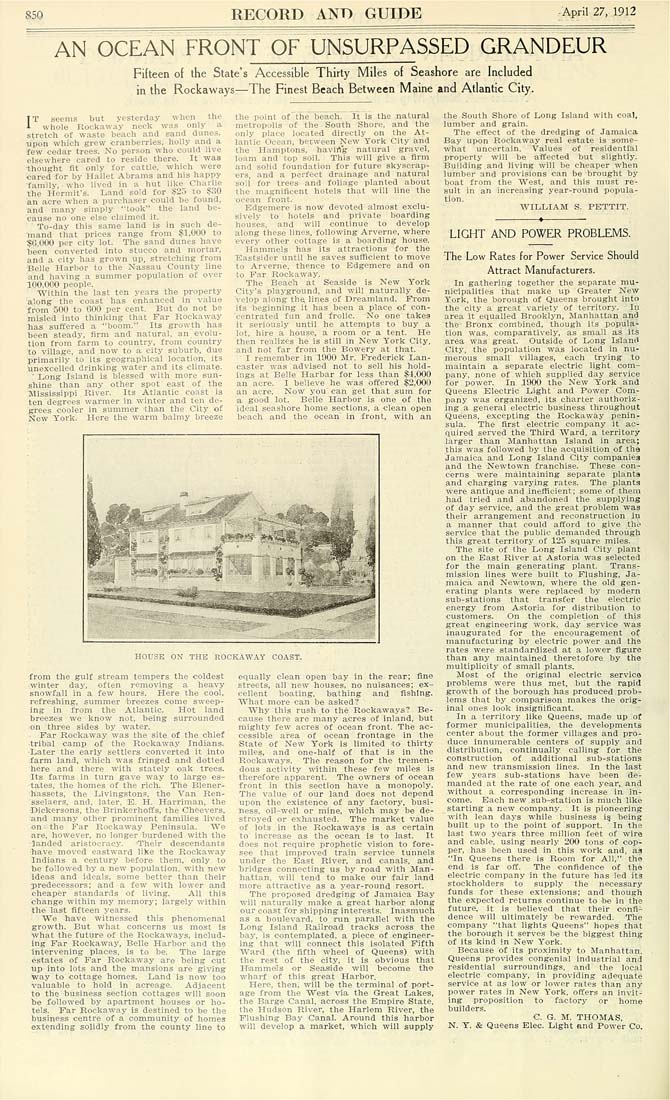
850 RECORD AND GUIDE -April 27, 1912 AN OCEAN FRONT OF UNSURPASSED GRANDEUR Fifteen of the State's Accessible Thirty Miles of Seashore are Included in the Rockaways—The Finest Beach Between Maine and Atlantic City. IT seems but yesterday when the i whole Bockaway neck was only a stretch ot waste beach and sand dunes, lipon which grew cranberries, holly and a few cedar trees. No person who could live elsewhere cared to reside there. It was thought flt only for cattle, which were cared for by Hallet Abrams and his happy ■family, ■ who lived in a hut like Charlie the Hermit's. Land sold for $2o lo $30 an acre when a purchaser could be found, and many simply "took" the land be¬ cause no one else claimed it. To-day this same land is in such de¬ mand that prices range from $1,000 to ^6,000 per city lot. The sand dunes have been converted into stucco and morlar, and a city has grown up, stretching from Belle Harbor to the Nassau Counly line and having a summer population of over 100,000 people. Within the last ten years the property along the coast has enhanced in value from 500 to 600 per cent. Eut do not be misled into thinking that Far Rockaway has suffered a "boom." Its growth has been steady, flrm and natural, an evolu¬ tion from farm to country, from country to village, and now to a city suburb, due primarily to ils geographical location, its unexcelled drinking water and its climate. ' Long Island is blessed with more sun¬ shine than any other spot east of the Mississippi River. Its Atianlic coast is ten degrees warmer in winter and ten de¬ grees cooler in summer than the City of New Tork. Here the warm balmy breeze the point of the beach. It is the natural metropolis of the South Shore, and the only place located directly on the At¬ lantic Ocean, between New York City and the Hamptons, having natural gravel, loam and top soil. This wil! give a firm and solid foundation for future skyscrap¬ ers, and a perfect drainage and natural soil for trees and foliage planted about the magnificent hotels that will line the ocean front. Edgemere is now devoted almost exclu¬ sively to hotels and private boarding houses, and will continue to develop along these lines, following Arverne, where every other cottage is a boarding house. Hammels has its attractions for the Eastsider until he saves sufRcient to move to Arverne. thence to Edgemere and on to Far Rockaway. The Beach at Seaside is New Tork City's playground, and will naturally de¬ velop along the lines of Dreamland. From its beginning it has been a place of con¬ centrated fun and frolic. No one takes it seriously unlil he attempts to buy a lot, hire a house, a room or a tent. He then realizes he is still in New Tork City, and not far from the Eowery at that. I remember in 1900 Mr. Frederick Lan¬ caster was advised not to sell his hold¬ ings at Belle Harbar for less than $4,000 an acre. I believe he was offered $2,000 an acre. Now you can gel that sum for a good lot. Belle Harbor is one of the ideal seashore home sections, a clean open boach and Ihe ocean in front, with an HOUSE ON THE ROCKA'WAY COAST. from the gulf stream tempers the coldest •winter day, often removing a heavy snowfall in a few hours. Here the cool, refreshing, summer breezes come sweep¬ ing in from the Atlantic. Hot land breezes we linow not, being surrounded on three sides by water. ■ Far Rockaway was the site of the chief ■tribal camp of the Rockaway Indians. ■Later the early settlers converted it into farm land, which was fringed and dotted here and there with stately oak trees. Its farms in turn gave way to large es¬ tates, the homes of liie rich. The Blener- hassets, the Livingstons, the Van Ren- sselaers, and, later, E. H. Harriman, the -Dickersons, the Brinkerhoffs, the Cheevers, and many other prominent families lived on the Far Rockaway Peninsula. 'We are, however, no longer burdened with the -landed aristocracy. 'Their descendants ■have moved eastward like the Rockaway Indians a century before them, only to be followed by a new population, with new idea.s and ideals, some better than their predecessors; and a few with lower and cheaper standards of living. AU this change within my memory; largely within the last fifteen years. 'We have witnessed this phenomenal growth. Eut what concerns us most is what the future of the Rockaways, includ¬ ing Far Rockaway, Belle Harbor and the intervening places, is to be. The large estates ot Far Rockaway are being cut up into lots and the mansions are giving way to cottage homes. Land is now too valuable to hold in acreage. Adjacent to the business section cottages will soon be followed by apartment houses or ho¬ tels. Far Rockaway is destined to be the business centre of a community of homes extending solidly from the county line to equally clean open bay in tlie rear; fine streets, all new houses, no nuisances; ex¬ cellent boating, bathing and fishing. What more can be asked? Why this rusli to the Rockaways? Be¬ cause there are many acres of inland, but mighty few acres of ocean front. The ac¬ cessible area ot ocean frontage in the State of New Tork is limited to thirty miles, and one-half of that is in the Rockaways. The reason for the tremen¬ dous activity within these few miles is therefore apparent. The owners of ocean front in this section have a monopoly. The value of our land does not depend upon the existence of any factory, busi¬ ness, oil-well or mine, which may be de¬ stroyed or exhausted. The market value of lots in the Rocltaways is as certain lo increase as the ocean is lo last. It does not require prophetic vision to fore¬ see that improved train service tunnels under the East River, and canals, and bridges connecting us by road with Man¬ hattan, will tend to make our fair land more attractive as a year-round resort. The proposed dredging of Jamaica Bay will naturally make a great harbor along our coast for shipping interests. Inasmuch as a boulevard, to run parallel with the Long Island Railroad tracks across the bay, is contemplated, a piece of engineer¬ ing that ^vill connect this isolated Fifth '^Vard (tbe flfth wheel of Queens) with the rest of the city, it is obvious that Hiammels or Seaside w^ill become the wharf of this greal Harbor. Here, then, will be the terminal of port¬ age from the West via the Great Lakes, the Barge Canal, across the Empire State, the Hudson River, the iE-Iarlem River, the Flushing Eay Canal. Around this harbor will develop a market, which will supply the Soulh Shore of Long Island with coal, lumber and grain. The effect of the dredging of Jamaica Eay upon Rockaway real eslate is some¬ what uncertain. "Values of residential property will be affected but slightly. Building and living will be cheaper when lumber and provisions can be brought by boat from tbe "West, and this must re¬ sult in an increasing year-round popula¬ tion, WILLIAM S. PETTIT, LIGHT AND POWER PROBLEMS. The Low Rates for Power Service Should Attract Manufacturers. In gathering together the separate mu¬ nicipalities that make up Greater New York, the borough of Queens brought into the city a great variety of territory. In area it equalled Brooklyn, Manhattan and the Bronx combined, though its popula¬ tion was, comparatively, as small as its area was great. Outside of Long Island Cily, the population was located in nu¬ merous small villages, each trying lo maintain a separate electric light com¬ pany, none of which supplied day service tor power. In 1900 the New Tork and Queens Electric Light and Power Com¬ pany was organized, its charter authoriz¬ ing a general electric business throughout Queens, excepting the Rockaway penin¬ sula. The first electric company it ac¬ quired served the Third Ward, a territory larger than Manhattan Island in area; this was followed by the acquisition of tha Jamaica and Long Island City companies and the Newtown franchise. These con¬ cerns were maintaining separate plants and charging varying rales. The plants were antique and inefficient; some ot them had tried and abandoned the supplying of day service, and the great problem was their arrangement and reconstruction in a manner that could afford to give the service that the public demanded through this great territory of 12-5 square miles. The site of the Long Island Cily plant on the East River al Asioria was selected for the main generating plant. Trans¬ mission lines were built to Flushing, Ja- .maica and Newtown, where the old gen¬ erating plants were replaced by modern sub-stations that transfer the electric energy from Astoria tor distribution to customers. On the completion ot this great engineering work, day service was inaugurated for the encouragement of manufacturing by eleclric power and the rates were standardized at a lower figure than any maintained theretofore by the multiplicity of small plants. Most of the original electric service problems were thus met, but the rapid growth of the borough has produced prob¬ lems that by comparison makes the orig¬ inal ones look insignificant. In a territory like Queens, made up of former municipalities, the developments center about the former villages and pro¬ duce innumerable centers of supply and distribution, continually calling for the construction of additional sub-stations and new transmission lines. In the last few years sub-stations have been de¬ manded at the rale of one each year,, and without a corresponding increase in in¬ come. Each new sub-station is much like starting a new company. Il is pioneering with lean days while business ig being built up to the point of support. In the last two years three million feet of wire and cable, using nearly 2(X) tons of cop¬ per, has been used in this work and, aa "In Queens there is Room for All," the end is far offi. The confidence of the electric company in the future has led its stockholders to supply the necessary funds for these extensions; and though the expected returns continue to be in the future, it is believed that their confi¬ dence will ultimately be rewarded. The company "that lights Queens" hopes that the borough it serves be the biggest thing of its kind in New Tork. Because of its proximity to Manhattan. Queens provides congenial industrial and residential surroundings, and the local electric company, in providing adequate service at as low or lower rales than any power rates in New York, offers an invit¬ ing proposition to faclory or home builders. ■C. G. M. THOMAS, N. T. & Queens Elec. Light and Power Co.