
Columbia University Libraries Digital Collections: The Real Estate Record
Use your browser's Print function to print these pages.
Real estate record and builders' guide: [v. 89, no. 2302]: April 27, 1912
Text version:
Please note: this text may be incomplete. For more information about this OCR, view About OCR text.
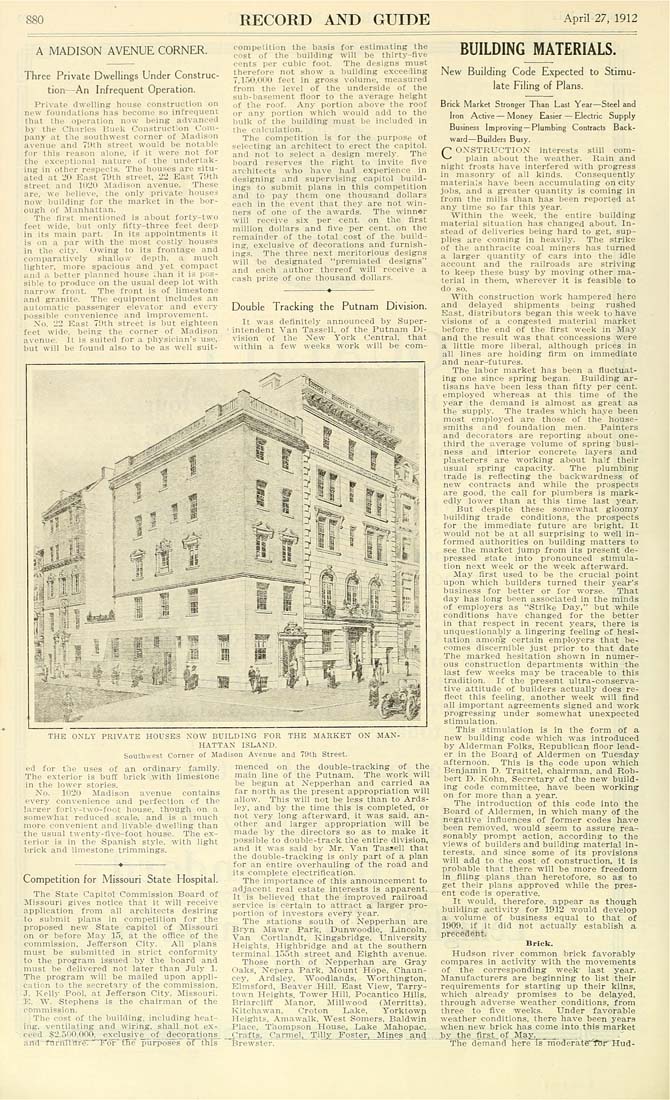
S80 RECORD AND GUIDE April 27, 1912 A MADISON AVENUE CORNER. Three Private Dwellings Under Construc¬ tion—An Infrequent Operation. Private dwelling house construction on new foundations has become so infrequent that the operation now being advanced by the Charies Buek Construction Com¬ pany at the southwest corner of Madison avenue and 7!>th street would be notable for this reason alone, if il were not for the exceptional nature of the undertak¬ ing in other respects. The houses are situ¬ ated al •20 East Tilth street, 2^2 East Tilth street and 1l»20 Madison avenue. These are. we believe, ihe only private houses now building for the market in the bor¬ ough of Jlanhattan. The first mentioned is about forty-two feet wide, but only fifty-three feet deep in its main part. In its appointments it is on a par with the most costly houses in the cily. Owing to its frontage and comparatively shallow depth, a much lighter, more spacious and yet compact and a bctior planned house ;han it is pos¬ sible lo produce on the usual deep lot wilh narrow front. The front is of limestone and granite. The equipment includes an automatic passenger elevator and every p.issible convenience and improvement. Xo, ■2'2 East Tilth streel is but eighteen feet wide, being the corner of Madison avenue. It is suited for a physician's use, hut will be found also to be as well suit- competition the basis for estimating the cost of the huilding will be thirty-five cents per cubic foot. The designs must therefore not show a building exceeding 7,l.")0,tMtO feet in gross volume, measured from the level of the underside of the sub-basement floor to the average height of the roof. Any porlion above the roof or any portion which would add to the bulk of the building must be included in the calculation. The competition is for the purpose ot selecting an architect to erect the capitol. and nol to select a design merely. The board reserves the right lo invite five architects who have had experience in designing and supervising capitol build¬ ings to submit plans in this competition and lo pay them one thousand dollars each in the event that they are not win¬ ners of one of the awards. The winner will receive six per cent, on the first million dollars and five per cent, on the remainder of the total cost of the build¬ ing, exclusive of decorations and furnish¬ ings. The three next meritorious designs will be designated "premiated designs" and each author thereof will receive a cash prize of one thousand dollars. BUILDING MATERIALS. Double Tracking the Putnam Division. It was definitely announced by Super¬ intendent Van Tassell. of the Putnam Di¬ vision of the New York Central, that within a few weehs work will be com- THE ONLY PRIVATE HOUSES XOW BUILDING FOR THE MARKET ON MAX- HATTAX ISLAXD, Southwest Corner of Madison Avenue and TSth Street. ed for t'le uses of an ordinary family. The exterior is buff brick with limestone in the lower stories. No. 1020 Madison avenue contains every convenience and perfection of the larger fnrty-two-fnot house, though on a somewhat reduced scale, and is a much more convenient and livable dwelling than the usual twenty-hve-foot house. The ex¬ terior is in the Spanish style, with light brick and limestone trimmings. Competition for Missouri State Hospital. The Slate Capitol Commission Board of Missouri gives notice that it will receive application from all architects desiring to submit plans in competition for the proposed new State capitol of Missouri on or before May 15, at the ofiice of the commission, Jefferson City. All plajis must be submitted in strict conformity to the program issued by the board and must be delivered not later than July 1. The program will be mailed upon appli¬ cation to the secretary of the commission. J. Kelly Pool, at Jefferson City, Missouri. R. W. Stephens is the chairman of the commission. The cost of the building, including heat- menced on the double-tracking of the main Une of the Putnam. The work will be begun at Nepperhan and carried aa far north as the present appropriation will allow. This will not be less than to Ards¬ ley, and by the time this is completed, ot not very long afterward, it was said, an¬ other and larger appropriation will be made by the directors so as to make it possible to double-track the entire division, and it was said by Mr. Van Tassell that the double-tracking is only part of a plan for an entire overhauling of the road and its complete electrification. The importance of this announcement to adjacent real estate interests is apparent. It is believed that the improved railroad service is certain lo attract a larger pro¬ portion of investors ever\- year. The stations south of Nepperhan are Bryn Mawr Park, Dunwoodie, Lincoln, Van Cortlandl, Kingsbridge, University Heights. Highbridge and at the southern terminal l-'ioth street and Eighth avenue. Those north of Nepperhan ase Gray Oaks, Nepera Park, Mount Hope, Chaun¬ cey, Ardsley, Woodlands, Worthington. Elmsford, Beaver Hill, Bast View, Tarry¬ town Heights, Tower Hill, Pocantico Hills. Briarcliff Manor, Millwood (Merrills). Kitchawan. Croton Lake, Yorktowp Heights, Amawalk, West Somers, Baldwin Place. Thompson House, Lake Mahopac, ing. ventilating and wiring, shall not ex¬ ceed $2,500,000, exclusiye__of decorations ^Crafts, Carmel, Tilly Foster, Mines and and-ftirnnttr~e. ""TTor'Oie purposes" of this Brewster. New Building Code Expected to Stimu¬ late Filing of Plans. Brick Market Stronger Than Last Year—Steel and Iron Active— Money Easier — Electric Supply Business Improving—Plumbing Conliacls Back¬ ward—Builders Busy. CONSTRUCTION interests still com¬ plain about the weather. Rain and night frosts have interfered with progress in masonry of all kinds. Conseciuently materials have been accumulating on city jobs, and a greater quantity is coming in from the mills than has been reported al any lime so far this year. Within the week, the entire building material situation has changed aboul. In¬ stead of deliveries being hard to get, sup¬ plies are coming in heavily. The strike of the anthracite coal miners has turned a larger ciuantity of cars into the idle account and the railroads are striving lo keep these busy by moving other ma¬ terial in them, wherever it is feasible to do so. With consiruction work hampered here and delayed shipments being rushed East, distributors began this week to have visions of a congested maierial market before the end of the first week in May and the result was that concessions were a little more liberal, although prices in all lines are holding firm on immediate and near-futures. The labor market has been a fluctuat¬ ing one since spring began. Building ar¬ tisans have been less than fifty per cent, employed whereas at this time of the year the demand is almost as great as the supply. The trades which haye been most eniploj-ed are those of the house- smiths and foundation men. Painters and decorators are reporting about one- third the average volume of spring busi¬ ness and interior concrete layers and plasterers are working about half their usual spring capacity. The plumbing trade is reflecting the backwardness of new contracts and while the prospects are good, the call for plumbers is mark¬ edly lower than at this time last year. But despite these soniewhat gloomy liLiilding trade conditions, the prospects for the immediate future are bright. It would not be at all surprising to well in¬ formed authorities on building matters to see the markel Jump from ils present de¬ pressed stale into pronounced stimula¬ tion next week or the week afterward. May first used to be the crucial point upon which builders turned their year's business for better or for worse. That day has long heen associated in the minds of employers as "Strike Day," but while conditions have changed for the better in that respect in recent years, there is unqueslionablj' a lingering feeling of hesi¬ tation among certain employers that be¬ comes discernible just prior lo that date The marked hesitation shown in numer¬ ous construction departments within the last few weeks may be traceable to this tradition. If the present ultra-conserva¬ tive attitude of builders actually does re¬ flect this feeling, another week will flnd all important agreements signed and work progressing under somewhat unexpected stimulation. This stimulation is in the form of a new building code Tvhich -was introduced by Alderman Polks, Republican floor lead¬ er in the Board of Aldermen on Tuesday afternoon. This is the code upon which Benjamin D. Traittel, chairman, and Rob- bert D. Kohn, Secretary of the new build¬ ing code committee, have been working on for more than a year. The introduction of this code into the Board of Aldermen, in which many of the negative influences of former codes have been renloved, would seem to assure rea¬ sonably prompt action, according to the views of builders and building material in¬ terests, and since some of its provisions will add to the cost of construction, it is probable that there will be more freedom in flling plans than heretofore, so as to get their plans approved while the pres¬ ent code is operative. It would, therefore, appear as though building activity for 1912 would develop a volume of business equal to that of 1909, if it did not actually establish a precedent. Brick, Hudson river common brick favorably compares in activity with the movements of the corresponding week last year. Manufacturers are beginning to list their requirements for starting up their kilns, which already promises to be delayed, through adverse weather conditions, from three to five weeks- Under favorable weather conditions, there have been years when new brick has come into this market bv the first of May.^ ___ The demand here is moi3erate"^r" Hud-