
Columbia University Libraries Digital Collections: The Real Estate Record
Use your browser's Print function to print these pages.
Real estate record and builders' guide: [v. 90, no. 2321]: September 7, 1912
Text version:
Please note: this text may be incomplete. For more information about this OCR, view About OCR text.
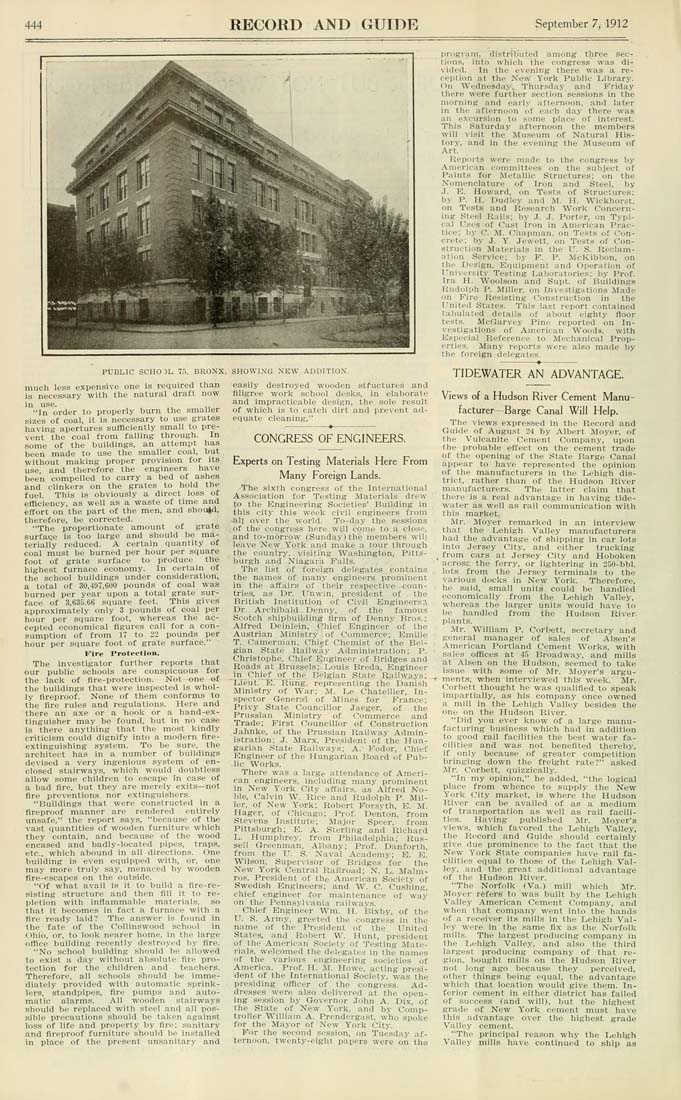
444 RECORD AND GUIDE September 7,- 1912 PUBLIC SCHOOL 73. BRONX, SHOWING NEW ADDITION. much less expensive one is required than is necessary with the natural draft now in use. ,, ,, "In order to properly burn the smaller sizes of coal, it is necessary to use grates having apertures sufficiently small to pre¬ vent the coal from falling through. In some of the buildings, an attempt has been made to use the smaller coal, but. without making proper provision for its use, and therefore the engineers have been compelled to carry a bed of ashes and clinkers on the grates to hold the fuel. This is obviously a direct loss of efficiency, as well as a waste of time and effort on the part of the men, and should, therefore, be corrected. "The proportionate amount of grate surfaqe is too large and should be ma¬ terially reduced. A certain quantity of coal must be burned per hour per square foot of grate surface to produce the highest furnace economy. In certain of the school buildings under consideration, a total of 30,497,600 pounds of coal was burned per year upon a total grate sur¬ face of 3,635.66 square feet. This gives approximately only 3 pounds of coal per hour per square foot, whereas the ac¬ cepted economical flgures call for a con¬ sumption of from 17 to 22 pounds per hour per square foot of grate surface." Flre Protection. The investigator further reports that our public schools are conspicuous for the lack of fire-protection. Not one of the buildings that were inspected is whol¬ ly flreproof. None of them conforms to the fire rules and regulations. Here and there an axe or a hook or a hand-ex¬ tinguisher may be found, but in no case is there anything that the most kindly criticism could dignify into a modern fire- extinguishing system. To be sure, the architect has in a number of buildings devised a very ingenious system of en¬ closed stairways, which would doubtless allow some children to escape in case of a bad fire, but they are merely exits—not fire preventions nor extinguishers. "Buildings that were constructed in a fireproof manner are rendered entirely unsafe," the report says, "because of the vast quantities of wooden furniture which they contain, and because of the wood encased and badly-located pipes, traps, etc., which abound in all directions. One building is even equipped with, or, one may more truly say, menaced by wooden fire-escapes on the outside. "Of what avail is it to build a fire-re¬ sisting structure and then fill it to re¬ pletion with inflammable materials, so that it becomes in fact a furnace with a flre ready laid? The answer is found in the fate of the Collinswood school in Ohio, or, to look nearer home, in the large offlce building recently destroyed by fire. "No school building should be allowed to exist a day without absolute fire pro¬ tection for the children and teachers. Therefore, all schools should be imme¬ diately provided with automatic sprink¬ lers, standpipes, flre pumps and auto¬ matic alarms, AU wooden stairways should be replaced with steel and all pos¬ sible precautions should be taken against loss of life and property by fire; sanitary and fireproof furniture should be installed in place of the present unsanitary and easily destroyed wooden stfuctures and filigree work school desks, in elaborate and impracticable design, the sole result of which is to catch dirt and prevent ad¬ equate cleaning," --------------*-------------- CONGRESS OF ENGINEERS. Experts on Testing Materials Here From Many Foreign Lands. •The sixth congress of the International Association for Testing Materials drew to the Engineering Societies' Building in this city this week civil engineers from -all over the worid. Torday the sessions .of the congress here .will come to a close, and to-morrow (Sunday) the members will leave New,York and make a tour through the country,. visiting Washington, Pitts¬ burgh and'Niagara Falls. The list of foreign delegates contains the names of inany engineers prominent in the affairs of their respective -coun¬ tries, as Dr. Unwin, president of the British Institution of Civil Engineers ;\ Dr. Archibald Denny, of the famous Scotch shipbuilding firm of Denny Bros.; Alfred Deinlein, Chief Engineer of the Austrian Ministry ! of Commerce; Emilie T, Camerman, Chiff Chemist of the Bel¬ gian State Railway Administration; P. Christophe, Chief Engineer of Bridges and Rokds at Briissels;'.Louis Breda, Engineer in Chief of the Belgian State Railways; ■'Lieut.'~E.' Riiiig, representing the Danish Ministry of War; M. Le Chatellier, In¬ spector General of Mines for France; Privy State Councillor Jaeger, of the Prussian Ministry of Commerce and Trade; First Councillor of Construction Jahnke, of the Prussian Railway Admin¬ istration; J. Marx, President of the Hun¬ garian State Railways; A. Fodor, Chief Engineer of the Hungarian Board of Pub¬ lic Works. There was a large attendance of Ameri¬ can engineers, including many prominent in New York City affairs, as Alfred No¬ ble, Calvin W. Rice and Rudolph P. Mil¬ ler, of New York; Robert Forsyth, E. M. Hager, of Chicago; Prof. Denton, from Stevens Institute; Major Speer, from Pittsburgh; E. A. Sterling and Richard L. Humphrey, from Philadelphia; Rus¬ sell Greenman, Albany; Prof. Danforth, from the U. S. Naval Academy; E. E. Wilson, Supervisor of Bridges for the New York Central Railroad; N, L. Malm- ros. President of the American Society of Swedish Engineers; and W. C. Gushing, chief engineer for maintenance of way on the Pennsylvania railways. Chief Engineer Wm. H. Bixby, of the U. S. Army, greeted the congress in the name of the President of the United States, and Robert W. Hunt, president of the American Society of Testing Mate¬ rials, welcomed the delegates in the names of the various engineering societies of America, Prof. H, M. Howe, acting presi¬ dent of the International Society, was the presiding officer of the congress. Ad¬ dresses were also delivered at the open¬ ing session .by Governor John A. Dix, of the State of New York, and by Comp¬ troller William A. Prendergast, who spoke for the Mayor of New York City. For the second session, on Tuesday af¬ ternoon, twenty-eight papers were on the program, distributed among three sec¬ tions, into which the congress was di¬ vided. In the evening there was a re¬ ception at the New York Public Library. On Wednesday,. Thursday, and Friday there were further section sessions in the morning and early afternoon, and later in the afternoon of each day there was an excursion to some place of interest. This Saturday afternoon the members will visit the Museum of Natural His¬ tory, and in the evening the Museum of Art. Reports were made to the congress by .American committees on the subject of Paints for Metallic Structures; on the Nomenclature of Iron and Steel, by J. B. Howard, on Tests of Structures: by P. H. Dudley and M. H. Wickhorst, on Tests and Research Work Concern¬ ing Steel Rails; by J. J. Porter, on Typi¬ cal Uses of Cast Iron in American Prac¬ tice; by C. M. Chapman, on Tests of Con¬ crete; by J. Y. Jewett, on Tests of Con¬ struction Materials in the U. S. Reclam¬ ation Service; by F. P. McKibbon, on the Design, Equipment and Operation ot University Testing Laboratories; by Prof. Ira H. Woolson and Supt. of Buildings Rudolph P. Miller, on Investigations Made on Fire Resisting Construction in the United States. This last report contained tabulated details of about eighty floor tests. McGarvey Pine reported on In¬ vestigations of American Woods, with Especial Reference to Mechanical Prop¬ erties. Many reports were also made by the foreign delegates. ----------------♦---------------- TIDEWATER AN ADVANTAGE. Views of a Hudson River Cement Manu¬ facturer—Barge Canal Will Help, The views expressed in the Record and Guide of August 24 by Albert Moyer, of the Vulcanite Cement Company, upon the probable effect on the cement trade Of the opening of the State Barge Canal appear to have represented the opinion of the manufacturers in the Lehigh dis¬ trict, rather than of the Hudson River manufacturers. The latter claim that there is a real advantage in having tide¬ water as well as rail communication with this market. Mr. Moyer remarked in an interview that the Lehigh Valley manufacturers had the advantage of shipping in car lots into Jersey City, and either trucking , from cars at Jersey City and Hoboken across the ferry, or lightering in 250-bbl. lots from the Jersey terminals to the various docks in New York. Therefore, he said, small units could be handled economically from the Lehigh Valley, whereas the larger units would have to be handled froni the Hudson River, plants. Mr. William P. Corbett, secretary and general manager of sales of Alsen's American Portland Cement Works, with sales offlces at 45 Broadway, and mills at Alsen on the Hudson, seemed to take issue with some of Mr. Moyer's argu¬ ments; wh^n interviewed this week. Mr. Corbett thought he was qualified to speak impartially, as his company once owned a mill in the Lehigh Valley besides the one on the Hudson River. "Did you ever know of a large manu¬ facturing business which had in addition to good rail facilities the best water fa¬ cilities and was not benefited thereby, if only because of greater competition bringing down the freight rate?" asked Mr. Corbett, quizzically. "In my opinion," he added, "the logical place from whence to supply the New York City market, is where the Hudson River can be availed of as a medium of transportation as well as rail facili¬ ties. Having published Mr. Meyer's views, which favored the Lehigh Valley, the Record and Guide should certainly give due prominence to the fact that the New York State companies have rail fa¬ cilities equal to those of the Lehigh Val¬ ley, and the great additional advantage of the Hudson River, "The Norfolk (Va.) mill which Mr. Moyer refers to was built by the Lehigh Valley American Cement Company, and when that company went into the hands of a receiver its mills in the Lehigh Val¬ ley were in the same fix as the Norfolk mills. The largest producing company in the Lehigh Valley, and also the third largest producing company of that re¬ gion, bought mills on the Hudson River not long ago because they perceived, other things being equal, the advantage which that location would give them. In¬ ferior cement in either district has failed of success (and will), but the highest grade of New York cement must have this advantage over the highest grade Valley cement, "The principal reason why the Lehigh Valley mills have continued to ship as