
Columbia University Libraries Digital Collections: The Real Estate Record
Use your browser's Print function to print these pages.
Real estate record and builders' guide: v. 90, no. 2337: December 28, 1912
Text version:
Please note: this text may be incomplete. For more information about this OCR, view About OCR text.
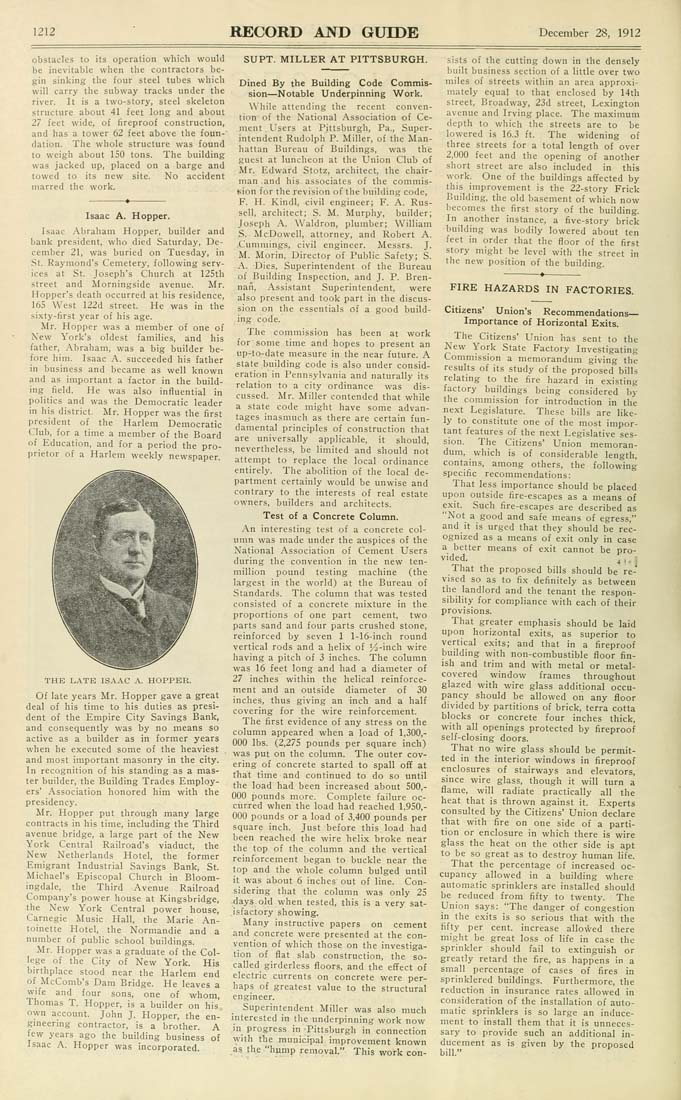
1212 RECORD AJSD GUIDE December 28, 1912 obstacles to its operation which would be inevitable when the contractors be¬ gin sinking the four steel tubes which will carry the subway tracks under the river. It is a two-story, steel skeleton structure about 41 feet long and about 27 feet wide, of fireproof construction, and has a tower 62 feet above the foun-' dation. The whole structure was found to weigh about ISO tons. The building was jacked up, placed on a barge and towed to its new site. No accident marred the work. Isaac A. Hopper. Isaac Abraham Hopper, builder and bank president, who died Saturday, De¬ cember 21, was buried on Tuesday, in St. Raymond's Cemetery, following serv¬ ices at St. Joseph's Church at 12Sth street and Morningside avenue. Mr. Hopper's death occurred at his residence, 165 West 122d street. He was in the sixty-first year of his age. Mr. Hopper was a member of one of New York's oldest families, and his father, Abraham, was a big builder be¬ fore him. Isaac A. succeeded his father in business and became as well known and as important a factor in the build¬ ing field. He was also influential in politics and was the Democratic leader in his district. Mr. Hopper was the first president of the Harlem Democratic Club, for a time a member of the Board of Education, and for a period the pro¬ prietor of a Harlem weekly newspaper. THE LATE ISAAC A. HOPPER. Of late years Mr. Hopper gave a great deal of his time to his duties as presi¬ dent of the Empire City Savings Bank, and consequently was by no means so active as a builder as in former years when he executed some of the heaviest and most important masonry in the city. In recognition of his standing as a mas¬ ter builder, the Building Trades Employ¬ ers' Association honored him with the presidency. Mr. Hopper put through many large contracts in his time, including the Third avenue bridge, a large part of the New York Central Railroad's viaduct, the New Netherlands Hotel, the former Emigrant Industrial Savings Bank, St. Michael's Episcopal Church in Bloom¬ ingdale, the Third Avenue Railroad Company's power house at Kingsbridge, the New York Central power house, Carnegie Music Hall, the Marie An¬ toinette Hotel, the Normandie and a number of public school buildings. Mr. Hopper was a graduate of the Col¬ lege of the City of New York. His birthplace stood near the Harlem end of McComb's Dam Bridge. He leaves a wife and four sons, one of whom, Thomas T. Hopper, is a builder on his. own account. John J. Hopper, the en¬ gineering contractor, is a brother. A few years ago the building business of Isaac A. Hopper was incorporated. SUPT. MILLER AT PITTSBURGH. Dined By the Building Code Commis¬ sion—Notable Underpinning Work. While attending the recent conven¬ tion of the National Association of Ce¬ ment.Users at Pittsburgh, Pa., Super¬ intendent Rudolph P. Miller, of the Man¬ hattan Bureau of Buildings, was the guest at luncheon at the Union Club of Mr. Edward Stotz, architect, the chair¬ man .and his associates of the commis¬ sion for the revilsion of the building code, F. H. Kindl, civil engineer; F. A. Rus¬ sell, architect; S. M. Murphy, builder; Joseph A. Waldron, plumber; William S. McDowell, attorney, and Robert A. .Cummings, civil engineer. Messrs. J. M. Morin, Director of Public Safety; S. A. Dies, Superintendent of the Bureau of Building Inspection, and J. P. Bren¬ nan, Assistant Superintendent, were also present and took part in the discus¬ sion on the essentials of a good build¬ ing code. The commission has been at work for'some time and hopes to present an up-to-date measure in the near future. A state building code is also under consid¬ eration in Pennsylvania and naturally its relation to a city ordinance was dis¬ cussed. Mr. Miller contended that while a state code might have some advan¬ tages inasmuch as there are certain fun¬ damental principles of construction that are universally applicable, it should, nevertheless, be limited and should not attempt to replace the local ordinance entirely. The abolition of the local de¬ partment certainly would be unwise and contrary to the interests of real estate owners, builders and architects. Test of a Concrete Column. An interesting test of a concrete col¬ umn was made under the auspices of the National Association of Cement Users during the convention in the new ten- million pound testing machine (the largest in the world) at the Bureau of Standards. The column that was tested consisted of a concrete mixture in the proportions of one part cement, two parts sand and four parts crushed stone, reinforced by seven 1 1-16-incb round vertical rods and a helix of j4-inch wire having a pitch of 3 inches. The column was 16 feet long and had a diameter of 27 inches within the helical reinforce¬ ment and an outside diameter of 30 inches, thus giving an inch and a half covering for the wire reinforcement. The first evidence of any stress on the column appeared when a load of 1,300,- 000 lbs. (2,275 pounds per square inch) was put on the column. The outer cov¬ ering of concrete started to spall oflE at that time and continued to do so until the load had been increased about 500,- 000 pounds more. Complete failure oc- ciirj-ed when the load had reached 1,950,- 000 pounds or a load of 3,400 pounds per square inch. Just before this load had been reached the wire helix broke near the top of the column and the vertical reinforcement began to buckle near the top and the whole column bulged until it was about 6 inches' out of line. Con¬ sidering that the column was only 25 •days.old when tested, this is a very sat- .isfactory showing. Many instructive papers on cement and concrete were presented at the con¬ vention of which those on the investiga¬ tion of flat slab construction, the so- called girderless floors, and the eflfect of electric currents on concrete were per¬ haps of greatest value to the structural engineer. Superintendent Miller was also much interested in the underpinning work now in progress in Pittsburgh in connection ■with the municipal-improvement known as the "hump removal." This work con¬ sists of the cutting down in the densely built business section of a little over two miles of streets within an area approxi¬ mately equal to that enclosed by 14th street, Broadway, 23d street, Lexington avenue and Irving place. The maximum depth to which the streets are to be lowered is 16.3 ft. The widening of three streets for a total length of over 2,000 feet and the opening of another short street are also included in this work. One of the buildings aflfected by this improvement is the 22-story Frick Building, the old basement of which now becomes the first story of the building. In another instance, a five-story brick building was bodily lowered about ten feet in order that the floor of the first story might be level with the street in the new position of the building. FIRE HAZARDS IN FACTORIES. Citizens' Union's Recommendations- Importance of Horizontal Exits. The Citizens' Union has sent to the New York State Factory Investigating Commission a memorandum giving the results of its study of the proposed bills relating to the fire hazard in existing factory buildings being considered by the commission for introduction in the next Legislature. These bills are like¬ ly to constitute one of the most impor¬ tant features of the next Legislative ses¬ sion. The Citizens' Union memoran¬ dum, which is of considerable length, contains, among others, the following specific recommendations: That less importance should be placed upon outside fire-escapes as a means of exit. Such fire-escapes are described as "Not a good and safe means of egress," and it is urged that they should be rec¬ ognized as a means of exit only in case a better means of exit cannot be pro¬ vided. ^,,^ That the proposed bills should be re¬ vised so as to fix definitely as between the landlord and the tenant the respon¬ sibility for compliance with each of their provisions. That greater emphasis should be laid upon horizontal exits, as superior to vertical exits; and that in a fireproof building with non-combustible floor fin¬ ish and trim and with metal or metal- covered window frames throughout glazed with wire glass additional occu- paiicy should be allowed oii any floor divided by partitions of brick, terra cotta blocks or concrete four inches thick, with all openings protected by fireproof self-closing doors. That no wire glass should be permit¬ ted in the interior windows in fireproof enclosures of stairways and elevators, since wire glass, though it will turn a flame, will radiate practically all the heat that is thrown against it. Experts consulted by the Citizens' Union declare that with fire on one side of a parti¬ tion or enclosure in which there is wire glass the heat on the other side is apt to be so great as to destroy human life. That the percentage of increased oc¬ cupancy allowed in a building where automatic sprinklers are installed should be reduced from fifty to twenty. The Union says: "The danger of congestion in the exits is so serious that with the fifty per cent, increase allowed there might be great loss of life in case the sprinkler should fail to extinguish or greatly retard the fire, as happens in a small percentage of cases of fires in sprinklered buildings. Furthermore, the reduction in insurance rates allowed in consideration of the installation of auto¬ matic sprinklers is so large an induce¬ ment to install them that it is unneces¬ sary to provide such an additional in¬ ducement as is given by the proposed bill."