
Columbia University Libraries Digital Collections: The Real Estate Record
Use your browser's Print function to print these pages.
Real estate record and builders' guide: [v. 91, no. 2345]: February 22, 1913
Text version:
Please note: this text may be incomplete. For more information about this OCR, view About OCR text.
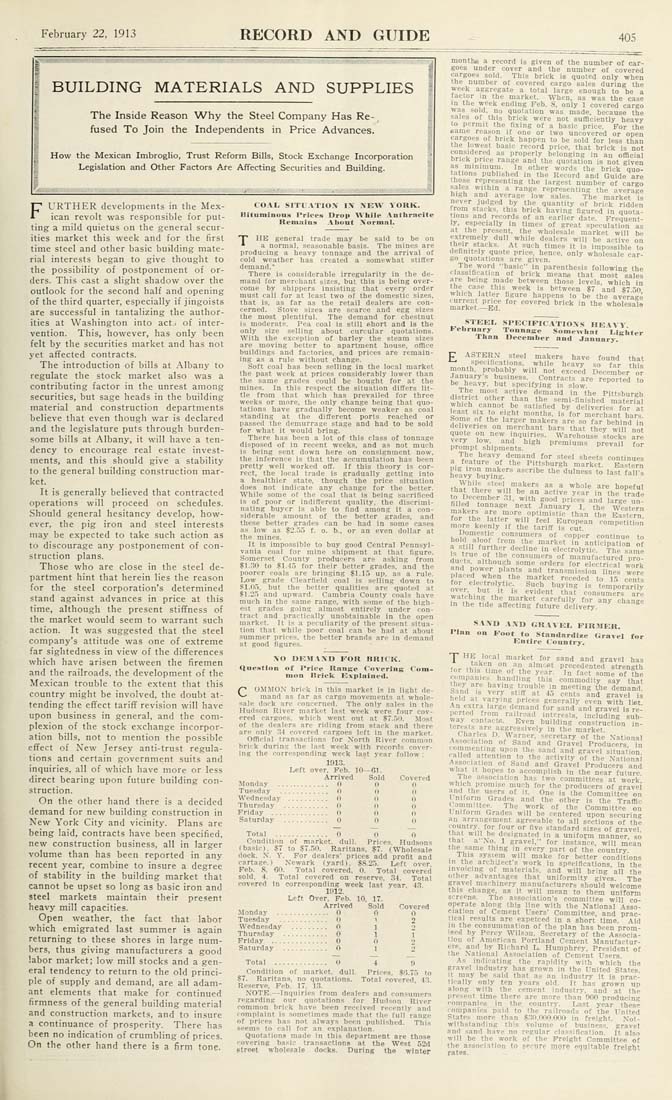
February 22, 1913 RECORD AND GUIDE 405 i ^.b.iiilpi^lJUr.iiifJyUiJKi'dniVi'Mi BUILDING MATERIALS AND SUPPLIES The Inside Reason \Vhy the Steel Company Has Re¬ fused To Join the Independents in Price Advances. How the Mexican Imbroglio, Trust Reform Bills, Stock Exchange Incorporation Legislation and Other Factors Are Affecting Securities and Building. FURTHER developnicnts in the Mex¬ ican revolt was responsible for put¬ ting a mild quietus on the general secur¬ ities market this week and for the first time steel and other basic building mate¬ rial interests began to give thought to the possibility of postponement of or¬ ders. This cast a slight shadow over the outlook for the second half and opening of the third quarter, especially if jingoists are successful in tantalizing the author¬ ities at Washington into act^ of inter¬ vention. This, however, has only been felt by the securities market and has not yet affected contracts. The introduction of bills at .Albany to regulate the stock market also was a contributing factor in the unrest among securities, but sage heads in the building material and construction departments believe that even though war is declared and the legislature puts through burden¬ some bills at Albany, it will have a ten¬ dency to encourage real estate invest¬ ments, and this should give a stability to the general building construction mar¬ ket. It is generally believed that contracted operations will proceed on schedules. Should general hesitancy develop, how¬ ever, the pig iron and steel interests may be expected to take such action as to discourage any postponement of con¬ struction plans. Those who are close in the steel de¬ partment hint that herein lies the reason for the steel corporation's determined stand against advances in price at this time, although the present stiffness of the market would seem to warrant such action. It was suggested that the steel company's attitude was one of extreme far sightedness in view of the differences which have arisen between the firemen and the railroads, the development of the Mexican trouble to the extent that this country might be involved, the doubt at¬ tending the effect tariff revision will have upon business in general, and the com¬ plexion of the stock exchange incorpor¬ ation bills, not to mention the possible effect of New Jersey anti-trust regula¬ tions and certain government suits and inquiries, all of which have more or less direct bearing upon future building con¬ struction. On the other hand there is a decided demand for new building construction in New York City and vicinity. Plans are being laid, contracts have been specified, new construction business, all in larger volume than has been reported in any recent year, combine to insure a degree of stability in the building market that cannot be upset so long as basic iron and steel markets maintain their present heavy mill capacities. Open weather, the fact that labor which emigrated last summer is again returning to these shores in large num¬ bers, thus giving manufacturers a good labor market; low mill stocks and a gen¬ eral tendency to return to the old princi¬ ple of supply and demand, are all adam¬ ant elements that make for continued firmness of the general building material and construction markets, and to insure a continuance of prosperity. There has been no indication of crumbling of prices. On the other hand there is a firm tone. COAL SlTl.VTION IX .\EAV YORK. llituminou.s Prices Drop AVIiile .\nt1irncite Reniuin.s .\l>out \ornial. T HE general trade may be said to be on * a normal, seasonable basis. The mines are producing a heavy tonnage and the arrival of cold weather has created a somewhat stiffer demand.' There is considerable irregularity in the de¬ mand for merchant sizes, but this is being over¬ come by shippers insisting that every order must call for at least two of the domestic sizes, that is, as far as the retail dealers are con¬ cerned. Stove sizes are scarce and egg sizes the most plentiful. The demand for chestnut is moderate. Pea coal is still ehort and Is the only size selling about curcular quotations. With the exception of barley the steam sizes Lire moving better to apartment house, office buildings and factories, and prices are remain¬ ing as a rule without change. Soft coal has been selling in the local market the past week at prices considerably lower than the same grades could be bought for at the mines. In this respect the situation differs lit¬ tle from that which has prevailed for three weeks or more, the only change being that quo¬ tations have gradually become weaker as coal standing at the different ports reached or passed the demurrage stage and had to be sold for what it would bring. There has been a lot of this class of tonnage disposed of in recent weeks, and as not much is being sent down here on consignment now. the inference is that the accumulation has been pretty well worked off. If this theory is cor¬ rect, the local trade is gradually getting into a healthier state, though the price situation does not indicate any change for the better. While some of the coal that is being sacrificed is of poor or indifferent quality, the discrimi¬ nating buyer is able to find among it a con¬ siderable amount of the better grades, and these better grades can be had in some cases as low as .$2..')5 f. o. b., or an even dollar at the mines. It is impossible to buy good Central Pennsyl¬ vania coal for mine shipment at that figure. Somerset County producers are asking from $l.:iO to .$1.4.j for their better grades, and the poorer coals are bringing $1.15 up, as a rule. Low grade Clearfield coal is selling down to SI.05. but the better qualities are quoted at $1.2."> and upward. Cambria County coals have much in the same range, with some of the high¬ est grades going almost entirely under con¬ tract and practically unobtainable in the open market. It is a peculiarity of the present situa¬ tion that while poor coal can be had at about summer prices, the better brands are in demand at good figures. NO DEM.VND FOR BRICK. Question of Price Range Coverlns Com¬ mon Brick Explained. /"■ OMMO.N' brick in this market is in light de- ^-' mand as far as cargo movements at whole¬ sale (lock are concerned. The only sales in the Hudson River market last week were four cov¬ ered cargoes, which went out at ^7.50. Most of the dealers are riding from stack and there are only 34 covered cargoes left in the market. Offlciai transactions for North River common hrick during the last week with records cover¬ ing the corresponding week last year follow : 1913. Left over. Feb. 10—61. Arrived Sold Covered Monday ............. 0 (I (i Tuesday ............ n i) o Wednesday .......... 0 (i o Thursday ........... (i 0 n Friday .............. 0 o o Saturday ........... 0 o o Total ............. 0 0 0 Condition of market, dull. Prices. Hudsons (basic). .$7 to $7.50. Raritans, $7. (Wholesale dock. X. V. For dealers' prices add profit and cartage.) Newark (yard). $8.2.5. Left over. Feb. 8. GO. Total covered. 0. Total covered sold. 4. Total covered on reserve. ,34. Total covered In corresponding week last year 43 1912. Lett Over, Feb. 10, 17. Arrived Sold Covered Monday ............. 0 0 0 Tuesday ............ 0 i 2 Wednesday ......... 0 1 2 Thursday ........... 0 1 7 Friday .............. 0 0 2 Saturday ........... 0 i -j Total ............. 0 4 n Condition of market, dull. Prices. .$0.7.5 to .?7. Raritans. no quotations. Total covered, 43. Reserve. Feb. 17. 13. NOTE.—Inquiries from dealers and consumers regarding our quotations for Hudson River common brick have been received recently and complaint is sometimes made that the full range of prices has not always been published. This seems to call for an explanation. Quotations made in this department are those covering basic transactions at the West 52d street wholesale docks. During the winter months a record is given of the number of car¬ goes under cover and the number of covered cargoes sold. This brick is quoted only when the number of covered cargo sales during the week aggregate a total large enough to be a factor m the market. When, as was the case in the week ending Feb. S, only 1 covered cargo was sold, no quotation was made, because the sales of this brick were not sufficiently heavy to permit the fixing of a basic price. For the eame reason it one or two uncovered or open cargoes of brick happen to be sold for less than the lowest basic record price, that brick Is not considered as properly belonging in an offlciai brick price range and the quotation is not given as minimum. In other words the brick quo- ations published in the Record and Guide are those representing the largest number ot cargo sales within a range representing the average high and average low sales. The market is neier judged by the quantity of brick ridden from stacks, this brick having figured in quota- ions and records ot an earlier date. Frequent¬ ly, especially in times ot great speculation as at the present, the wholesale market will be extremely dull while dealers will be active on their stacks. At such times it is impossible to definitely quote price, hence, only wholesale car¬ go quotations are given. The word •■basic" in parenthesis following the classification of brick means that most sales are being made between those levels, which in the case this week is between $7 and $7 oO which latter figure happens to be the average m^aTket-^Ed'' ™^^'"-'""on i,niii°°=?^il^ consumers of copper continue to a s?ill f^fr.h ■''°; 'r'' ■?'*'"''''' ■° anticipation of a still further decline in electrolytic. The same ducts"', uio'""/"""""'"'^ °' manufactured pro¬ ducts, although some orders for electrical work and power plants and transmission lines were Placed when the market receded to 15 c^nts for electrolytic. Such buying is temnorarilv °j:,\i^^\,}' '' i"^'"™' "'at consumers aie watcdiing the market carefully for any change in the tide affecting future delivery. SAND AND GRAVEL FIR.MER. Plan on Foot to Standardize Gravel for Entire Country. Y HE local market for sand and gravel has fnr ihL ,° "" j^\ almost precedented strength for this time of the year. In fact some of the cc.mpanie., handling this commodity say that they are having trouble in meeting the demand. Sand IS very stiff at 45 cents ?nd gravel is held at varying prices generally even with list -An extra large demand for sand and gravel is re¬ ported from railroad interests, including sub¬ way contacts. Even building construction in¬ terests are aggressively in the market. tharles D. Warner, secretary ot the Xational -Association of Sand and Gravel Producers in cX"rt'' = t',"^t"'"'". "'.I ='■■""' """^ S-'a^'?' situation, (ailed attention to the activity of the .National Association of Sand and Gravel Producers and what It hopes to accomplish in the near future The association has two committees at work' which promise much for the producers of gravel anti the users of it. One is the Committee on 1 niform Grades and the other is the Traffic Committee. The work of the Committee on Initorm Grades will be centered upon securing an arrangement agreeable to all sections of the (ountr.v for four or five standard sizes ot gravel hat will be designated in a uniform manner, so that a -.W 1 gravel,■• for instance, will mean the same thing in every part of the country. This system will make for better conditions In the archaecfs work in specifications. In the invoicing ot materials, and will bring all the other advantages that uniformity gives The gravel machinery manufacturers should welcome this change, as it will mean to them uniform screens. The association's committee will co¬ operate along this line with the National Asso¬ ciation of Cement Users' Committee, and prac¬ tical results are expetced in a short time. Aid in the consummation of the plan has been prom¬ ised by Percy Wilson. Secretary of the Associa¬ tion of American Portland Cement Manufactur¬ ers, aud by Richard L. Humphrey, President ot the -National Association of Cement Users As indicating the rapidity with which the gravel industry has grown in the United States It may he said that as an industry it is prac¬ tically only ten years old. It has grown up along with the cement industrv. and at the present time there are more than 900 producing companies in the country. Last year these companies paid to the railroads of the United States more than $.30,000,000 in freight. Not¬ withstanding this volume of business, gravel and sand have no regular classification. It also will be the work of the Freight Committee of the association to fccure rriQre equitable freight rates.