
Columbia University Libraries Digital Collections: The Real Estate Record
Use your browser's Print function to print these pages.
Real estate record and builders' guide: [v. 91, no. 2346]: March 1, 1913
Text version:
Please note: this text may be incomplete. For more information about this OCR, view About OCR text.
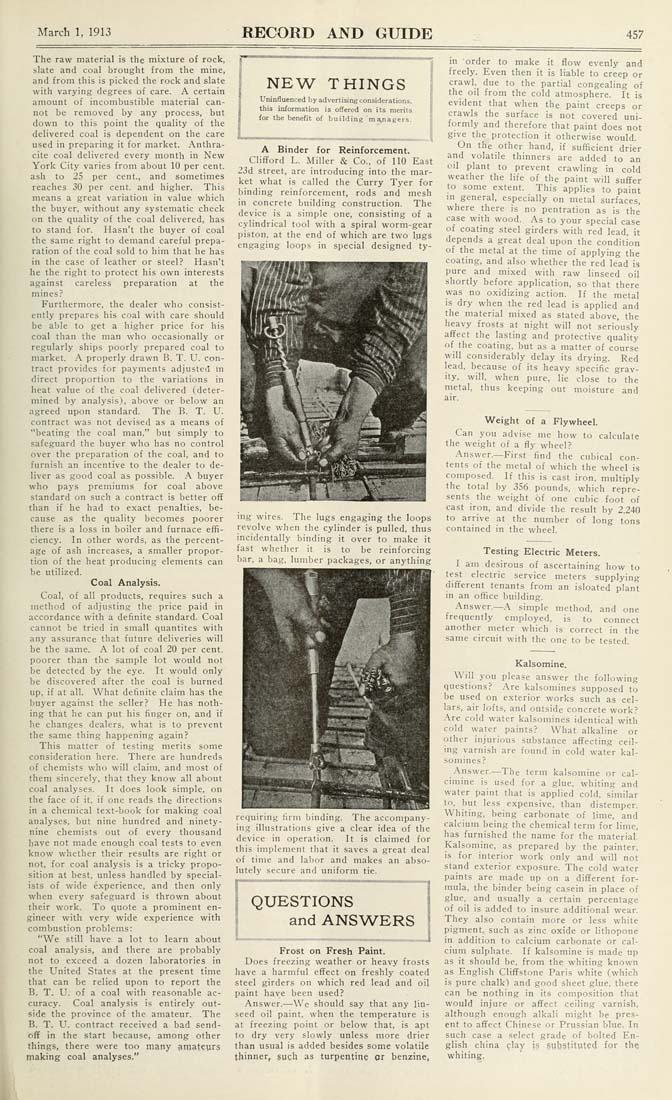
March 1, 1913 RECORD AND GUIDE 457 i The raw material is the mixture of rock, slate and coal brought from the mine, and from this is picked the rock and slate with varying degrees of care. A certain amount of incombustible material can¬ not be removed by any process, but down to this point the quality of the delivered coal is dependent on the care used in preparing it for market. Anthra¬ cite coal delivered every month in New York City varies from about 10 per cent, ash to 25 per cent., and sometimes reaches 30 per cent, and higher. This means a great variation in value which the buyer, without any systematic check on the quality of the coal delivered, has to stand for. Hasn't the buyer of coal the same right to demand careful prepa¬ ration of the coal sold to him that he has in the case of leather or steel? Hasn't he the right to protect his own interests against careless preparation at the mines? Furthermore, the dealer who consist¬ ently prepares his coal with care should be able to get a higher price for his coal than the man who occasionally or regularly ships poorly prepared coal to market. A properly drawn B. T. U. con¬ tract provides for payments adjusteu in direct proportion to the variations in heat value of the coal delivered (deter¬ mined by analysis), above or below an agreed upon standard. The B. T. U. contract was not devised as a means of "beating the coal man," but simply to safeguard the buyer who has no control over the preparation of the coal, and to furnish an incentive to the dealer to de¬ liver as good coal as possible. A buyer who pays premiums for coal above standard on such a contract is better off than if he had to exact penalties, be¬ cause as the quality becomes poorer there is a loss in boiler and furnace effi¬ ciency. In other words, as the percent¬ age of ash increases, a smaller propor¬ tion of the heat producing elements can be utilized. Coal Analysis. Coal, of all products, requires such a method of adjusting the price paid in accordance with a definite standard. Coal cannot be tried in small quantites with any assurance that future deliveries will be the same. A lot of coal 20 per cent, poorer than the sample lot would not be detected by the eye. It would only be discovered after the coal is burned up, if at all. What definite claim has the buyer against the seller? He has noth¬ ing that he can put his finger on, and if he changes dealers, what is to prevent the same thing happening again? This matter of testing" merits some consideration here. There are hundreds of chemists who will claim, and most of them sincerely, that they know all about coal analyses. It does look simple, on the face of it, if one reads the directions in a chemical text-book for making coal analyses, but nine hundred and ninety- nine chemists out of every thousand have not made enough coal tests to even know whether their results are right or not, for coal analysis is a tricky propo¬ sition at best, unless handled by special¬ ists of wide experience, and then only when every safeguard is thrown about their work. To quote a prominent en¬ gineer with very wide experience with combustion problems: "We still have a lot to learn about coal analysis, and there are probably not to exceed a dozen laboratories in the United States at the present time that can be relied upon to report the B. T. U. of a coal with reasonable ac¬ curacy. Coal analysis is entirely out¬ side the province of the amateur. The B. T. U. contract received a bad send- off in the start because, among other things, there were too many amateurs making coal analyses." ■iiiniiinjiiiiiiiiiiimrniiiiiiiiriniinTtiiiiiiiiiiiiniiiiiirriF iiinnmiiiiiunirriMiii I NEW THINGS I Uninfluenced by advertising considerations, j this information is offered on its merits I for the benefit of building ■ma,nagers. jlllMllirUlUllllllIlltUllllllltlllllllllUUIIIIiltlllliniJJEIIHIIllUIIIIUlJtIIIIIUIIIIIIIIIIIIIIlllllllllirllllllllJinilllllllLMIIUIIIIlElllJIIIllllllliiiii...........I, = A Binder for Reinforcement. Clifford L. Miller & Co., of 110 East 23d street, are introducing into the mar¬ ket what is called the Curry Tyer for binding reinforcement, rods and mesh in concrete building construction. The device is a simple one, consisting of a cylindrical tool with a spiral worm-gear piston, at the end of which are two lugs cnsa^ing loops in special designed ty¬ ing wire.,. The lugi engaging the loops revolve when the cylinder is pulled, thus incidentally binding it over to make it fast whether it is to be reinforcing bar, a bag, lumber packages, or anything requiring firm binding. The accompany¬ ing illustrations give a clear idea of the device in operation. It is claimed for this implement that it saves a great deal of time and labor and makes an abso¬ lutely secure and uniform tie. giiiiiKnniiiiiJii.....u.....umiiuiiiiniiigMunnin.....lui......iiiru.....uiiiiiiii»uiiuiMiiiniuniiiiwiiiiuiiiuiuiuiiuuiiiiiiuiiiuijiiuiiiiiiiuiiiiiiuiiiiiiiiiiiiiN.....juiniuia I I I QUESTIONS I i and ANSWERS I 'iiiMiiiiiiiiiiiiiiiiniiiiiii I'lUNiriiiiilu.....inttiiiiiiiiiuiiiiNt......iiitiiiiiu.......m.....iii[iiiiiiiiuliiliiniiiiiiiiiiMiiiJ.......miriiiiS Frost on Fresh Paint. Does freezing weather or heavy frosts have a harmful effect on freshly coated steel girders on which red lead and oil paint have been used? Answer.—We should say that any lin¬ seed oil paint, when the temperature is at freezing point or below that, is apt to dry very slowly unless more drier than usual is added besides some volatile thinner, such as turpentine or benzine, in order to make it flow evenly and freely. Even then it is liable to creep or crawl, due to the partial congealing of the oil from the cold atmosphere. It is evident that when the paint creeps or crawls the surface is not covered uni¬ formly and therefore that paint does not give the protection it otherwise would. On the other hand, if sufficient drier and volatile thinners are added to an oil plant to prevent crawling in cold weather the life of the paint will suffer to some extent. This applies to paint in general, especially on metal surfaces, where there is no pentration as is the case with wood. As to your special case of coating steel girders with red lead, it depends a great deal upon the condition of the metal at the time of applying the coating, and also whether the red lead is pure and mi.xed with raw linseed oil shortly before application, so that there was no oxidizing action. If the metal is dry when the red lead is applied and the material mixed as stated above, the heavy frosts at night will not seriously affect the lasting and protective quality of the coating, but as a matter of course will considerably delay its drying. Red lead, because of its heavy specific grav¬ ity, will, when pure, lie close to the metal, thus keeping out moisture and air. Weight of a Flywheel. Can you advise me liow to calculate the weight of a fly wheel? Answer.—First find the cubical con¬ tents of the metal of which the wheel is composed. If this is cast iron, multiply the total by 356 pounds, which repre¬ sents the weight of one cubic foot of cast iron, and divide the result by 2,240 to arrive at the number of long tons contained in the wheel. Testing Electric Meters. I am desirous of ascertaining how to test electric service meters supplying different tenants from an isloated plant in an office building. Answer.—,\ simple method, and one frequently employed, is to connect another meter which is correct in the same circuit with the one to be tested. Kalsomine. Will you please answer llie following questions? Are kalsomines supposed to be used on exterior works such as cel¬ lars, air lofts, and outside concrete work? Are cold water kalsomines identical with cold water paints? What alkaline or other injurious substance affecting ceil¬ ing varnish are found in cold water kal¬ somines? Answer.—The term kalsomine or cal¬ cimine is used for a glue, whiting and water paint that is applied cold, similar to, but less expensive, than distemper. Whiting, being carbonate of lime, and calcium being the chemical term for lime, has furnished the name for the material. Kalsomine, as prepared by the painter, is for interior work only and will not stand exterior exposure. The cold water paints are made up on a different for¬ mula, the binder being casein in place of glue, and usually a certain percentage of oil is added to insure additional wear. They also contain more or less white pigment, such as zinc oxide or lithopone in addition to calcium carbonate or cal¬ cium sulphate. If kalsomine is made up as it should be, from the whiting known as English Cliffstone Paris white (which is pure chalk) and good sheet glue, there can be nothing in its composition that would injure or affect ceiling varnish, although enough alkali might be pres¬ ent to affect Chinese or Prussian blue. In such case a select grade of bolted En¬ glish china clay js §ub§tituted for the whiting.