
Columbia University Libraries Digital Collections: The Real Estate Record
Use your browser's Print function to print these pages.
Real estate record and builders' guide: [v. 92, no. 2365]: July 12, 1913
Text version:
Please note: this text may be incomplete. For more information about this OCR, view About OCR text.
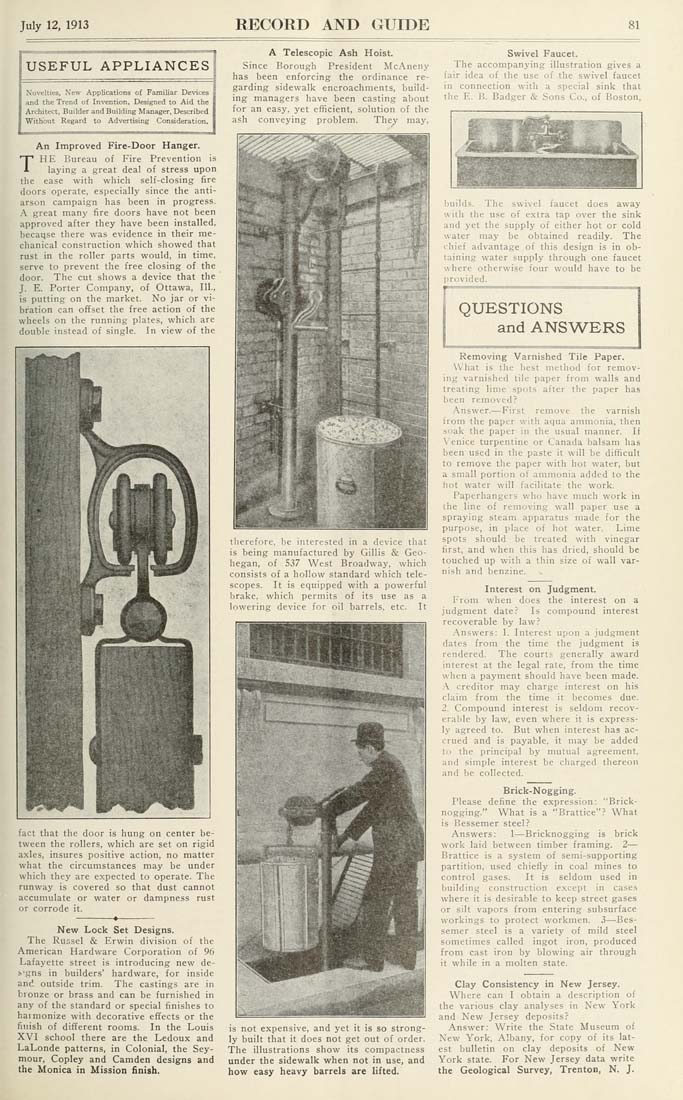
July 12, 1913 RECORD AND GUIDE 81 ("limiiEmmciBijminn I USEFUL appliances! Novelties. New Applications of FamiHar Devices | and the Trend of Invention. Designed to Aid the Architect, Builder and Building Manager, Described Without Regard to Advertising Consideration. An Improved Fire-Door Hanger. THE Bureau of Fire Prevention is laying a great deal of stress upon the ease with which self-closing fire doors operate, especially since the anti- arson campaign has been in progress. A great many fire doors have not been approved after they have been installed, becat4se there was evidence in their me¬ chanical construction which showed that rust in the roller parts would, in time, serve to prevent the free closing of the door. The cut shows a device that the J. E. Porter Company, of Ottawa, III., is putting on the market. No jar or vi¬ bration can offset the free action of the wheels on the running plates, which are double instead of single. In view of the fact that the door is hung on center be¬ tween the rollers, which are set on rigid axles, insures positive action, no matter what the circumstances may be under which they are expected to operate. The runway is covered so that dust cannot accumulate or water or dampness rust or corrode it. New Lock Set Designs. The RuGsel & Erwin division of the American Hardware Corporation of 96 Lafayette street is introducing new de- i-'gns in builders' hardware, for inside and outside trim. The castings are in bronze or brass and can be furnished in any of the standard or special finishes to haimonize with decorative effects or the finish of different rooms. In the Louis XVI school there are the Ledoux and LaLonde patterns, in Colonial, the Sey¬ mour, Copley and Camden designs and the Monica in Mission finish. A Telescopic Ash Hoist. Since Borough President McAneny has been enforcing the ordinance re¬ garding sidewalk encroachments, build¬ ing managers have been casting about for an easy, yet efficient, solution of the ash conveying problem. They may. tlierefore, be interested in a device that is being manufactured by Gillis & Geo- hegan, of 537 West Broadway, which consists of a hollow standard which tele¬ scopes. It is equipped with a powerful brake, which permits of its use as a lowering device for oi! barrels, etc. It is not expensive, and yet it is so strong¬ ly built that it does not get out of order. The illustrations show its compactness under the sidewalk when not in use, and how easy heavy barrels are lifted. Swivel Faucet. The accompanying illustration gives a lair idea of the use of the swivel faucet in connection with a special sink that the E. B. Badger & Sons Co., of Boston, builds. The swivel faucet does away with the use of extra tap over the sink and yet the supply of either hot or cold water may be obtained readily. The chief advantage of this design is in ob¬ taining water supply through one faucet where otherwise four would have to be provided. iiuiiuiwwiuuiii uuimniiuimg QUESTIONS and ANSWERS Removing Varnished Tile Paper. What is the best method for remov¬ ing varnished tile paper from walls and treating lime spots after the paper has been removed? .Answer.—First remove the varnish from the paper with aqua ammonia, then soak the paper in the usual manner. If Venice turpentine or Canada balsam has been used in the paste it will be difficult to remove the paper with hot water, but a small portion of ammonia added to the hot water will facilitate the work. Paperhangers who have much work in the line of removing wall paper use a spraying steam apparatus made for the purpose, in place of hot water. Lime spots should be treated with vinegar first, and when this has dried, should be touched up with a thin size of wall var¬ nish and benzine. Interest on Judgment. From when does the interest on a judgment date? Is compound interest recoverable by law? -■\nswers: 1. Interest upon a judgment dates from the time the judgment is rendered. The courts generally award interest at the legal rate, from the time when a payment should have been made. -\ creditor may charge interest on his claim from the time it becomes due. 2. Compound interest is seldom recov¬ erable by law, even where it is express¬ ly agreed to. But when interest has ac¬ crued and is payable, it may be added tn the principal by mutual agreement, aud simple interest be charged thereon and be collected. Brick-Nogging. Please define the expression: "Brick- nogging." What is a "Brattice"? What is Bessemer steel? Answers: 1—Bricknogging is brick work laid between timber framing. 2— Brattice is a system of semi-supporting partition, used chiefly in coal mines to control gases. It is seldom used in building construction except in cases where it is desirable to keep street gases or silt vapors from entering subsurface workings to protect workmen. 3—Bes¬ semer steel is a variety of mild steel sometimes called ingot iron, produced from cast iron by blowing air through it while in a molten state. Clay Consistency in New Jersey. Where can I obtain a description of the various clay analyses in New York and New Jersey deposits? Answer: Write the State Museum of New York, Albany, for copy of its lat¬ est bulletin on clay deposits of New York state. For New Jersey data write the Geological Survey, Trenton, N. J.