
Columbia University Libraries Digital Collections: The Real Estate Record
Use your browser's Print function to print these pages.
Real estate record and builders' guide: [v. 92, no. 2375]: September 20, 1913
Text version:
Please note: this text may be incomplete. For more information about this OCR, view About OCR text.
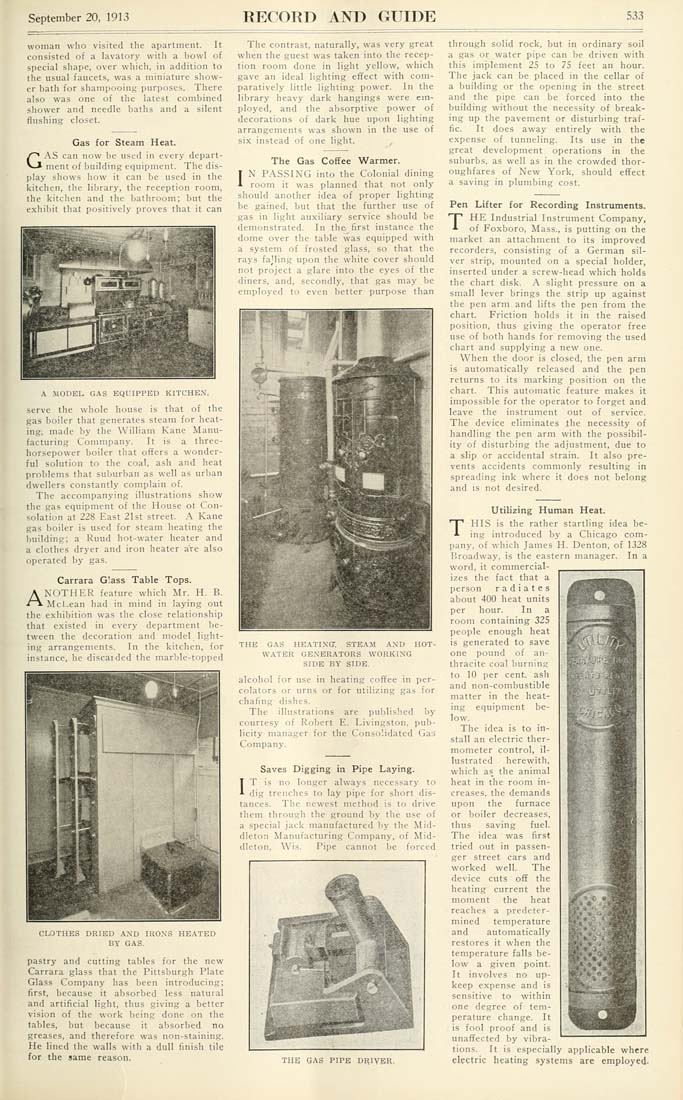
September 20, 1913 RECORD AND GUIDE 533 woman who visited the apartment. It consisted of a lavatory with a bowl of special shape, over which, in addition to the usual faucets, was a miniature show¬ er bath for shampooing purposes. There also was one of the latest combined shower and needle baths and a silent flushing closet. Gas for Steam Heat. GAS can now be used in every depart¬ ment of building equipment. The dis¬ play shows how it can be used in the kitchen, the library, the reception room, the kitchen and the bathroom; but the exhibit that positively proves that it can A MODEL GAS EQUIPPED KITCHEN. serve the whole house is that of the gas boiler that generates steam for heat¬ ing, made by the William Kane Manu¬ facturing Commpany. It is a three- horsepower boiler that offers a wonder¬ ful solution to the coal, ash and heat problems that suburban as well as urban dwellers constantly complain of. The accompanying illustrations show the gas equipment of the House ot Con¬ solation at 228 East 21st street. .A Kane gas boiler is used for steam heating the building; a Ruud hot-water heater and a clothes dryer and iron heater are also operated by gas. Carrara Glass Table Tops. ANOTHER feature which Mr. H. B. Mct^ean had in mind in laying out the exhibition was the close relationship that existed in every department be¬ tween the decoration and model light¬ ing arrangements. In the kitchen, for instance, he discaided the marble-topped CLOTHES DRIED A.\D lUO.XS HEATED BY GAS. pastry and cutting tables for the new Carrara glass that the Pittsburgh Plate Glass Company has been introducing; first, because it absorbed less natural and artificial light, thus giving a better vision of the work being done on the tables, but because it absorbed no greases, and therefore was non-staining. He lined the walls with a dull finish tile for the same reason. The contrast, naturally, was very great when the guest was taken into the recep¬ tion room done in light yellow, which gave an ideal lighting effect with com¬ paratively little lighting power. In the library heavy dark hangings were cm- ployed, and the absorptive power of decorations of dark hue upon lighting arrangements was shown in the use of si.x instead of one light. The Gas Coffee Warmer. I N PASSING into the Colonial dining 1 room it was planned that not only should another idea of proper lighting be gained, but that the further use of gas in light auxiliary service should be demonstrated. In the first instance the dome over the table was equipped with a system of frosted glass, so that the rays fajling upon the white cover should not project a glare into the eyes of the diners, and, secondly, that gas may be employed to even better purpose than THE GAS HEATING. STEA.M AND HOT- ■ft'ATER GENERATORS WORKING SIDE BY SIDE. alcohol for use in heating coffee in per¬ colators or urns or for utilizing gas for chafin.g dishes. The illustrations are published by courtesy of Robert E. Livingston, pub¬ licity mana.ger for the Consolidated Gas Company. Saves Digging in Pipe Laying. IT is no longer always necessary to dig trenches to lay pipe for short dis¬ tances. Thc newest method is to drive them throu.gh the ground by the use of a special jack manufactured by the Mid¬ dleton Manufacturing Company, of Mid¬ dleton. Wis. Pipe cannot be forced through solid rock, but in ordinary soil a gas or water pipe can be driven with this implement 25 to 75 feet an hour. The jack can be placed in the cellar of a building or the opening in the street and the pipe can be forced into the building without the necessity of break¬ ing up the pavement or disturbing traf¬ fic. It does away entirely with the expense of tunneling. Its use in the great development operations in the suburbs, as well as in the crowded thor¬ oughfares of New York, should effect a saving in plumbing cost. Pen Lifter for Recording Instruments. "T" HE Industrial Instrument Company, •*• of Foxboro, Mass., is putting on the market an attachment to its improved recorders, consisting of a German sil¬ ver strip, mounted on a special holder, inserted under a screw-head which holds the chart disk. A slight pressure on a small lever brings the strip up against the pen arm and lifts the pen from the chart. Friction holds it in the raised position, thus giving the operator free use of both hands for removing the used chart and supplying a new one. When the door is closed, the pen arm is automatically released and the pen returns to its marking position on the chart. This automatic feature makes it impossible for the operator to forget and leave the instrument out of service. The device eliminates the necessity of handling the pen arm with the possibil¬ ity of disturbing the adjustment, due to a slip or accidental strain. It also pre¬ vents accidents commonly resulting in spreading ink where it does not belong and is not desired. THE GAS PIPE PRI-VER. Utilizing Human Heat. THIS is the rather startling idea be¬ ing introduced by a Chicago com¬ pany, of which James H. Denton, of 1328 Broadway, is the eastern manager. In a word, it commercial¬ izes the fact that a person radiates about 400 heat units per hour. In a room containing 325 people enough heat is generated to save one pound of an¬ thracite coal burning to 10 per cent, ash and non-combustible matter in the heat¬ ing equipment be¬ low. The idea is to in¬ stall an electric ther¬ mometer control, il¬ lustrated herewith, which as the animal heat in the room in¬ creases, the demands upon the furnace or boiler decreases, thus saving fuel. The idea was first tried out in passen- .ger street cars and worked well. The device cuts off the heating current the moment the heat reaches a predeter¬ mined temperature and automatically restores it when the temperature falls be¬ low a given point. It involves no up¬ keep expense and is sensitive to within one de.gree of tem¬ perature change. It is fool proof and is unaffected by vibra¬ tions. It is especially applicable where electric heating systems are employed.